Category Archives: Pascha

little goats now in the spring

The hymns of Pascha and Bright Monday are playing themselves in my mind every day, all day long, like heavenly prayers. Christ is risen indeed! And my house is filled with honeysuckle scent, as a consequence of a long gardening party I’ve been having with myself.

I’ve been on my hands and knees in the dirt quite a bit this week. Above you can see one perennial bed I’ve been thinning and re-planting. Eleven tomato plants have been tucked into various places all over the yard, and in order to make a sunny home for one of them it was necessary to severely prune the honeysuckle vine that was starting to bloom profusely. Beforehand, as I walked past it several times, the sweetness almost made me woozy, and reminded me of the lilies in church on Holy Friday, as at a funeral.

I couldn’t bear to throw all the prunings into the yard waste bin, so I cut carefully and put the trimmings in three vases to enjoy indoors. There were still so many left, I filled another jarful to give to a neighbor, but it’s still here, too. Even though the petals are drying and starting to fall on the table, all of this flowery flavor is still permeating my days.

A wonderful story was passed on to us on the blog Mystagogy, of the Athonite monk Elder Porphyrios (1906-1991) who on a Bright Tuesday visited his cardiologist, overflowing with Easter brightness and quoting a hymn:

What happiness is in the Resurrection! “And leaping for joy, we celebrate the Cause.” Have you ever seen the little goats now in the spring who jump on the grass? They eat a little from their mother and begin to jump again? This is what it means to leap – to jump. This is how we should also jump for unspeakable joy at the Resurrection of our Lord and our own.

It is a sweet and not long anecdote you can read here.

There is this lightness and heavenly singing, but pressing in on all sides, sorrow and pain. In the lives of extended family, and friends near and far, things happen even in Bright Week that reek of death. A husband commits suicide, a child dies suddenly and mysteriously, a sweet woman becomes incapacitated with irrational fears….

How to make sense of it all? How to carry the joy along with the burdens of the people you love? It probably requires a measure of the Holy Spirit I haven’t acquired in order to do a good job of it. My joy is often a shallow emotionality, and certainly my burden-bearing is hampered by laziness and the distraction of my own burdens that I needlessly carry.

Or is it needlessly? It was only a short time ago I was ruminating on the yoke of Christ — and He did say His burden is light. He was exhorting us to take up His yoke. I want to “be there” for people who are hurting, and often the only thing to do, and it’s not minor, is to bring them to God’s throne in my heart and prayers. If I will just stay there I should be able to hold on to this sweetness and Light as well. 

Christ is risen!
It’s a joyful day, whatever day it is.

Pascha goes on and on! So we have Paschal Bright Week services, Monday, Tuesday, Wednesday….

Christ rose on the first day of the week, Sunday. The Church has always considered this to be be the eighth day as well, the beginning of a new order of things. I don’t really understand this. But our bishop mentioned it this morning, Bright Monday, when he talked about the grace that extends throughout the week hinting at the newness of life given us in Christ’s Resurrection.

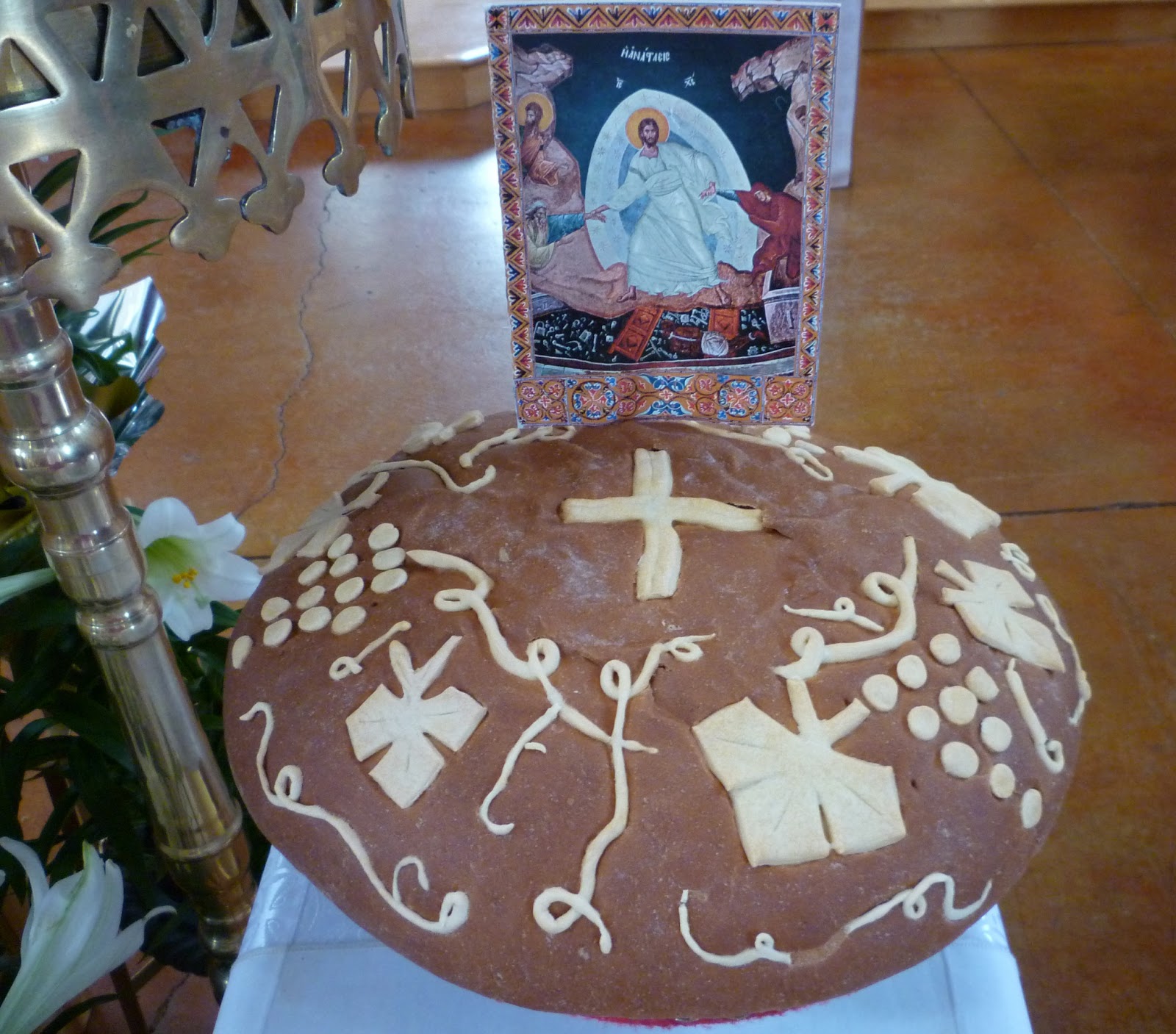
We all are feeling the newness. Today we lived in the joy of Christ’s presence and celebrated it in many ways, including a loaf of bread. This year it was baked by a young girl with the help of a more experienced baker. It must weigh over five pounds — I know, because I was honored to carry it in the procession around the church, and then standing on the porch as the gospel for the day was read.

This bread is called the Artos and “symbolizes the physical presence of the resurrected Christ among the disciples.” It will remain in the church all week and be carried in procession after Divine Liturgy those days; on Saturday it will be cut into pieces and distributed to the parishioners.

Below is a photo I found online of a Bright Week procession elsewhere.  It seems it might be the only photo available — maybe everyone wants to actively participate in these blessed processions and not stand apart to be a photographer.

On Pascha night I remembered that I have a piece of last year’s Artos in my refrigerator. I’m sure I was saving it for a time when I was ill or afflicted, and I must never have thought that I was terribly bad off at any time during the year. Praise God for that. So I’ll have to eat it for joy this week and put a new portion in reserve for any upcoming needs. Having been exposed to the air for a whole week it becomes dry and keeps very well!

The day of our Lord’s Resurrection is another case, it seems, of how we live in the present life and at the same time we live in the reality and anticipation of God’s coming Kingdom. St. Gregory Palamas wrote in a sermon “On the Sabbath & The Lord’s Day”:

Whatever is said in praise of the 7th day applies even more to the 8th, for the latter fulfills the former. It was Moses who unwittingly ascribed honor to the 8th day, the Lord’s Day. The Jubilee year (Leviticus 25:8ff), which Moses regarded as a year of forgiveness and named accordingly, was not counted among the ‘weeks of years’ under the law , but came after them all, and was an eighth year proclaimed after the last of these 7 year periods. Moses did the same with regards to periods of 7 weeks.

However, the lawgiver did not only introduce in this hidden way the dignity of the 8th day, which we call the Lord’s Day because it is dedicated to the Lord’s resurrection, but also on the feast called “Trumpets” referred to the 8th day as ‘the final solemn assembly’ (cf. Lev.23:36 LXX, Numbers 29:35) meaning the completion and fulfillment of all the feasts. At that point he clearly said that the 8th day would be holy for us, proclaiming in advance how divine, glorious, & august Sunday was to be after everything pertaining to the law had passed away.

But I see that Metropolitan Anthony in a passage I quoted just last week tells us that we are living this present life in the Seventh Day:

…the seventh day will be seen as all the span of time that extends from the last act of creation on the part of God to the last day, the eighth day, the coming of the Lord, when all things will be fulfilled, all things will come to an end, reach their goal, and blossom out in glory. It is within this seventh day, which is the whole span of history, that the creativeness of man is to find its scope and its place.

In this whole span of history we have much work to do, including our bread-baking and flower-arranging to celebrate Christ’s rising from the dead. St. Isaac of Syria tells a bit about how the fullness of our Eighth Day is yet to come, and seems to see things somewhat differently from Met. Anthony:

The Lord’s Day is a mystery of the knowledge of the truth that is not received by flesh and blood, and it transcends speculations. In this age there is no eighth day, nor is there a true Sabbath. For he who said that ‘God rested on the seventh day,’ signified the rest [of our nature] from the course of this life, since the grave is also of a bodily nature and belongs to this world. Six days are accomplished in the husbandry of life by means of keeping the commandments; the seventh is spent entirely in the grave; and the eighth is the departure from it.

It certainly is a mystery to my small mind, but I am always comforted by these realities of the faith that show how great is our God, and His plans for us, so high as the heavens are above the earth, that they are hard to grasp with our minds. And I’m full of that joy that is not received by flesh and blood, of the glorious risen Savior Christ. He is here every day.

Tonight’s the night!

The victory is in each of us, the victory is in all those of us who believe that death cannot separate us from God….However frightening and dark the world is nowadays, we know that victory has already been won, that God has won and that we who believe in him partake together with him in his victory. And therefore, let us bring, to all around us, this message of life and glory!

— Metropolitan Anthony Bloom

Lazarus

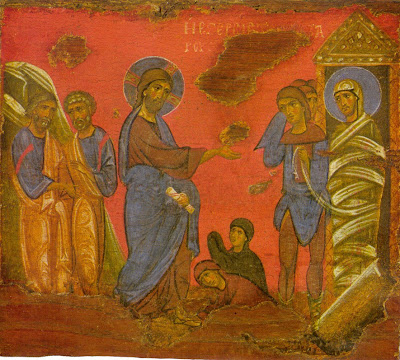
Tonight was the service of Matins for Lazarus Saturday. It made me so happy. About a week before Pascha we experience this foretaste of Paschal joy, witnessing the raising of Lazarus after he had lain in the tomb for four days. But first, picture the scene when Jesus came into town: Lazarus’s sisters were grieving and seemed to blame Jesus for their brother’s death, saying, “If you had been here, he wouldn’t have died.” Jesus wept. The sisters made mention of the fact that their brother’s corpse was at the point of stinking. It was kind of a downer all around.

I know Lent is a time of drawing close to God, and learning of His tender love for us, and looking eagerly toward The Resurrection. But it’s also characterized as a time of bright sadness. This year I have felt the sadness part more than the bright part, as a burden-bearing, until these last few days.

Since December I’d had bright white lights still up around my kitchen window, and for many weeks I left them on night and day, to help my mood. Sometime in March I unplugged the string, but I was still reluctant to untape and untack them. I pondered leaving them all year, unlit but ready to come to my aid with the next dreary day in the Fall, but it was an idea stemming wholly from weariness.

Suddenly one morning during a short spell of sunshine, I knew I needed to wash the window and the sill, so of course the lights could not stay there. I washed and swept and scrubbed all kinds of things around the house and the yard for two or three days, and prepared myself to be resurrected. I took away the candlesticks and put fresh flowers instead on the windowsill.

And the brightness has taken over. Pascha is so late this year, Spring also in many places, but Lent seems to have passed quickly. Perhaps during Holy Week I can finish my housecleaning and make the place look properly freshened up for Christ’s glorious Resurrection.

But first Lazarus will walk — alive! — out of the tomb and be unbound. If he can be raised after his body was rotting, so can I be relieved of my burdens and my stinking sins and put on Christ.  As he said,

Come unto Me, all ye that labour and are heavy laden, and I will give you rest. Take My yoke upon you, and learn of Me; for I am meek and lowly in heart: and ye shall find rest unto your souls. For My yoke is easy, and My burden is light.

I will try to pay attention and learn and find that rest through the next week as we are on our way to Calvary, and I’m really looking forward to being there at the empty tomb!