Tag Archives: Lazarus

It crept in as an intruder.

“The world, knowing how all our real investments are beyond the grave, might expect us to be less concerned than other people who go in for what is called Higher Thought and tell us that ‘death doesn’t matter’; but we ‘are not high-minded’, and we follow One who stood and wept at the grave of Lazarus—not, surely, because He was grieved that Mary and Martha wept, and sorrowed for their lack of faith (though some thus interpret) but because death, the punishment of sin, is even more horrible in His eyes than in ours.

“The nature which He had created as God, the nature which He had assumed as Man, lay there before Him in its ignominy; a foul smell, food for worms. Though He was to revive it a moment later, He wept at the shame…. Of all men, we hope most of death; yet nothing will reconcile us to—well, its unnaturalness. We know that we were not made for it; we know how it crept into our destiny as an intruder; and we know Who has defeated it.

“Because Our Lord is risen we know that on one level it is an enemy already disarmed; but because we know that the natural level also is God’s creation we cannot cease to fight against the death which mars it, as against all other blemishes upon it, against pain and poverty, barbarism and ignorance. Because we love something else more than this world we love even this world better than those who know no other.”

— C.S. Lewis, “Some Thoughts”

Totally involved in the pain.

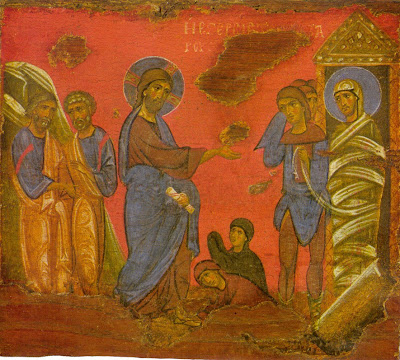
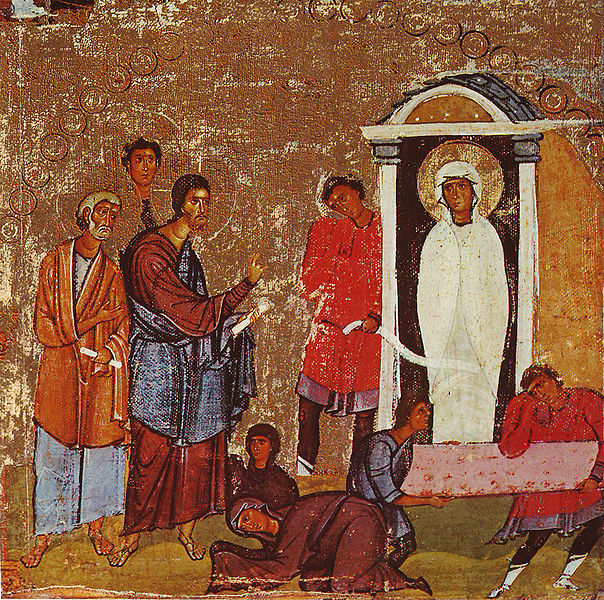
The Raising of Lazarus


“Despite the effects of the Fall and despite our deep sinfulness, the world continues to be God’s creation. It has not ceased to be ‘altogether beautiful.’ Despite human alienation and suffering, the Divine Beauty is still present in our midst and still remains ever active, incessantly performing its work of healing and transfiguration. Even now beauty is saving the world, and it will always continue to do so. But it is the beauty of a God who is totally involved in the pain of the world that He has made, of a God who died on the Cross and on the third day rose victorious from the dead.”

–Metropolitan Kallistos Ware

Lazarus

Tonight was the service of Matins for Lazarus Saturday. It made me so happy. About a week before Pascha we experience this foretaste of Paschal joy, witnessing the raising of Lazarus after he had lain in the tomb for four days. But first, picture the scene when Jesus came into town: Lazarus’s sisters were grieving and seemed to blame Jesus for their brother’s death, saying, “If you had been here, he wouldn’t have died.” Jesus wept. The sisters made mention of the fact that their brother’s corpse was at the point of stinking. It was kind of a downer all around.

I know Lent is a time of drawing close to God, and learning of His tender love for us, and looking eagerly toward The Resurrection. But it’s also characterized as a time of bright sadness. This year I have felt the sadness part more than the bright part, as a burden-bearing, until these last few days.

Since December I’d had bright white lights still up around my kitchen window, and for many weeks I left them on night and day, to help my mood. Sometime in March I unplugged the string, but I was still reluctant to untape and untack them. I pondered leaving them all year, unlit but ready to come to my aid with the next dreary day in the Fall, but it was an idea stemming wholly from weariness.

Suddenly one morning during a short spell of sunshine, I knew I needed to wash the window and the sill, so of course the lights could not stay there. I washed and swept and scrubbed all kinds of things around the house and the yard for two or three days, and prepared myself to be resurrected. I took away the candlesticks and put fresh flowers instead on the windowsill.

And the brightness has taken over. Pascha is so late this year, Spring also in many places, but Lent seems to have passed quickly. Perhaps during Holy Week I can finish my housecleaning and make the place look properly freshened up for Christ’s glorious Resurrection.

But first Lazarus will walk — alive! — out of the tomb and be unbound. If he can be raised after his body was rotting, so can I be relieved of my burdens and my stinking sins and put on Christ.  As he said,

Come unto Me, all ye that labour and are heavy laden, and I will give you rest. Take My yoke upon you, and learn of Me; for I am meek and lowly in heart: and ye shall find rest unto your souls. For My yoke is easy, and My burden is light.

I will try to pay attention and learn and find that rest through the next week as we are on our way to Calvary, and I’m really looking forward to being there at the empty tomb!