Category Archives: Pascha

Day of Rejoicing

The Day of Rejoicing is a tradition in some Orthodox churches, on which we visit and bless graves on the second Tuesday after Easter. Last year I posted about this happy day, when we visit the cemetery and sing “Christ is risen!”

Our priest blesses graves at four cemeteries this day, but I was present at only one. I got a ride with my godmother and another friend, and we had in the car roses, eggs and eggshells that we would later place on the gravestones. It was a hot day, so we also carried umbrellas, and as we made our way to the service the smell of roses was ever present from within and without.

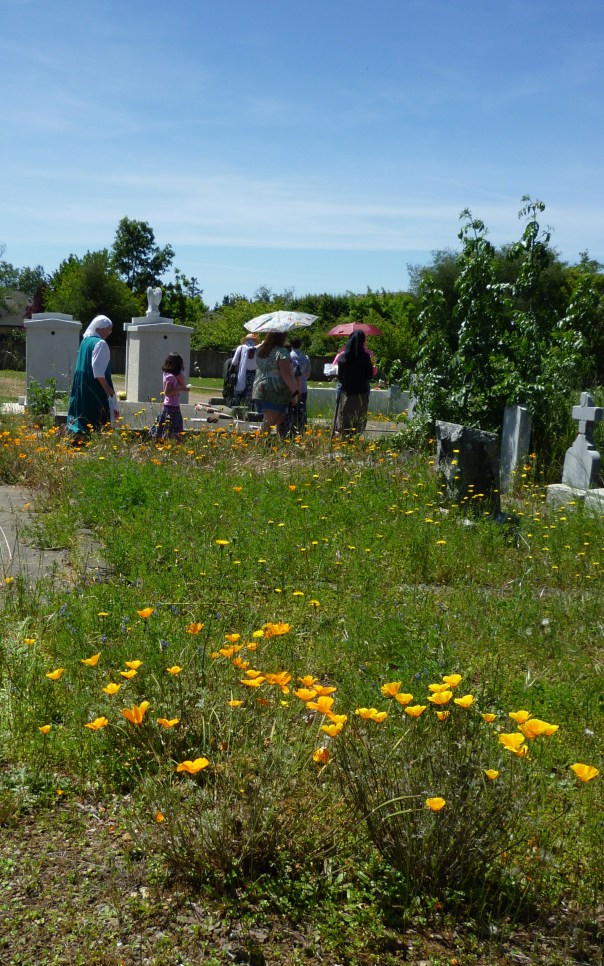
In the upper part of the cemetery is the grave of a very beloved priest who founded one of the local monasteries, so the nuns always come from there to sing at his grave. It’s the one with the exuberant rockrose, which this year was in all its glory. Father accepted a sunhat from the nuns, which he only removed during the reading of the Gospel.

radonitsa 4-29-14 w poppies

We walked down to the newer and flatter area that has lawns instead of weeds, and completed the service there. Lots of bouquets, mostly of pretty artificial flowers, had been placed on various markers, but I liked best the California poppies that were decorating the older section.

One of the last prayers includes a phrase that I love, referring to our “quickly flowing, brief and temporal life,” after which our bodies will also sleep in the grave. We blessed the cemetery that it might be “a place of sweet sleep” for the bodies of these souls who wait for the time when they will receive them back, when all the dead will be resurrected, some to condemnation, and some to a Resurrection of Life.

Even now, with God’s help, we can live in that Life that Christ has given us, as we wait for the fullness of our own redemption, when we also will put on incorruption and immortality. We have much to be glad about on this day of rejoicing.

Christ is risen! Truly He is risen!

radonitsa blessing Zossima 14

We rejoice with the dead and scatter eggshells.

Grave with exuberant rockrose

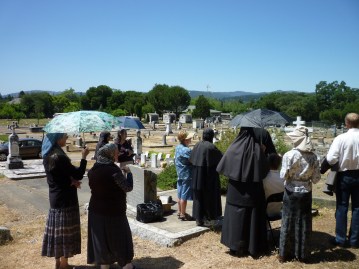
Today is Radonitsa or The Day of Rejoicing, Tuesday of Thomas Week in the Russian tradition, though some Orthodox churches visit graves on Thomas Sunday. My parish doesn’t have a churchyard (yet) so we don’t have a gathering in the church with traditional foods, as is the Old World custom. But several of us joined nuns from the nearby skete at a cemetery not far away and sang a service of remembrance, alternating with joyful Easter hymns. It was a warm day on a dry hill; the sun was toasting the weeds underfoot and making them smell like cookies in the oven.

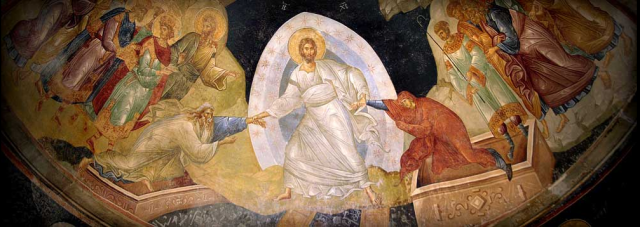
The Resurrection icon at top shows several elements that signify the ramifications of Christ’s rising from the dead, and every version shows in the center Christ pulling Adam and Eve from their tombs, from Hades. David and Solomon and Abel and John the Baptist and others are featured – we all are raised with Christ, as the church books explain:

“Having previously celebrated the radiant feast of Christ’s glorious Resurrection, the faithful commemorate the dead today with the pious intent to share the great joy of this Pascha feast with those who have departed this life in the hope of their own resurrection.

“This is the same blessed joy with which the dead heard our Lord announce His victory over death when He descended into Hades, thus leading forth by the hand the righteous souls of the Old Covenant into Paradise. This is the same unhoped-for joy the Holy Myrrhbearing Women experienced when discovering the empty tomb and the undisturbed grave clothes. In addition, this is the same bright joy the Holy Apostles encountered in the Upper Room where Christ appeared though the doors were closed. In short, this feast is a kindred joy, to celebrate the luminous Resurrection with our Orthodox forefathers who have fallen asleep.”

My own parish comes out of a Russian tradition (though we are presently mostly Americans without Russian ancestry, and part of The Orthodox Church in America.) So we keep this day, which even St. John Chrysostom mentions in the 4th century. After the short service we all walked around scattering eggshells on graves and calling to those who have fallen asleep, “Christ is risen!”

Hans Christian Andersen on Greek Easter

Hans Christian Andersen’s travel memoirs from the 1840’s, when he witnessed both Roman and Greek Easter festivities. He did love the Greek way:

Day and night the church was filled with people. The King, the Queen, and the whole court were there on the midnight before Easter Day: the priests stood praying and mourning around the flower-filled coffin; the whole congregation prayed in silence. The clock struck twelve, and at the same moment the Bishop stepped forth, and said: “Christ is risen!”

“Christ is risen!” burst from every tongue. Kettle-drums and trumpets sent forth their strains; the music played the liveliest dances! The whole people fell on each other’s necks, kissed, and joyously cried, “Christ is risen !” Shot after shot was heard outside; rockets darted into the air, torches were lighted, men and young lads, each with a candle in his hand, danced in a long row through the city. The women kindled fires, slaughtered lambs, and roasted them in the streets. Little children, who had all got new fez and new red shoes, danced in their shirts around the fires, kissed each other, and exclaimed like their parents, “Christ is risen!” O, I could have pressed each of these children to my heart and exulted with them. “Christ is risen!” It was touching, elevating, and beautiful.

Read the whole thing here.

(In California, as the clock struck twelve.)

little goats now in the spring

The hymns of Pascha and Bright Monday are playing themselves in my mind every day, all day long, like heavenly prayers. Christ is risen indeed! And my house is filled with honeysuckle scent, as a consequence of a long gardening party I’ve been having with myself.

I’ve been on my hands and knees in the dirt quite a bit this week. Above you can see one perennial bed I’ve been thinning and re-planting. Eleven tomato plants have been tucked into various places all over the yard, and in order to make a sunny home for one of them it was necessary to severely prune the honeysuckle vine that was starting to bloom profusely. Beforehand, as I walked past it several times, the sweetness almost made me woozy, and reminded me of the lilies in church on Holy Friday, as at a funeral.

I couldn’t bear to throw all the prunings into the yard waste bin, so I cut carefully and put the trimmings in three vases to enjoy indoors. There were still so many left, I filled another jarful to give to a neighbor, but it’s still here, too. Even though the petals are drying and starting to fall on the table, all of this flowery flavor is still permeating my days.

A wonderful story was passed on to us on the blog Mystagogy, of the Athonite monk Elder Porphyrios (1906-1991) who on a Bright Tuesday visited his cardiologist, overflowing with Easter brightness and quoting a hymn:

What happiness is in the Resurrection! “And leaping for joy, we celebrate the Cause.” Have you ever seen the little goats now in the spring who jump on the grass? They eat a little from their mother and begin to jump again? This is what it means to leap – to jump. This is how we should also jump for unspeakable joy at the Resurrection of our Lord and our own.

It is a sweet and not long anecdote you can read here.

There is this lightness and heavenly singing, but pressing in on all sides, sorrow and pain. In the lives of extended family, and friends near and far, things happen even in Bright Week that reek of death. A husband commits suicide, a child dies suddenly and mysteriously, a sweet woman becomes incapacitated with irrational fears….

How to make sense of it all? How to carry the joy along with the burdens of the people you love? It probably requires a measure of the Holy Spirit I haven’t acquired in order to do a good job of it. My joy is often a shallow emotionality, and certainly my burden-bearing is hampered by laziness and the distraction of my own burdens that I needlessly carry.

Or is it needlessly? It was only a short time ago I was ruminating on the yoke of Christ — and He did say His burden is light. He was exhorting us to take up His yoke. I want to “be there” for people who are hurting, and often the only thing to do, and it’s not minor, is to bring them to God’s throne in my heart and prayers. If I will just stay there I should be able to hold on to this sweetness and Light as well. 

Christ is risen!