…and other images of atonement are the subject of Fr. Stephen Freeman’s post Knocking Down the Gates of Hell, in which he shares the findings of a research paper he once wrote on Martin Luther’s hymns. Luther’s own atonement theology highly favored the imagery that also dominates that of the early church fathers, in which Christ smashes the gates of Hell and frees all those in chains.
Fr. Stephen shares several verses from various exuberant Orthodox Paschal hymns we are singing this month, such as these I excerpted from his post:
Hell, who had filled all men with fear,
Trembled at the sight of Thee,
And in haste he yielded up his prisoners,
O Immortal Sun of Glory.
Thou hast destroyed the palaces of hell by Thy Burial, O Christ.
Thou hast trampled death down by Thy death, O Lord,
And redeemed earth’s children from corruption.
Though Thou art buried in a grave, O Christ,
Though Thou goest down to hell, O Savior,
Thou hast stripped hell naked, emptying its graves.
Death seized Thee, O Jesus,
And was strangled in Thy trap.
Hell’s gates were smashed, the fallen were set free,
And carried from beneath the earth on high.
Thou didst will, O Savior,
To go beneath the earth.
Thou didst free death’s fallen captives from their chains,
Leading them from earth to heaven.
In the earth’s dark bosom
The Grain of Wheat is laid.
By its death, it shall bring forth abundant fruit:
Adam’s sons, freed from the chains of death.
Wishing to save Adam,
Thou didst come down to earth.
Not finding him on earth, O Master,
Thou didst descend to Hades seeking him.
The Paschal icon shows the resurrected Christ pulling Adam and others out of Hades.

It’s Bright Monday as I write. This morning’s Divine Liturgy was splendid and full of love and light. We are all giddy with joy and fatigue, and can’t stop greeting one another with kisses and proclamations of “Christ is risen!” In the Paschal Canon where we sing, “Let us embrace each other joyously!” I always hope I will be standing next to someone I can hug at that moment. Today two women I didn’t know were the closest, and I made so bold as to hug them both at once, which they didn’t seem to mind. 
I realized just in time for the midnight service of Pascha Saturday/Sunday, something I have had to call to mind again and again over the last months, that wherever my late husband is, he lives in the present. The part of me that grieves for his presence the way it used to be, as my earthly lover and companion, can never be satisfied; it is a longing for the past, and God is giving me instead Himself and all His gifts in this present moment. My dear Mr. Glad does not live “back there” in the past, either!
It’s because the various parts of me are not all united that my heart’s faith and love must keep instructing my mind — and other tangled and erratic parts? — that to be here right now with God is the way to stay close to my husband. In the reality of the Resurrection and our Blessed Hope, in the gathering of time and times that is kairos, he and I are more together than we have ever been, and in Love.
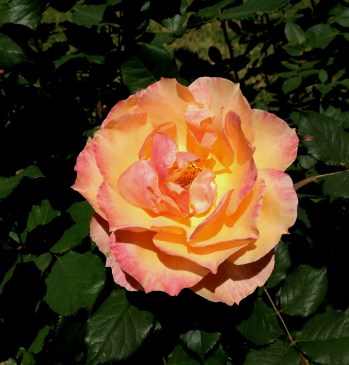
One sweet thing about Pascha coming so late this year is that roses are blooming all over. We have dozens of rosebushes at church that are loaded with flowers (not to mention the white roses that filled bouquets decorating inside the church.) This morning I took a picture of one favorite, to decorate this blog post. Happy Spring! Christ is risen! If you have read this far, I send you my Easter love!


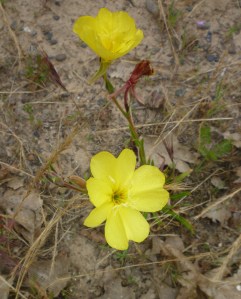 d my ankles began to hurt. Note to self: No Danskos next time.
 This third cemetery has a smooth endowed section with flat grave markers, down the hill from what is in this picture, and we all trailed over there on the paths between the large square plots, to finish the service near those newer graves. Not far off a group of three people we didn’t know was gathered around a gravesite that was heaped with flowers, one woman obviously weeping.