Category Archives: Pascha

We enter the today of Holy Week.

In the past I have written a little about the atmosphere of Holy Week in the Orthodox Church. I have only been breathing it by means of a few, perhaps shallow, breaths, over the years. I feel that way because of the distractions that I haven’t been able to avoid, or the weaknesses of my flesh and will, which prevent me from staying close to the Lord through this last week before Pascha. I suppose I am like His disciples that way.

Icon for Holy Tuesday, of The Parable of the Wise and Foolish Virgins

With all that, I have been affected, and every year finds me looking forward to the riches that we live in, this week that does indeed carry the scent of holiness. The days with their minutes and hours are not in themselves vessels for the treasures, but it is in the services of the Church and their rich liturgical hymnography and prayers that we receive the gift.

Even after years of knowing better, I still occasionally notice the thought trying to push itself forward: “Why would I want to go to another church service? Won’t I be bored, since it is basically the same as the last one, and it is so long?” I have to laugh, because of the ways that the idea is so silly. Do you ever get tired of your spouse or your child saying, “I love you?” It takes a while in church to settle oneself enough to really hear God speaking, and then, He says “I love you” with so many hymns and songs and words of Scripture, not to mention bread and water, wine and oil, candlelight and incense….

I suppose you could say that the message is always the same, but no two services are ever exactly the same. The message, essentially being the Giver of Life Himself, is never tiresome; in this life we barely begin to experience His Life.

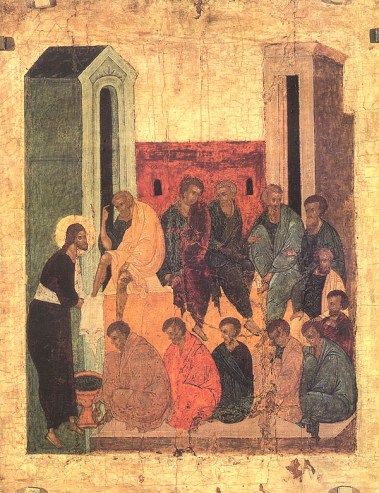
Holy Wednesday – Washing the Disciples’ Feet

I am writing this a few days before, so as to keep my calendar as free as I can. I wanted to pass on this meditation that I saved from when I read it last year – I hope it is a grace-filled breath of fresh air to you.

HOLY WEEK: A MYSTIC TORRENT

As we enter Holy Week, the festal atmosphere of Lazarus Saturday and Palm Sunday yields to the solemnity, sobriety and sadness of Holy Week as the Lord moves toward His voluntary and life-giving Passion.  The Son of God came into the world “to bear witness to the truth” and “to give His life as a ransom for many.” It is our privilege and responsibility to accompany Christ to Golgotha to the extent that our lives make that possible, especially by our participation in the services that guide us to Golgotha and beyond—to the empty tomb. 

As Father Sergius Bulgakov wrote, “The beauty, the richness and the power of these services take possession of the soul and sweep it along as upon a mystic torrent.” Therefore, during Holy Week we are challenged to “lay aside all earthly cares” and focus on our Lord Jesus Christ, whether we are at a particular service or not. This is a week filled with school, church and other necessary responsibilities.  There is no room or time for worldly entertainment -— not when the Lamb of God will be slain for the sins of the world.

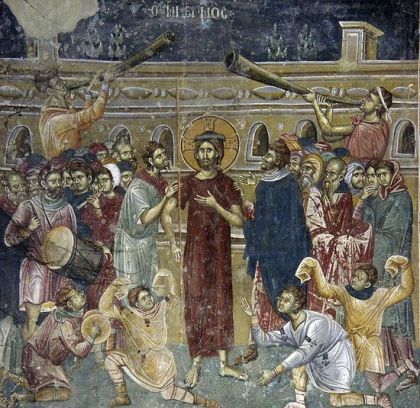
Holy Friday

At the services of Holy Week, we enter into the “today” of the events being reactualized so that the event and all of its salvific power is made present to the gathered community. Thus, we are not simply commemorating a past event for its dramatic impact, or presenting something of an Orthodox “passion play.”  Rather, we re-present the event of the Crucifixion so that we participate in it within the liturgical time of the Church’s worship. 

As Bishop Hilarion Alfeyev writes, “Each one of us receives Christ as our personal Savior, and so we each make our own all the events of Christ’s life through personal experience, to whatever extent we can. The feast day is a realization here and now of an event that occurred once in time but is always happening outside time.” And he adds, speaking of the great saints and their faith in the Resurrection of Christ, “They lived… by their experience of eternity and knew that Easter was not a single day of the year, but an eternal reality in which they participated daily.”

-Fr. Steven Kostoff

The entire faith and love and hope.

My whole church is bereaved, because one of our strong young men, the only son of his parents, grown up for 35 years in the parish, suddenly sickened and died. It happened so fast, it seems unreal to us. This morning I attended a prayer service in advance of the funeral proper.

One of the lines that is repeated in song is, “Blessed art Thou, O Lord; teach me Thy statutes,” and I mused on what God might be teaching me right now. Certainly, we should all “number our days, that we may apply our hearts unto wisdom.” But I don’t want to forget something else that our rector reminded us of, at the end of the service, that even in our grief we have joy, knowing that Christ has overcome death — that’s why we could pray that our brother will be granted rest “with the spirits of the righteous made perfect.”

Every time there is another death or funeral, my own soul’s griefs are awakened, acknowledged and comforted. And our pastor also kindly included in our church bulletin today an encouraging passage (an excerpt from this article) from Father Alexander Schmemann. He starts out explaining why death must be understood as an evil enemy. But keep reading:

God created man with a body and soul, i.e. at once both spiritual and material, and it is precisely this union of spirit, soul and body that is called man in the Bible and in the Gospel. Man, as created by God, is an animate body and an incarnate spirit, and for that reason any separation of them, and not only the final separation, in death, but even before death, any violation of that union is evil. It is a spiritual catastrophe. From this we receive our belief in the salvation of the world through the incarnate God, i.e. again, above all, our belief in His acceptance of flesh and body, not “body-like,” but a body in the fullest sense of the word: a body that needs food, that tires and that suffers. Thus that which in the Scriptures is called life, that life, which above all consists of the human body animated by the spirit and of the spirit made flesh, comes to an end — at death — in the separation of soul and body. No, man does not disappear in death, for creation may not destroy that which God has called from nothingness into being. But man is plunged into death, into the darkness of lifelessness and debility. He, as the Apostle Paul says, is given over to destruction and ruin.

Here, I would once more like to repeat and emphasize that God did not create the world for this separation, dying, ruin and corruption. And for this reason the Christian Gospel proclaims that “the last enemy to be destroyed is death.” The Resurrection is the recreation of the world in its original beauty and totality. It is the complete spiritualization of matter and the complete incarnation of the spirit in God’s creation. The world has been given to man as his life, and for this reason, according to our Christian Orthodox teaching, God will not annihilate it but will transfigure it into “a new heaven and a new earth,” into man’s spiritual body, into the temple of God’s presence and God’s glory in creation.

“The last enemy to be destroyed is death…” And that destruction, that extermination of death began when the Son of God Himself in His immortal love for us voluntarily descended into death and its darkness, filling its despair and horror with His light and love. And this is why we sing on Pascha not only “Christ is risen from the dead,” but also “trampling down death by death…”

He alone arose from the dead, but He has destroyed our death, destroying its dominion, its despair, its finality. Christ does not promise us Nirvana or some sort of misty life beyond the grave, but the resurrection of life, a new heaven and a new earth, the joy of the universal resurrection. “The dead shall arise, and those in the tombs will sing for joy…” Christ is risen, and life abides, life lives… That is the meaning; that is the unending joy of this truly central and fundamental confirmation of the Symbol of Faith: “And the third day, He rose again according to the Scriptures.” According to the Scriptures, i.e. in accordance with that knowledge of life, with that design for the world and humanity, for the soul and body, for the spirit and matter, for life and death, which has been revealed to us in the Holy Scriptures. This is the entire faith, the entire love, and the entire hope of Christianity. And this is why the Apostle Paul says, “If Christ is not risen, then your faith is in vain.”

–Protopresbyter Alexander Schmemann, 1980,
Translated from Russian by Robert A. Parent

harrowing of hell wide

Death was strangled…

…and other images of atonement are the subject of Fr. Stephen Freeman’s post Knocking Down the Gates of Hell, in which he shares the findings of a research paper he once wrote on Martin Luther’s hymns. Luther’s own atonement theology highly favored the imagery that also dominates that of the early church fathers, in which Christ smashes the gates of Hell and frees all those in chains.

Fr. Stephen shares several verses from various exuberant Orthodox Paschal hymns we are singing this month, such as these I excerpted from his post:

Hell, who had filled all men with fear,
Trembled at the sight of Thee,
And in haste he yielded up his prisoners,
O Immortal Sun of Glory.

Thou hast destroyed the palaces of hell by Thy Burial, O Christ.
Thou hast trampled death down by Thy death, O Lord,
And redeemed earth’s children from corruption.

Though Thou art buried in a grave, O Christ,
Though Thou goest down to hell, O Savior,
Thou hast stripped hell naked, emptying its graves.

Death seized Thee, O Jesus,
And was strangled in Thy trap.
Hell’s gates were smashed, the fallen were set free,
And carried from beneath the earth on high.

Thou didst will, O Savior,
To go beneath the earth.
Thou didst free death’s fallen captives from their chains,
Leading them from earth to heaven.

In the earth’s dark bosom
The Grain of Wheat is laid.
By its death, it shall bring forth abundant fruit:
Adam’s sons, freed from the chains of death.

Wishing to save Adam,
Thou didst come down to earth.
Not finding him on earth, O Master,
Thou didst descend to Hades seeking him.

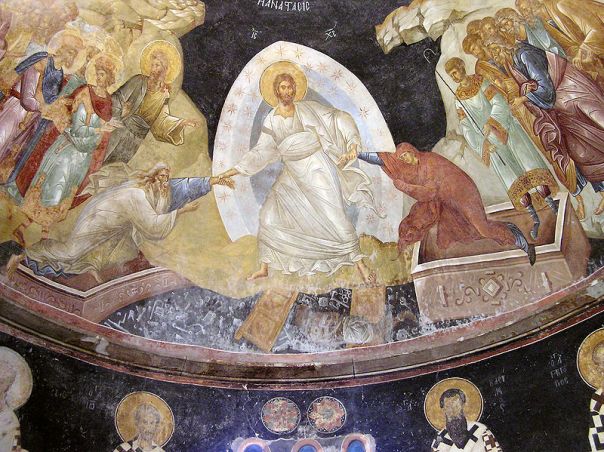
The Paschal icon shows the resurrected Christ pulling Adam and others out of Hades.

db271-resurrectionstvladorthchurch

It’s Bright Monday as I write. This morning’s Divine Liturgy was splendid and full of love and light. We are all giddy with joy and fatigue, and can’t stop greeting one another with kisses and proclamations of “Christ is risen!” In the Paschal Canon where we sing, “Let us embrace each other joyously!” I always hope I will be standing next to someone I can hug at that moment. Today two women I didn’t know were the closest, and I made so bold as to hug them both at once, which they didn’t seem to mind. gl - EB

I realized just in time for the midnight service of Pascha Saturday/Sunday, something I have had to call to mind again and again over the last months, that wherever my late husband is, he lives in the present. The part of me that grieves for his presence the way it used to be, as my earthly lover and companion, can never be satisfied; it is a longing for the past, and God is giving me instead Himself and all His gifts in this present moment. My dear Mr. Glad does not live “back there” in the past, either!

It’s because the various parts of me are not all united that my heart’s faith and love must keep instructing my mind — and other tangled and erratic parts? — that to be here right now with God is the way to stay close to my husband. In the reality of the Resurrection and our Blessed Hope, in the gathering of time and times that is kairos, he and I are more together than we have ever been, and in Love.

gl rose pascha 16


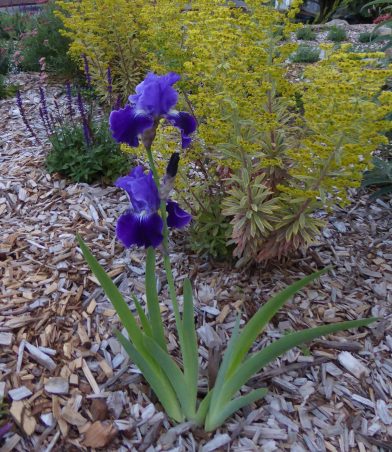
One sweet thing about Pascha coming so late this year is that roses are blooming all over. We have dozens of rosebushes at church that are loaded with flowers (not to mention the white roses that filled bouquets decorating inside the church.) This morning I took a picture of one favorite, to decorate this blog post. Happy Spring! Christ is risen! If you have read this far, I send you my Easter love!