Tag Archives: birds

The Glow from Brief Light

Sally Thomas’s book of poems was published just in time for me to get a copy and read it during Advent. The title is Brief Light: Sonnets and Other Small Poems, and these poems are so illuminating, they fit right in with this season when the Light of the World first shined upon us.

Various sorts of light, or the lack of it, are an important aspect of many of the selections. The title brings to mind wintry light that is brief and thin – and there are several poems for this darker season of the year we have entered, with titles and subjects including Christmas, New Year’s, Advent, frost and snow.

I like the “small poem” aspect of the collection, seeing as I am eternally poetry-challenged and usually put off by the ones with very many stanzas. “Snow Weather” is the shortest in the book, and manages, and partly through its very brevity, to capture a dramatic moment that grabs at my own heart.

Snow Weather

A falcon on a wire
Against the laden sky
Scanned his brown empire
With a black-ice eye.

Nothing beneath him stirred
In that sunless instant,
But my heart, for a keen-eyed bird
Blind to me, or indifferent.

The light that Thomas shines on this event reveals something in her own soul, and searches out even the falcon’s impulses.

Birds abound in the poems: a wren in “Tornado Watch,” and the “Mourning Dove” whose being she “felt in the small of my back/The soft clattering updraft of wings.” But the starlings in “Poem in Advent” are the most glorious. This is the first poem I’ve read about the birds that she so aptly describes in couplets beginning with these:

At twilight the poplars, upright and naked,
Wear starlings like restless leaves. Unafflicted
By the cold, they come and go in noisy shifts,
Filling the trees, free-falling into updrafts….

And going on to relate how the starling flock, though “harbinger of every nightfall,” is not only unafflicted by the cold but is a hopeful reminder to us of where we have come from, and “never mournful.”

This reminds me of the prayer read at every Orthodox Vespers, “Thou appointest the darkness and there was the night.” It was after years of hearing this line that it began to sink into my being that God Himself fills the night that He created, and is to us like the black night into which Thomas’s starlings settle. “Darkness, careful, cups them in its hand.”

The subject matter of the collection ranges far and wide and shows how rich a life is lived by this woman interested in everything. Many poems about children and family, her motherly concerns — and marriage, and depression, boats, a snake, depression. But all with a ray of light revealing the transcendent quality of our existence, the interconnectedness of everything.

This is the first time I’ve been so bold as to review a book of poetry, and I don’t know that I’ve read many such reviews, either. I don’t know where to stop, when most of the poems are a pleasure from the first reading and also promise a greater reward if I will spend more time with them.

But let me mention another one or two: “Introvert” is chilling in its description of forced narcissus, “all sweetness, winter-white” alongside a man’s desire to break into his woman’s inwardness, even to “prise her open, bone from hinging bone….” And “Lamplight” is a favorite of mine so far, in which the poet shares the simple event and startling perspective of looking in instead of out at her bedroom window one night, where

…the room shone privately
As with a happiness, a mystery to me.
I stood outside and wondered at that glow.

There is plenty of wisdom shining from the poems in Brief Light, gifts that will go on giving. I am soaking up the glow.

What We Found in the Grass


I’m at my daughter Pippin’s home in the Northern California forest, getting ready for the arrival of Baby. While we’re waiting we’ve been taking lots of walks, including some similar to what I enjoyed three years ago when I reported in Meadow and Trees.

When I am walking with Pippin it often happens that she scoops something from the trail and drops it into my hand. A baby pine cone from a Ponderosa, or a feather that has fallen from a red-shafted flicker.

She will stop suddenly in the middle of the meadow because she spies a praying mantis in the grass. By comparison with her, I am blind. But once she takes a picture of something, I know that I want to take its picture too.

I snapped photos of bear scat and raccoon tracks, wild rose hips and an unknown feathery plant that grows in swaths, especially near the edge of the forest. I soaked up the scents of pine and grasses that were rising in the summer heat.
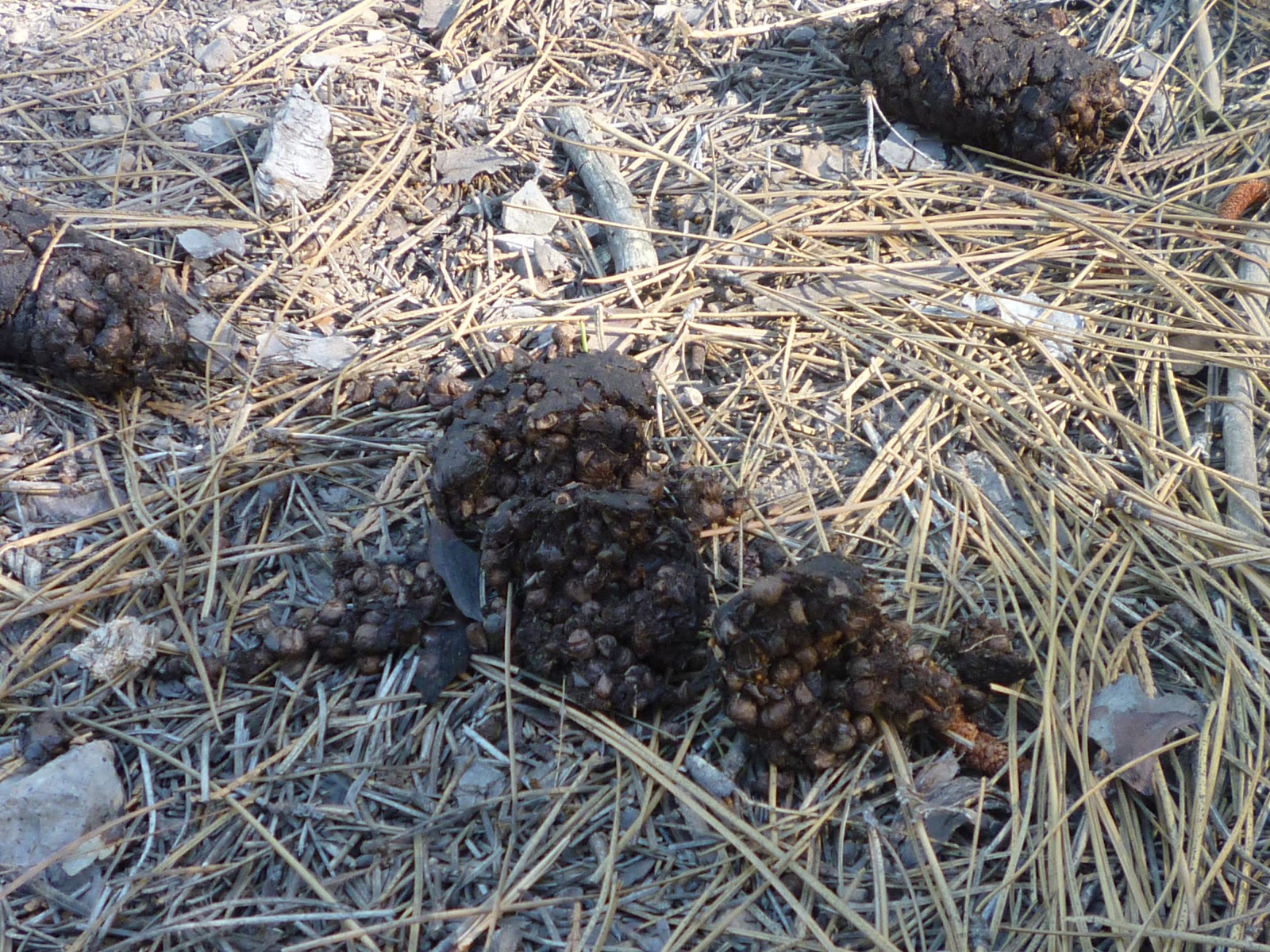
after the bear feasted on manzanita berries….
feathery plant

Pippin and I helped each other provide shade if needed in order to get better lighting on the little purple thistles that were in full sun under a blue September sky.

We kneeled down to do a serious photo shoot of the mantis and I attempted a movie to catch him moving his small head this way and that.

(Pippin Photo)
a non-stubby thistle

There are places where the dried-up meadow is sparse with stubby weeds and tiny stickers that get into my socks. I try to ignore the prickles because it’s no fun stopping for them every few minutes.

Our swish-swish through the grass is accompanied by the gentle clicks of sprays of tiny grasshoppers jumping every which way out of our way. Some of them crash against my chest.

After a while we get to a wetter area where the water sits longer in the spring. Now in late summer some of the swampy areas have dried up, and the algae has become a papery brown layer that stays at its previous level when it was a blanket floating on mountain runoff.

Blades of green marshy grass stick up through it like toothpicks holding it well above the current ground level, and lots more pale dead grass lies flattened  where the snow has weighed it down through many winters. As we tromped along, our boots breaking through the paper made a noise such as you might hear when marching through large cornflakes. Tiny frogs hopped out of our path and escaped being crunched.
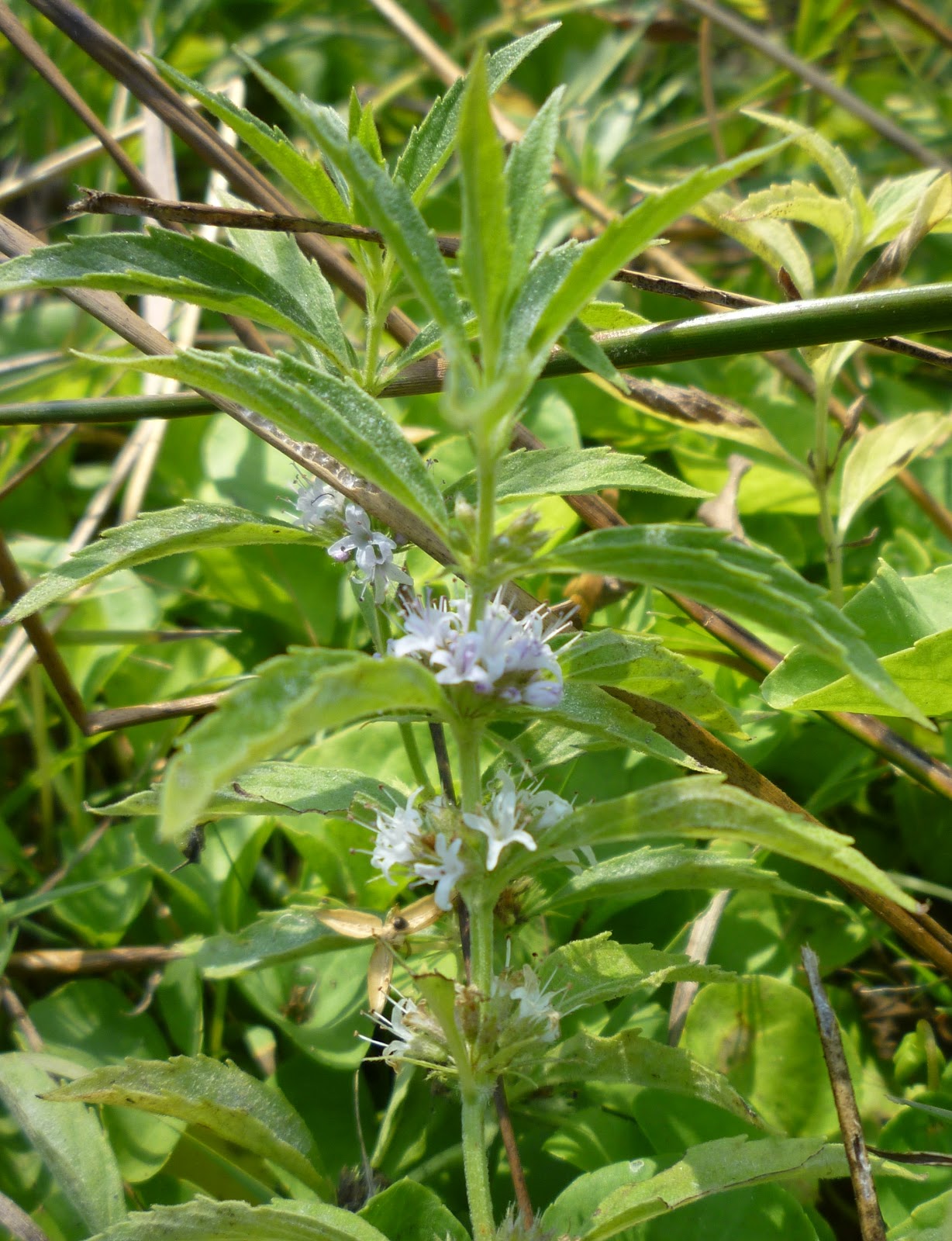
pennyroyal

An apparently man-made channel runs on one side of the meadow and keeps the creek water from spreading out and making the entire area into a marsh. A solitary duck paddled fast into the reeds when we came near, where pennyroyal grew on the banks and long runners of wild raspberry snaked along the ground.

In addition to my camera loaded with pictures (even slanty ones like that below) I brought home the tiny cones, the feather, my weary feet and a warm peacefulness.

Lost in a very good dream…

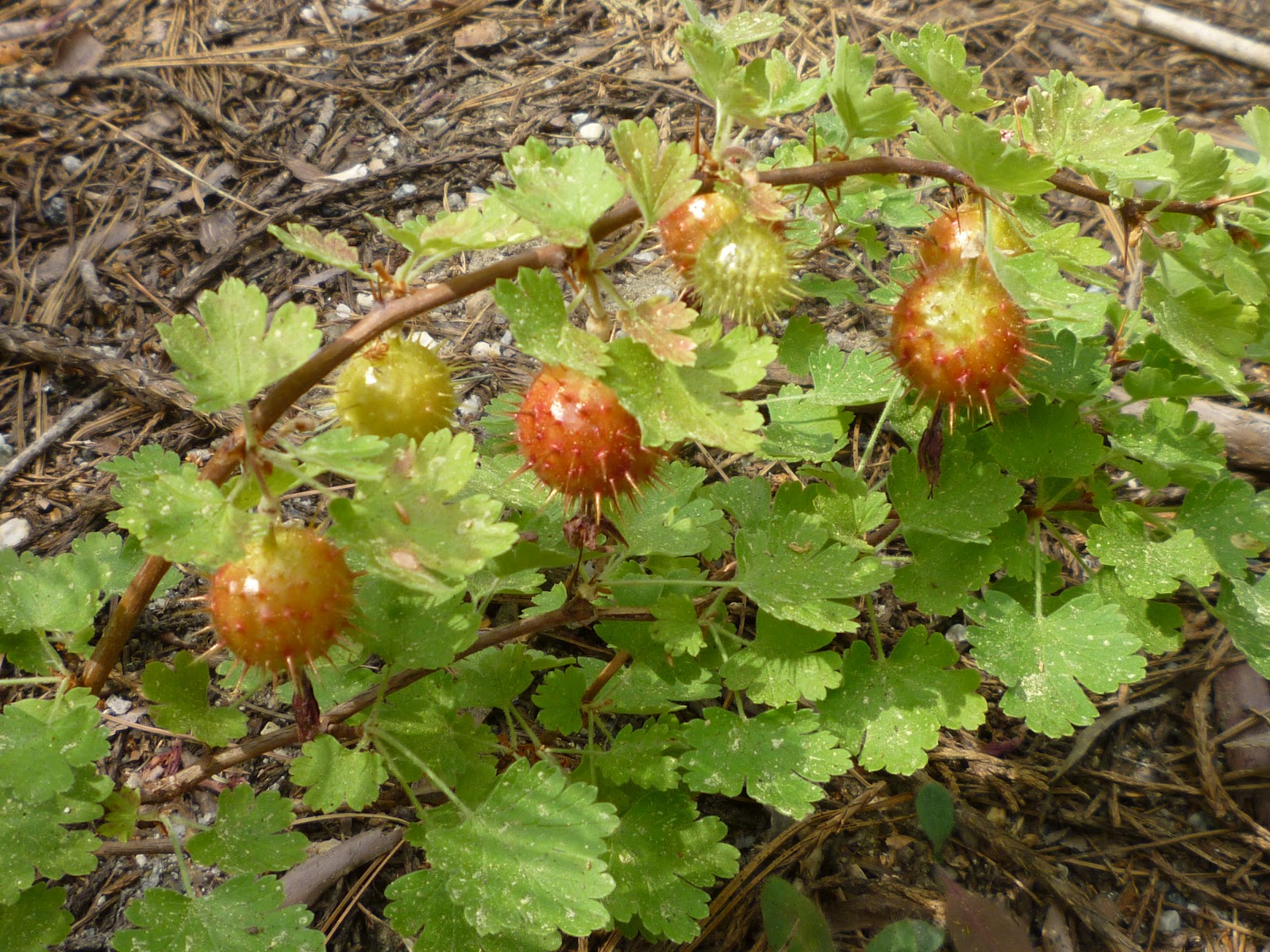
gooseberries

Coming home from the mountains last week, I didn’t have the usual thoughts of “That was lovely, but I have lots of things to do at home now and I can’t wait to get started.” No, this time I was mostly sad to say good-bye, and also couldn’t find good words to go with my pictures.

But one of our guests up there managed in her thank-you note yesterday to take away my sadness with her response to the few higher-elevation days we shared. I’m making her my guest blogger today. (Her thoughts in brown.)

Mountain time is a time-out from time, 
like the timelessness of being 
lost in a very good dream.
little lupine plants

When we came down from Gumdrop Dome the ground under the forest was scattered everywhere with tiny lupine plants. I wonder what month I would need to be there to see the slopes covered with tiny purple spikes?

… the dilated twinkle of 100 billion stars in the night sky (which reductionistically would take 3,000 yrs. to count.)

Of our three nights at over 8,000 feet elevation, we had only one night’s opening in the clouds to see the star glory. We missed most of the meteor shower — still, we saw a few shooting stars. And we gawked at the Milky Way, and were happy that the air was unbelievably warm all during our stay, day and night, so that we could gawk longer.

overlooking a canyon
All the sweet consolations of fragrant fresh mountain air, delicious soft water, 
warm sleepy nights… 

…laughter, storytelling, hiking and/or trying to chase Mr. Glad up Gumdrop Dome (in a loony-tune cartoon, some of us could take a running start up a sheer vertical rock face, hauling a low center of big gravity, our momentum so great that we actually overshoot the summit –beating him to the base – but unfortunately, not in one piece).

swooping in to join the fray
the terrible joy 
of ecstatic hummingbirds 
a-feeding.

Maui Diary 4 – Bright Trees and Critters

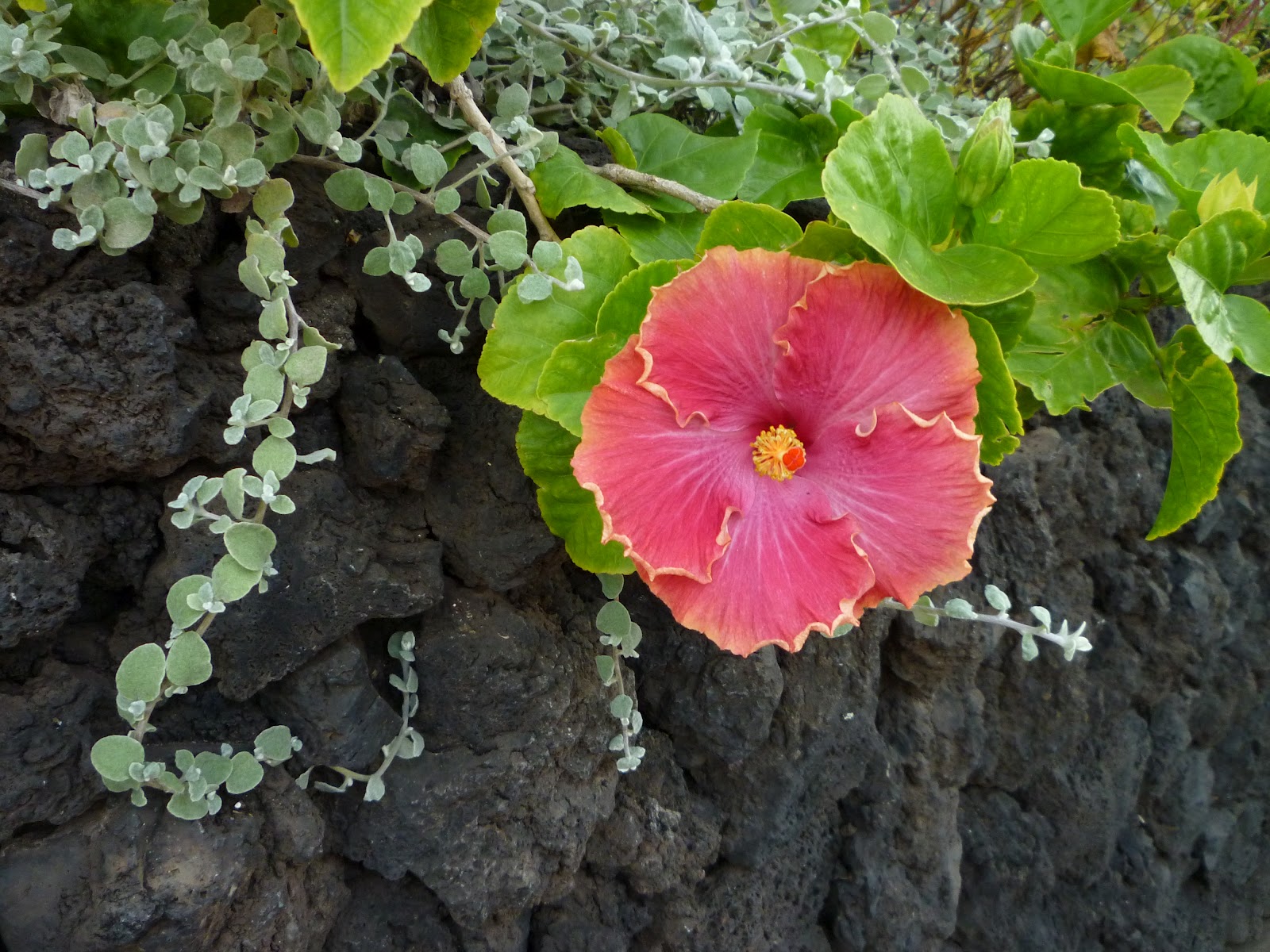
Hibiscus looks nice against volcanic rock.

For most of my life, the image that came to my mind when someone mentioned Hawaii was of beaches, and volcanoes spewing lava into the ocean. Ten years ago or so a friend visited the islands and told me about the beautiful flowers, and at that point I began to be interested.

Reading The Folding Cliffs, about the history of Kauai in a setting that highlighted the lush landscape, took my imagination further along, to the point where I was willing and interested to visit.

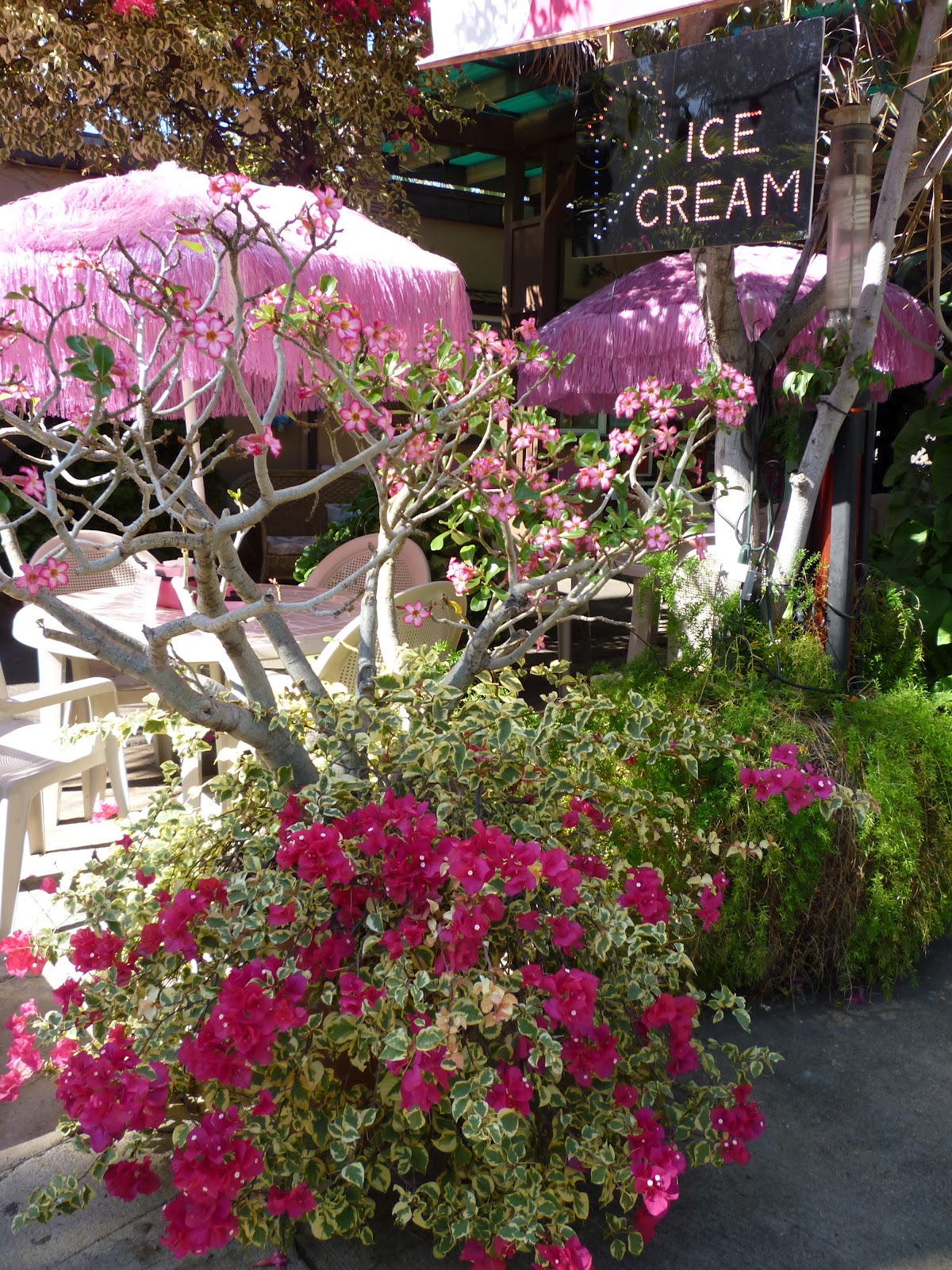
bougainvillea bush

If our stay on Maui had a focus, I would say it was the ocean, based on the amount of time spent, but with the flowers blooming everywhere I turned my head, I came away with my visual sense more than satisfied in that department — it was more than I could take in.

Right out our back door there were spider lilies and red ginger, and multi-colored bougainvillea trained into shrubs. Along the roads hedges of hibiscus or bougainvillea or even more extravagant flowers let us know we were in the tropics.

African Tulip Tree

The writer of the plant guide we took to Maui was clearly biased against species that were not native, or that at least had been brought from other Polynesian islands long ago, but I admit to liking many of those plants very much. The African Tulip Tree makes lovely splashes of orange against the green landscape, and it at least doesn’t seem to have spread into the weed category yet.

Bougainvillea along roadway

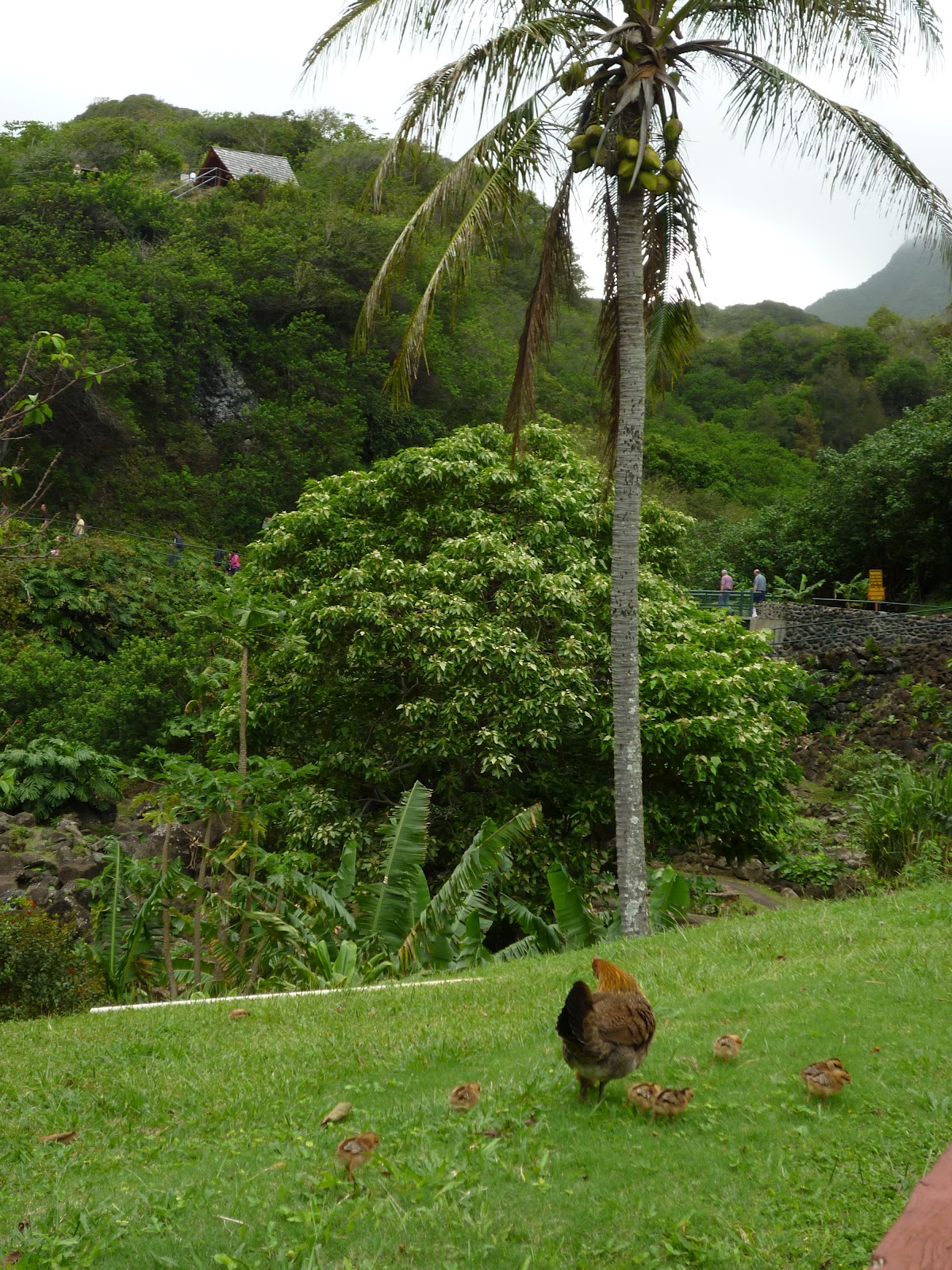
We’d heard reports of wild chickens being found all over Maui, and we were happy to see a lot of them on beaches, along streets, most anywhere. And other beasts who had no doubt escaped from households and barnyards generations ago.

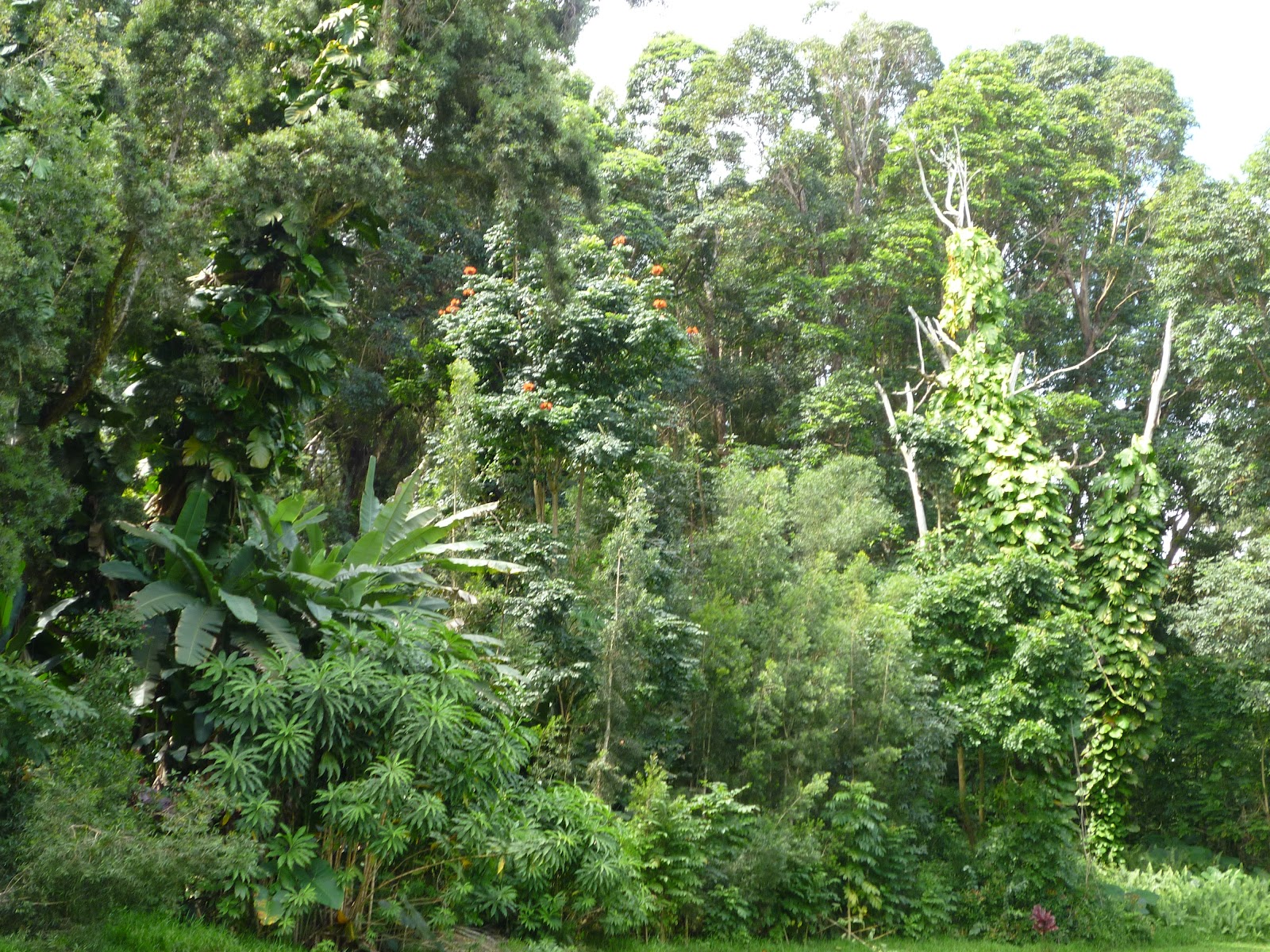
On the drive to Hana we ate our lunch at a wayside park where a green lawn ran up the hill to a tall and thick forest — or perhaps on that rainy stretch it would be called a jungle. I spotted chickens with shiny feathers up there, and walked up to try getting a picture. It was not to be: the closest bird disappeared behind some vines, I followed as quietly as I could and peeked under the trees, to see a couple of cats lounging there with the chickens. It was just a glimpse, and then the whole inter-species family was gone from sight.

Where I saw cats and chickens

This cat sat patiently under our table while we were picnicking, and waited for us to drop a bite of sandwich. And at Honolua Bay a bright rooster in the middle of the jungle path was engrossed in pecking the meat out of a broken coconut. Many times we saw road signs warning of the approach of a pig or nene crossing. Nenes are the type of goose that is the state bird of Hawaii.

Feral chickens in Iao Valley
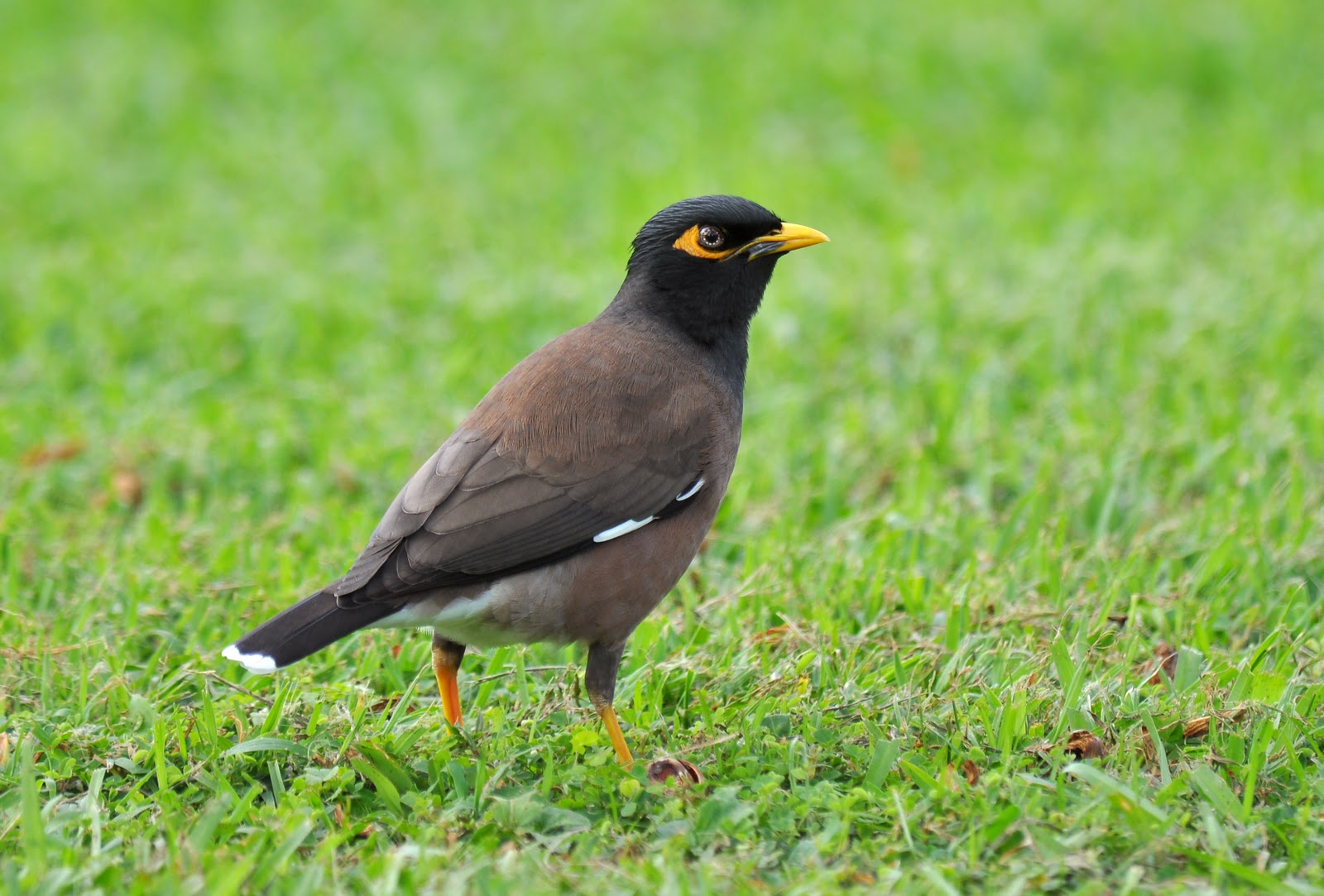
Common Myna

We were on the island for several days before we discovered that the perky bird we saw everywhere is the Common Myna, native to Asia but living all over the world. On a list of the 100 Most Invasive Species, there are only three birds, and the Myna is one of them. Found this picture on the Internet.

My favorite animal sighting was in the Upcountry where there are farms and ranches with jacaranda trees catching your eye with their purple flowers. We drove past a large pasture with a herd of dark cattle grazing on the green, and as many white birds as steers walking around chummily in their midst. I assume that they are what has been sensibly named the Cattle Egret.

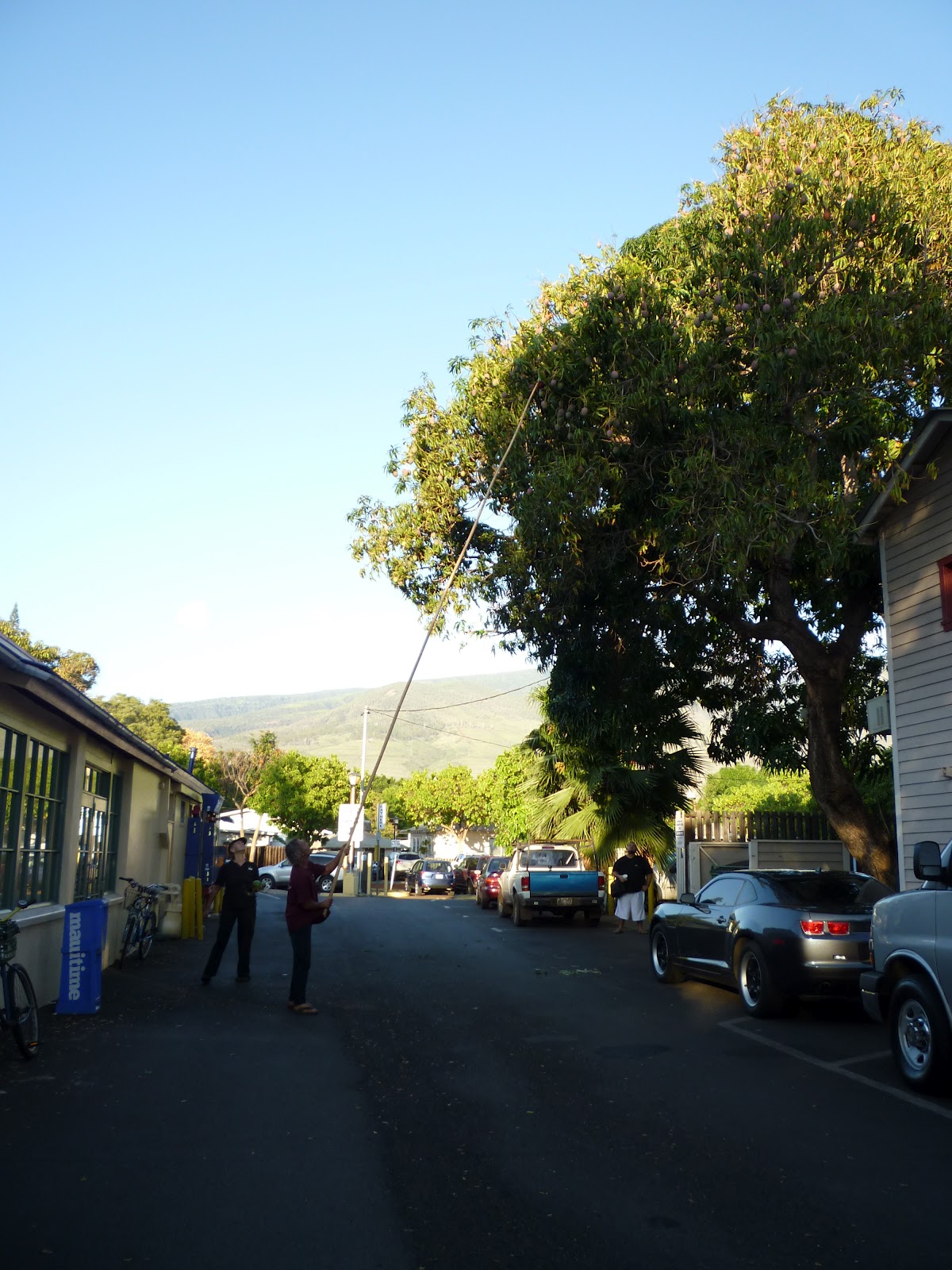
picking mangoes

It seems that a lot of trees bearing flowers or fruits are so tall that it takes some trouble to harvest the crop. I asked the rosette-pinning woman (whom I tell about further down) if pickers use ladders to get the flowers from those tall plumeria trees, and she replied that they “mostly climb” to fetch them. Walking around Lahaina, we saw a man picking mangoes with a long pole contraption, and it’s certain one would need a ladder or good tree-climbing skills to get papayas.

tiny plumeria tree at center


Plumeria! I’m in love with plumeria. I knew of leis, of course, and I’d heard that flower mentioned, but I had to go to Hawaii to see what a plumeria blossom looks like or get intoxicated by its scent. It was a surprise to find that these sweet flowers grow on trees.

I wish I had taken a dozen more pictures of plumeria trees. Many of the taller ones look at first glance as though they are some kind of dead thing, but then you notice the flowers at the tip of every smooth and bare branch.

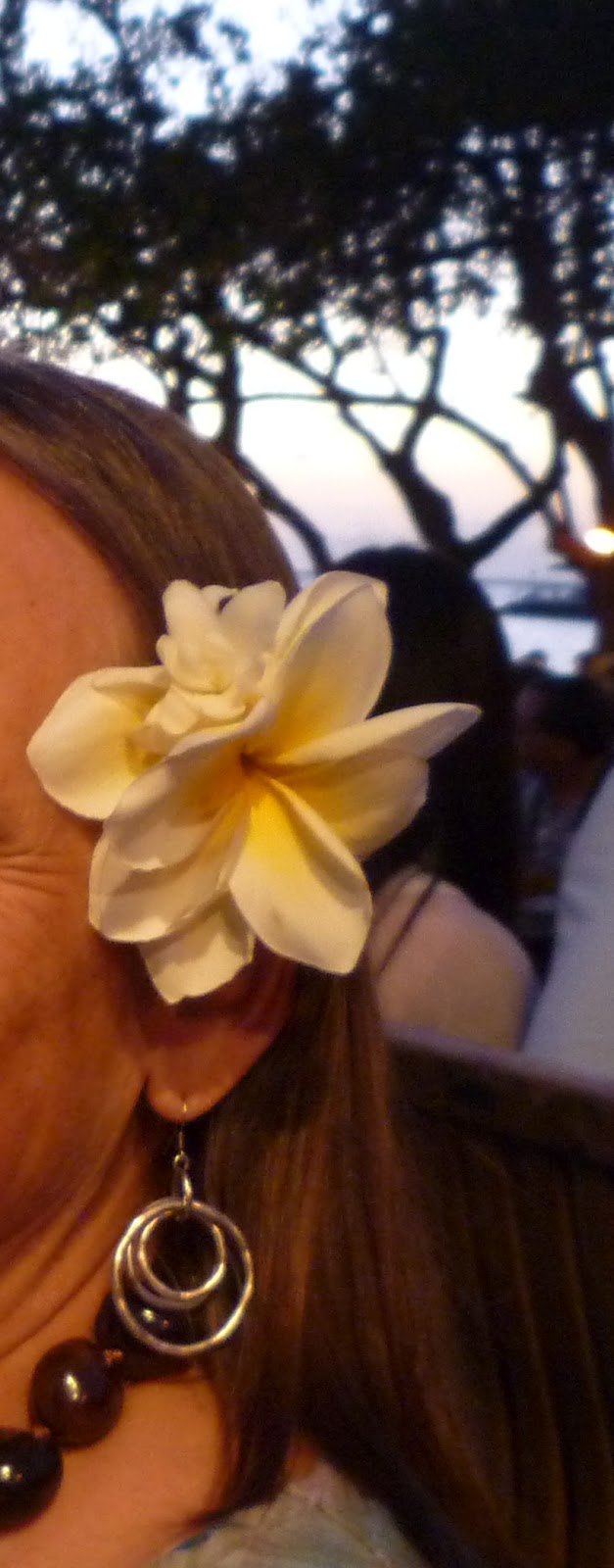
We went to a luau where a girl in Hawaiian dress taught female guests how to stick plumeria flowers on to a toothpick to make a rosette, which she then fastened into our hair with a bobby pin.

When we had first arrived at the luau, I was given a tuberose, which I had been carrying around for a while, so I stuck that on to my toothpick as well, and while our taste buds enjoyed the traditional foods, my nose feasted on the rose and plumeria delicacies. I already have forgotten most of the food I ate, but the memory of my fragrant rosette lives on.