Tag Archives: cemeteries

Joyful with those who wait in Hope.

Fr D Healds cistus 4-15

The second Tuesday after Pascha it is common for Orthodox to visit cemeteries to share the joy of Easter with the departed, just as Christ must have done when he “descended into Hades” first thing after His Resurrection. In our area it is a strong tradition among parishes and monasteries, and I learned to love this trip to the cemeteries early in my life as an Orthodox Christian.

Until this year I had only visited one of the many cemeteries that are included on this day, but now that my own husband lies “newly reposed” in different one, I wanted to go and sing “Christ is risen!” by his grave as well. Priests from two Orthodox churches arrived unintentionally at the same time and led the service right next to the yet unmarked grave of Mr. Glad. You can see the long rectangle where turf was replaced, in the center of this picture.

The cemetery where his body was laid is of the modern “endowed” sort. All of the grounds are kept up by the owners, paid for by the burial fees. This is the same cemetery that I first visited in 2012 and afterward wrote about in A Sleeping Place Is Blessed. Not two years later Mr. Glad realized it would be prudent to buy plots for us there.

Fvl cemetery Radonitsa 15

Up the road a few miles at the next stop, we were met by Nina who was waiting by the graves of both of her husbands. I saw on the marker that her first husband died when I was still a child. Through the oaks down the hill we could see a third priest praying with two women at one gravesite.

This cemetery is of the old and non-endowed sort, where you are lucky if once a year some community organization chops down the larger weeds. And there is concrete, lots of it, in big broken squares and rectangles of curbs and cracked slabs over and around family groupings. I had forgotten about the hilliness, and about this difficulty of standing and walking on uneven concrete surfaces, anFvl 2 flowers 15d my ankles began to hurt. Note to self: No Danskos next time.
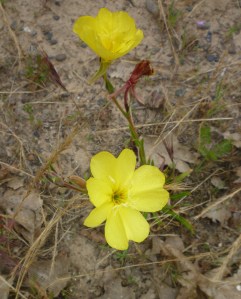
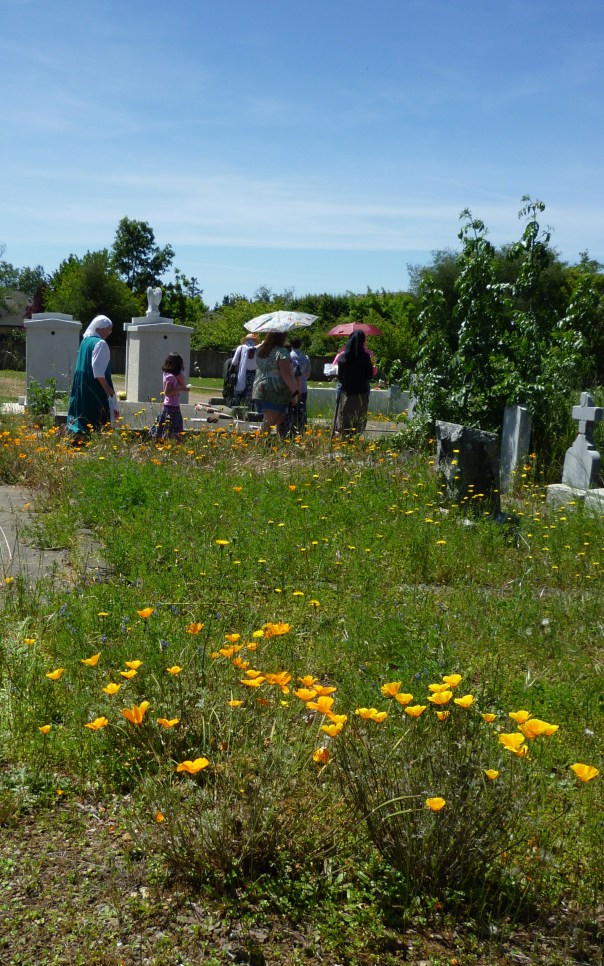
Besides the concrete, in the unpaved areas there are often foxtails and dust. But flowers grow in the cracks even in drought, and the rockrose that was planted long ago (photo at top) is vigorous. Last year it was really hot on Radonitsa (the Slavic word for this Day of Joy) but today it was cool and drizzly, so our shoes got wet on the lawns.

We didn’t have a big crowd at any of the cemeteries. A different group showed up at each place, with the most people at the third one, including several nuns from a nearby monastery; and women originally from Bulgaria, Ukraine, and Russia, presumably because they are used to doing a similar thing in their countries. Yevhenia, my new friend from Ukraine (that’s a phonetic spelling of how I try to pronounce her name, a form of Eugenia) said that in her country they bring tables and chairs to the cemetery so that they don’t have to rush off, and they picnic on festal foods while they think a while longer about death and God. They like to leave food on the graves, too, for poor people to pick up later on.

When I came home and read again about the Day of Rejoicing, I found that “The Slavs, like many ancient peoples, had a tradition of visiting family members’ graves during the springtime and feasting together with them.” It was an easy custom to continue after their conversion to Christianity, a faith that gave them a truly joyful message to bring along with the food, about Christ’s life-giving death.

Hlds cem 15This third cemetery has a smooth endowed section with flat grave markers, down the hill from what is in this picture, and we all trailed over there on the paths between the large square plots, to finish the service near those newer graves. Not far off a group of three people we didn’t know was gathered around a gravesite that was heaped with flowers, one woman obviously weeping.

They watched and listened to us as we faced their direction and sang the Paschal Canon enthusiastically, and when Father walked around censing, and blessing the graves with holy water as he sang, he went as far as their spot and sprinkled water on it, too, just very naturally, but did not interrupt the service. When we finished we went to talk to them; the woman’s mother had died. Maybe the two men were her husband and son. She kept telling us, “Thank you!” through her tears, and we exchanged hugs and repeated greetings of “Christ is risen!”

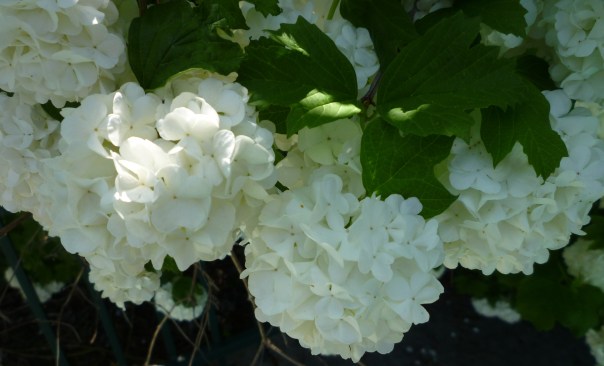
Some of us had colored eggshells left over from Pascha, to sprinkle on the graves. I didn’t have anything like that for Mr. Glad’s grave but a friend shared his with me. I hope to be ready next year, as I’ve conceived a plan, to make use of the blooms of our big snowball bush (viburnum) which are usually at their peak about this time. On the graves of those awaiting the Resurrection, they would be a lovely adornment.
snowballs crp 15

Day of Rejoicing

Image

The Day of Rejoicing is a tradition in some Orthodox churches, on which we visit and bless graves on the second Tuesday after Easter. Last year I posted about this happy day, when we visit the cemetery and sing “Christ is risen!”

Our priest blesses graves at four cemeteries this day, but I was present at only one. I got a ride with my godmother and another friend, and we had in the car roses, eggs and eggshells that we would later place on the gravestones. It was a hot day, so we also carried umbrellas, and as we made our way to the service the smell of roses was ever present from within and without.

In the upper part of the cemetery is the grave of a very beloved priest who founded one of the local monasteries, so the nuns always come from there to sing at his grave. It’s the one with the exuberant rockrose, which this year was in all its glory. Father accepted a sunhat from the nuns, which he only removed during the reading of the Gospel.

radonitsa 4-29-14 w poppies

We walked down to the newer and flatter area that has lawns instead of weeds, and completed the service there. Lots of bouquets, mostly of pretty artificial flowers, had been placed on various markers, but I liked best the California poppies that were decorating the older section.

One of the last prayers includes a phrase that I love, referring to our “quickly flowing, brief and temporal life,” after which our bodies will also sleep in the grave. We blessed the cemetery that it might be “a place of sweet sleep” for the bodies of these souls who wait for the time when they will receive them back, when all the dead will be resurrected, some to condemnation, and some to a Resurrection of Life.

Even now, with God’s help, we can live in that Life that Christ has given us, as we wait for the fullness of our own redemption, when we also will put on incorruption and immortality. We have much to be glad about on this day of rejoicing.

Christ is risen! Truly He is risen!

radonitsa blessing Zossima 14

How long will the rocks of Berkeley last?

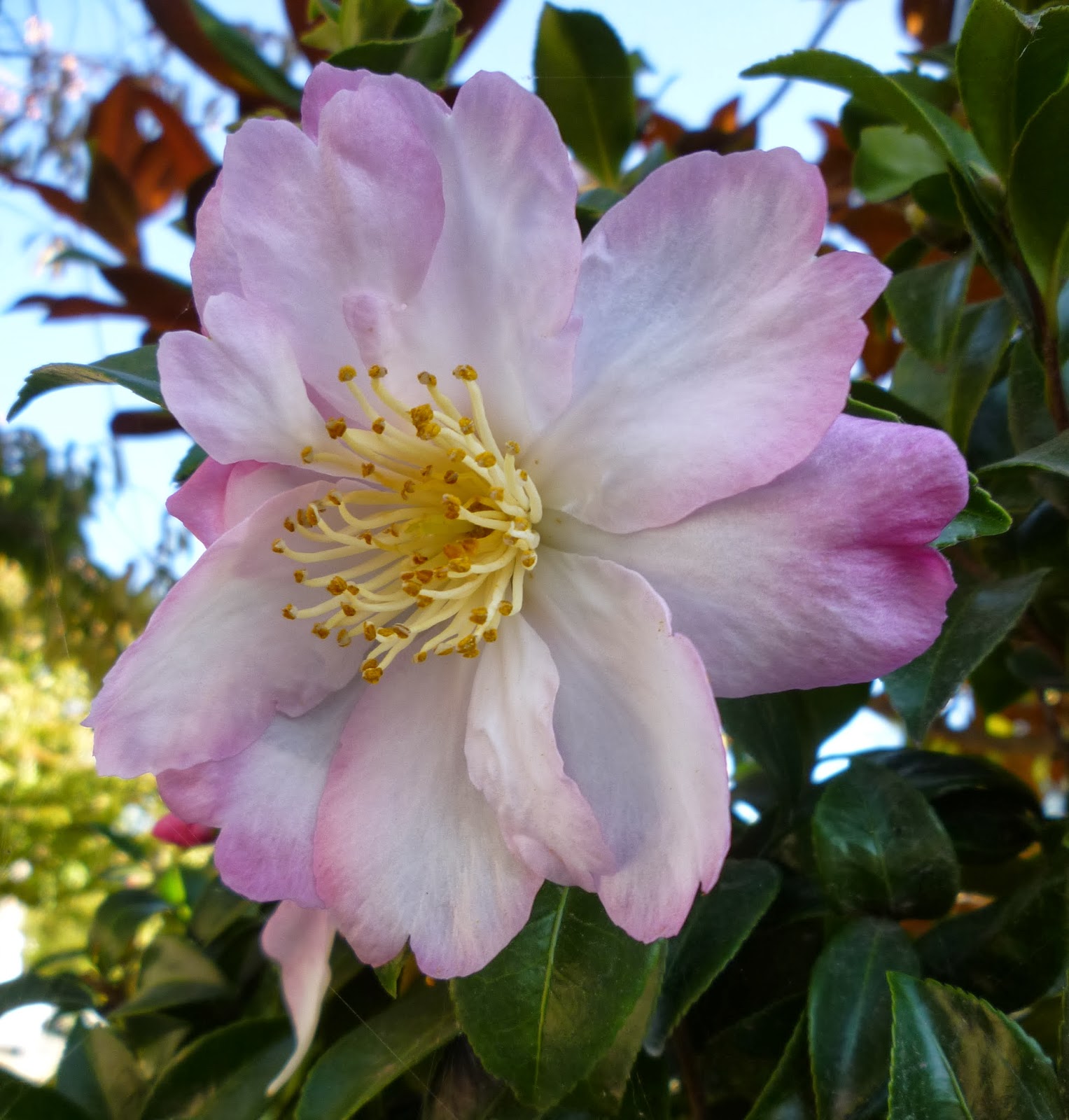
Berkeley Camellia in October

My sisters came to visit, and for the first time in about 50 years we returned together to places in Berkeley where we used to play. None of us has ever lived there, but as children we visited our maternal grandparents every summer.

Both of our parents had grown up in Berkeley, and last week we walked and drove the mostly hilly streets to find several of the houses in which our grandparents and our father and his sisters had lived. Of course we also stopped and stared at our other grandma’s house, savoring the memories that had been born in us there.

Not far away is Indian Rock Park, of which you can see pictures in my post about the neighborhood where Grandma and Grandpa lived for half a century. Indian Rock is huge — but not as big as we remembered it. And the park includes massive slabs and lava stones directly across the street, which I don’t know if I’ve ever played on. We didn’t go there this time, either, but climbed to the top of Indian Rock itself and sat a while, looking out over the tops of a thousand houses to San Francisco Bay.

Down Indian Rock Path

Not for very long, though, because we wanted to skip on down the steps of Indian Rock Path to Solano Avenue shops. Well, maybe not skip. But skipping is probably what we used to do!

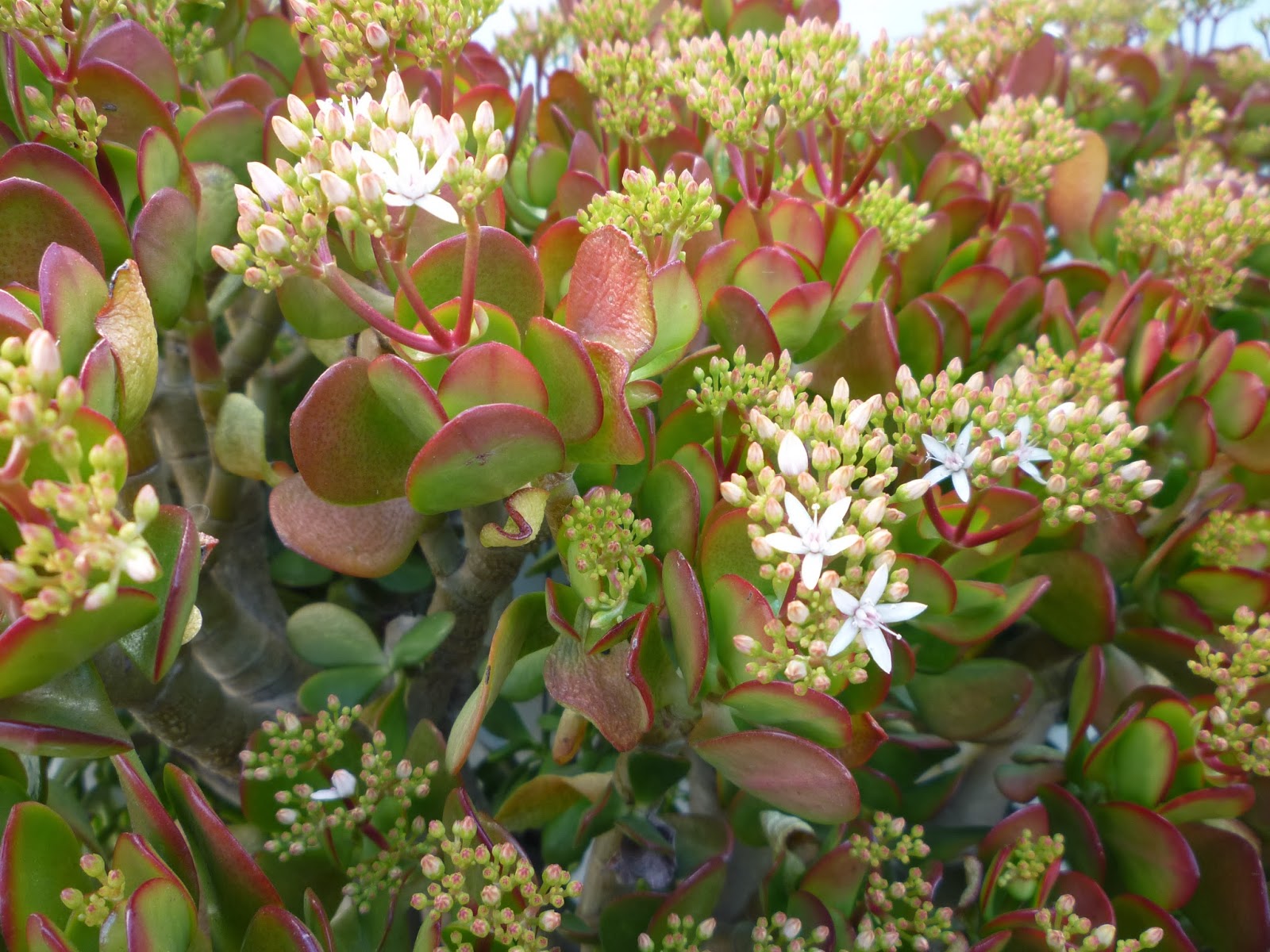
Jade plant in bloom on the path

In our memories the excursion to the ice cream parlor took much longer than what we found this time, even though we have passed the age when one can be unconscious of one’s legs and feet whether walking uphill or down. That shop has a new name, but the wares are similar, and you can look at old scoops while you wait.

After lunch, because we wanted to return to the higher neighborhood, it was necessary to hike up, and this time we took the steep route of Marin Avenue. Again my experience seemed altogether different from that of years ago, when most evenings after dinner Grandma, at an age greater than any of us have reached yet, would lead us on brisk neighborhood walks. It was slower than then. And the crucial person was missing.

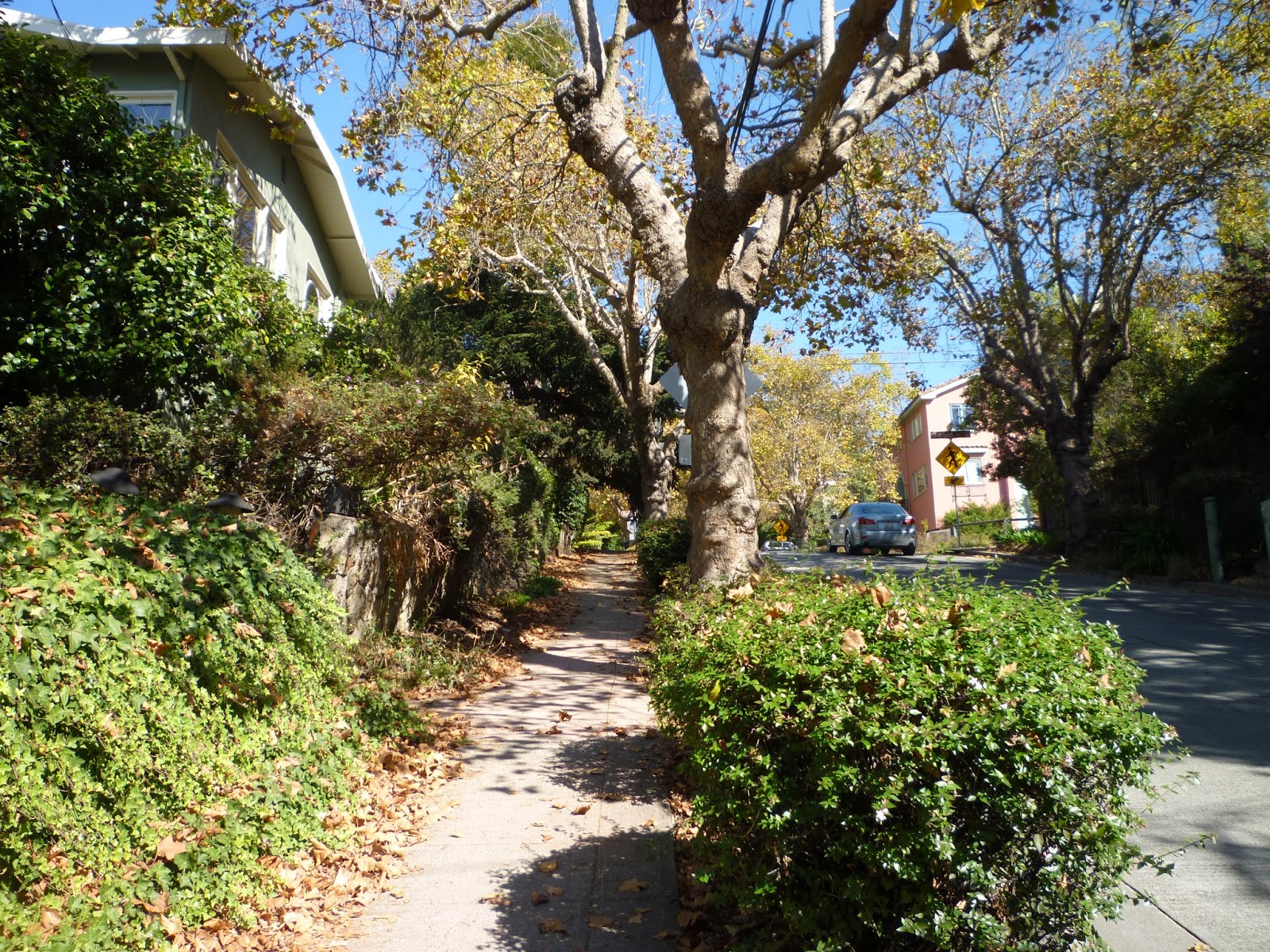
Marin Avenue is a hike.

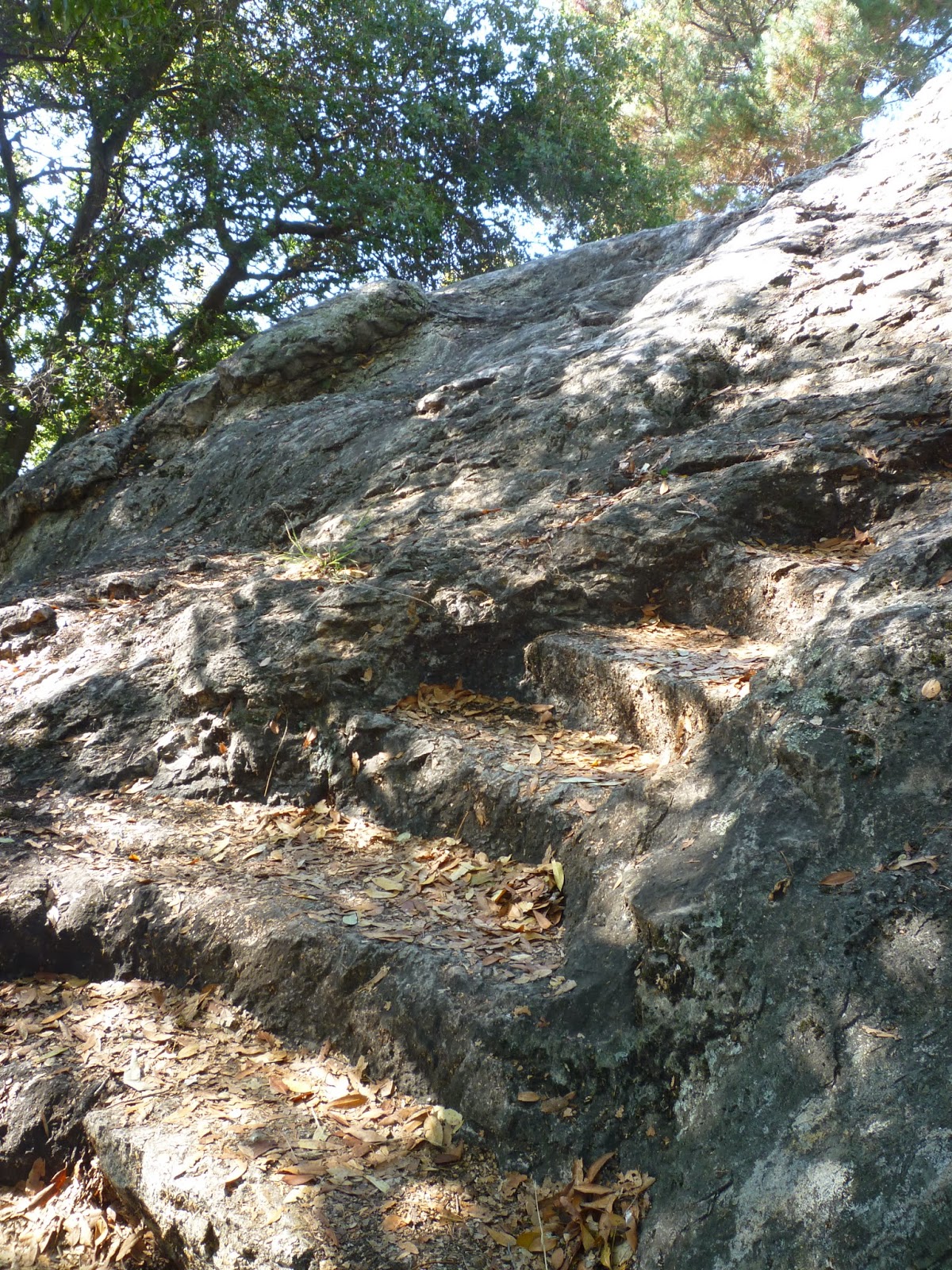
Mortar Rock steps

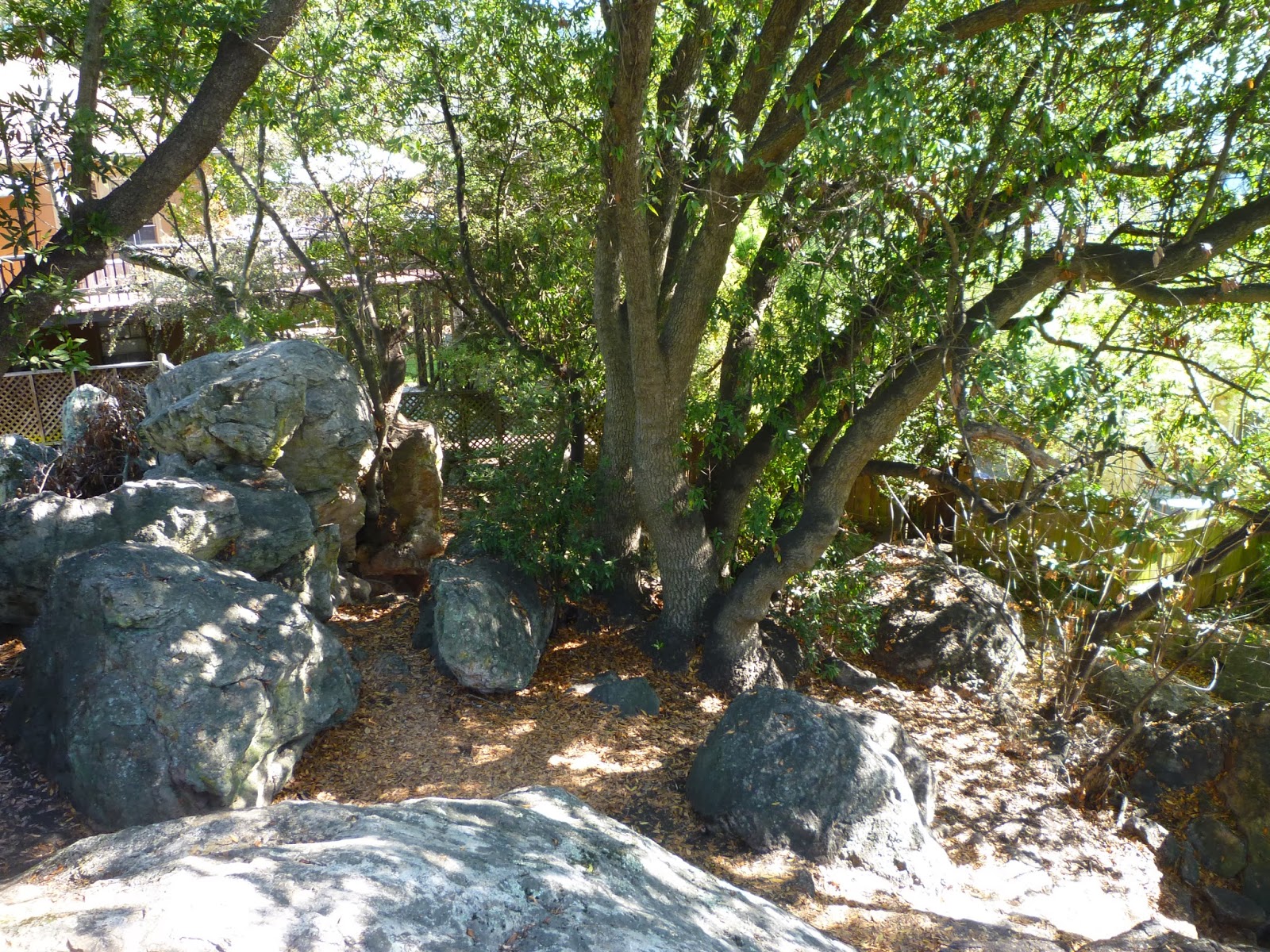
We circled back to Mortar Rock, just around the corner from Indian Rock, and wandered there longer, just as we used to play there longer in our childhoods. More of those stone surfaces are easily climbable, and Grandma always felt better about us going by ourselves, because we didn’t have to cross a busy street to get there.

The houses next to these parks and paths don’t have much privacy. In this picture you can see how close they are, and how there are not fences blocking them from park goers and their glances.

When I first put my feet on the dry paths of Mortar Rock Park, suddenly a familar herby smell registered in my senses, making me look down to see long pointy dead leaves underfoot, just as my mind was linking to “bay tree.” I lifted my head and saw that the dappled shade was cast by at least two tall old California Bay Laurels (along with oaks and buckeye) whose several large trunks were curving high over the rocks.

And yes, there were the grinding mortars in the rock, empty of anything but leaves at this time of year. Do children still pretend to be Indians grinding acorns in them?

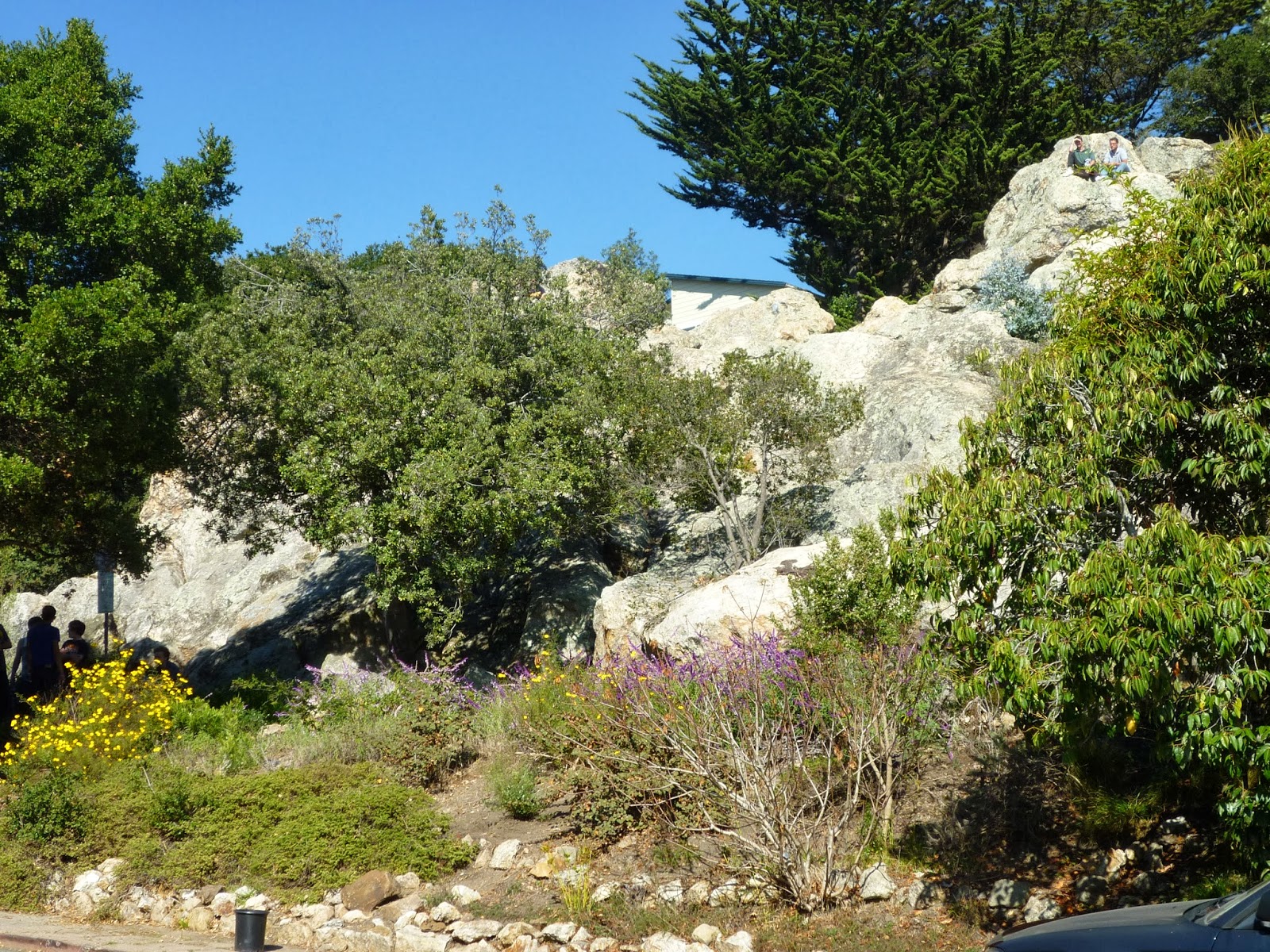
One of the houses we were searching for was only a few blocks from here, so we walked up the street, admiring the many flowers still in bloom in this mild climate. Banks of fuchsias always remind us of the long row of them that grew along the brick path in Grandma and Grandpa’s back yard.

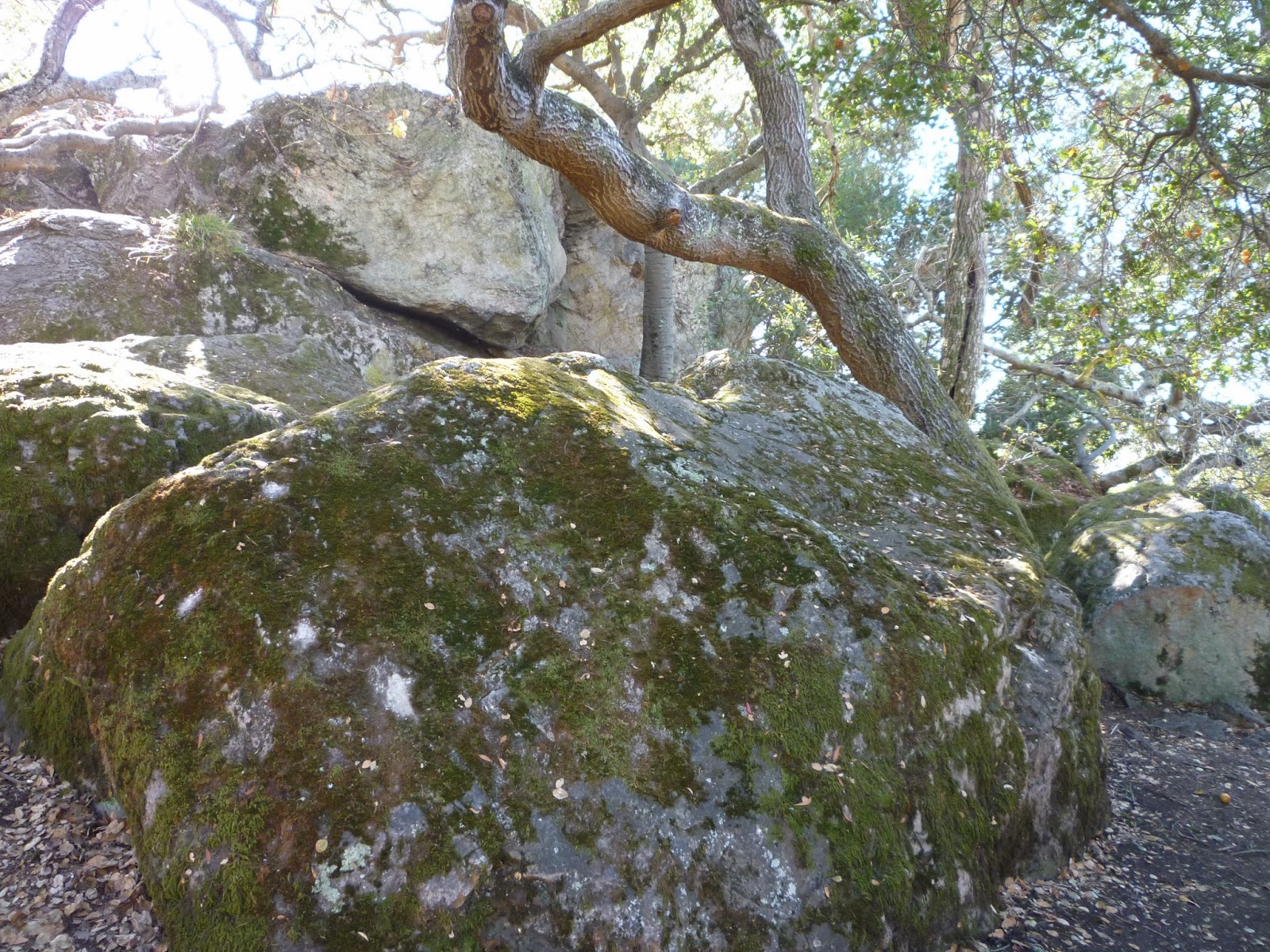
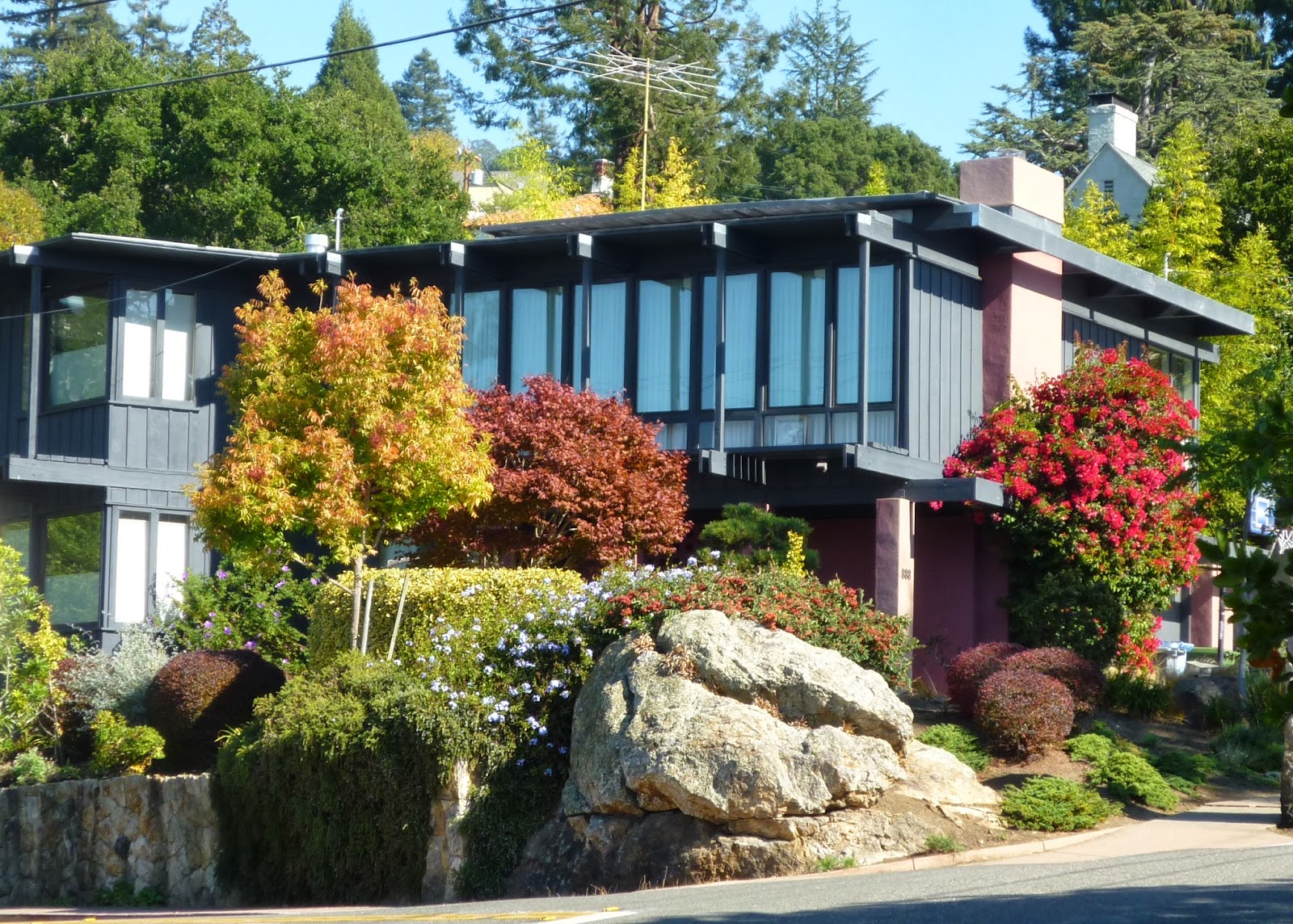
More rocks! This house, though modern in design, has a very traditional and unchanging boulder to distinguish its front yard.


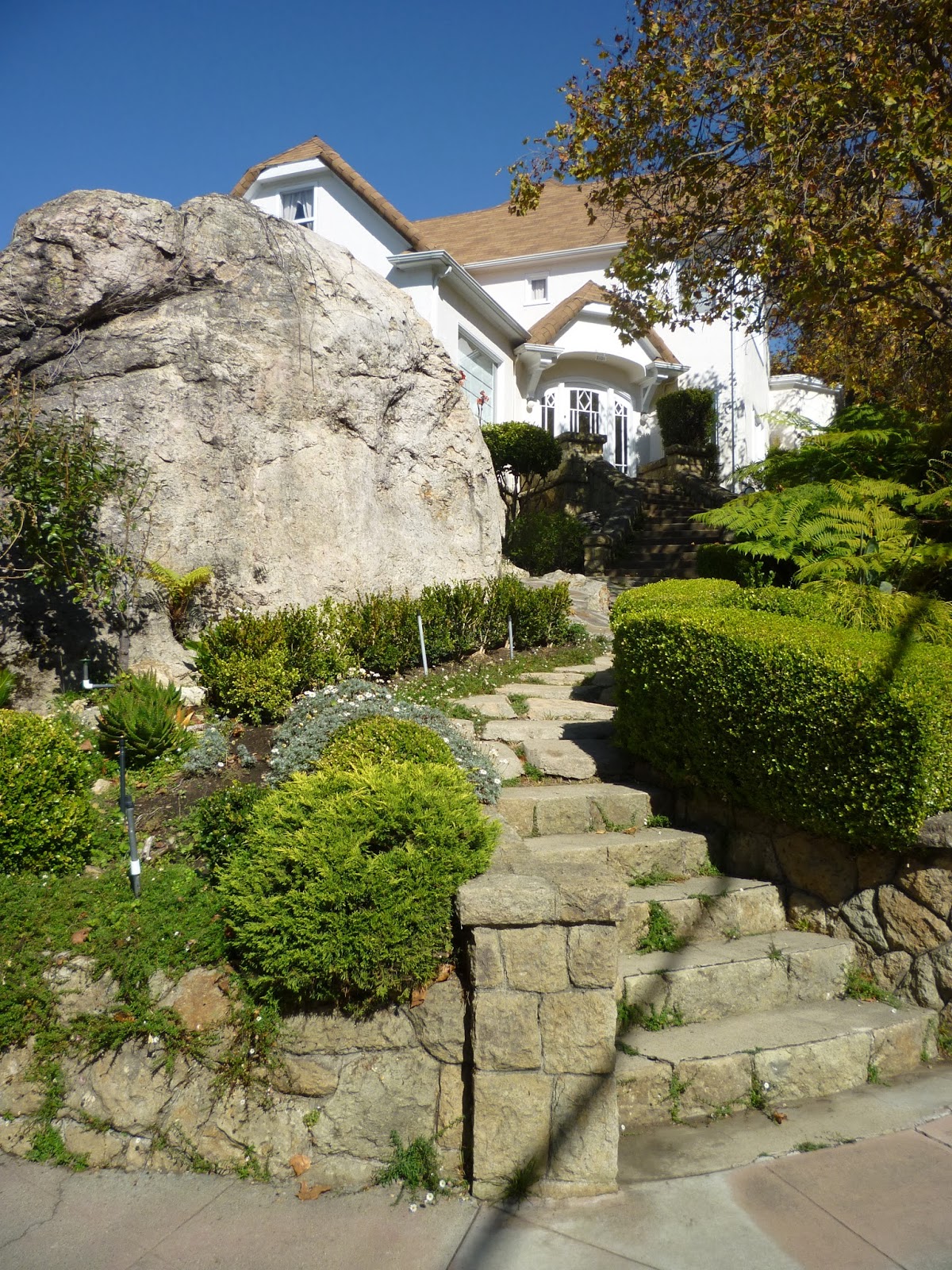
This one’s even more of a monolith. Having such a thing in your front yard would certainly lend drama to the landscaping. I wonder if the owners of the house are helped to keep a humble perspective on their lives, with the antiquity of their mineral friend constantly looming. So solid, and not going anywhere.

Lots of giant volcanic rocks dot the neighborhood. I saw these I didn’t remember on Santa Barbara Avenue, taking up a lot or two.

Rocks on Santa Barbara Ave., Berkeley CA

The weather was summery, and we seemed to walk always up, and up. It felt good to stop frequently to snap pictures of fall color or late summer flowers. Eventually we arrived at the first house of our father’s on our list, on Santa Barbara Avenue.

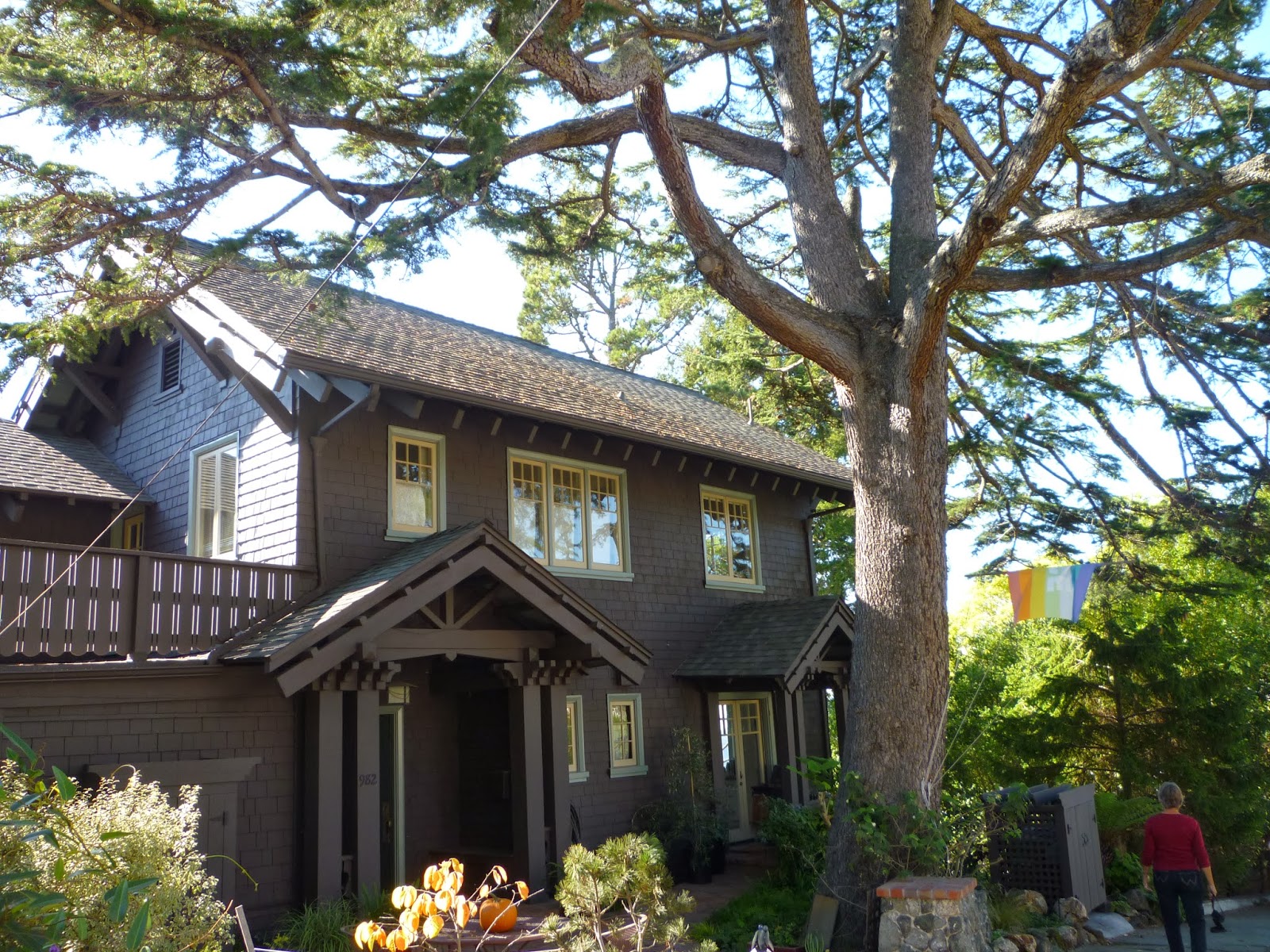
Another childhood home of my father, on Euclid, has had a facelift recently — we compared it with photos from 15 years ago when a patriarchal tree must have blocked the view and the warming sunlight, and the color was white. Paint and trees and even whole houses are easier to change or remove than those giant rocks.

Euclid house

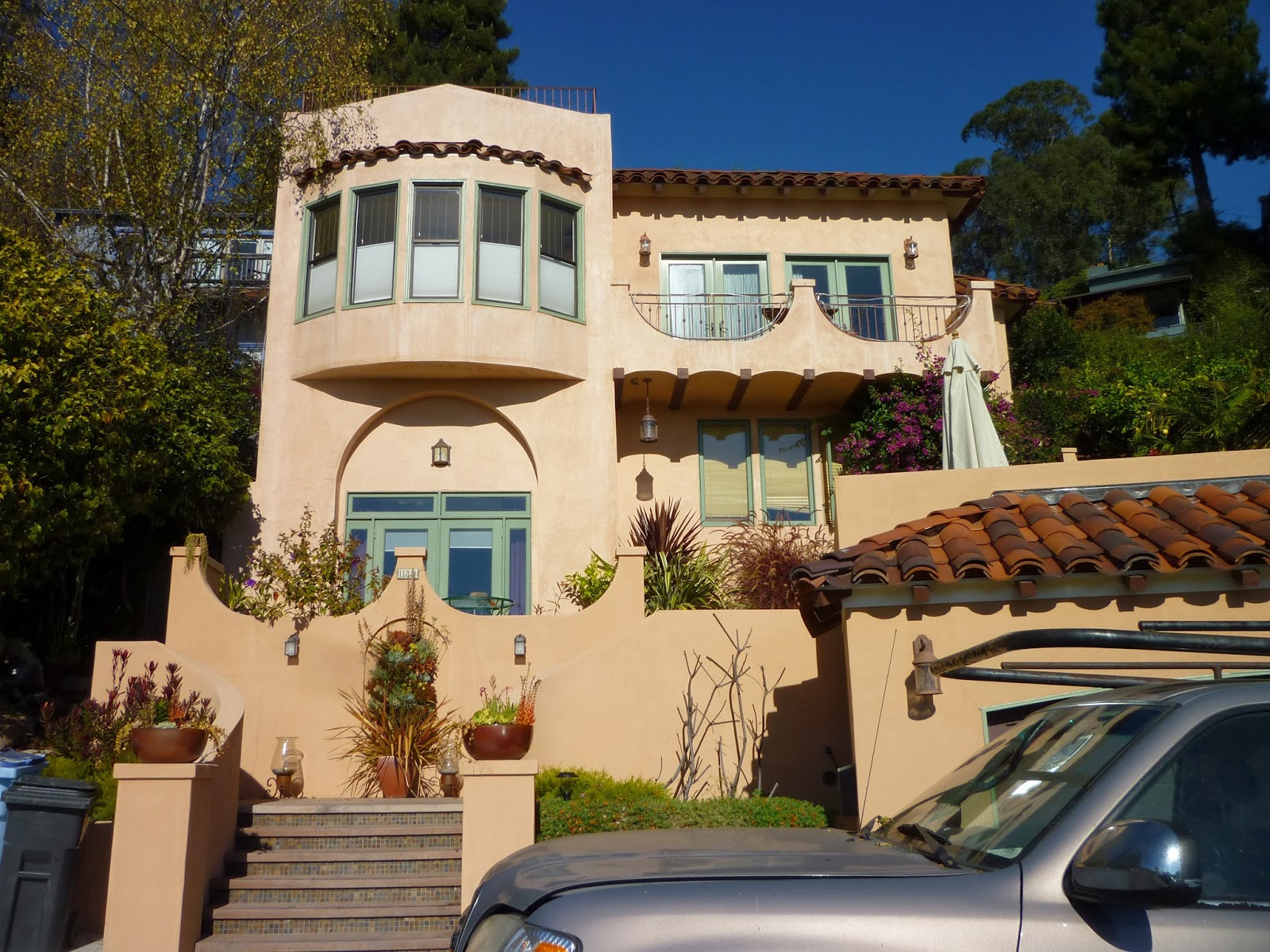
And though it seems ages ago that we walked these streets together, and slept in the Berkeley bedroom wondering at the city lights spread out before us, most of these houses are not more than a hundred years old. Young things, really.

We went back to our car and drove to a few more houses, none so photogenic now. We bought gas at the station where our grandma used to buy hers, and we shopped at the market where she used to shop. We ate dinner at Spenger’s Fish Grotto where we’d eaten many times with our grandparents. And then my dear sisters and I finished our day with shopping at our grandma’s favorite Park & Shop market, now Andronico’s.

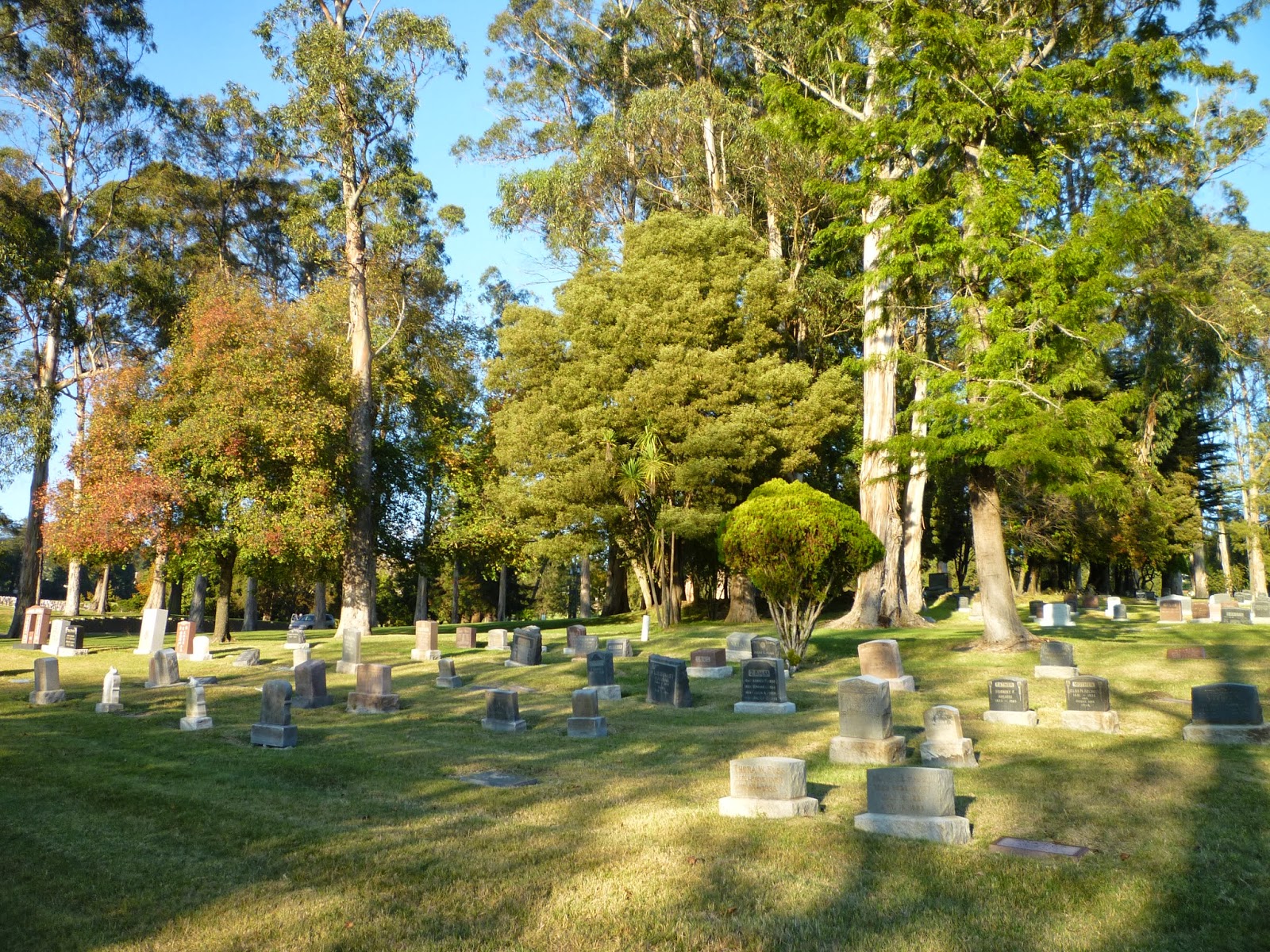
But a little earlier in the evening we’d added to our tour a visit to the cemetery where both Grandma and Grandpa are buried. None of us had visited since the last graveside service almost 20 years ago, and it took some exploring to find the marker. I felt closer to Grandma and Grandpa there at their grave than I had on the street in front of their house.

Cemeteries are where one finds another sort of stone, markers of lives that grew up like grass, and withered and died, most with life spans briefer even than flimsy wooden houses and certainly shorter than those huge stones people built neighborhoods around fairly recently. At the end of time, we read in 2 Peter, “… the day of the Lord will come as a thief in the night; in the which the heavens shall pass away with a great noise, and the elements shall melt with fervent heat, the earth also and the works that are therein shall be burned up.”

Indian Rock and all the granite in the Sierras, though it’s been around longer than we can imagine, will be gone, along with houses and gravestones. Then what is most enduring, the souls into whom God breathed life, will be raised. We are what on this earth is eternal.

A sleeping place is blessed.

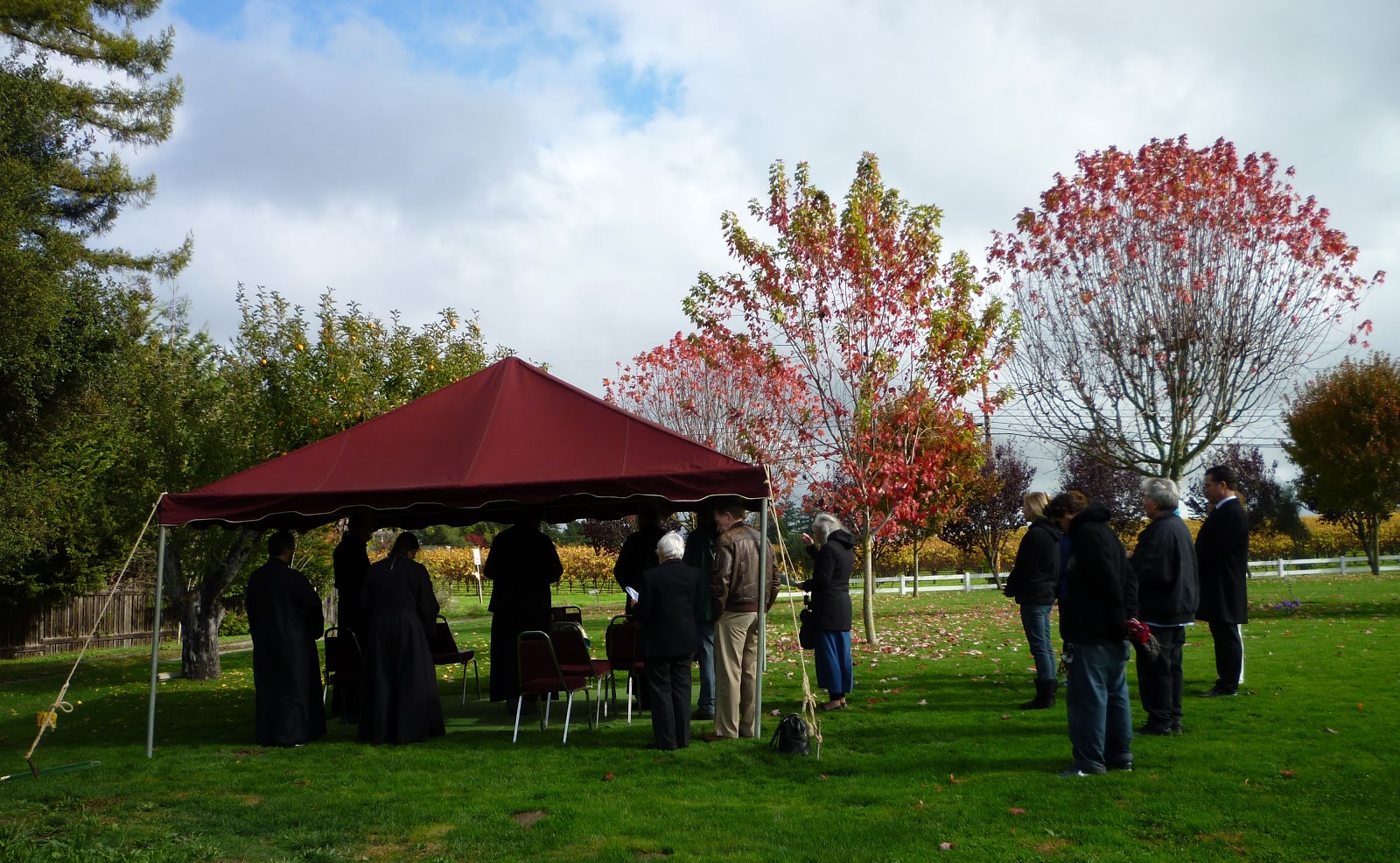
When our rector went to a nearby cemetery to bless a section designated for new gravesites, I was eager to go along and be among those praying and singing. A small group of us gathered at noon after a morning of rain. The light changed often as the clouds came between us and the thin autumn sunshine. The trees cast shadows in the middle of the day, and I never took off my fleece jacket.

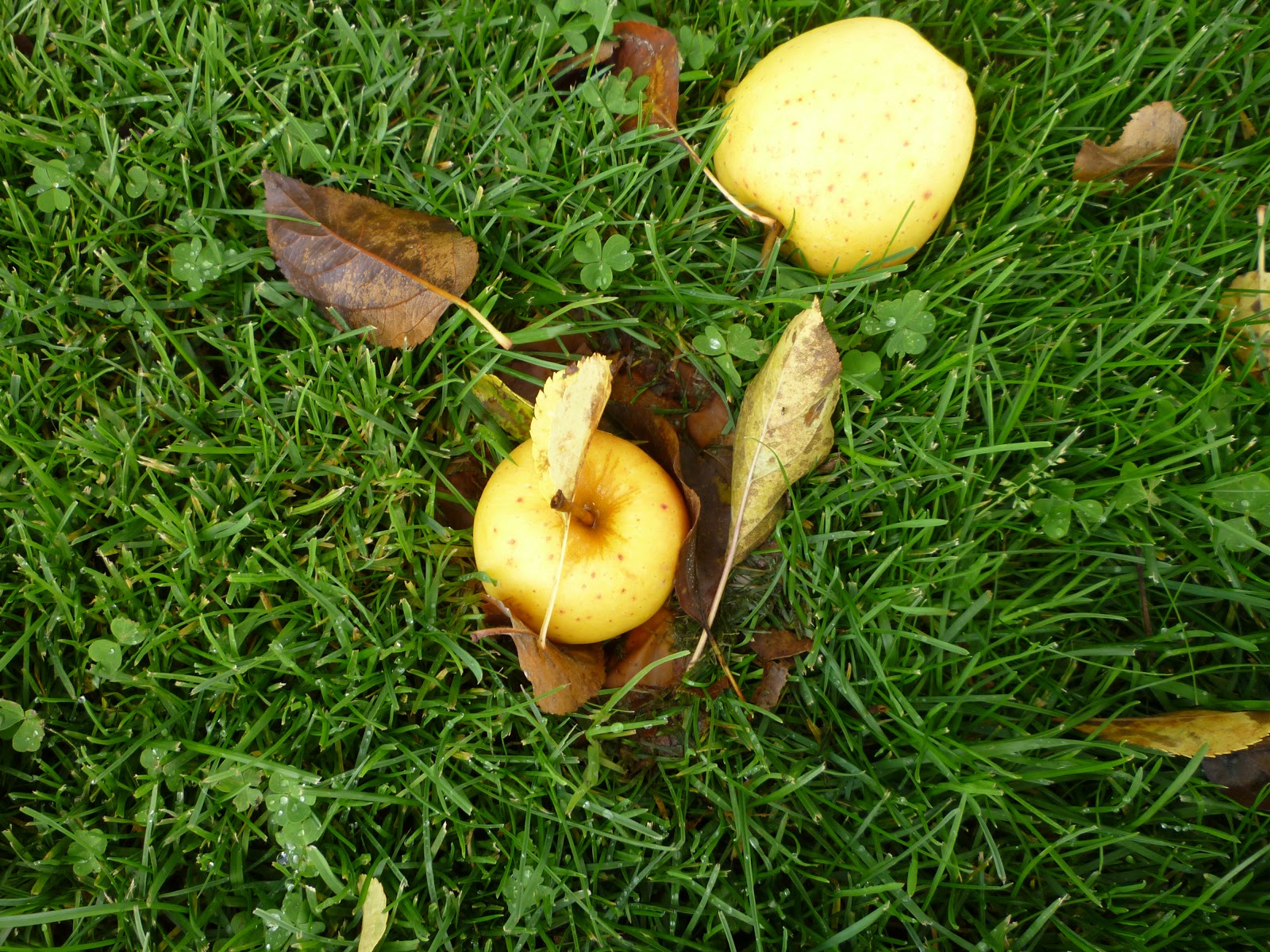
Not long into the service three words, “quickly flowing life,” pressed on my mind, referring to our earthly existence. It seemed the perfect time of year for this opportunity to turn our minds to death and corruption; I could see the vineyard across the street all in gold, and apples had fallen from trees all around the awning that had been set up for us.

Strangely enough, my husband was in another town not far away, attending the funeral of a Christian man. His body was put into the grave at about the time we were hearing the Gospel reading, about how Joseph of Arimathea took Christ’s dead body and cared for it. Here is the account from the Gospel of John:

After these things Joseph of Arimathea, who was a disciple of Jesus, but secretly for fear of the Jews, asked Pilate that he might take away the body of Jesus, and Pilate gave him permission. So he came and took away his body. Nicodemus also, who earlier had come to Jesus by night, came bringing a mixture of myrrh and aloes, about seventy-five pounds in weight. So they took the body of Jesus and bound it in linen cloths with the spices, as is the burial custom of the Jews. Now in the place where he was crucified there was a garden, and in the garden a new tomb in which no one had yet been laid. So because of the Jewish day of Preparation, since the tomb was close at hand, they laid Jesus there.

Our bodies are temples of the Holy Spirit, and when at death our souls are separated from our bodies it is right that they be laid in the earth to await the resurrection. Fr. Alexander Schmemann (in an article that is worth reading in its entirety) makes clear what is Christian faith as regards this event:

…it is with faith or unbelief, not simply in the “immortality of the soul,” but precisely in the Resurrection of Christ and in our “universal resurrection” at the end of time that all of Christianity “stands or falls,” as they say. If Christ did not rise, then the Gospel is the most horrible fraud of all. But if Christ did rise, then not only do all our pre-Christian representations and beliefs in the “immortality of the soul” change radically, but they simply fall away.

…..

He alone arose from the dead, but He has destroyed our death, destroying its dominion, its despair, its finality. Christ does not promise us Nirvana or some sort of misty life beyond the grave, but the resurrection of life, a new heaven and a new earth, the joy of the universal resurrection. “The dead shall arise, and those in the tombs will sing for joy…” Christ is risen, and life abides, life lives… That is the meaning; that is the unending joy of this truly central and fundamental confirmation of the Symbol of Faith: “And the third day, He rose again according to the Scriptures.”

The soul won’t be separated from the body forever, but for a time the body will be as asleep, while we anticipate our rising, when we will sing with joy at the final defeat of death. Until then, this spot on the earth would be as good as any for waiting.

When the service was over, we were invited to pick as many apples as we wanted from the trees, which I think were Golden Delicious. It didn’t take me long to finish my apple. The service was less than an hour. In a couple of months there won’t be any leaves left on the vines or the apple trees, and the years of each of us are quickly flowing.

Lord, teach us to number our days, that we may apply our hearts to wisdom.

[We had no idea of it at the time, but not three years after I wrote this post, my husband joined the ranks of those waiting here for that rising.]