Tag Archives: Fr. Patrick Reardon

Moses of old prefigured it.

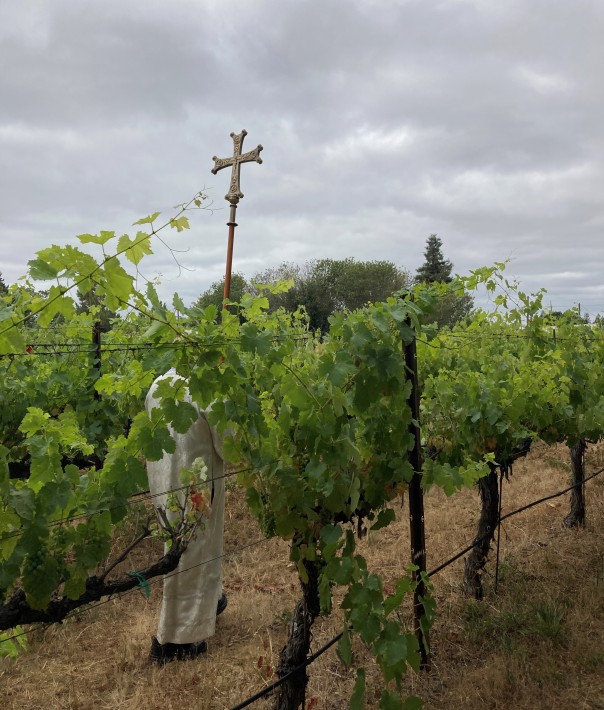
Thy precious Cross, O Christ God,
which Moses of old prefigured in his own person
when he overthrew Amalek and put him to flight;
which David commanded to be worshipped,
calling it Thy footstool:
this same Cross we sinners worship today with unworthy lips.
We praise Thee Who wast pleased to be nailed upon it,
and we cry to Thee:

“With the thief, make us worthy of Thy Kingdom, O Lord!”
Thy Cross, O Lord,
is life and resurrection for Thy people.
And we who put our trust in it
praise Thee, our God crucified in the flesh.
Have mercy on us!

Here is a good article by Patrick Henry Reardon about the Biblical passage referred to above, in which Moses interceded for the army of Israel as it did battle with the Amalekites: “The Best Intercessor in the Bible.”

“Moses conquered the Devil, wrote Gregory the Theologian,
‘by stretching out his hands upon the hill,
in order that the Cross, thus symbolized and prefigured,
might prevail.'”

Illarion Mikhailovich Pryanishnikov, Cross Procession

Love’s triad confronts modern man.

This very meditative homily on the words of St. Paul, when he wrote about faith, hope and love, I found to be truly rich and encouraging. Father Patrick Reardon points out in his sermon the strange reductions of St. Paul’s teachings that came from various Christians writing many centuries after the apostle’s letters were circulating among the churches.

In fact, it can only be theoretical to separate love from hope and faith, as St. Paul does in I Corinthians 13, for the purpose of making clear that love is preeminent; true love is not manifested without faith and hope. We also learn in this Bible lesson of another fruit of the Spirit that makes up a second triad of virtues, further fleshing out the reality of what it means to live in love. The interrelated meanings of the several words and their contexts lift one’s mind right up to the throne of God where the Three Persons live eternally in Love, a Love in which we are invited to partake.

If you are interested in further contemplation about this Love that originates in the Holy Trinity, and how it contrasts with Faust, or is described by Dante, you will want to listen to the 16-minute talk on the Ancient Faith site here:  “The Supremacy of Love,”  or by means of the direct MP3 file linked at top.

Happy Valentine’s Day!

The ultimate human experience.

From a church bulletin:

The Resurrection of Jesus… was the ultimate human experience. For the first time, a human brain and a human nervous system were suffused from within by the energies of the Resurrection. The whole, material universe begins to be transformed from that moment to what Paul will call “the fullness of Christ.” For the first time, a human heart pulsed with a life beyond the power of death, the pulsation of a heart which will never stop. For all eternity that heart will beat.

Jesus was thereby manifest as the “firstborn from the dead” as he is called in the book of Revelation. His experience of rising from the dead, the first man to do so, is the secure promise of the glory that awaits all those who are joined to him in faith and Divine Grace. This will be the final stage of Salvation. The final stage of Salvation will come only at the end of the world. You see, even dying and going to heaven is not the last stage. It’s a rather important one, but it’s not the last stage. True Soteria—True Salvation—is found when our bodies will rise in glory.

—Father Patrick Henry Reardon


Natan’s Psalter

A podcast I listened to at the beginning of Lent encouraged me in my desire to spend more time reading the Psalms. It was Fr. Patrick Reardon’s homily in which he exhorted his own parishioners on three points, one of which was the need to pray more during Lent. He suggested the Psalms, because the use of them is a tradition that was without doubt handed down to us by the Apostles.

Fr. Patrick told the moving story about the book of Psalms that Natan Sharansky‘s wife gave him the night before he was put in a Soviet prison, and how much it meant to him during the many years he spent there. Sharansky’s story of it is on the site of the National Library of Israel, where I found this photo.

If you would like to listen to Fr. Patrick’s homily yourself it can be found here: “As Though it Were Our Last.”