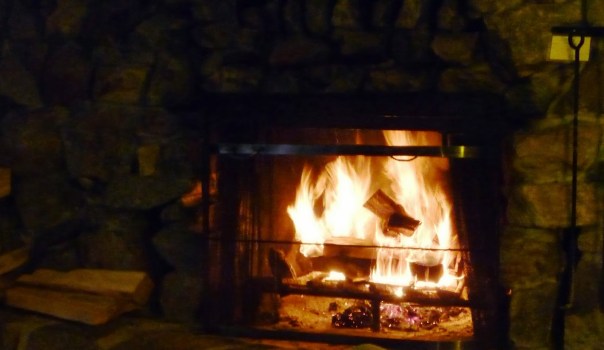
 “Any one thinking of the Holy Child as born in December would mean by it exactly what we mean by it; that Christ is not merely a summer sun of the prosperous but a winter fire for the unfortunate.”
-G.K. Chesterton
“Any one thinking of the Holy Child as born in December would mean by it exactly what we mean by it; that Christ is not merely a summer sun of the prosperous but a winter fire for the unfortunate.”
-G.K. Chesterton

In my Orthodox Christian household we have been enjoying our Christmas holy days, which just began on the 25th. I am keeping in mind the wisdom of G.K. Chesterton, who said, “The best way to shorten winter is to prolong Christmas.” That is, as you will remember, the opposite of what the witch did in Narnia, when she cast a spell making it “always winter but never Christmas.”
 Hilaire Belloc wrote a lovely piece in 1928 about the way his house kept Christmas throughout the Twelve Days, titled “A Remaining Christmas,” and Hearth and Field has kindly republished it. There are naturally some things we do differently in my tradition, such as, we have Theophany at the end of the Twelve Days, and in the West it is Epiphany. But it is the same story that compels us to “Rejoice, and again I say, rejoice!” (Philippians 4:4) Here is one paragraph:
“Now, you must not think that Christmas being over, the season and its glories are at an end, for in this house there is kept up the full custom of the Twelve Days, so that ‘Twelfth Day’, the Epiphany, still has, to its inhabitants, its full and ancient meaning as it had when Shakespeare wrote. The green is kept in its place in every room, and not a leaf of it must be moved until Epiphany morning, but on the other hand not a leaf of it must remain in the house, nor the Christmas tree either, by Epiphany evening. It is all taken out and 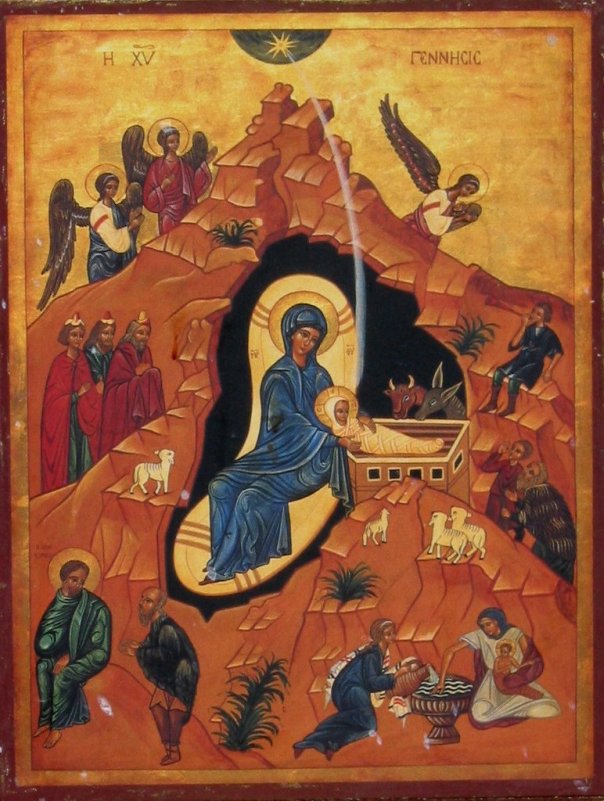 burnt in a special little coppice reserved for these good trees which have done their Christmas duty; and now, after so many years, you might almost call it a little forest, for each tree has lived, bearing witness to the holy vitality of unbroken ritual and inherited things.”
I didn’t get my greenery and full decorations up until Christmas Eve, so we are definitely leaving those for a while yet. Of course we have been nibbling away on the remains of our culinary feast, and I play carols in the car, and in the house when I remember.
Yesterday the younger house guests and I had a thoroughly sugary and creative session of decorating those gingerbread cookies we’d cut out on the Second Day. Also on the Third Day an impromptu Christmas tea party happened here, when more friends stopped by, and their children played my piano, which I know it was longing for. I brought out my real teacups, and twelve of us squeezed around the table to eat more Christmas cookies and drain the contents of four teapots. “Christ is born!”

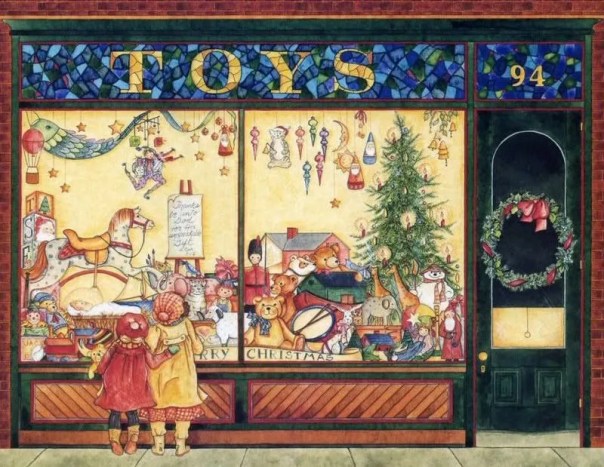
On this Fourth Day, I listened to a wonderful story by Chesterton, read by Fr. Malcolm Guite, “The Shop of Ghosts.” It starts with visions seen through a toy shop window, and continues with a conversation with Father Christmas. Thank you, Mr. Chesterton, for helping us to prolong Christmas. It will never die.
I found that Belloc essay, which you can read here: “A Remaining Christmas,” along with his poem I am sharing below. If you want more commentary on the poem, this article by Joseph Pearce might be a good place to start. In it he also mentions T.S. Eliot’s “Journey of the Magi.” I had thought to post this compilation of Things Christmastide closer to Twelfth Night, but it seems to want to go out now, I guess to help us make the most of the days to come. If we are weary from the busyness that accompanied us to the manger, let’s stay there a while and worship, and find rest.
TWELFTH NIGHT
As I was lifting over Down
A winter’s night to Petworth Town,
I came upon a company
Of Travellers who would talk with me.
The riding moon was small and bright,
They cast no shadows in her light:
There was no man for miles a-near.
I would not walk with them for fear.
A star in heaven by Gumber glowed,
An ox across the darkness lowed,
Whereat a burning light there stood
Right in the heart of Gumber Wood.
Across the rime their marching rang,
And in a little while they sang;
They sang a song I used to know,
Gloria
In Excelsis Domino.
The frozen way those people trod
It led towards the Mother of God;
Perhaps if I had travelled with them
I might have come to Bethlehem.
-Hilaire Belloc

A CHRISTMAS CAROL
The Christ-child lay on Mary’s lap,
His hair was like a light.
(O weary, weary were the world,
But here is all alright.)
The Christ-child lay on Mary’s breast
His hair was like a star.
(O stern and cunning are the kings,
But here the true hearts are.)
The Christ-child lay on Mary’s heart,
His hair was like a fire.
(O weary, weary is the world,
But here the world’s desire.)
The Christ-child stood on Mary’s knee,
His hair was like a crown,
And all the flowers looked up at Him,
And all the stars looked down.
— G.K. Chesterton
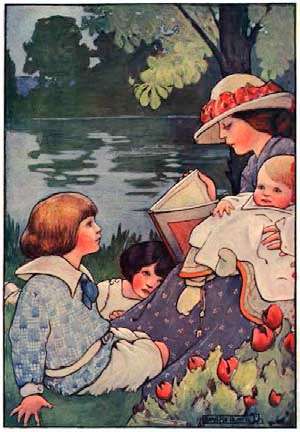
“If people must not be taught religion, they might be taught reason, philosophy. If the State must not teach them to pray it might teach them to think. And when I say that children should be taught to think I do not mean (like many moderns) that they should be taught to doubt; for the two processes are not only not the same, but are in many ways opposite. To doubt is only to destroy; to think is to create.”
-G.K. Chesterton

