Tag Archives: humility

The Absence

Blessed are the poor in spirit: for theirs is the kingdom of heaven. Matt. 5:3

I liked the first poem I read by R.S. Thomas so well that I borrowed a collection of his poems from the library. It had some water damage already so I don’t worry about leaving it in the bathroom or reading it at the breakfast table, and I’ve been perusing it for a few weeks.

One doesn’t have to explore this book for very long to find that Thomas’s poetry is full of the feeling of coldness between us and God. Themes of harsh landscape and winter reappear, with lots of stone, stone, stone. My husband has been watching a TV detective series set in Wales and he commented that he would not want to live there, it looks so bleak. Maybe Thomas’s perspective is touched by the geography of his homeland.

This poem below is an example of this tone, though it’s not as painful as some of his verse that describes the alienation that is so common to the human experience. The last line relieves me with its hopeful turn and reminds me of what I’ve heard elsewhere: It’s only when we are truly empty of anything to offer God, and present ourselves humbly before Him, that He can speak to us, with His fullness that is silence, His presence that is His Word.

THE ABSENCE

It is this great absence
that is like a presence, that compels
me to address it without hope
of a reply. It is a room I enter

from which someone has just
gone, the vestibule for the arrival
of one who has not yet come.
I modernise the anachronism

of my language, but he is no more here
than before. Genes and molecules
have no more power to call
him up than the incense of the Hebrews

at their altars. My equations fail
as my words do. What resource have I
other than the emptiness without him of my whole
being, a vacuum he may not abhor?

— R.S. Thomas
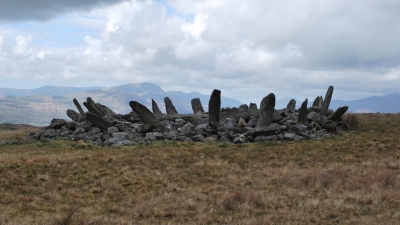
wales stones
Bryn Cader Faner cairn in Wales

Gleanings – Logos and Intelligibility

Once or twice a week I go to the gym and walk on the treadmill for an hour or so, and I read, either The New Yorker or Touchstone magazine. Worlds apart in perspective and subject matter, those two periodicals, but both having some content of interest to me, treated in enough depth to keep my attention away from the tedious treading.

I always keep a ball-point pen next to my water bottle on the little shelf of the machine, so that even while I hang on with one hand as I hike, all out of breath, my other hand is free to stab at the page trying to make marks that will help me find my way back later. It’s always my intention to return when I am in a more contemplative mood, to the words or sentences that piqued my interest because they remind me of something else in my life and philosophy. I love how everything is connected to everything else, even when I don’t have time to figure out exactly how, or to articulate it in my own words.

In the last few years that sort of time and ability seem especially lacking, yet I keep on reading and underlining and thinking at only an introductory level about one article at a time. Then I stash that magazine in my basket by the computer and the next time I start in on a fresh one. This kind of behavior has been going on for a long time, so I have a great store of “material,” as we writers call it, with new resources constantly arriving.

I’m going to try to post more frequently and without much comment — without much real writing! —  snippets from my readings, so that I don’t completely lose the benefit of the riches I’m enjoying every week. Maybe one or another of my readers will find a topic of interest now and then, but even if you don’t, copying some excerpts will give me more satisfaction than the usual procrastinations.

touchstone cover 10-14One article I read this month was from the September/October 2014 Issue of Touchstone, an introduction to metaphysics by Graeme Hunter titled “The Light of Everyman.” Hunter starts out by writing, “The hardest things to talk about are simple ones. My topic is the simplest thing of all: reality.”

He proceeds to explain how metaphysics is important because it “sees only the realities to which all people and all cultures have equal access,” and he also explores the question of how we can know that reality is intelligible to us. Some philosophers have concluded that in fact it is not intelligible, which leads them to nihilism; and some don’t want to go all the way there, and they end up making the whole issue more complicated than it has to be, even nonsensical.

Hunter proposes a solution to the question, which is the part that I wanted to share, as he explores the line from scripture that we know in English as, “In the beginning was the Word”:

“‘En arche en ho Logos’ are the first five words of John. No translation can do them justice. The word Logos is one of the most polysemous words in the Greek dictionary. Its meanings include ‘word,’ ‘speech,’ ‘argument,’ ‘theory,’ ‘account,’ ‘blueprint,’ the laying out of things and gathering them up. But underlying its many meanings is the simple idea we have just been talking about: the idea of intelligibility.”

“The intelligibility of things cannot be proven, as we have seen [earlier in the article]. And we have also seen that the natural sciences give us no right to assume it. But what if, as John proclaims, the intelligibility of things has been revealed, not just in the form of a divine pronouncement written in a holy book, but in the form of God made man, and dwelling among us, full of grace and truth? God as Intelligibility. The Maker who knows the worldchrist extreme-humility; the Knower who makes it; making and knowing as one thing; Maker and Knower taking human form.”


The Icon of Extreme Humility seems a good one to contemplate as we are talking about the Son of God who “humbled himself, taking the form of a man…”

What the World Needs Now

A recent confluence of thoughts began with hate and destruction, in a blog post from Fr. George:

When we dream about changing the world, we are expressing our own dissatisfaction with it, and thus our rejection and disdain for it. Can you really change something you hate? Not really. What you really want to do is kill it. We want to destroy the world to build one of our own liking.

To love is to accept things as they are, calling the good as good and the bad as bad, and not needing to change them in order to accept them. The truth is you can only change yourself, and even there we have limits because we were all made in certain ways and some things were not made to change.

Fr. George’s exhortation to love and accept “things as they are” brought to mind this poem by Mary Oliver that I have posted in the past:

MESSENGER

My work is loving the world.
Here the sunflowers, there the hummingbird —
equal seekers of sweetness.
Here the quickening yeast; there the blue plums.
Here the clam deep in the speckled sand.

Are my boots old? Is my coat torn?
Am I no longer young, and still not half-perfect? Let me
keep my mind on what matters,
which is my work,

which is mostly standing still and learning to be astonished.
The phoebe, the delphinium.
The sheep in the pasture, and the pasture.
Which is mostly rejoicing, since all ingredients are here,

which is gratitude, to be given a mind and a heart
and these body-clothes,
a mouth with which to give shouts of joy
to the moth and the wren, to the sleepy dug-up clam,
telling them all, over and over, how it is
that we live forever.

When I pay attention, I can hear that a message is always being sent my way, a choice is set before me every day, and on some days it seems to come every few minutes: Will I receive life, and my life, as a gift, or will I fight against what is handed to me, and try to create my own life and self the way I see fit?

I’m familiar with the teaching from wise church fathers that acceptance is a large part of humility. And when I read this passage from Metropolitan Anthony (from “Meditations on a Theme”) it seemed to go right along with these other expressions I’ve gathered here, on what should be my attitude in this life I’ve been made steward over. Met. Anthony credits St. Theophan as the source of his comments about how the earth can teach us:

Just think about what earth is. It lies there in silence, open, defenseless, vulnerable before the face of the sky. From the sky it receives scorching heat, the sun’s rays, rain, and dew. It also receives what we call fertilizer, that is, manure—everything that we throw into it. And what happens? It brings forth fruit. And the more it bears what we emotionally call humiliation and insult, the more fruit it yields.

Thus, humility means opening up to God perfectly, without any defenses against Him, the action of the Holy Spirit, or the positive image of Christ and His teachings. It means being vulnerable to grace, just as in our sinfulness we are sometimes vulnerable to harm from human hands, from a sharp word, a cruel deed, or mockery. It means giving ourselves over, that it be our own desire that God do with us as He wills. It means accepting everything, opening up; and then giving the Holy Spirit room to win us over.

This week I’m getting ready for a trip to the mountains, to My Lake (see posts with the label cabin). I’ll be getting the garden watered, and in the mountains I’ll be seeing lots of earth and its fruiting forests and wildflowers. I will try to take it all as a reminder to open up and give the Holy Spirit room.

How to Get Light instead of Fog.

St. Isaac of Syria

Thanks to Christ is in our Midst for this posting appropriate to the beginning of Lent. To me it is a helpful elaboration on C.S. Lewis’s statement that “Virtue — even attempted virtue — brings light; indulgence brings fog.”

…If you cannot be still within your heart, then at least make still your tongue. If you cannot give right ordering to your thoughts, at least give right ordering to your senses. If you cannot be solitary in your mind, at least be solitary in body. If you cannot labor with your body, at least be afflicted in mind. If you cannot keep your vigil standing, keep vigil sitting on your pallet, or lying down. If you cannot fast for two days at a time, at least fast till evening. And if you cannot fast until evening, then at least keep yourself from satiety.

If you are not holy in your heart, at least be holy in body. If you do not mourn in your heart, at least cover your face with mourning. If you cannot be merciful, at least speak as though you are a sinner. If you are not a peacemaker, at least do not be a troublemaker. If you cannot be assiduous, at least consider yourself lazy. If you are not victorious, do not exalt yourself over the vanquished. If you cannot close the mouth of a man who disparages his companion, at least refrain from joining him in this.

Know that if fire goes forth from you and consumes other men, God will demand from your hands the souls which your fire has burned. And if you yourself do not put forth the fire, but are in agreement with him who does, and are pleased by it, in the judgment you will be reckoned as his accomplice. If you love gentleness, be peaceful, if you are deemed worthy of peace, you will rejoice at all time. Seek understanding, not gold. Clothe yourself with humility, not fine linen. Gain peace, not a kingdom.

~St. Isaac of Syria