Tag Archives: John Donne

Immensity cloistered in thy dear womb.

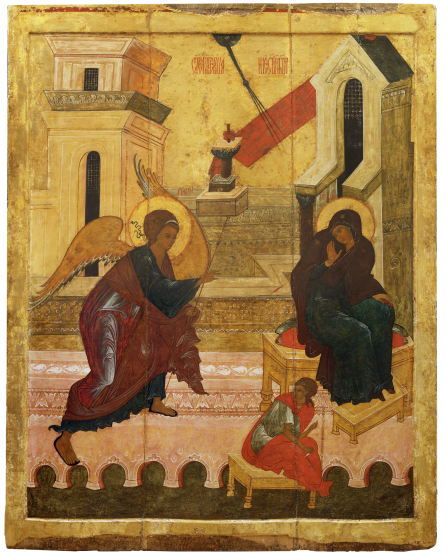
ANNUNCIATION

Salvation to all that will is nigh;
That All, which always is all everywhere,
Which cannot sin, and yet all sins must bear,
Which cannot die, yet cannot choose but die,
Lo, faithful virgin, yields Himself to lie
In prison, in thy womb; and though He there
Can take no sin, nor thou give, yet He will wear,
Taken from thence, flesh, which death’s force may try.
Ere by the spheres time was created, thou
Wast in His mind, who is thy Son and Brother;
Whom thou conceivst, conceived; yea thou art now
Thy Maker’s maker, and thy Father’s mother;
Thou hast light in dark, and shutst in little room,
Immensity cloistered in thy dear womb.

-John Donne

Annunciation Holy Russia Louvre

His pity toward thee wondrous high.

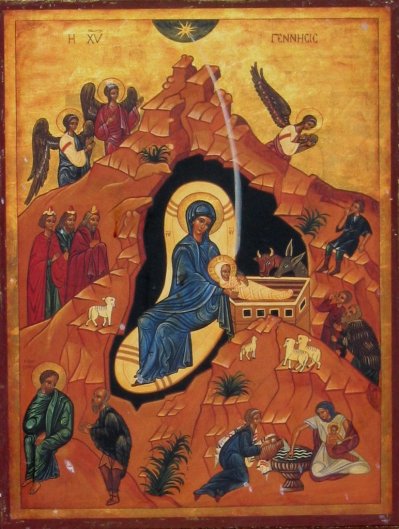
NATIVITY

Immensity cloistered in thy dear womb,
Now leaves His well-belov’d imprisonment,
There He hath made Himself to His intent
Weak enough, now into the world to come;
But O, for thee, for Him, hath the inn no room?
Yet lay Him in this stall, and from the Orient,
Stars and wise men will travel to prevent
The effect of Herod’s jealous general doom.
Seest thou, my soul, with thy faith’s eyes, how He
Which fills all place, yet none holds Him, doth lie?
Was not His pity towards thee wondrous high,
That would have need to be pitied by thee?
Kiss Him, and with Him into Egypt go,
With His kind mother, who partakes thy woe.

-John Donne

Nativity.0

As the sun at noon.

This poem by John Donne I believe did not start out as a poem. Someone posted it as follows, in poetic lines, but I found the same lines as prose on Bartleby.com, in the middle of a passage in “Sermons Preached on Christmas Day.” Donne evidently did not give the title “In Heaven it is Always Autumn” to anything, but more than one person has more recently used his line to title a poem, as I found in my searching.

Donne uses several vivid words to describe the winter we can experience in our soul at any time of year, showing that he is familiar with that inner dark and coldness. We know that he did suffer terrible grief when his wife died, and it was doubtless not the only occasion when he felt desperate need of God’s presence and mercy.

What an encouraging word the preacher poet brings out of his training in God’s ways, able to comfort us “benighted” ones with the comfort that he has been comforted with, as in II Cor. 1:4. Because these thoughts were part of a Christmas sermon, I thought of sharing them later at Christmastime, but taking my cue from the first line extracted, and because it happened to be in the current season of the year I needed a reminder of God’s thawing Love, I’m not waiting.

“In heaven it is always autumn,
His mercies are ever in their maturity.
We ask our daily bread
And God never says
You should have come yesterday,
He never says
You must again tomorrow,
But today if you will hear His voice,
Today He will hear you.
He brought light out of darkness,
Not out of a lesser light;
He can bring thy summer out of winter
Tho’ thou have no spring,
Though in the ways of fortune or understanding or conscience
Thou have been benighted til now,
Wintered and frozen, clouded and eclipsed,
Damped and benumbed, smothered and stupefied til now,
Now God comes to thee,
Not as in the dawning of the day,
Not as in the bud of the spring
But as the sun at noon,
As the sheaves in harvest.”

– John Donne, 1624
Trace Him by the branches.

Many months ago when it was my birthday, I received from my husband a book of the works of John Donne, poetry and prose and sermons. On a recent trip we had listened to a Mars Hill Audio Journal CD that included an interview about him, with the always fascinating Dana Gioia. I’ve been perusing the book since then and have found many good and juicy snippets, such as this:

Acknowledg God to be the Author of thy Being; find him so at the spring-head, and then thou shalt easily trace him, by the branches, to all that belongs to thy well-being. The Lord of Hosts, and the God of peace, the God of the mountaines, and the God of the valleyes, the God of noone, and of midnight, of all times, the God of East and West, of all places, the God of Princes, and of Subjects, of all persons, is all one and the same God; and that which we intend, when we say Iehovah, is all Hee.

–John Donne 1572-1631, Sermons V