When Les Murray died, some obituaries made reference to him “vanishing into the future.” This poem contains the source of that phrase, and makes me think of kairos, or “eternal time,” and the Kingdom of God, which is always a stretch of the mind, because our relationship to this time that we swim in is so mysterious.
I appreciate Murray’s exploration of the subject, which humbles me with the reminder of all that we don’t know, and the foolishness of getting caught up in our “projections.” I am comforted by the last lines bringing us back to Christ, and us together with Him, in the “future,” which, if we could see with the eyes of faith, is also Now. He not only “told us that evil would come,” but He said, “Lo, I am with you always, even to the end of the world.”
Fr. Stephen Freeman writes about time, history, and the Kingdom in “What’s With the Kingdom of God?” and in “Mystery as Reality,” asking, “…if the Kingdom of God is already complete and we are already able to participate in it and we await the day of its full manifestation, then what is the place of history and the events associated with our salvation that have occurred in space and time?”
I’ll leave the broader questions for now and hope that after all that rambling you can still enjoy this more focused poem for itself. The reference to yarrow stalks in the poem is in regard to their use in reading the I Ching.
THE FUTURE
There is nothing about it. Much science fiction is set there
but it is not about it. Prophecy is not about it.
It sways no yarrow stalks. And crystal is a mirror.
Even the man we nailed on a tree for a lookout
said little about it; he told us evil would come.
We see, by convention, a small living distance into it
but even that’s a projection. And all our projections
fail to curve where it curves.
It is the black hole
out of which no radiation escapes to us.
The commonplace and magnificent roads of our lives
go on some way through cityscape and landscape
or steeply sloping, or scree, into that sheer fall
where everything will be that we have ever sent there,
compacted, spinning – except perhaps us, to see it.
It is said we see the start.
But, from here, there’s a blindness.
The side-heaped chasm that will swallow all our present
blinds us to the normal sun that may be imagined
in their ordinary day. A day to which all our portraits,
ideals, revolutions, denim and dishabille
are quaintly heartrending. To see those people is impossible,
to greet them, mawkish. Nonetheless, I begin:
‘When I was alive –’
and I am turned around
to find myself looking at a cheerful picnic party,
the women decently legless, in muslin and gloves,
the men in beards and weskits, with the long
cheroots and duck trousers of the better sort,
relaxing on a stone verandah. Ceylon, or Sydney.
And as I look, I know they are utterly gone,
each one on his day, with pillow, small bottles, mist,
with all the futures they dreamed or dealt in, going
down to that engulfment everything approaches;
with the man on the tree, they have vanished into the Future.
-Les Murray
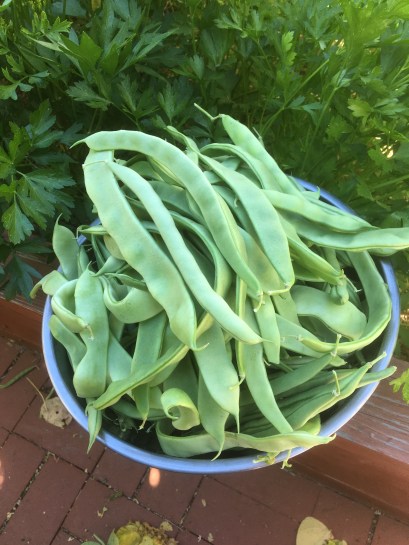
 While some of us are still gathering in the harvest, I don’t think it’s too late to post about my garden beans. I have been working on a bean story since last summer, which I thought would be the end of my pole bean career, or at the least, the end of growing my favorite Blue Lakes in two-foot high vegetable boxes; I found myself swaying and tottering as I would stand in the boxes in order to pick them, trying not to stand on the basil plants, and it was unnerving.
 More recently I harvested the Painted Lady perennial runner beans that I’ve told you about a few times. This year they produced so heavily from the five or six plants in the corners of my boxes, that I have enough to make a pot of soup, and I plan to create a recipe just for them.
 Sunday there was a big bowl of dead-ripe bananas in the parish hall, for the taking. Maybe they had been left from our church’s monthly hosting of the overflow from the local rescue mission. The program started up again last week for the fall and winter.
 On my outing to the library I was able to shed my wool sweater. I was picking up a collection of poems by Les Murray, whose name has popped up here and there for months now; I see that he died just this year. When I eventually checked, what do you know, I didn’t have to search farther than my neighborhood branch to find New Selected Poems. It was lunchtime when I got home, so I took a little bowl of
  Gladsome Lights