Tag Archives: Mars Hill Audio

Good shepherds and pink splashes.

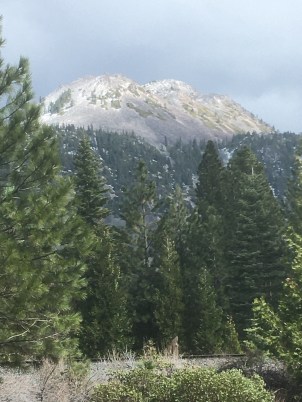
I didn’t know the name for it at the time, but one morning last week I experienced an acute and painful case of Cognitive Overload. It was the day I had been looking forward to for two months, when I would drive up to Pippin’s; the day before that I’d started packing my car with the books and food and even a 50-ft garden hose I was going to take to the family there in far-Northern California.

The morning of, I read an article about the coronavirus before I got dressed, and for the next two hours I debated whether I should change my plans. What if I were asymptomatically infected already? I could be the one responsible for bringing the pathogen to a relatively remote area. That was my main concern, and I worked myself into tears not being able to decide what to do.

Eventually all of my daughters weighed in, and the Professor, too. They didn’t just say, “Go ahead,” or “Come!” but they gave their reasons, which helped me choose among my own jangling thoughts and pick a course of action. I went.
I took along a dozen Mars Hill Audio Journal CD’s for the ride because I thought I might catch up on some of the interviews. One of the first ones I listened to was of Alan Jacobs talking about his book How to Think: A Survival Guide for a World at Odds. Toward the end of the interview when he and Ken Myers were talking about how thinking takes time and effort, and how “practical discernment must be cultivated and developed over time,” he mentioned a discussion he had with Jonathan Rauch about an aspect of thinking that Rauch told him he hadn’t emphasized enough; here are some snippets I transcribed:

“Jonathan Rauch reminded him of the inability of any one human being to bear the cognitive load of decision making that we are called upon to do every day… there is a necessity to offload some of this responsibility to a reliable and healthy community. Each of us individually can’t know what we need to know about every issue; that means we have to trust other people to help guide us and inform us. We just don’t have the cognitive energy to be able to do this…. that triage is impossible for any of us to do on our own. Don’t listen to the people who tell you to think for yourself. It’s not possible to think for yourself… we are always embedded both socially and temporally…  That can work for us, if we see to it that we are properly and helpfully embedded.”

There I was, driving up Highway 5, peacefully following through on a decision that I had made by offloading some of my cognitive load. 🙂 When I had a husband to confer with, that would have been enough community. Various articles on the Internet aren’t helpful because they aren’t humans in my community, but thank God I am embedded in a family.

In the days since then, I’ve been grateful for other communities that I am part of, for better or worse, and the way they have taken some of the load. We pray that by God’s providence, whether the decisions of our civic authorities are always the best or not, they will turn out for the best in the end. The governor of my state said that everyone in my age group should stay home, period. Soon afterward, the more immediate area I live in came under “shelter in place” orders.

I remember the many years during which I would defer to my husband about many, many decisions that I didn’t always think he made with the most wisdom —  even then I was often glad not to have to think through every last decision on my own; it was enough that I had the good judgment to defer. Maybe my tears last week were partly the cumulative outflow of five years of pent-up frustrations, the weight of a widow’s decision fatigue.

Before I learned of the governor’s edict, I had planned to attend church as soon as I returned, though everyone was debating about the prudence of that, even those of us who know that it’s not through the Holy Mysteries in the chalice that we could share pathogens. It’s all of us breathing parishioners and the surfaces we touch…. Here also I have been relieved of the exhausting effort to have perfect wisdom. My rector, with these words, has passed on to us the decision of our bishop to close the church for at least two weeks:

“Let us realize that we simply cannot know the burdens that our Bishops carry as pastors. We all heard the incredible words of the Savior on Sunday about the “Good Shepherd” in John 10 in honor of St Gregory Palamas, how a true bishop cares for the flock…. let’s remember that the bishop has the ‘mind of the Church’ and so we receive his words, actions and requests with joy, and yes, obedience.”

And Monk Seraphim of Mull Monastery, as he was embarking on a trip through five airports on his return to Scotland, wrote to us:

“This is not our time to ‘shine’ by showing empty courage and adolescent bravado. A Christian shines through humility and sacrifice of one’s self, sacrifice of one’s ‘courageous’ image in the world.

“We are human beings, made of flesh and bones. Flesh and bones can become Chalices of God’s presence in the world, but they can also become ill. As a Christian, my duty is to comfort and to love, to keep myself and my neighbour from harm.”

“Pray for the weak and those most exposed, and try to help any way you can. Forget about ‘playing it cool’ – no one rejoices in our pride except the evil one. Be human. Be a human being, surrounded by human beings, loving them, helping them, protecting them. In this simple, living, non ‘heroic’ attitude is the Cross that will lead to the Resurrection.”

I did try to protect my fellow humans as I traveled down the state. I used so many homemade alcohol wipes at gas stations and rest stops that my hands were in great need of TLC last night. Today I’m resting from the trip, and feeling comforted and joyful because of God’s care for me.

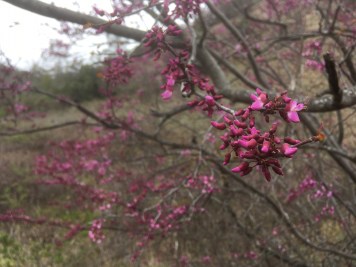
I want to tell you, too, more about my visit and fun with the grandkids, but for now I’ll just mention that I saw a thousand ? or so Western Redbud trees and bushes on my travels. The grass on the California hills is still mostly brown, changing to gray-green in some places, and these bright pink splashes all over the place are also speaking JOY!

Wing to wing, oar to oar.

Amy and Leon Kass edited an anthology of “readings on courting and marrying.” I have a copy of the book, which I bought after hearing them interviewed at length on the Mars Hill Audio Journal. In that series of discussions, “Wandering Toward the Altar,” they said that they found, from talking with many of their students — and they were both university professors — that modern young people aren’t prepared to fall in love in the way their ancestors found so easy. They hoped that providing certain thoughtfully-chosen literary readings for these impaired youth might compensate for the unfortunate changes iAmy and Leon small_0n society as a whole that had led to this sad situation, which did not facilitate good marriages, and worked against people getting married at all.
I have always wondered if their project bore fruit, if the Kasses ever heard of anyone being helped toward a normalization of love and marriage by the reading of their anthology. I’d like to go back and listen again, to think more about their assessment of the problem and its causes, but that is not the subject of my post.  I mention them because for the title of the anthology they used a phrase from Robert Frost, found in a poem he wrote on the occasion of his daughter’s wedding. That poem is the main thing I wanted to share here.

For the Kasses the poem captures “the togetherness of the married couple empowered to resist the flux of wind and water. Frost is not the first to use the language of speed or quickness to show how love may quicken the life of a couple into a vitality that far exceeds what each partner might attain alone. But Frost also plays on the archaic meaning of ‘speed,’ ‘prosperity or success in an undertaking,’ as well as on its Latin root, spes, meaning ‘hope,’ to point to the possibility of rest within motion, permanence within change, the eternal within the perishable.”

~ Amy A. Kass and Leon R. Kass, from Wing to Wing, Oar to Oar: Readings on Courting and Marriage

THE MASTER SPEED

No speed of wind or water rushing by
But you have speed far greater. You can climb
Back up a stream of radiance to the sky,
And back through history up the stream of time.
And you were given this swiftness, not for haste,
Nor chiefly that you may go where you will,
But in the rush of everything to waste,
That you may have the power of standing still —
Off any still or moving thing you say.
Two such as you with master speed
Cannot be parted nor be swept away
From one another once you are agreed
That life is only life forevermore
Together wing to wing and oar to oar.

~ Robert Frost

Trace Him by the branches.

Many months ago when it was my birthday, I received from my husband a book of the works of John Donne, poetry and prose and sermons. On a recent trip we had listened to a Mars Hill Audio Journal CD that included an interview about him, with the always fascinating Dana Gioia. I’ve been perusing the book since then and have found many good and juicy snippets, such as this:

Acknowledg God to be the Author of thy Being; find him so at the spring-head, and then thou shalt easily trace him, by the branches, to all that belongs to thy well-being. The Lord of Hosts, and the God of peace, the God of the mountaines, and the God of the valleyes, the God of noone, and of midnight, of all times, the God of East and West, of all places, the God of Princes, and of Subjects, of all persons, is all one and the same God; and that which we intend, when we say Iehovah, is all Hee.

–John Donne 1572-1631, Sermons V

From Earthsea to Alexander

To prepare for a recent road trip, I visited the public library looking for a book on CD. I ended up with a whole stack of boxes to take along in the car later that morning and was very pleased with a few of them.

My car was also loaded down with a Thanksgiving turkey, baking pans and tablecloths and some already cooked food, things to contribute to a feast at Pippin’s house. I was taking myself early to help prepare, and Mr. Glad would follow later.

Ray Bradbury

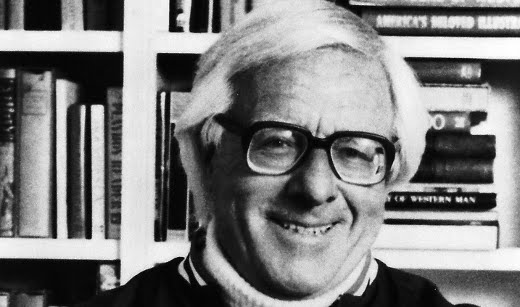
Two slim library cases held one disk each of an introduction to a book in the Big Read program of the National Endowment for the Arts. I was only vaguely familiar with the list and the program, not having any family member that I know of participating. But of the offerings I browsed I was interested in A Wizard of Earthsea by Ursula K. LeGuin because of recent recommendations from someone, I can’t remember who. And Fahrenheit 451 by Ray Bradbury was a book my reading group discussed a decade or so ago. The recordings were about 30 minutes each.

When I slid the Wizard introduction into the player and the narrator’s voice came into my car, it took me a few seconds to realize that it was Dana Gioia, my favorite book reviewer, poetry critic, and literature teacher. His voice was recognizable, but his intonation was all jazzed up, brighter and more dramatic, I suppose to keep the average somewhat reluctant American reader listening.

His commentary was in brief snatches, and mostly introductory to several other authors who talked about the book, including LeGuin herself, and to short passages read from the text. None of the comments or readings was longer than a minute or so, and most were much briefer than that, which made it easy for me to pay attention; I’m sure this feature was also designed for listeners of diverse ages who are used to having their short attention spans catered to.

The Big Read program is intended to reverse or at least slow the decline in the number of readers in our nation, and I haven’t heard if it is working. But this recording was a wonderful introduction to LeGuin. I enjoyed myself thoroughly while listening to what seemed like a sort of CliffsNotes in audio technicolor. There is music in the background that also adds to the drama.

CliffsNotes (Yes, they do squish the name together like that nowadays) seems to have some videos out, and digital flashcards, but for literature I think these NEA audio files would be much preferable, being a better bridge to visual and private reading activity than listening to a talking head, as I assume the CliffsNotes videos are.

The general plot and themes of the novel were discussed, and the particular skills of that writer. LeGuin talked about her background as a reader and writer and how she developed into the writer she is. Her childhood was spent in an intellectually rich household in Berkeley, where her father founded the anthropology department at the university and her mother wrote a book on Ishi.

There were many refugees from Europe in town then, such that “everyone had an accent.” It seems that her exposure to many cultures nourished her imagination to create new worlds and people groups. The Earthsea books do sound appealing to me now, and if I keep looking at that cover illustration I pasted here I’ll be bound to buy the first one soon.

But the first CD I took out of the box from my library stash was not from the NEA; it was a 2-disk collection of Popular Poetry, Popular Verse, Volume II from Naxos AudioBooks, a broad offering of everything from Shakespeare and Longfellow to Donne and Robert Herrick. It’s not surprising that I didn’t remember hearing most of the poems before  — but I’d like to listen again. The many love poems made me miss my husband whom I had only seen a couple of hours before.

Quite a bit of music was interspersed between groupings of poems. I skipped most of this because I was impatient to hear more poems, and I had no idea how long I might have to wait through the instrumental portions. The poems were read by Tony and Jasper Britton, and by Emma Fielding, all of whose voices and reading were not over-dramatic or annoying in any way. Here are some of the rich words that fell upon my ears:

Prayer (I) 
By George Herbert

Prayer the church’s banquet, angel’s age,
God’s breath in man returning to his birth,
The soul in paraphrase, heart in pilgrimage,
The Christian plummet sounding heav’n and earth
Engine against th’ Almighty, sinner’s tow’r,
Reversed thunder, Christ-side-piercing spear,
The six-days world transposing in an hour,
A kind of tune, which all things hear and fear;
Softness, and peace, and joy, and love, and bliss,
Exalted manna, gladness of the best,
Heaven in ordinary, man well drest,
The milky way, the bird of Paradise,
Church-bells beyond the stars heard, the soul’s blood,
The land of spices; something understood.

Out of the 5+ hours I was on the road on the way up the state, there were only 10 minutes or so that I didn’t need my windshield wipers. The rain was often drenching, so when I had to stop for refueling and resting I was back in the car lickety-split and pushing the Play button again.

I tried a speech by author David McCullough, his Jefferson Lecture in the Humanities from 2003, but he was very dry, in content and delivery. I have found from Mars Hill Audio Journals that some writers of the most fascinating books are not good at speaking even in interviews.

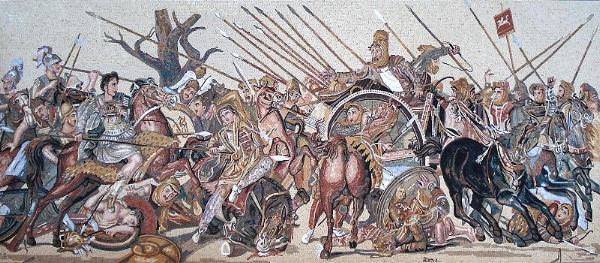
The last thing I was listening to when I arrived home again the day after Thanksgiving was Alexander the Great and His Time by Agnes Savill. It is nine CD’s and I only heard three of them, but it was the most detail I’ve ever read on Alexander, who is certainly a fascinating ancient man. The descriptions of battles sometimes were hard for me to follow, but overall it was an easy “read” and I’m trying to figure out when I might finish it.

I kept thinking about the great contrast between my comfortable life — just sitting in my heated car snacking on food that I had easily bought at the store — and that of the high-achieving, fighting, indomitable but gracious man who slogged all over his world under the harshest conditions and must have had comparatively little ease in his relatively short life.

Alexander in The Battle of Issus

And the other Big Read disk? That was my favorite of the two I tried, because I still remembered Fahrenheit 451. It was wonderful to hear the author tell how he and his brother would run, not walk, to the library, and spend hours there every week. He started writing stories as a young child, and never stopped.

Here’s a list of books in the Big Read program. I’m planning to listen to more of the introductory recordings, which are lots of fun even if I never get around to reading the actual book.