Tag Archives: wine

The essence of all His miracles.

By the Word of the Lord the heavens were made (Psalm 33:6) God made everything, man from dust, etc. So why would changing water to wine at Cana be difficult?

“…for our nature, weakened by sin, it is an unattainable miracle. Yet, isn’t the working of miracles the usual occupation of the Creator? When the servants filled the six large vessels with water, the Lord Christ said to them: Draw out now, and bear unto the governor of the feast (John 2:8). He did not even say, ‘Let the water become wine,’ he merely thought it. For God’s thoughts have the same power as His words.

“Why is it said that this was the ‘beginning of miracles,’ when it appears that, long before this miracle, the Lord worked other miracles? Because, brethren, the changing of water into wine is the fundamental miracle of Christ, and is the essence of all His miracles. Human nature was diluted with its own tears, and it was necessary to change it into wine. The divine spark in man was extinguished, and it was necessary to rekindle it. Infirmity is like water, health is like wine; the impurities of the evil spirits are like water, purity is like wine; death is like water, life is like wine; ignorance is like water, truth is like wine. Hence, whenever the Lord made the sick whole, the impure pure, the dead alive, and prodigals enlightened, He essentially turned water into wine.”

-St. Nikolai Velimirović 

Read the entire homily here (scroll down to the bottom): Prologue of Ohrid

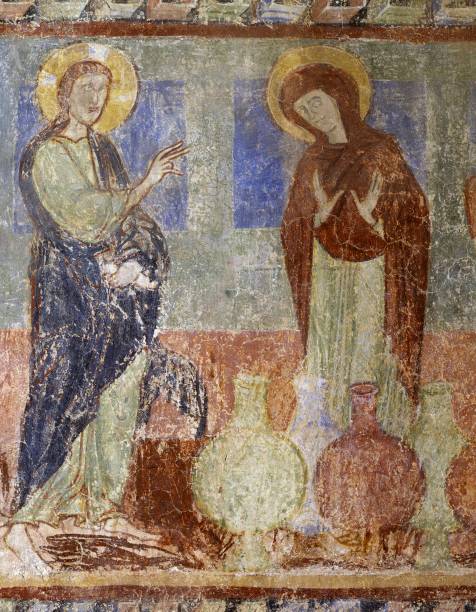
Miracle at Cana, Castel d’Appiano, Italy, 13th century.

Maggie and other marvels.

Granddaughter Maggie was here for a few days with her mother Pearl. Maggie continued her road trip back to college but Pearl is with me still. They fill my heart and my days by being their sweet selves. Since I typically do all my own work, I am constantly startled when I notice that someone is loading the dishwasher or shredding the lettuce for tacos or whatever task, before I even get to the point of realizing it needs doing.

We went wine tasting for a short while one day; at one vineyard we took a one-mile walk through the rows of vines, and it smelled really good in there: chardonnay, cabernet, syrah, viognier, dried grass, all lending their scents to the air, but mildly, because it was a coolish day.

Ice plant at the beach.

The next day, to the beach! Pearl and I walked down the shore quite a way, and when we came back we all just lay there in the sun. I lost consciousness for at least a few minutes, lying on my back with the sun heating my face through my hat. As we stared out past the edge of land to the vast Pacific, Maggie said that the ocean seems to our eyes as big as outer space. I thought how nice it would be if I could restart the regular beach outings that I made so often in 2020 and 2021.

My granddaughter spent quite a while collecting tiny pieces of sand. She was conceiving a plan to use them in the Instagram-alternative scrapbook she is starting; she will glue them on to the page and then paint over them with clear nail polish so they might continue to look wet.

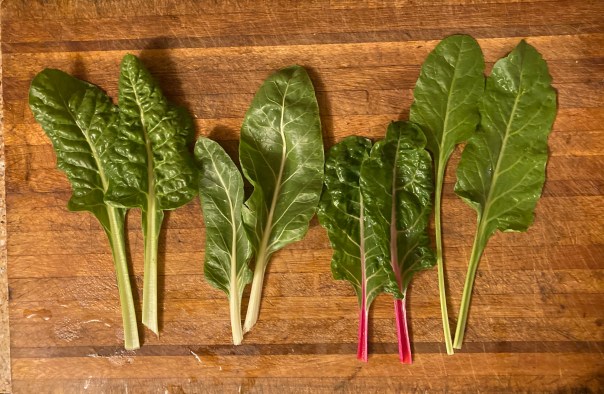
That evening we were able to sit on the patio for a dinner that I made, which included chard from my garden. I had washed it up a few days before, during which process I realized that I had four varieties of Swiss chard growing out there.

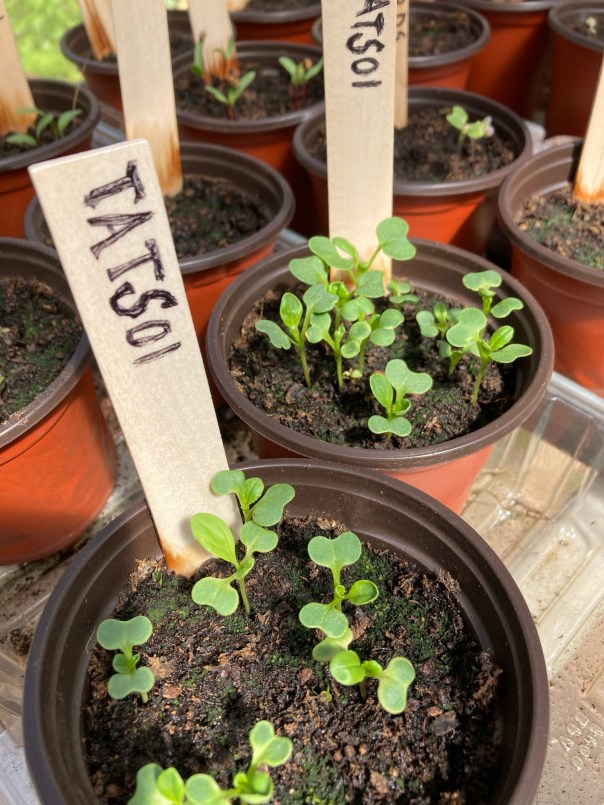
I pulled out some of that chard, to make room for new plants that I grew from seed in the greenhouse over the last month, and most of which I have set out in the planter boxes. Portuguese Kale, two varieties of collards, Italian Silver Rib Chard — and a new one from the mustard family: Tatsoi. Here it is when its true leaves were barely emerging.

Also Detroit Red Beets. If half of the seedlings I set out thrive, I should have plenty of greens to get me through the winter and into next spring.

Lastly, I show you the barrel planter, where the the snapdragons and Tropical Sage seem to take care of themselves and keep reseeding and blooming. The salvia that was pink for two or three years just last week sprouted stems of red-orange flowers. I saw them from the kitchen window, and had to run out right away to see what they could possibly be. When I give my attention to the garden, even just a little bit, it rewards me abundantly.

RFC drinks in graces.

“It was St. Thomas, I think, who pointed out a long time ago that if God wanted to get rid of the universe, He would not have to do anything; He would have to stop doing something. Wine is — the fruit of the vine stands in act, outside of nothing — because it is His very present pleasure to have it so. The creative act is contemporary, intimate, and immediate to each part, parcel and period of the world.

“…The bloom of yeast lies upon the grapeskins year after year because He likes it; C6H12O6=2C2H5OH+CO2 is a dependable process because, every September, He says, That was nice; do it again.

“Let us pause and drink to that.”

Robert Farrar Capon knows well that there are people who will not drink to anything, because they are teetotalers. He’s writing this chapter on “Water in Excelsis,” in the book The Supper of the Lamb, about a God Who delights in his creation, and he is not sympathetic to what he sees as a mistaken attitude: “Only the ungrateful or the purblind can fail to see that sugar in the grape and yeast on the skins is a divine idea, not a human one.”

And as for what he calls The Woman’s Christian Temperance Union’s version of The Lord’s Supper, only about 100 years old and lacking completely what Holy Scripture and church tradition prescribe as the proper drink, he does not shrink back from engaging its adherents in argument, particularly the ones who think that the Greek word for wine in the Gospels meant something other than wine.

“The commentator cited, as I recall, grape juice for one meaning, and raisin paste for another. He inclined, ultimately, toward the latter.

“I suppose such people are blessed with reverent minds which prevent them from drawing irreverent conclusions. I myself, however, could never resist the temptation to read raisin paste for wine in the story of the Miracle of Cana.

“‘When the ruler of the feast had tasted the water that was made raisin paste…he said unto the bridegroom, “Every man at the beginning doth set forth good raisin paste, and when men have well drunk [eaten? — the text is no doubt corrupt], then that which is worse: but thou hast kept the good raisin paste until now.”‘ Does it not whet your appetite for the critical opera omnia of such an author, where he will freely have at the length and breadth of Scripture? Can you not see his promised land flowing with peanut butter and jelly; his apocalypse, in which the great whore Babylon is given the cup of the ginger ale of the fierceness of the wrath of God?”

Capon has a different argument with secularists, and it is over their classifying wine as an alcoholic beverage, when the author knows it as a class in itself, far removed from the hard liquor that is often used to ill effect, and which he tells us is “for strong souls after great dinners.” Capon:

“With wine at hand, the good man concerns himself, not with getting drunk, but with drinking in all the natural delectabilities of wine: taste, color, bouquet; its manifold graces; the way it complements food and enhances conversation; and its sovereign power to turn evenings into occasions, to lift eating beyond nourishment to conviviality, and to bring the race, for a few hours at least, to that happy state where men are wise and women beautiful, and even one’s children begin to look promising.”

I admit I am inspired by RFC’s eager receptivity to God’s gifts. What little appreciation I’ve had for wine as a beverage has been slow in developing, and I let my husband be in charge of that aspect of our dining. But wine in the chalice of Holy Communion has always seemed to me the obvious choice in obedience to Christ’s teaching.

This chapter contains more and expanded theologizing about the secular and the sacred, using wine and the making of wine as a demonstration of the goodness and delight of God. I am still musing on much of this and hope to ramble on here again, sharing with you the infectious loves of Robert Farrar Capon.

Other posts in this series are:
RFC is the man we need.
RFC begins with the meat.
RFC considers blood and sacrifice.
RFC makes one of nature’s marvels.
RFC drinks in graces.

RFC begins with the meat.

The book into which I am dipping to give you several tastes is Supper of the Lamb by Robert Farrar Capon. The title refers on one level to the four meals he will show us how to make, for eight people at each sitting, out of one leg of lamb. As I said in my first post, it’s not these recipes that most interested me about the book, but they form the loose structure around which the author gathers all his personality and wisdom.

He tells us that “Lamb for Eight Persons Four Times is not simply a recipe. It is a way of life.” A way that has us deliberately creating leftovers so that for most suppers we can use little bits of our meat and make it go a long way. I have a lot of experience with this kind of cooking, and I appreciate Capon’s undergirding philosophy, that there are times to feast, and they are not every day.

He has a term for the everyday: ferial eating. I found in the dictionary that it’s a church term for a weekday on which no feast is celebrated. Capon’s first principle for this ordinary type of eating is: Never serve anybody a whole anything. Because “appetite rises to meet food supply,” and we just don’t need to eat large amounts every day.

Every dish in the ferial cuisine, however, provides a double or treble delight: Not only is the body nourished and the palate pleased, the mind is intrigued by the triumph of ingenuity over scarcity — by the making of slight materials into a considerable matter.

I have to admit that in the days when our feasts were rare, it was easier for us all to stay slim and healthy. For several years now, cooking for only two people, I’ve probably been serving way too many whole items, and I also have so many leftovers from which to create more yummy meals that I hardly have enough cold storage for them. The type of lifestyle where the cook shops nearly every day and prepares what is fresh in the shops in that season seems to be what I should aim for.

Still, I very much appreciate that Capon introduces us early on to his idea of the creative and resourceful cook, who knows how to season and sauce her humble food so that it’s often more interesting and delectable than the festal roast.

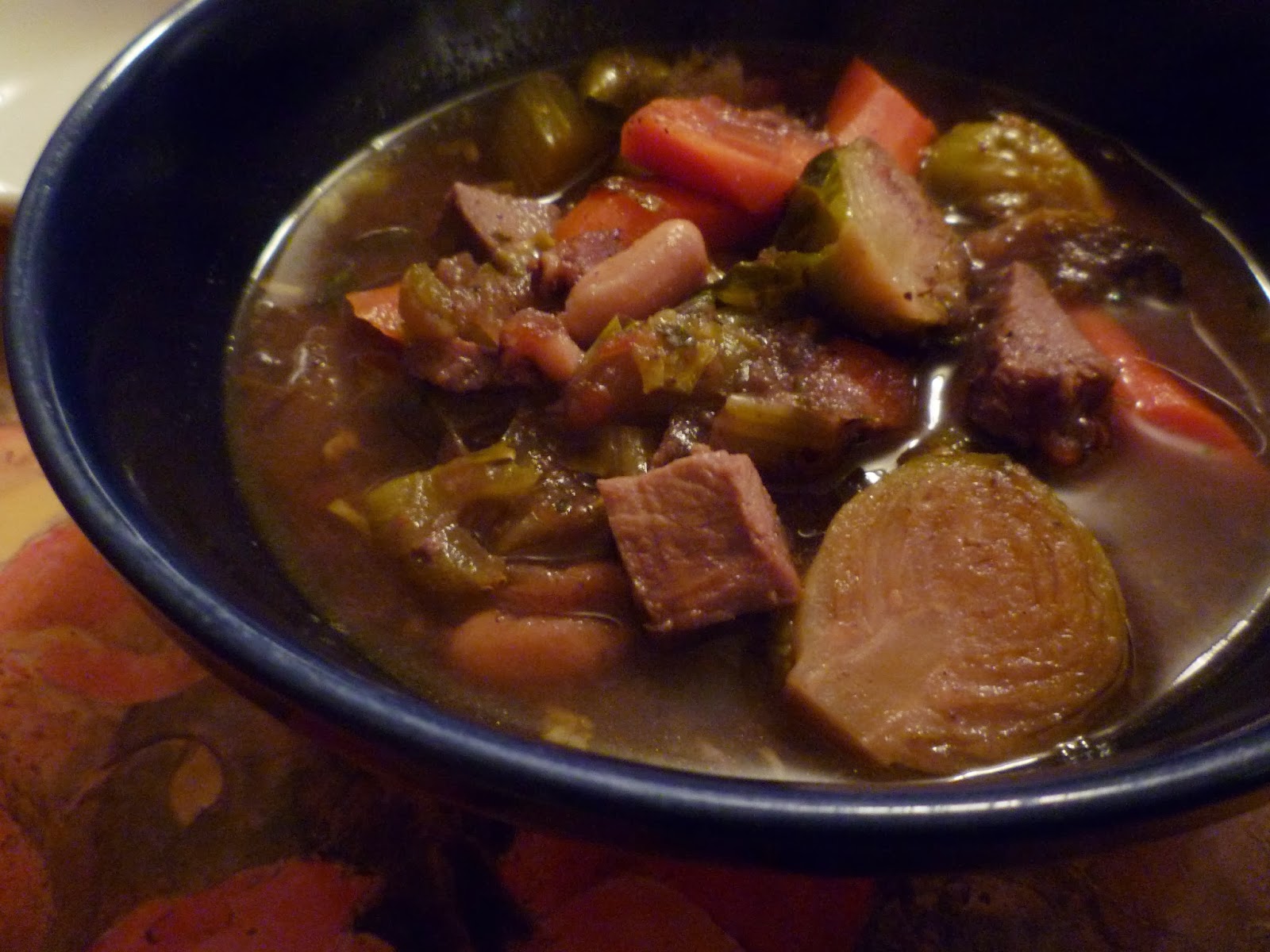
Just tonight my man and I enjoyed for the second time (as I’d ended up with a big potful) a soup that was made according to these methods, using the leftover lamb roast from Christmas as well as the leftover liquid it was cooked in, which included a good amount of wine, with rosemary and garlic. Not too much meat was left, but I added some lentils and vegetables, and Mr. Glad could not help feeling it quite unfair that he should be eating such amazing food when so many people never get stuff like this. (The stew in the photo is from a previous and different ferial meal.)

Our author chef carves his (large) leg of lamb into parts to make first a stew, and then three other ferial meals, including a casserole with spinach, a stir-fry, and a soup. His recipe for stew includes an injunction against flouring the meat before browning it:

…it is the point at which nine tenths of the stews in the world go wrong. The trouble is that few cooks realize how long it takes to brown meat thoroughly….People who flour their meat and brown it in butter are entitled to their religion….I think it fair to note, however, that such people have never gotten around to browning meat. All they have done is darkened some butter and scorched a little flour. The meat inside remains untouched. Accordingly, their stews never know the savor of the true burnt offering; in their haste they settle for the dubious pleasure of eating charred wheat.

Unfortunately my mother taught me to flour my meat and it was only a few years ago that I learned better. RFC also gives advice about liquid:

A word about the liquid itself. Unless you are physically prevented from doing so, always use stock or wine, especially in a ferial stew. We are working here with an admitted minimum of meat. To add water to it is to strain it, to demand of it a cruel exertion, to have it arrive at the table worn out with overwork. This is no festal dish with enough meat in it to make meals for a week. This is a poor dish, whose meat is to be pitied and spared. Accordingly, any liquid that goes into it should be of a charitable and kindly sort…which knows how much more blessed it is to give than to receive. Stock then; not water. And, no matter what else, wine. A gallon of good California red in the kitchen closet will do more for your cooking than all the books in the world.

Capon has more opinions about wine, and the philosophy of meat-eating, “little invisible spooks” (Can you guess what those might be??), and the “higher session” of The Supper of the Lamb, and that is why I need a few more posts to share my gleanings. Coming soon!

The first post in this series is RFC is the man you need.