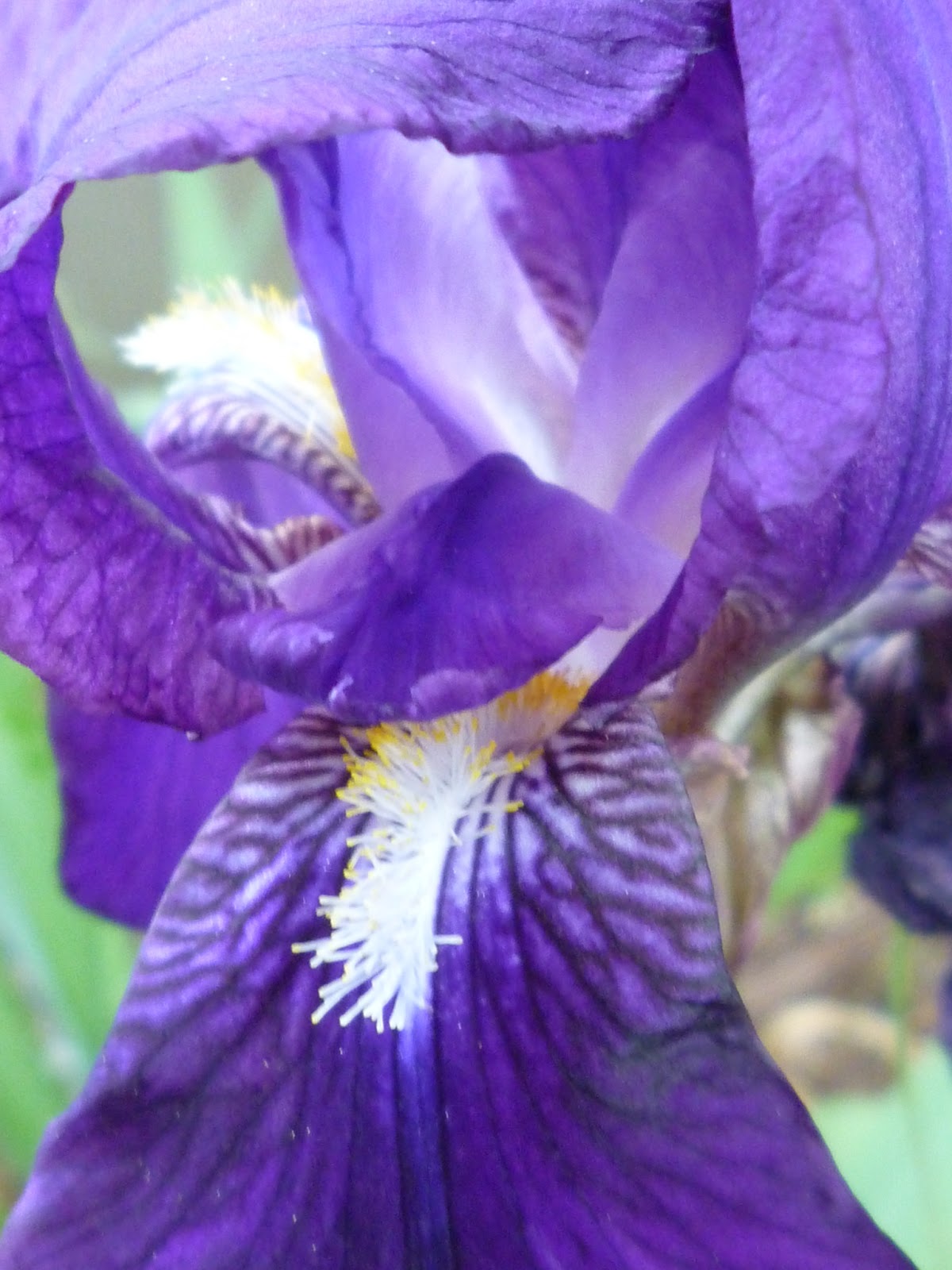
Tomorrow may be a gardening day, of the sort on which one digs and pulls and gets dirt under the fingernails, says the lazy procrastinator. But today one Iceland poppy bloom is out, and irises, and the manzanita is a wall of pink-on-green. So it was a photographic sort of gardening day…
I only took close-ups, because broader views show too dramatically what lackadaisical workers have oversight here. God is favoring us anyway! Isn’t He just like that.
Last week was filled with historical talk and images – even theology. First there was the cemetery where we had buried my father-in-law in January. We checked to make sure that the gravestone had been cut and set properly, and then we visited the graves of Mr. Glad’s great-grandparents and grandparents on both sides of the family, and several aunts and uncles.
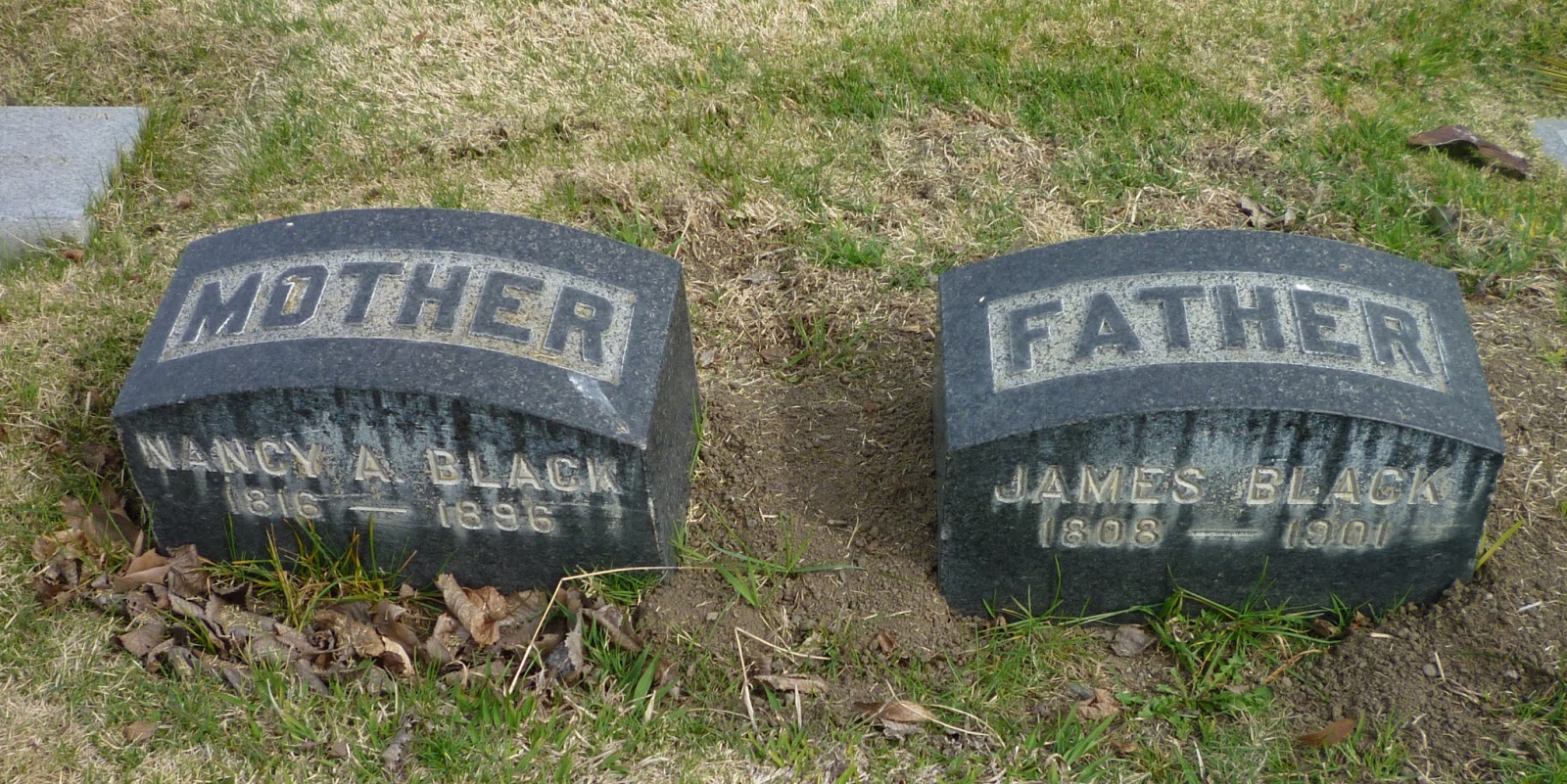
Above is a photo of one set of the great-grandparents whose graves we visited, people born in Cornwall in the mid-19th century. They came to California to work in the New Almaden quicksilver (mercury) mines near San Jose, where the wife Eliza gave birth to my husband’s grandmother and several other children.
When I look into the bright eyes of that face I just wish I could hug her. Why do you focus on her and not him, my husband asked? Because she’s a woman and I’m a woman, I answered. I feel strangely connected to her across the years and in spite of the fact that I never knew her nor are we even related by blood. I wonder if she is praying for her descendants, including my children and grandchildren? I can’t see and touch her right now, but (Matthew 22) “God is not the God of the dead, but of the living.” She is a real living person, not an idea.
New Almaden Englishtown
The novel Angle of Repose by Wallace Stegner tells the story of a miner and his wife who lived for a time there in Englishtown, with tales involving Mexican miners in the camp’s “Spanishtown.” The Cornish people attended the Methodist Episcopal Church on the hill and Eliza is remembered as loving to read her Bible.
When her children were grown and the parents had moved into San Jose, she still prepared a large spread every Sunday afternoon and expected all the children and their families to come for Sunday dinner. She was especially fond of her grandsons.
Many of the women those days kept chickens and cows but Eliza was the only one in her family who had the gumption to kill a chicken. When any of the others wanted chicken for dinner they would take their bird to Eliza to chop off its head.
A mother and father not ours
On the first night of our trip to these forbears’ old stomping grounds we had dinner with a dear cousin who also is linked and indebted to them. We came bearing gifts of photographs of some relations who have passed on, and we talked about our family — and of course, our own childhoods.
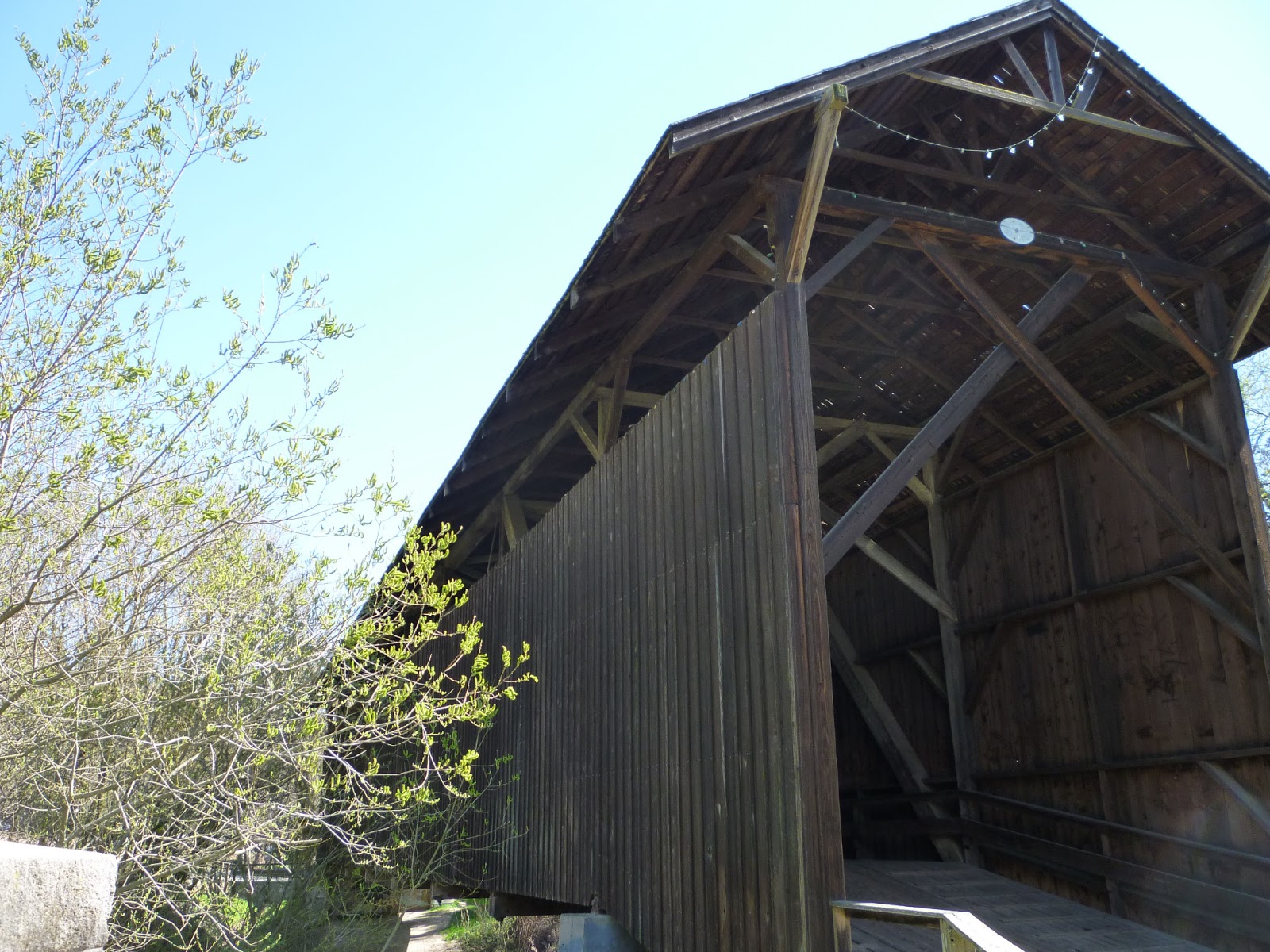
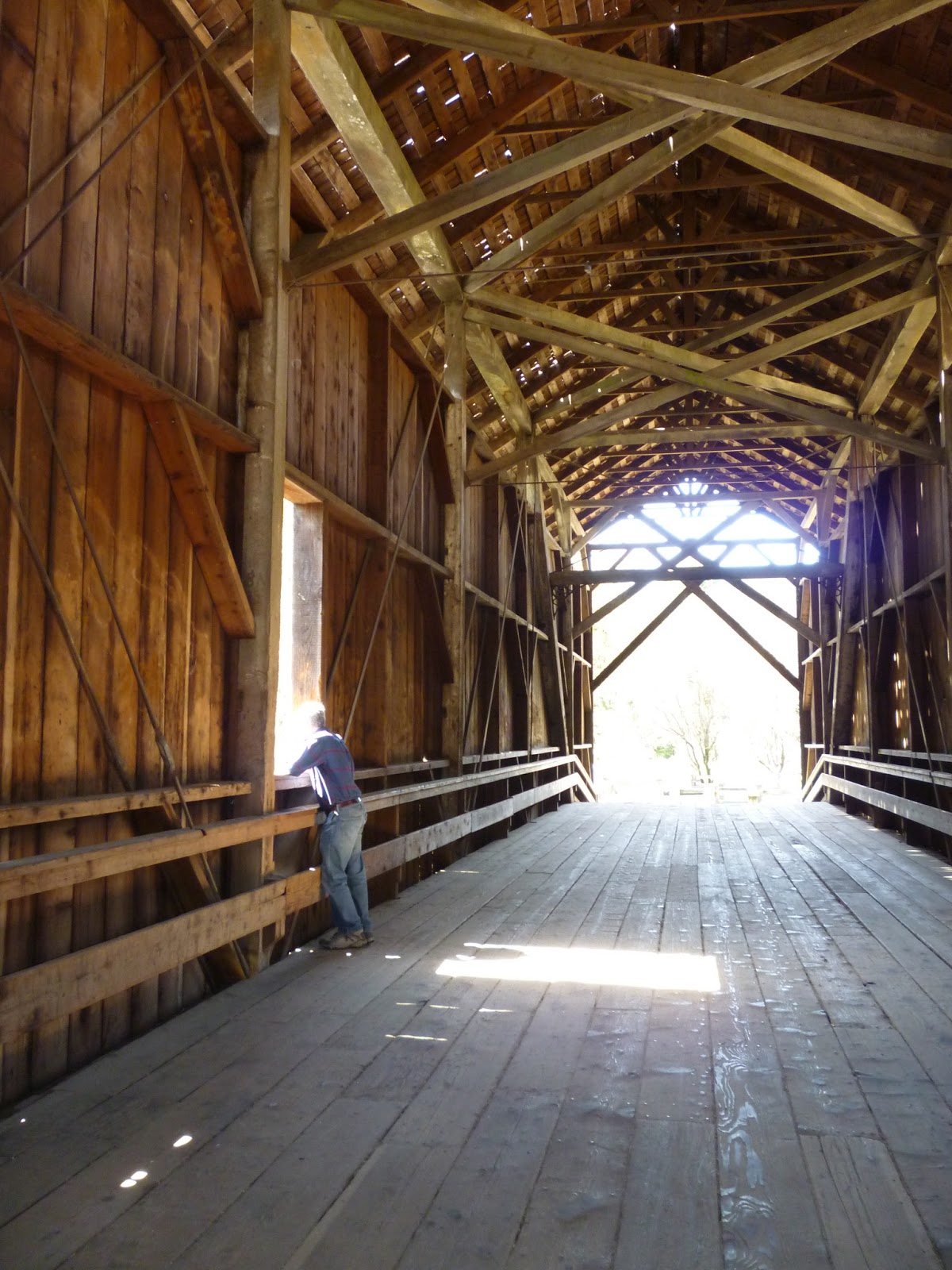
Next day the Mister and I ate a picnic next to the Felton Covered Bridge in the Santa Cruz mountains. It’s the tallest known covered bridge in the country, built of redwood in 1892 to span the San Lorenzo River. No one knows why the builders made it so high.
I started thinking about bridges as a metaphor, as in “Bridges to the Past”….What would be the thing to be bridged, the gulf over which we can meet on a bridge? If we are on this side of the bridge, what or who is on the other side?
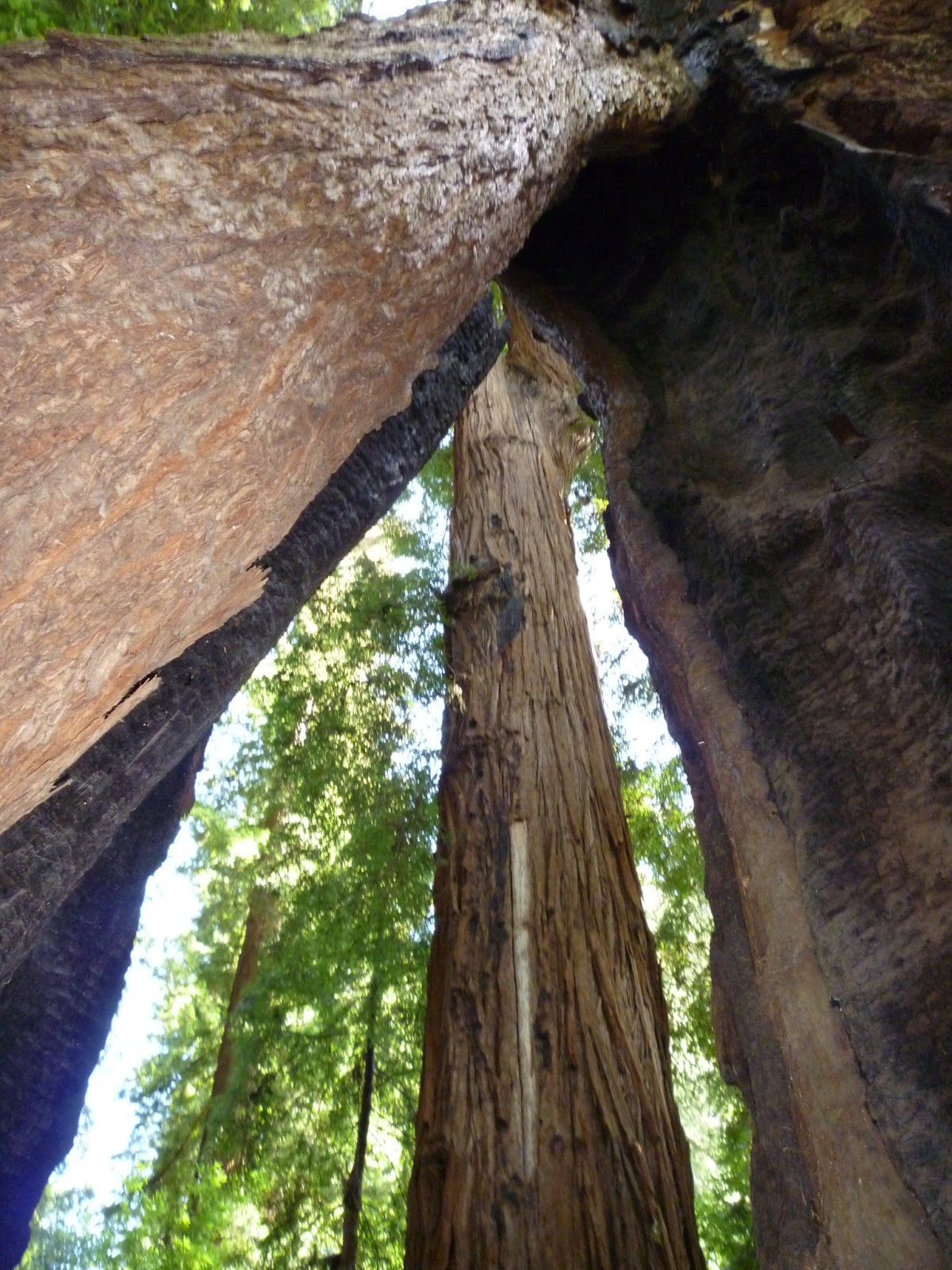
Burned redwoods at Henry Cowell.
The bridge lies near the Mt. Hermon Christian conference center, where my husband from his earliest days enjoyed the creeks and paths, and sleeping on the porch of his grandmother’s cabin.
He and I spent our brief honeymoon in that cabin, and strolled dreamily around the redwoods of Henry Cowell park nearby. It was drizzling that day in March 41 years ago and we had the park to ourselves, no doubt breathing the same woodsy, cold and moist air that we drank up on this trip.
Our marriage has endured to the present; it’s a continuing thing, so the bridge idea doesn’t exactly fit in that case, but it was pressed back into my mind a few more times anyway.
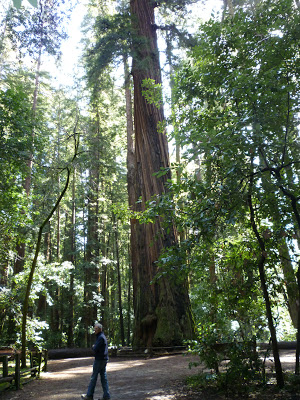
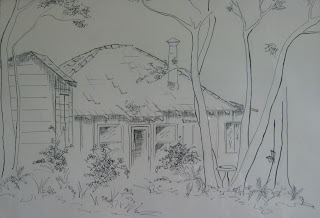
Mr. Glad and “The Giant” redwood tree.Our cabin in the old days.
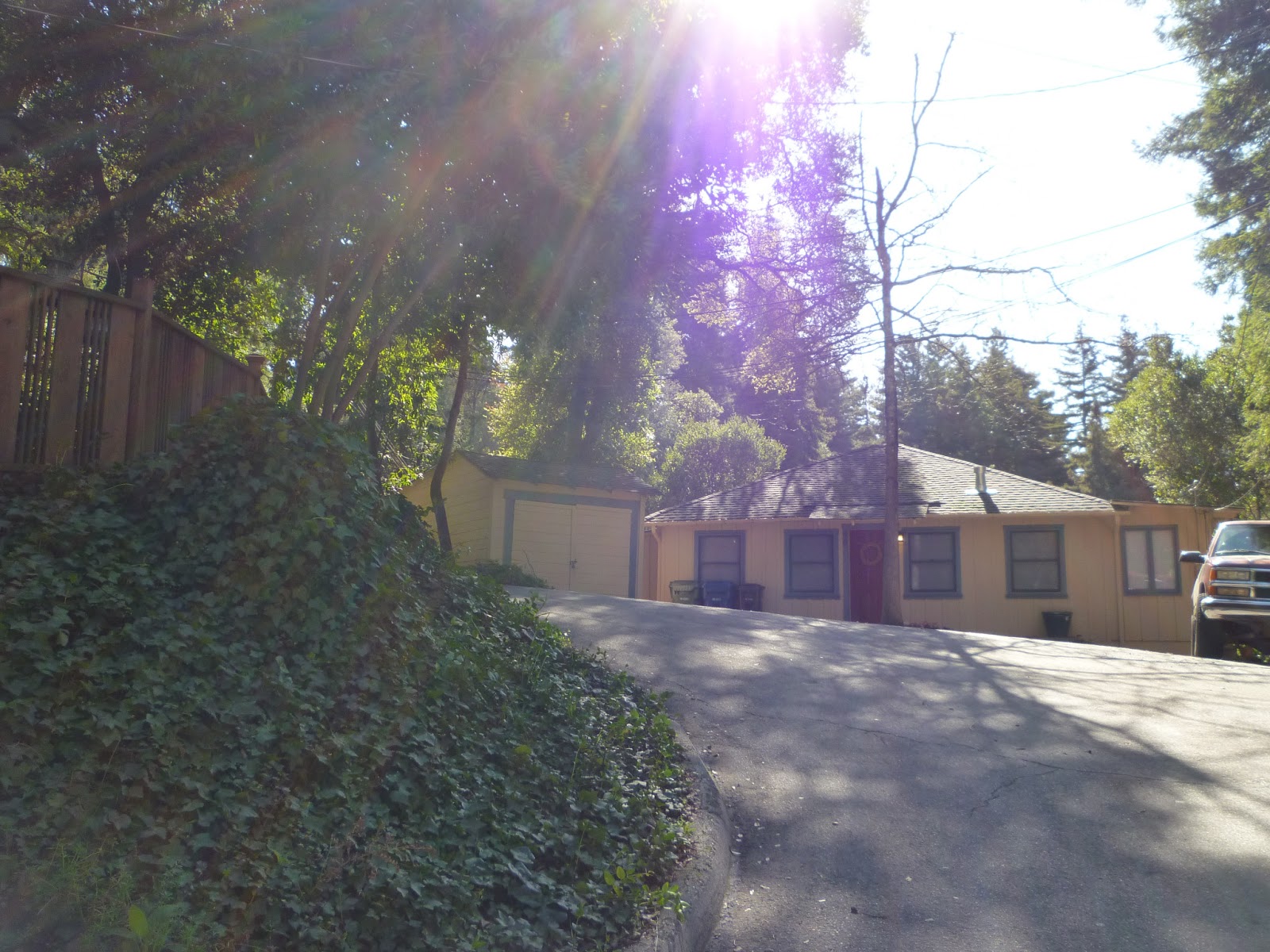
From the covered bridge and the park we drove up a hill to the neighborhood of the old cabin where we’d spent so many happy times with several generations sleeping in nooks and corners and beds tucked into closets. Another cousin and his wife live around the corner in a cabin that’s been in his family for many decades, too.
We two couples walked up and down all over the place remembering the fun and family going back 60 years. Mr. Glad and I hadn’t visited “his” cabin since 23 years ago it passed from our family. We saw that trees and ferns and birdbath have been taken away, to make space for parking trucks.
That’s too bad. Well, let’s keep going downhill toward the kind of landmarks that don’t change so easily.
Two Cousins on New Swinging Bridge
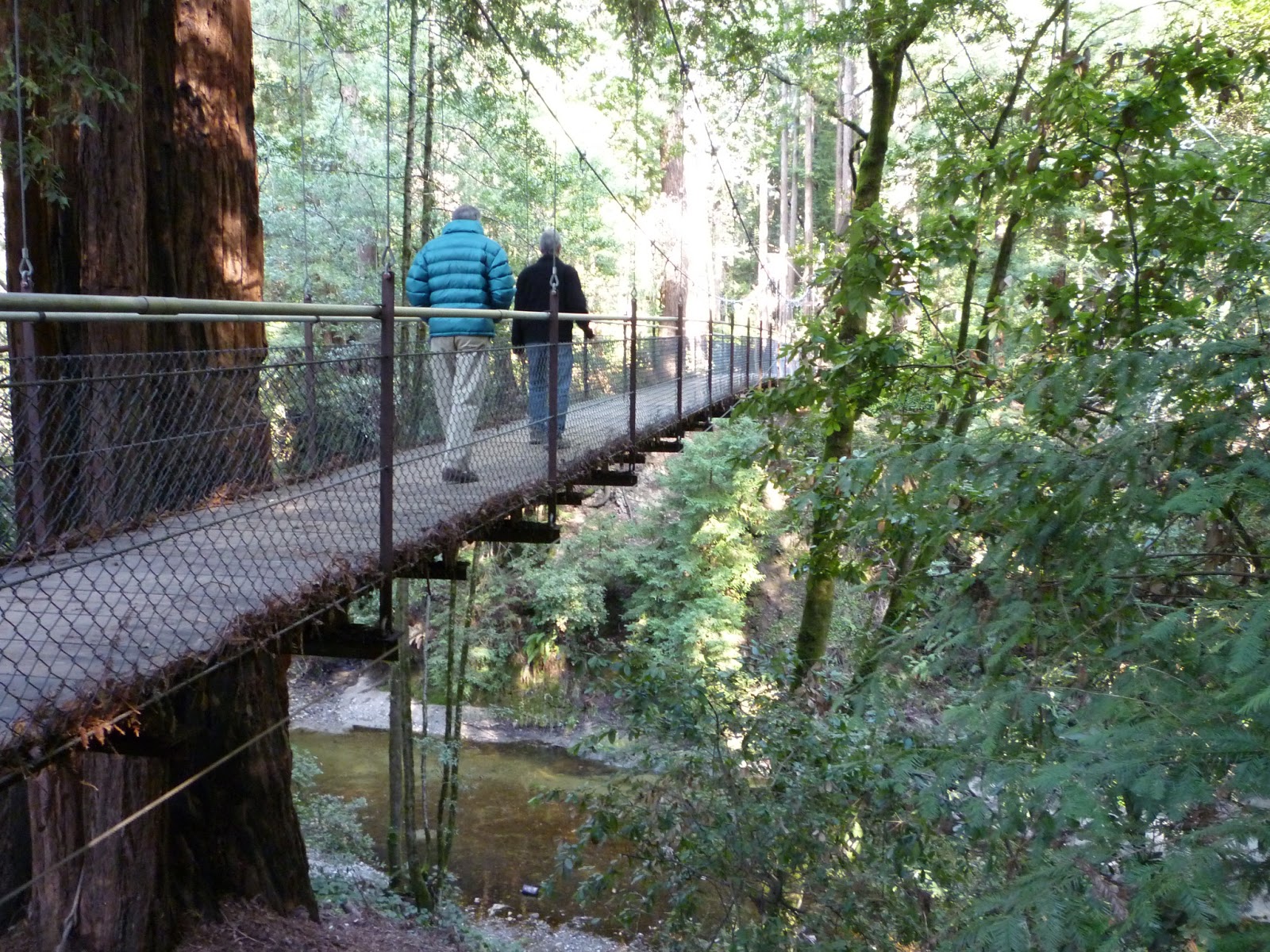
The natural beauty endures – some of these redwood trees have been around for hundreds or thousands of years. The unnamed tall tree above looked to us as large as The Giant we had seen a few hours before in the state park. We were gazing up at it from the Swinging Bridge, a suspension bridge that still sways when you walk on it, though it has been improved from what it was in Mr. Glad’s younger years.
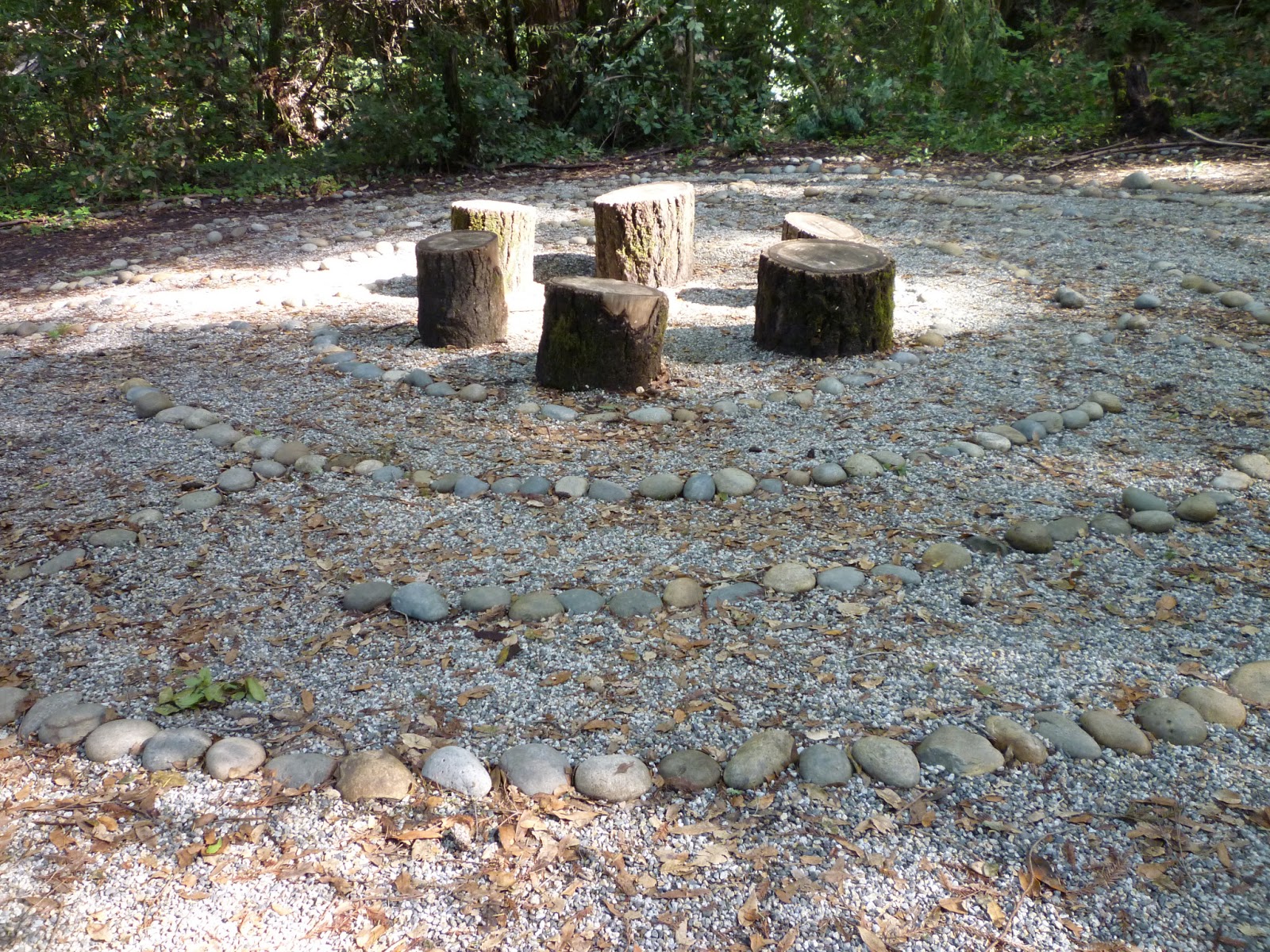
Cabin Cousin named this scene “Stumphenge.” People are always making structures and arrangements that are symbolic of the most meaningful things in their lives. Some of those structures, as I was to reminded the next morning, are intangible.
It’s obvious I love a good bridge — some of them are majestic works of art, and even the less dramatic show the human need and desire to go from here to there on the earth, to interact with the natural landscape in practical and artistic, and sometimes playful, ways.
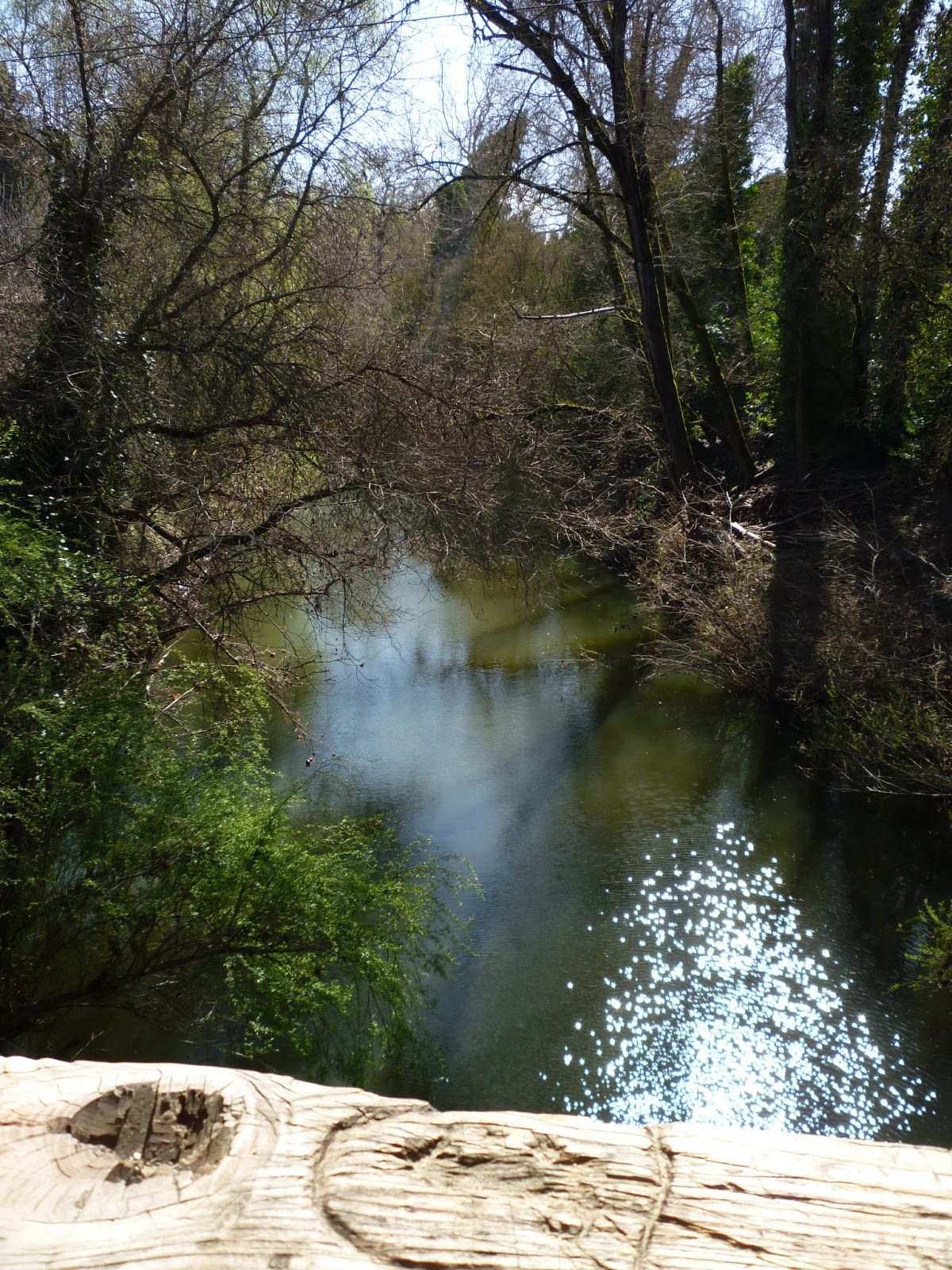
I am often more comfortable on a sturdy bridge than I am down in the canyon or river below. Two creeks come together on the Mt. Hermon property. This confluence of Bean and Zayante Creeks is just about The Most Favorite Spot from the Mr. Glad history files. I have waded in the creek here too, with our children, and have sat picnicking on lovely warm summer days. We looked down from the swinging bridge and sighed our contented memories.
At this time of year we didn’t want to be down there in the chilly water. From the bridge, wearing our cozy jackets, we could get a wide view. You feel that you know where you are, and there are no sand or pebbles scratching between your toes.
The next day as we drove home Mr. Glad and I listened to a discussion about a famous theologian who is now acknowledged to be a BRIDGE between East and West, Pentecostals and non-Pentecostals, and other disparate groupings. If I tell you his name many of you will feel an immediate urge to click away to another blog, because the Unitarians have done that to you.
When they controlled the educational system of this nation Unitarians worked hard to steer young people away from the Puritans, and one small tactic in this program was to inoculate them against a man who preached a lot on themes like humility, beauty, and the sweetness of the Love of God. They did this by making sure that schoolchildren had in their curriculum one of his worst and least representative sermons.
In our usual intellectually focused condition we search for these rational bridges to connect us to our roots and to each other. I’m afraid the Unitarians were trying to keep us on a platform without even a good view of the life-giving stream. If I stay in my mind and only think about God, it is like looking down from a bridge at the river, when what I am dying of thirst to do is splash and drink and be refreshed by the Living Water.
But in the presence of God, living our theology by prayer and love to one another, we can be part of a continuum, like the earthly water that over the millennia constantly comes back to us as rain into the streams and snow on the mountains, evaporates from the oceans to make clouds that float inland again….
If Jonathan Edwards and I both live in Christ, who said, “Except you eat the flesh of the Son of man, and drink his blood, you have no life in you,” then we are in the same vital current. And that’s the important thing.
One of my dearest and most influential friends, Anne, gave me a copy of Edwards’s Religious Affections more than twenty years ago, and I spent a while this morning becoming re-acquainted. But I don’t think it’s likely that I will read much more of the works of this brilliant thinker who is for some people a bridge. I already spend too much time standing on and studying bridges and platforms.
Instead I want to live in communion with God and with His people — including my distant-but-near relations from the 19th century, the 18th century — even the Holy Apostles, and all of that Cloud of Witnesses who (I Corinthians) “did all drink the same spiritual drink: for they drank of that spiritual Rock that followed them: and that Rock was Christ.”
We got rain in the night, and we’re getting a little today. A little rain, and that’s not the pouring I refer to.
It’s our Glad life that has become a little too much for us of late — or so it would seem, but we haven’t left anyone in the lurch yet. We had a blessed and happy visit from Mr. and Mrs. Bread, alongside difficult and sad situations to bear up under with other friends. That kind of thing always feels like too much.
The dirty dishes have been left to sit on the counter (in the lurch?) longer than I like, and it hasn’t done any permanent damage that I can see.
The Johnny Jump-Ups appear to have been nibbled by snails, but as I breeze by I don’t want to take time to hunt under rocks for them.
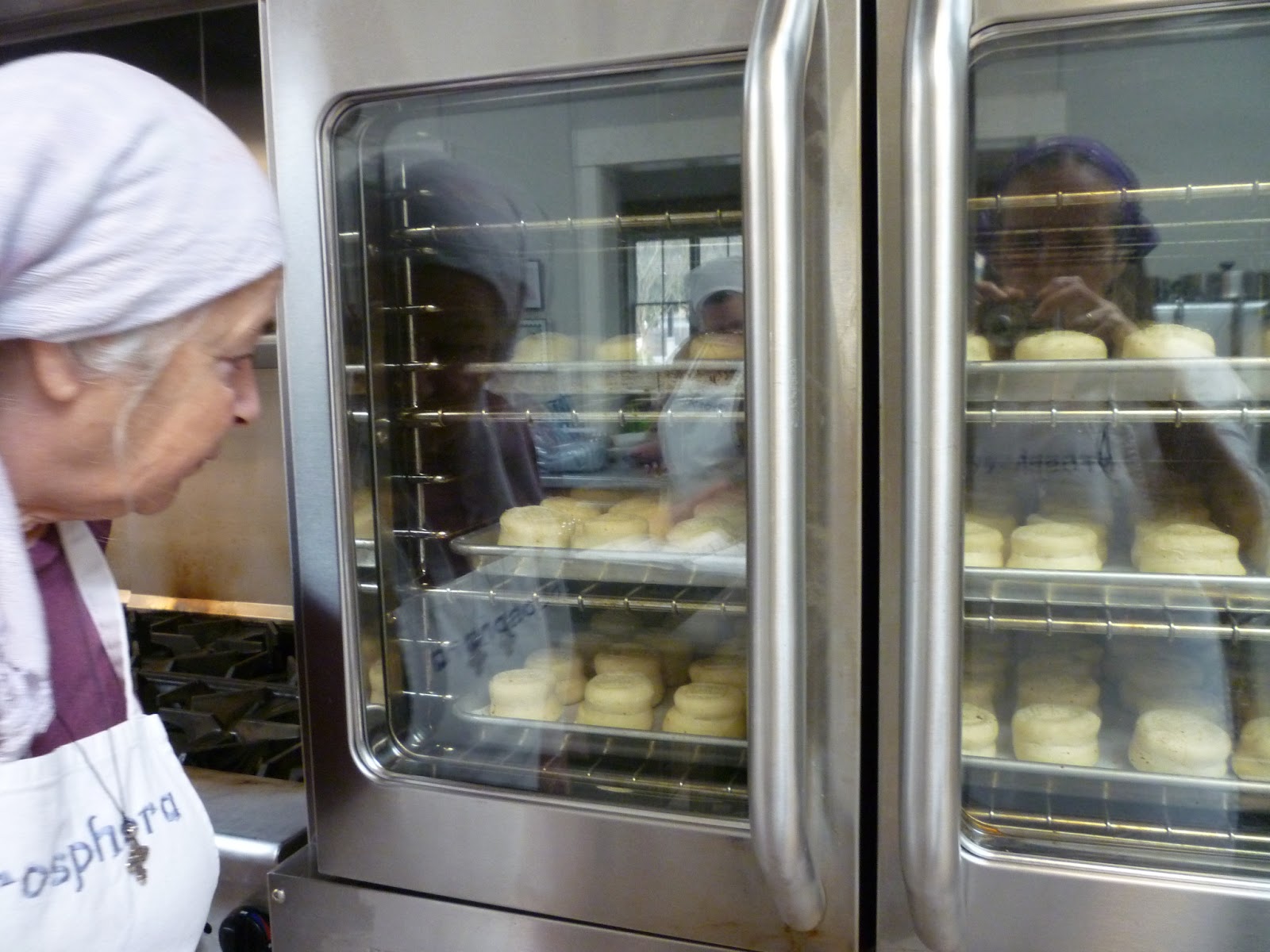
My kitchen didn’t produce any bread — the disorder was beyond the point where I could be creative that way — so thank God I was on the communion bread team at church yesterday and could happily knead and cut and stamp and let the senses of both my body and soul fill with warm and satisfying smells. Even the dough smelled good and soothing. In the photo I am the reflection in the oven door.
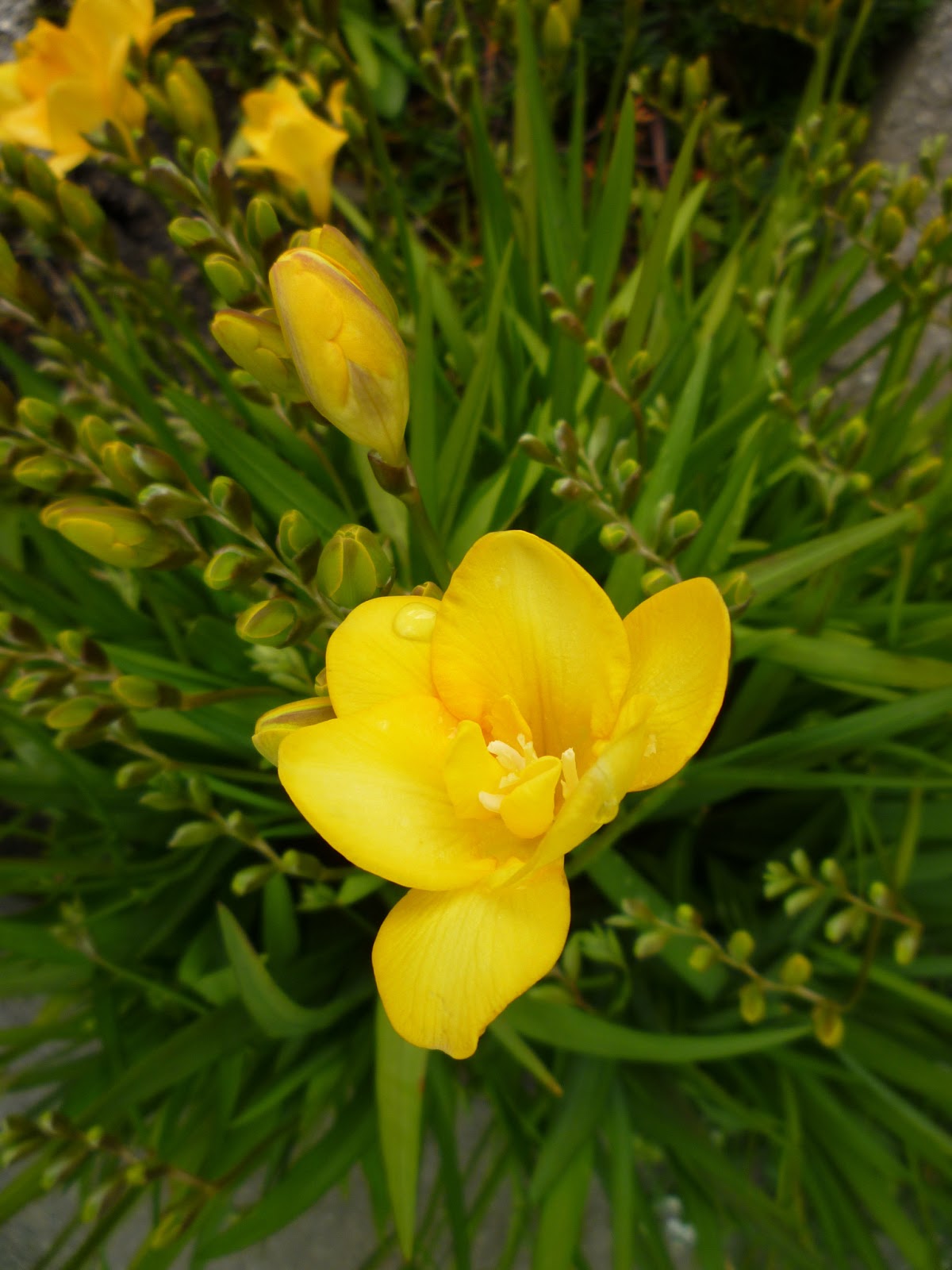
And even before the rain, the freesias started blooming, almost too brightly for my camera’s limited settings. We did go for a quick walk around the neighborhood, and I saw that even the most rundown ugly house with junk scattered about has been blessed with a gorgeous tree all in blossom, sitting as though dropped from heaven in the middle of the front yard.
I’ve been too busy for thoughtful writing sessions, but the pictures I snapped reassure me that the seasons are going around normally still. You know Who we have to thank for that.
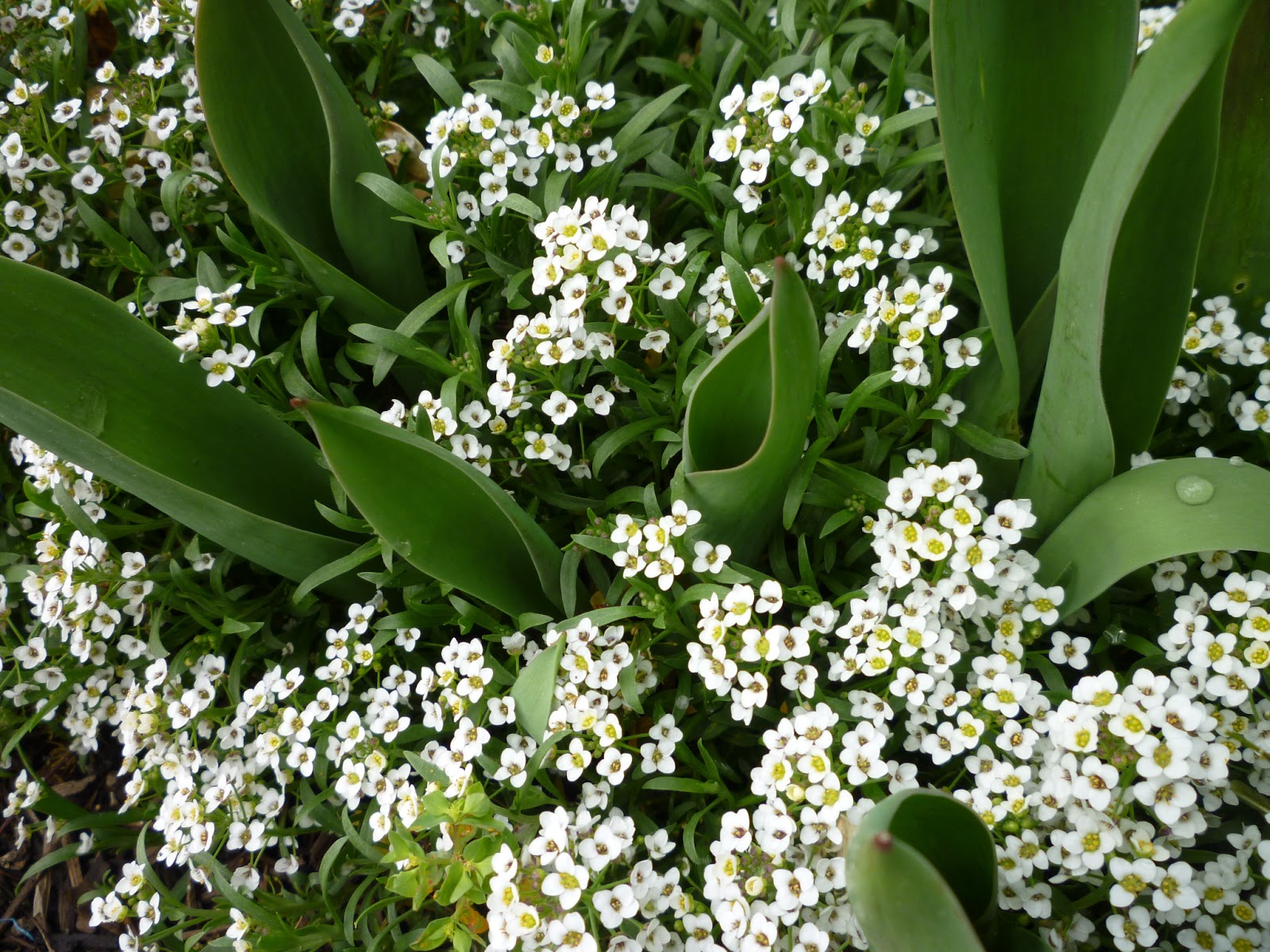
The tulips are still making progress up through the now-softening soil, and Sweet Alyssum is growing the perfect blanket to spread below the blooms that are on the way.
Mr. Glad and I are going on a tiny trip this week, leaving behind the clutter of our forever unfinished business, and there will be time and mind-space enough for me to collect some more images and thoughts of Spring and Life. I think I just wanted to send this note that I am here and God is still at work.
Thank you to Leah for posting this excellent word from St. Nikolai.
excerpt: Prayer V
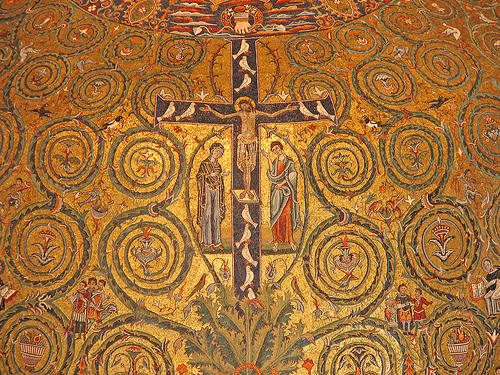
How stupid the servants of the tree of knowledge are! They do not measure their strength in You, but in their numbers. They do not adopt a law of justice in Your name, but by their numbers. Whichever way the majority of them choose is the way of truth and justice. The tree of knowledge has become the tree of crime, stupidity, and icy darkness.
Truly, the knowledgeable men of this world know everything except that they are servants of Satan. When the last day dawns, Satan will rejoice in the number of people in his harvest. All the meager ears of grain! But in his stupidity, even Satan counts on quantity rather than quality. One of Your ears of grain will be worth more than the entire harvest of Satan. For You, O Conqueror of death, rely on the fullness of the bread of life, and not on numbers.
In vain I tell the godless: “Head for the Tree of Life and you will know more than you could possibly wish to know. From the tree of knowledge Satan fashions a ladder for you to descend into the nether world.”








 Gladsome Lights