Monthly Archives: May 2014

The Law the Lawyers Know About

The Law the Lawyers Know About

The law the lawyers know about
Is property and land;
But why the leaves are on the trees,
And why the wind disturbs the seas,
Why honey is the food of bees,
Why horses have such tender knees,
Why winters come and rivers freeze,
Why Faith is more than what one sees,
And Hope survives the worst disease,
And Charity is more than these,
They do not understand.

–H.D.C. Pepler

bee on o. blossom crp

Seven feet and sweet.

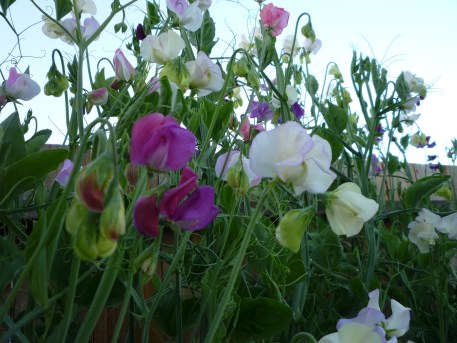
P1100126Every two or three days I try to cut all of the flowers off my sweet pea vines. I have to stretch way up now to reach the top ones, because they are seven feet tall and still growing.

Since the weather turned hot the stems have shortened and I need something like this half-pint milk jar to put them in. I found it earlier this month in a Carson City antique store when Mrs. C. and I were browsing there. Now I wish I’d bought several more.

P1100108

I’ve been scrounging around my cupboards and in the garage to find jars, so that I can take bouquets to friends – so far everyone has been welcoming of their bouquets, but I know that the heavy scent is too much for some people.

??????????
Chartwell sweet peas

My vines are very messy compared to the sweet pea rows Pippin and I saw at Chartwell in Kent, Winston Churchill’s country house. I was quite impressed to see such a wealth of sweet peas so meticulously trained and cared for. The English are famously devoted gardeners, aren’t they?

Last night Mr. Glad and I watched the movie “The Last September,” about the English in Cork, Ireland about 1920, and in one scene I was excited to see a bouquet of sweet peas on a table. They looked very like mine!

P1100123 crp

To get a good crop of sweet peas in our area, we have to start them in October. If we wait until Spring, the weather heats up too soon and cuts your pea season short. This is the case with edible peas, too. That white board is what I use to stand on when I’m picking so that I don’t sink in the mud.sweet pea seeds 2013
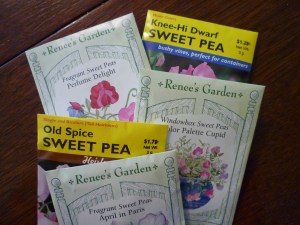
These are the packets I bought last Fall, but I didn’t get around to using the two dwarf packets, which I had planned to put into pots.

And for the sake of history, a picture of what I think was the last time I made the effort, already seven years ago, in almost the same place, against the previous fence.

roses & sweet peas 07
2007 with roses

Sweet Peas make me so happy, I’m already planning
for more seeds and a longer patch of vines for next year.

P1100129crp

Roses on My Path – single red bush x 2 +1

red focal pt P1090839

Red isn’t high on my list of favorite rose colors, but I have to admire the way a single red rosebush makes these front yards very classy.

It didn’t matter that the flowers on the corner above were not in good shape, as I discovered when I came in for a closer shot. As seen from the street driving by, or walking on the other side, the total effect was quite cheering.

red focal pt P1090856crp

Before I got around to putting up my reds, Kate sent me a picture taken of the front door of her building. It’s cheating, I know, to include it, because this rose is growing in Washington DC, 3,000 miles and a cultural distance from my neighborhood, but it’s such a perfect example of how a red rose can be shown to its best advantage while beautifying its whole environment. If I encountered more settings like this red would move up closer to the top of my list.

Kate's roses May 2014

Pagans and Inverted Victorians

This short piece from the Touchstone journal compares the perspectives and lifestyles of pagans, early Christians, and feminists regarding home and virtue — and disconnections that rob us of our full humanity.

Home Remodeling by Peter Leithart

In the ancient world, household and city were confined to opposite corners. The inner space of the household was for women and children, while the open space of the city was for men. Men gained honor and displayed their prowess in the forum and on the battlefield, places where only men could go. Alasdair MacIntyre has pointed out that virtue for Homer was military prowess, and the etymological connection between the Latin “vir” (man) and “virtus” (virtue) is no accident.

English theologian John Milbank has argued that the social revolution of Christianity broke down this distinction. The church is both household and city, Christians both brothers and fellow citizens. As the gospel penetrated late antique culture, the household itself, along with its work and its child-rearing, was increasingly valorized, producing what to ancient paganism would have been the oxymoron of the “virtuous woman.”

The deep paganism of modern feminism is evident in the effort to reverse that Christian achievement. Many feminists feel that they cannot flourish in the cramped space of the home. To be fully human, they must abandon the hearth and crib to take part in the agon [contest] of the male world outside.

In developing this neo-pagan social cartography, however, feminists are often reacting against a reversal that had taken place earlier within Christian culture. Nineteenth-century sentimental domesticity joined with fascination for the classics to re-divide household and city. From this angle, feminists look less like radicals than like inverted Victorians.

In any case, the Christian response to the whole mess seems clear: to reaffirm the original Christian revolution by insisting that, for both men and women, the household is a school of virtue.

Touchstone, Sept-Oct 2010