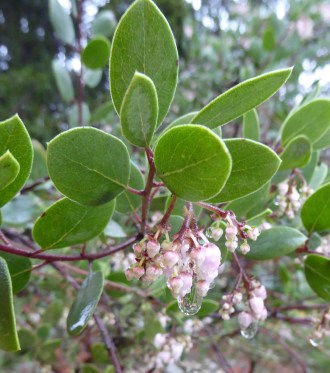
“As for the fascination of rain for the water drinker, it is a fact the neglect of which I simply cannot comprehend. The enthusiastic water drinker must regard a rainstorm as a sort of universal banquet and debauch of his own favourite beverage.
“Think of the imaginative intoxication of the wine drinker if the crimson clouds sent down claret or the golden clouds hock. Paint upon primitive darkness some such scenes of apocalypse, towering and gorgeous skyscapes in which champagne falls like fire from heaven or the dark skies grow purple and tawny with the terrible colours of port.
“All this must the wild abstainer feel, as he rolls in the long soaking grass, kicks his ecstatic heels to heaven, and listens to the roaring rain. It is he, the water drinker, who ought to be the true bacchanal of the forests; for all the forests are drinking water. Moreover, the forests are apparently enjoying it: the trees rave and reel to and fro like drunken giants; they clash boughs as revellers clash cups; they roar undying thirst and howl the health of the world.”
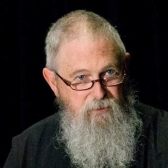
In his essay, “Does Goodness Require the Possibility of Evil?”, Father Stephen Freeman compares the Christian understanding of evil, choices, and being with that of Carl Jung, Star Trek, and Depth Psychology. He says that our modern way of elevating choice above all else leads us in the wrong direction:
“Before looking at the nature of good and evil, it is worth seeing the problem involved when choice is inserted into the conversation. What happens in that approach is that we are no longer speaking about the nature of good and evil, indeed, both are relativized in importance. Everything quickly revolves back to the nature of choosing, and makes the actions of our will the center of the good. Thus, there is no true good or evil, only goodchoices and evil choices. It is a narcissistic ontology – a system of thought in which we ourselves become the center of attention.”
The writer reminds us that only God is good, and that the goodness that we know in our lives is a gift from Him. So where is evil in all this? And how to sort out the choices that we have made? How many of our ignorant or hasty choices turned out for “evil”? Fr. Stephen recalls the example of Joseph in the Old Testament, who was the victim of his brothers’ evil choices.
“We cannot see the consequences of our actions (beyond the most immediate circumstances) nor can we control the myriad of other events that will interact with any choice we might make. We are simply insufficient of ourselves to create good through our choices.”
Getting from our narcissism and confused choices to receiving goodness has to do with movement:
“The course of our existence is a movement. That movement is impelled towards the good through our desire for God (sometimes manifest simply as a longing for beauty, truth, and goodness).”
To get a fuller picture than I can convey in these little clips, read the whole article: here.
I just noticed that Father Stephen discussed “Goodness, Truth and Beauty” with Jonathan Pageau a couple of years ago: here.
I already own a book on architecture that is just at my level, The Architecture of Happiness. But reading on the internet tempts me to explore many different realms… further than I actually want to go, when it comes right down to it.
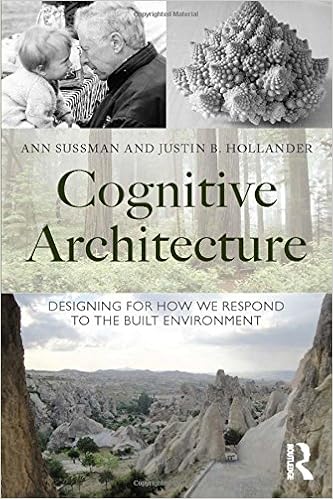
Something I read back in the fall made me want to see the book Cognitive Architecture, by Sussman and Hollander, and my library’s “Link” feature helped me to get it, from southern California. It came in just before Christmas, and just before I needed clear away piles of books and papers, seeds and seed catalogs, to make space for a few Christmas decorations.
So I barely glanced at it, and quickly put it…. somewhere. I was pretty sure it was upstairs, probably in my bedroom, and when I found it last week — after looking everywhere several times over the last month — it was in an odd little stack of things, with a prayer book and a Christmas card and other unrelated stuff. One reason I hadn’t seen it earlier was that it was so much smaller than I remembered it.
Paris
So small, my immediate thought was, maybe I could actually get through this book! Even though I’ve sort of moved on and my current goal is to whittle down the number of half-finished books I already have, without adding more.
So I only browsed, and it is pretty interesting, about designing buildings for the way people live and behave, the sort of “animal” that humans are. One example is, that people in cities are known to like to walk or congregate on the edges of open spaces or streets, near buildings or walls, so that the buildings “have their backs.” But not so much if the building is turned in on itself and doesn’t seem open to the people, with low windows, for example, for easy window shopping. An example of a space not conducive to this protected and friendly feeling is the Boston City Hall Plaza, which is known as an unloved space and is up for renovation:
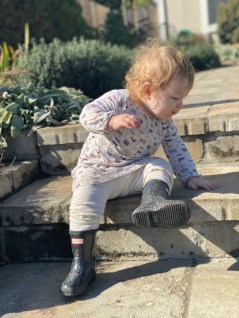
It is known that people prefer not to climb stairs if they can avoid it. I know that doesn’t apply to toddlers. This is my neighbor Grace who was enjoying going up and down my front steps this afternoon.
Many of the other points of human-centered design were not new to me. I had learned a lot from De Botton’s book, and I also have this one that Pippin gave me, in which I can browse actual buildings and their architects, which is more appropriate for me, who am not considering a career in design.
I wonder if I have other books I could write about without having read them, and in that way get some satisfaction from my failures…? I’ve enjoyed making use of this one to organize the Architecture compartment of my mind, and I found a pleasing poem in it as well:
THINGS
What happened is, we grew lonely living among the things, so we gave the clock a face, the chair a back, the table four stout legs which will never suffer fatigue.
We fitted our shoes with tongues as smooth as our own and hung tongues inside bells so we could listen to their emotional language, and because we loved graceful profiles the pitcher received a lip, the bottle a long, slender neck.
Even what was beyond us was recast in our image; we gave the country a heart, the storm an eye, the cave a mouth so we could pass into safety.

 “Before looking at the nature of good and evil, it is worth seeing the problem involved when choice is inserted into the conversation. What happens in that approach is that we are no longer speaking about the nature of good and evil, indeed, both are relativized in importance. Everything quickly revolves back to the nature of choosing, and makes the actions of our will the center of the good. Thus, there is no true good or evil, only good
 this? And how to sort out the choices that we have made? How many of our ignorant or hasty choices turned out for “evil”? Fr. Stephen recalls the example of Joseph in the Old Testament, who was the victim of his brothers’ evil choices.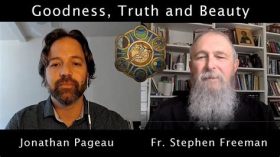
 Something I read back in the fall made me want to see the book Cognitive Architecture, by Sussman and Hollander, and my library’s “Link” feature helped me to get it, from southern California. It came in just before Christmas, and just before I needed clear away piles of books and papers, seeds and seed catalogs, to make space for a few Christmas decorations.
:max_bytes(150000):strip_icc():format(webp)/__opt__aboutcom__coeus__resources__content_migration__treehugger__images__2018__04__P1020567-4b1e40c7b5a84be685ca9034185d7476.jpg)

 design.
 Gladsome Lights