Tag Archives: fasting

RFC for Butter Week

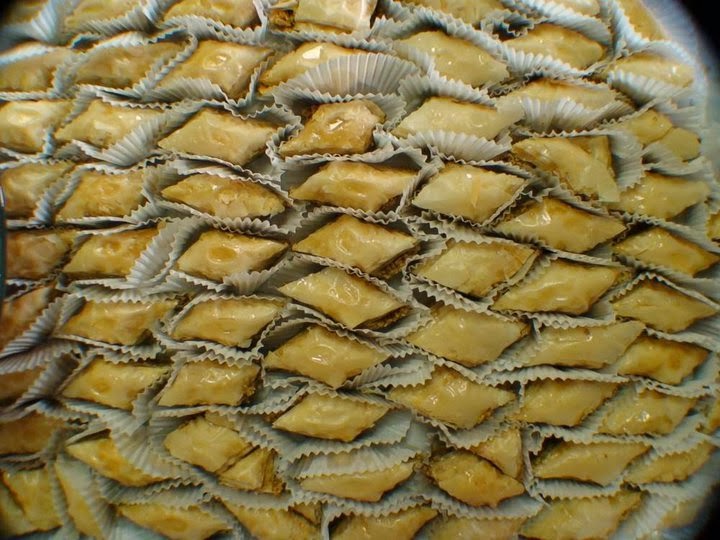
Please don’t try Roger Farrar Capon’s baklava recipe. He describes it as “french-fried,” and yes, it does involved a large quantity of oil ! which I declare a horrid perversion of the spirit of baklava. This is the first thing I have found in The Supper of the Lamb that has so disappointed and surprised me. I guess no one can be perfect.

But the perfect baklava recipe does exist, simplicity itself for method; and for taste, the divine melding of flavors, of which that of Butter is central. It is the one used in my parish to make umpteen sheet pans of baklava every year for festivals and celebratory meals, and I will eventually make it at home and share the recipe here.
As I write, we Orthodox Christians are in the midst of what is sometimes called Butter Week, the week before Lent properly begins, and the last in which we eat dairy products (but start fasting from meat). The perfect time to tell about Capon’s attitude toward butter, which I am very sympathetic to. For example, at the end of a section on sauces he shares:

One last secret. There is almost no sauce that will not be improved by having a lump of butter whisked into it the moment before it is served. In addition to what it does for the flavor, it provides the sauce itself with a patina, a sheen which delights the eye even before the palate begins to judge. It is an embellishment not lightly to be forgone. Dishes should come to the table vested, robed. Don Giovanni is marvelous any way you can get to hear it. But given a choice between seeing it performed full dress, or on a bare stage with the cast in T shirts and sneakers, no rational man would hesitate. A great sauce deserves a great finish. Whatever you do, therefore, don’t omit the final grace — the loving pat of butter.

Those last words remind me of my grandmother, who showed this kind of love in her kitchen and to those she fed, including herself, and she lived healthily and on her own past the age of 100. I can still picture her standing by the stove and tucking fat pats of butter into the slits she had made in our baked potatoes just before taking them to the dining table.

Capon considers bread and butter, or cheese, to be basic ferial (everyday) food for those meals that one is keeping simple and light, for the sake of being able to enjoy real feasting less often. I’ll write more on that principle later. In contrast to bread and butter, we have what RFC calls “the epitome of baking”: pastry. He gives a lot of time and great detail to teaching us how to make puff pastry and Danish pastry, which must be made with butter, of course. I personally am not interested in this kind of cooking at my stage of life, and am happy to eat my butter in a hundred places other than pastry. Capon explains further that butter

…is not, in any except the merely technical sense of the word, grease. It melts at the temperature of the tongue, and consequently goes down as easily as cream. (You do not like to drink cream? I am sorry. Let us agree to disagree and get on with it.) Any man who cannot tell the difference between butter and margarine has callouses on the inside of his mouth…Butter is a substance in its own right, justified by its own delectability, not by its contributory services. It is a unique and solid sauce; it is apt to more dishes than anything in the world, and it is, like all the greatest sauces, worthy of being eaten plain.

Besides pastry, there are many recipes at the back of the book that feature this blessed food, including what look to be very nice cakes and cookies. I think all of us have plenty of that kind of recipe already, and if you don’t, just look on my own Recipes and Vague Instructions page on this blog. I wholeheartedly agree with RFC that butter “glorifies almost everything it touches.”
Other posts in this series are:
RFC is the man we need.
RFC begins with the meat.
RFC considers blood and sacrifice.
RFC makes one of nature’s marvels.

RFC is the man we need.

A few months ago I read The Supper of the Lamb: A Culinary Reflection by Robert Farrar Capon, and knew before I’d got halfway through the book that I’d want to write a series of posts on this man’s extraordinary perspective. But then the Nativity Fast arrived, and it was unhelpful during that period to focus on food and its delights, so I put off the project until the new year, which for me seems to have begun in earnest only this month.

At the speed I customarily do anything, if I begin now I still won’t finish before Lent has arrived, but I am going to start anyway. For me the recipes and food itself are not the main thing in Capon’s book, and there are parts that tie in very well with transcendent aspects of food and even with fasting.

His thoughts and words are often so charming in themselves, I might not always have anything to add to the quotes I share. But the topics collaborate with a couple of other books that I find very provocative as well, so I’m hoping to bring more writers into the discussion. In the blog titles I will refer to Robert Farrar Capon as RFC so as to make room there for words other than his long name.

Though the first chapter starts right off with a list of ingredients, for me the recipes included in the book serve primarily to illustrate and demonstrate the author’s philosophy and love. He was an Episcopal priest who wrote other books as well, but this is the first one I have met, and I just now discovered that he died last fall, probably when I was just coming to the end of The Supper of the Lamb.

Also in the first chapter, he answers critics who might disregard him because he is not a professional cook, by pointing out that amateur is not exactly the same thing as non-professional. And he clarifies here at the outset that he is, more than anything, a Lover:

The world may or may not need another cookbook, but it needs all the lovers — amateurs — it can get. It is a gorgeous old place, full of clownish graces and beautiful drolleries, and it has enough textures, tastes, and smells to keep us intrigued for more time than we have. Unfortunately, however, our response to its loveliness is not always delight: It is, far more often than it should be, boredom. And that is not only odd, it is tragic; for boredom is not neutral — It is the fertilizing principle of unloveliness.

In such a situation, the amateur — the lover, the man who thinks heedlessness a sin and boredom a heresy — is just the man you need.

And I ask you, with an intro like that, how can I not love him?


More posts on this book:

RFC begins with the meat. 

RFC considers blood and sacrifice. 

RFC makes one of nature’s marvels.

RFC drinks in graces.


Beautiful Beans

A few weeks ago I bought a bag of Bean Soup Mix, with plans to use it during Lent. If those beans looked cheerful through the plastic bag, they more than brightened up the kitchen when released. I couldn’t stop taking their picture.
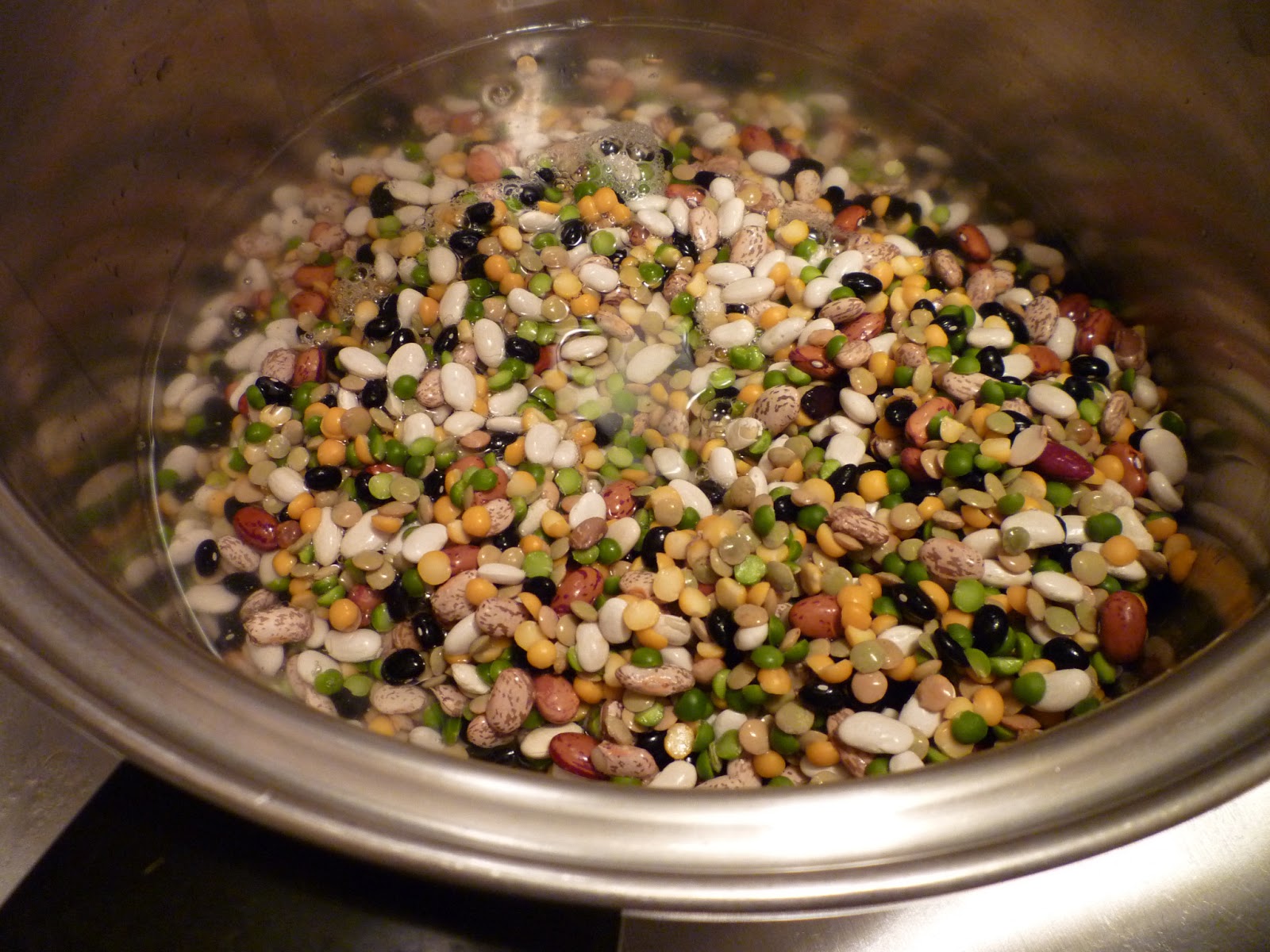
Then I washed them in the colander, and Mr. Glad said they looked like pebbles on the beach. Ah, no wonder they were captivating me. So I took their picture again.

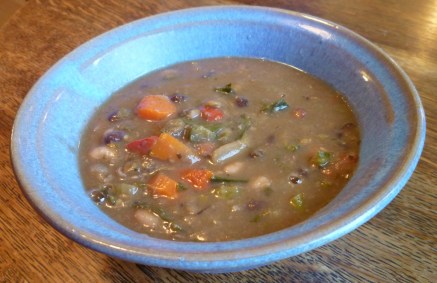
I wanted my soup to be heavy on the vegetables, so one day I chop-chop-chopped and made colorful piles of collards, carrots, celery and several other ingredients all over the kitchen. After the beans soaked overnight and cooked a while by themselves, in went the vegetables, then some herbs and vegetable stock, and it seemed no time at all before I had my soup just the way I wanted.

It would be minestrone if it only had some tomato — that’s the one common soup ingredient I didn’t add in this case. The soup is not Asian, Tex-Mex, Italian or curried, so it will do nicely as Plain Food. We can use the break from the many spicy or highly flavored dishes I make so often. And vegetables – I think they are, dietarily speaking, my staff of life.

More or less of what?

My thoughts about children’s books and Lent converge on this excerpt from Richard Wilbur’s More Opposites, which I think one of The Most Fun collections of poems and drawings. I don’t even require another person to read Wilbur’s humorous poems to — they often make me chuckle contentedly or muse to myself. I see that I already posted this particular one, but it was years ago, and I for one can use it often.

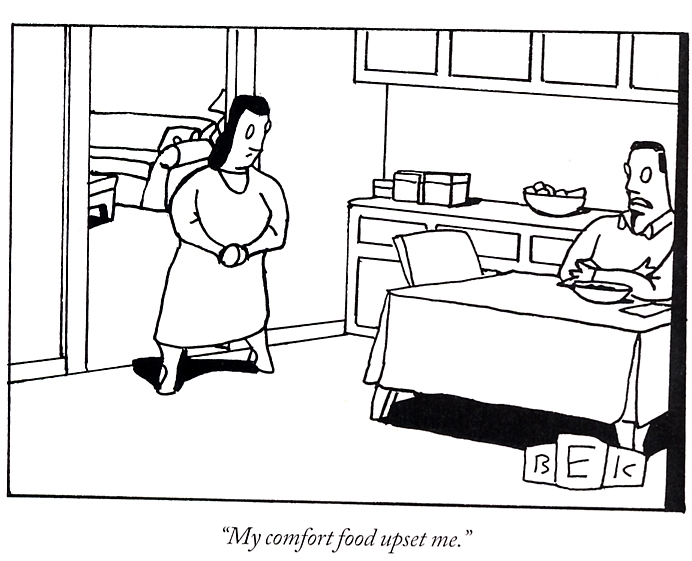
The illustrations of this question in the book include a simple drawing of people with distressed faces holding their tummies. I think the cartoon at bottom makes a similar companion to the poem.

It’s #15 in the More Opposites book:

The opposite of less is more.
What’s better? Which one are you for?
My question may seem simple, but
The catch is — more or less of what?

“Let’s have more of everything!” you cry.
Well, after we have had more pie,
More pickles, and more layer cake,
I think we’ll want less stomach-ache.

The best thing’s to avoid excess.
Try to be temperate, more or less.

There is a Mennonite cookbook titled More With Less, from which I gleaned many good cooking ideas in the early days of my homemaking career. But more valuable than the actual recipes was the refreshing concept that one might have more health and more enjoyment of eating and probably more money to spend on other things if you ate less.

Of course this is something we need to keep in mind all the time, not just during Lent. The church fathers caution us not to eat so much food that we aren’t able to pray after eating it; an overfull stomach hinders prayer. If it’s possible that Less Food = More Prayer….
Let’s just pause and think on that.