Tag Archives: G.K. Chesterton

A botanical theme has emerged.

Decorating is a homemaking job that I wish I could get over and done with and on to other things. This post is about how the realization of that wish is a long time coming. On one level the story bores me to death, even though it’s my own house I’m writing about, the house I’ve been investing in for 20 years. That should warn most of my readers to leave right now and go read something more entertaining.

What makes me want to tell this too-long tale anyway is the way it illustrates how an incredible amount of mental and physical labor can go into what seems a simple project. I suppose I’m not used to this precisely because I’m not into home decorating and haven’t applied my perfectionistic creative energies to it so much before. In a way it’s a larger-scale version of my doll clothes effort: what I envision doesn’t come in a kit.

If I could make a kit out of it no one would buy it. It’s just the best that we could do given our priorities, and with a tract house that doesn’t have enough walls to be cozy or enough windows to brighten the view. The story I tell is also amusing if one considers the output of my mental energies compared to the mediocrity of the results.

G.K. Chesterton said,

It is the main earthly business of a human being to make his home, and the immediate surroundings of his home, as symbolic and significant to his own imagination as he can. 

I’m not sure what all G.K. meant by that, but he does seem to give me liberty, and even to tell me it is my duty, to spend time on my house and property with the purely physical and aesthetic aspects in mind.

One year ago

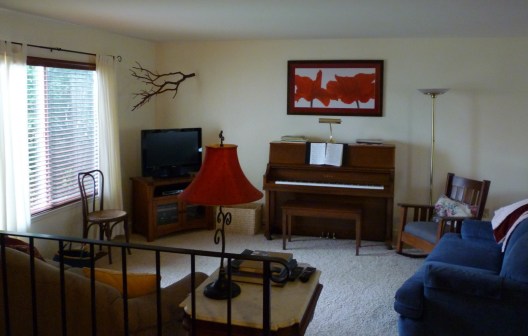
So, I push on. Last year we changed the arrangement of the living room furniture so that the pictures on the wall didn’t work anymore. It seemed that the painting that used to be above a couch was too “heavy” after we moved the piano under it. It was then the largest wall item above the largest piece of furniture. Also, the TV had come out of the closet and found a new and permanent place in a corner, and the emptiness above it bothered me for months while I tried to figure out what to put there.

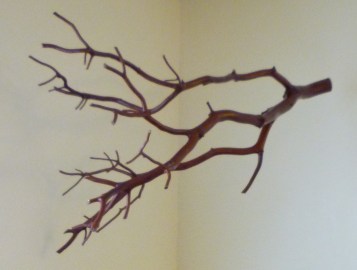
The first thing that came to mind was a manzanita branch such as I remembered my grandmother having in her living room for a while, a natural curio of sorts. Hers had sat on the coffee table, I think, but mine would hang above the TV to fill some of that airspace and balance out the piano nearby. (We’d need to get a smaller something to put above the piano, too.)

I started looking online for manzanita, but I found only small and twiggy, pale specimens, for use in flower arrangements. So I gave up for a while and spent hours looking for a decorative mobile. Nothing pleased. By that time we were in the middle of the remodel, so it wasn’t urgent.

Then in April we went north to Pippin’s place, where the previous winter’s record-breaking amounts of snow had piled up everywhere. As we walked through her forest we saw several manzanita bushes with large branches broken off. My mind started twirling around the idea that I could prepare my own decorative branch. The others helped me choose a couple that might work and we hauled them home.

Nine months ago

I still didn’t know if I could accomplish what I envisioned; I’ve never been one to do woodworking of any sort. I knew enough to trim off the flowers and small twigs. Then it occurred to me that wood needs to dry out before one can work it. I read that manzanita tends to split, so people have trouble making furniture out of it. Maybe my branches would split too much as they dried?

I left them sitting around in the garage for a couple of months and they only split a little bit. On the Internet I read somewhere to paint them with Danish oil to preserve the wood, so I did that. And one of my children said I should stain the trimmed ends of the branch so the whiteness of the wood wouldn’t distract from the lovely smooth and dark bark.

I think this is the one I didn’t use.

It was B.’s upcoming birthday party that put the fire under me to get the chosen branch up in the corner. We bravely screwed two hooks into the smooth new ceiling, and I painted them white so they would fade into the background. Then three strands of fishing line were tied to those, and to the branch.

Soldier was here and helped me position it just so; he’s tall and strong and could stand there calmly holding it in midair while I fumbled with the almost invisible threads. Then voilà! At last, that one part of my decor was in place (now we only had to ignore the empty space above the piano) and all our party guests could admire it. I began brainstorming on a solution to that remaining space nearby.

Three weeks later I dusted the manzanita with a feather duster and the next morning it crashed onto the TV and to the floor. Nothing was harmed. Guess we needed stronger filament. It took me about two months to get to the store to buy it. Then it took another month before B. and I could make ourselves re-hang the branch. See what kind of do-it-yourself-ers we aren’t?

I was sure I knew how to orient the branch, the way Pippin had told me to, but after B. and I got it centered and hung and he’d gone bike-riding, I realized by looking at previous photos that I had it exactly backwards, and it truly didn’t look the best. I tried just flipping it over, and that sort of worked; I only had to re-tie one filament, and we were o.k….except that now the branch was a little closer to the ceiling than ideal, and the top of it was vaguely lined up with the curtain rod, which didn’t look right. I suffered with that all through Christmas, trying not to care. Of course most people said it was fine because no one wanted to go through the difficulty of doing it over.

I had to buy a piano lamp before I could decide what would go behind it; our old one was shot. Piano lamps are expensive! The cheapest one I could settle on was out of stock for a few weeks, so we waited on that. I had looked at so many paintings or other wall decorations, many hours of browsing over several months, and found nothing I wanted enough to spend money on.

So I thought I would saw and paint some wooden birds to hang up there…they needed to be warm and colorful, because the corner with a black TV and a stark naked branch turned out surprisingly modern and chilly. (Maybe what I need is a branch about five times that big, just sitting on the floor behind the TV and reaching toward the ceiling…and permanently trimmed with Christmas ornaments…? )

But then we must return to how I’m not a woodworker, or a painter for that matter. I think it was on New Year’s Day that I felt desperate to make some progress; I decided to spend money and get something. B. and I knew we needed color there, and we knew the parameters of what the measurements needed to be. I bookmarked some paintings, and when B. came home from watching a football game we chose one and ordered it. Whoopee!

The painting arrived and sat on the floor near its destination for over a week. I knew we needed to be in the right mood to even talk about putting it up. In the meantime, one day I got a burst of courage and all by myself re-did the lines supporting my manzanita. I think it might be as much as an inch lower. A most satisfying inch.

Last week we hung the picture. Those are giant poppies providing the splash of color. I hope Mr. Chesterton is happy and won’t mind if I get back to my sewing and reading now.

Washington – Homesickness Cured

In an essay titled “The Inside of Life,” G.K. Chesterton said that he envied Robinson Crusoe being shipwrecked on an island. He talks about “the poetry of limits,” which I am learning is the category where my own favorite life-poems are found. I found another one just last week.

At the beginning of our trip to Washington I was homesick — the first time I recall being plagued by that feeling when actually away from home, though I probably did complain over it right here at the peak of our remodeling project.

There’s never been a year when I took so many trips as 2010. It’s one of those things that is really different about my life nowadays and that I’m learning to adjust to. I’m just a homebody threatening to turn agoraphobic if I get pushed too far. The good old days were the ones when our family’s only car was not available to me and I didn’t have the option of driving to town. I “had to” stay home.

Time wasn’t enough for me to do a proper job preparing for our trip. As G.K.C. also says in that essay, “Life is too large for us as it is: we have all too many things to attend to.” I didn’t seem to have the right clothes, but when I noticed that, it was too late to buy or sew the right ones. I was self-conscious about looking odd until the day I could put on my hiking boots and paint-spattered fleece for the trail.

I always like to write postcards when traveling, so I packed a list of addresses along with some stamps into a zippered pouch along with my pocket calendar and a little prayer book; then the whole thing got left at home in the flurry of departure. All week I wondered if I had lost it at the airport or somewhere on the way, and I felt a bit lost without those props to my usual routine of being me. I couldn’t remember the addresses of most of the people I wanted to favor with a picture and note.

The first night of the journey we stayed with B.’s cousin and her husband who have a house looking out on Hammersley Inlet. They are warm and loving, and I was glad for the time to get to know them better.  It was rejuvenative to walk along the shore and collect large oyster shells, in the company of someone else who appreciated their beauty. Anne didn’t think it strange that I deliberated so much over each one I picked up, and she actually seemed to like talking about the reasons why one or another would be more worthy of carrying around for the rest of the trip. After washing three of my favorite potential soap dishes in the kitchen sink I forgot to take them with me the next morning. Somehow that was o.k. The collecting had been the important part.

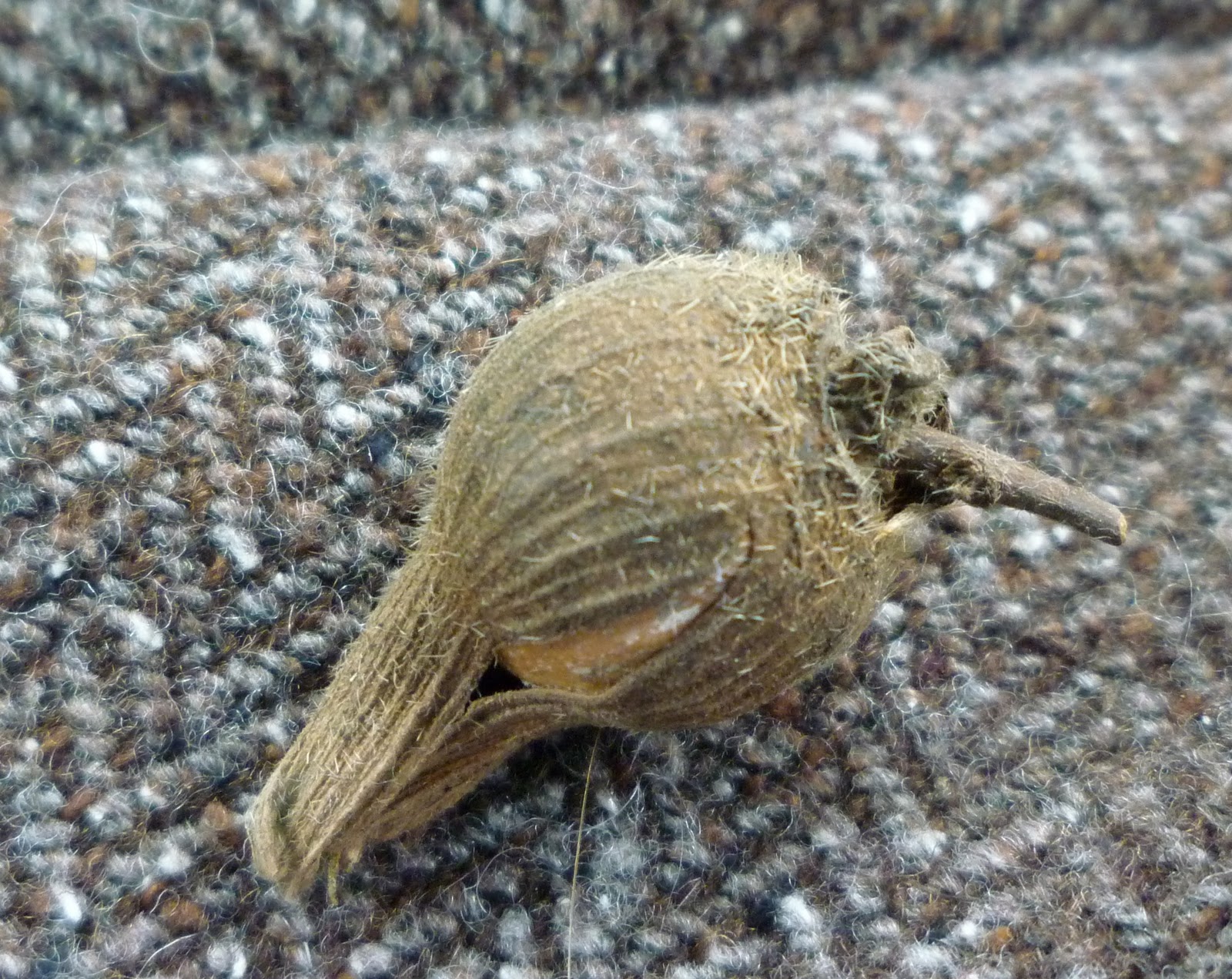
We walked with our Bremerton friends also, in the forest nearby, where my beloved “May” showed me piggy back plants, and filbert nuts hanging on the tree; a hazelnut went into my pocket and made it all the way home.

Just making the acquaintance of these tangible natural artifacts was comforting. If I had to leave their territories so soon and move on like an unwilling gypsy, at least I could snap a picture, or kidnap a small nut, to prolong the connection.

On our way to the Lake Quinault Lodge we got lost and spent a couple of hours getting back in the right direction. Rural Washington doesn’t have as many road signs as one could want, and of course, there are all those waterways that confused me when I was trying to be B.’s navigator. Robinson Crusoe didn’t have all this complexity of terrain, and what he had to deal with, he also had time aplenty for. Again, from G.K.C., “What dullness there is in our life arises mostly from its rapidity: people pass us too quickly to show us their interesting side.” Canals and roadsides, too, I find.

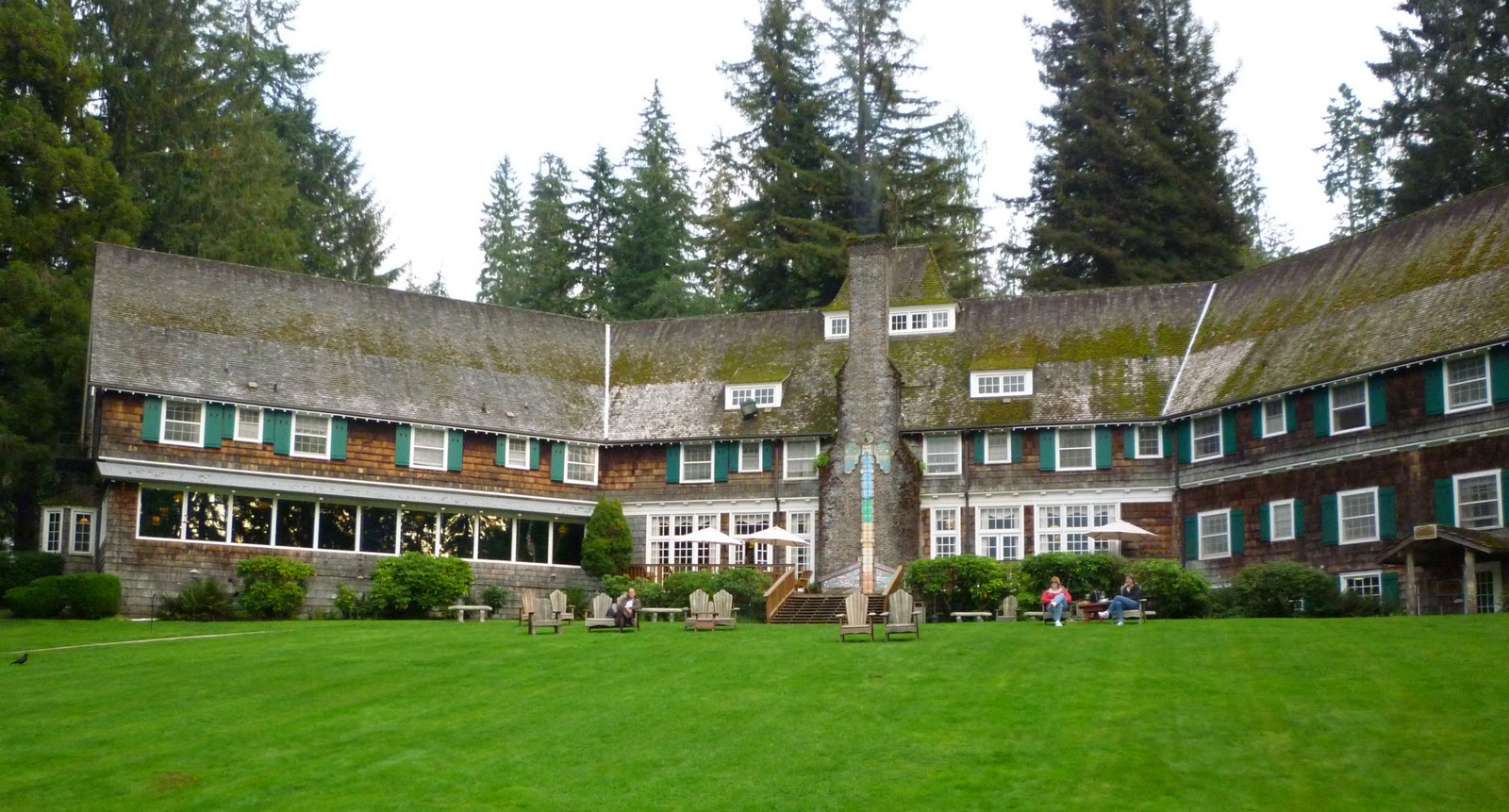
We had a reservation for three nights where B. had stayed with his family long ago, a classic inn built in 1926.  F.D.R. also stayed here in 1938 when he was considering whether to make a national park on the Olympic Peninsula. He decided yes, and the rain forest was preserved.

Olympic National Park is kind of like a wheel with spokes going in, but no hub; we had to drive long distances from the outer rim of the park into the choice areas. On the way along the rim to our first spoke, we spent time on Ruby Beach, where the surf crashed and the air was bracing. Just now I was wondering how it compares with the eastern coast in latitude, and after a bit of hunting and pecking around the Net I can tell you that it’s similar to Prince Edward Island, and still well south of the British Isles.

My attention was quickly drawn downward to the smooth and varied pebbles comprising the beach, and I picked up one after another as I noticed their peculiar colors and patterns. Quoting Chesterton, “This desire to be wrecked on an island partly arises from an idea which is at the root of all the arts–the idea of separation.” I removed some of these stones from their vast and cluttered background so I could consider each individually. And I myself had been separated from all my home responsibilities and from all but one talking human. No multitasking necessary.

In that essay that I had read only recently, Chesterton uses literature as a specific example of the artistic principle he’s considering, but it seems to me it is broadly useful for explaining why some activities are just as bracing to my mind and soul as that ocean air.

According to this idea, one appeal of reading a novel is that the number of people we meet there is limited. “Romance seeks to divide certain people from the lump of humanity, as the statue is divided from the lump of marble. We read a good novel not in order to know more people, but in order to know fewer….instead of this bewildering human swarm which passes us every day, fiction asks us to follow one figure (say the postman) consistently through his ecstasies and agonies. That is what makes one so impatient with that type of pessimistic rebel who is always complaining of the narrowness of his life, and demanding a larger sphere. Life is too large for us as it is….All true romance is an attempt to simplify it, to cut it down to plainer and more pictorial proportions.”

Topographically, logistically, socially, the greater Seattle area is way too large for me. Its vastness and complexity weigh on me like an overcast day. Walking with one or two friends is good — more circumscribed and easier to enjoy. But a small pebble is just right. I stuffed my pockets with pebbles, and breathed as heartily as I could of that oxygen-rich and moist air. I sat on a log and did not want to leave.

We Need Food of All Kinds

Soldier’s wedding will take place in a few days.  Mr. Glad and I are just trying to get ourselves and the house and my father-in-law ready for the Joyous Event–and trying at the same time to get over our summer colds. I was pleased to pick the first lemon cucumber and add it with our arugula and the multi-colored cherry tomatoes to some lettuce last night, to fortify us for the work, and for the happy busyness ahead.

This morning I was well enough and eager to get back to church, where we remembered the life of St. Lawrence of Rome. God has filled my cup with delights like this–how many parishes are able to celebrate on a Tuesday morning?

St. Lawrence was a deacon serving with Pope Sixtus in the third century; his life and martyrdom are peppered with several encouraging stories. He seems to have had a good sense of humor, and among the various groups who call him patron are comedians.

G. K. Chesterton said it is the test of a good religion, whether you can joke about it. I’m sure he didn’t mean anything like mocking God or His salvation. But being able to laugh at oneself is a sign of humility, and I think it might be a collective form of this humor he is talking about. The whole subject of humor is something mysterious to me, and I would do well to study Chesterton’s other writings about it. For now I will change the subject after my favorite pertinent quote, also from him: “Angels can fly because they take themselves lightly.”

I came home from the feast and noticed the hyssop flowers having grown taller and taller. Bees were drinking nectar from the blooms, but bees are hard to photograph–one has to take time and a couple dozen pictures in hopes of getting one without a blur of bee, and I have lots of housework yet to do.

My life is like my garden. It’s full of beautiful and colorful things and events, ever changing, and I notice so few of them. Fewer still can I pick and show anyone else. My sociable or communicative side I find is always writing script in my mind, for how to tell other people about my discoveries and joys. But when the foliage and flowers grow so fast, events tumbling and intertwining with each other like a jungle, the feeling of not keeping up has been a gift in itself. From a feeling of helplessness, God has given me grace to just stop that script-writing for a few minutes at a time and direct my noticing and my thanks only to Him. Let me be like the bee, blurry if need be, but doing my job of imbibing the sweetness.

God is constantly willing.

Weeds grew thick and tall in my recent and repeated absences, threatening to hide and destroy the beauty of the garden I’d planted. This morning I spent an hour tidying things up and giving space to the cucumbers and peppers so that they could grow unhindered. I’d hired a girl to irrigate enough to keep everything alive, but I didn’t ask her to pull weeds.

(Unripe grape tomatoes above, nasturtium in arugula below. All pictures taken just this evening.)

While hauling several baskets full to the trash I remembered my own advice to another young friend who was just falling in love with gardening. She asked me whether I thought she should do a little bit of garden work every day, or spend a couple of hours one or two days a week. I told her that the best way is to tend it a little bit every day. There is always a weed to pull, a tomato branch to be tied up, or a dead flower to be clipped off. The plants need water, and food, perhaps even a little shade from time to time.

One year our Baby was raising a pumpkin she hoped would be a huge one she could enter in the local Giant Pumpkin Contest. We were told it was advisable to put the growing pumpkin on a pallet when it was still small so that it could stay dry and be easily moved no matter how large it grew. When I got around to helping my daughter with that part of the project the fruit wasn’t very large yet, but the stem, having lain on the moist ground, had already sent out roots into the soil. This situation was hidden by a canopy of leaves, and when we hoisted the pumpkin on to the pallet, the vine stayed anchored by those roots, and the pumpkin broke off at the stem.

That was a hard lesson. I thought sadly of how a farmer, even a novice homeschooling pumpkin-grower, can’t afford to procrastinate. Any job involving a living thing has to be paced according to that creature’s rate of growth. And agriculture usually involves many living things all in relationship to one another: the plant, the soil, pests with their own life cycle, and probably others I’m not thinking of, not being a very good farmer still.

This morning’s brief mediation on how I really ought to tend more constantly to my garden continued when I later sat down at the computer to read the transcript of an interview with the Orthodox theologian and writer Vigen Guroian in which the topic of conversation turned, as is usually the case with him, to gardening, and he said “…were not God constantly willing His creation, loving His creation into existence, it would disappear.”

From my perspective as a lazy, distracted, and time-constrained gardener, I appreciate the steadfastness of our Lord in continuing His creative work moment-by-moment.  Colossians 1:17 says that he “holds all creation together.” I am one of His creatures, whom so far He has seen fit to give life and breath to every morning, making it possible for me to tend my own mini-garden, which also couldn’t live without His blessing and daily upholding.

Something G.K. Chesterton said on the subject often flits through my mind, when musing on this subject. He said, that in contrast to children, who through excess of vitality want things repeated, “…grown-up people are not strong enough to exult in monotony. But perhaps God is strong enough… It is possible that God says every morning, ‘Do it again,’ to the sun; and every evening, ‘Do it again,’ to the moon. It may not be automatic necessity that makes all daisies alike: it may be that God makes every daisy separately, but has never got tired of making them. It may be that He has the eternal appetite of infancy; for we have sinned and grown old, and our Father is younger than we.

So far, the garden hasn’t seemed monotonous to me. Every day is different there. Of course, The Creator is making the daisies, and I get to discover them, along with the roses and budding fruits and spreading spinach. I do love my garden, and will try to be more constantly willing to keep it going, imitating my Lord.