Tag Archives: John Stewart Collis

Collis refutes thin air.

You cannot make things out of thin air, people say. There is no such thing as thin air, if by that is meant something empty. It is really very thick and powerful, and from it all things are made that are made, or without it cannot be made, whether tree, plant, person, or army tank.

What is the atmosphere? It is an air ocean. We walk at the bottom of an air ocean at a depth of from two hundred to five hundred miles. We cannot see it, we cannot touch it, and yet it presses down upon us with a pressure of a ton to every square foot. Each acre of land sustains forty-six thousand tons of air. It is possible to carry this surprising weight on our heads owing to the way it equalizes the pressure all around us.

The atmosphere is composed, as everything is composed, of small items called molecules. They are not all of the same kind. Some contain oxygen, others carbon dioxide, some nitrogen, others argon; some ozone, others nitric acid; some water vapour, others ammonia. In quantity nitrogen heads the list and oxygen seconds it, while in importance the carbon dioxide is second to none. When we grasp that water, carbon, nitrogen, nitric acid, and ammonia contribute ninety per cent of all the materials that are built into the tissues of plants, it is easy to see how necessary it is that they should have roots in the air as well as roots in the soil.

The leaves are these upper roots or mouths — plants are pretty well all mouth.

— John Stewart Collis in The Worm Forgives the Plough

lamium & plum leaves Nov 08

Collis cannot hear ants.

I’ve continued reading along in The Worm Forgives the Plough by John Stewart Collis, though days and weeks did go by when I neglected that paperback sitting on my nightstand and followed instead the lives of fascinating characters in Pearl S. Buck’s novels.

After the first half of the Collis book and its descriptions of farm work, the author begins to give lessons on clouds and chalk, geology and evolution. He explains botany in lucid prose, and earthworms. I wasn’t so interested in some of these topics and did skim a bit, but when he started writing in vivid detail about the kingdoms of ants and how they live, I paid closer attention. Just a short example here:

Thus ants are specialized in activity, but they all share common destinies and dooms. All, for instance, are without ears, and live in a world dedicated to silence. Here again we cannot easily conceive this life. There is silence along their streets, and even on the field of battle there is no sound. And since they are deaf it seems certain that they are also voiceless. It may be that we have not the ears to hear the utterances of insects even as we have not the eyes to see the tiniest of their brothers. Anyway the fact iant-trail-2s that we don’t hear anything and it is probable that the silence is absolute. Just as we can watch a spider attack a fly caught in its web and see it slowly eat its living meal without a sound being heard, so also, however close we might bend down upon cohorts of embattled ants, we will hear no shout of insectual command, no cry of triumph, no moans of the dying, and even when a head is sawn off or a severed limb falls to the ground, no shriek of pain will humanize the scene.

— John Stewart Collis

A white veil of threads.

“Time marched on. Each day seemed long, each week short. It was already autumn. What is the salient characteristic of autumn? The spiders’ threads in the early morning frost. I am not thinking much of the circular networks, marvellous as these are, hung along the gate, but rather the threads that are strung across everything, so that if you bend down till your eye is level with the field you can see a white veil over the whole expanse. They are everywhere, on everything. ‘Do they drape the cannons in France?’ asked Mr Ralph Wightman, true poet, in a striking image, the other day. To look down at these things is like looking up at the stars — we are baffled by quantity.”

-John Stewart Collis in The Worm Forgives the Plough

Collis stands on a dunghill.

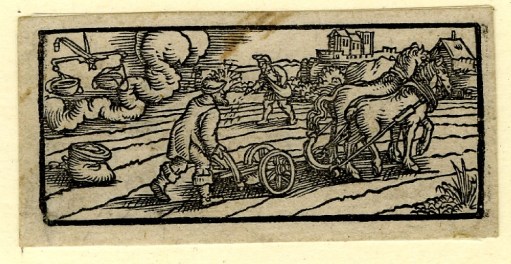
I have no objection whatever to standing on a dunghill. There is no place where I am more content to stand. But for how long? That’s the question. The dunghill today is rightly celebrated by poet, by prophet, and by priest. It is numbered amongst the highest riches of a land. I never feel better employed than when dealing with one. Thus engaged I can qualify for the approval of Sir Albert Howard and the tributes of statesmen, while also providing a perfect subject for a woodcut. True. But consider the reality. It is 2 p.m. There are three and a half hours to go. There is an icy wind. Also a drizzle. There is no one to talk to, and if anyone turns up there will be nothing to talk about. Though I am ‘close to the earth’ the dunghill soon ceased to be anything but an object, heavy and clogging. One wonders ‘what is the time?’ Alas — only 3.15!

–John Stewart Collis in The Worm Forgives the Plough

woodcut 16th cent Brit Museum
Woodcut from British Museum collection – 16th century