Tag Archives: Nevada

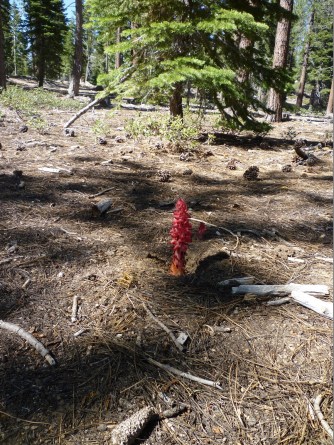
The parasitic snow plants are blazing at Tahoe.

Mr. and Mrs. C. invited us to their cabin again on the south end of Lake Tahoe. At 6,000 ft. elevation it’s still pretty brisk in May, but the sky was SO blue, the lake was SO blue, and the air was dry, full of the smells of pine trees and cedars with some wood smoke thrown in. I breathed deeply.

Here is a map if you need to get your bearings. The lake itself lies on the Nevada-California state line. We usually approach from the southwest and drive through the state capital of Sacramento to get there.

I had escaped the world down below where picture storage was one of the many time-consuming computer problems that had recently worn me out, and I arrived with a reluctance to use my camera. Of course that didn’t last long, especially when wildflowers are out. May in the Sierras brings flowers you can’t see in the summertime, so I had to seize my opportunity, didn’t I? My other blog posts about the Tahoe area have different photos from what I came away with this time.
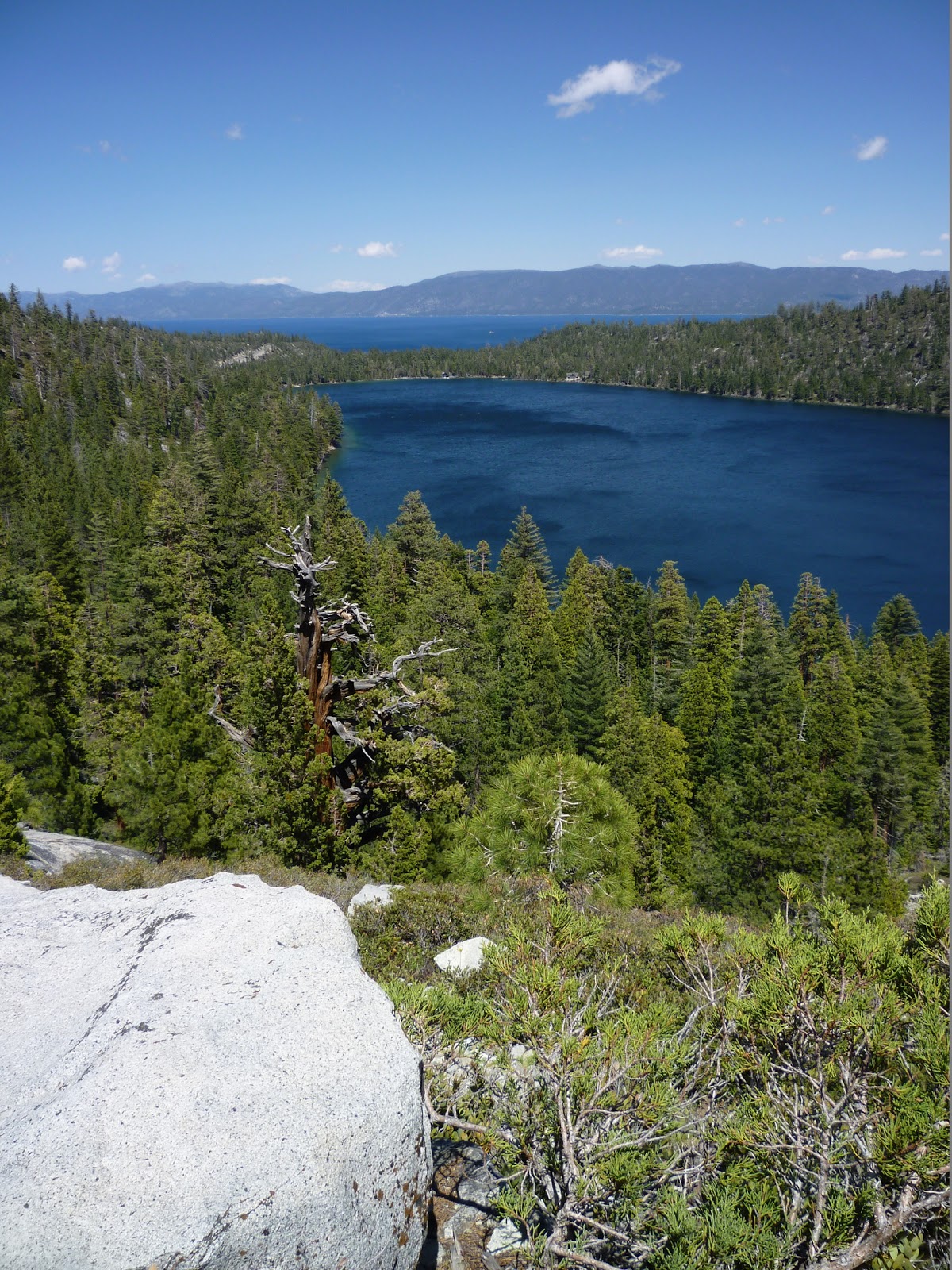
Cascade Lake in foreground, Tahoe in distance.

We hiked to the top of Cascade Falls one day. It drops and flows into Cascade Lake which lies just south of Emerald Bay, a little higher in elevation. This picture was taken from a granite shelf looking as straight-down as I could manage to the bottom of the falls.

Sticky Cinqefoil
                      This looks to me like some kind of buttercup but I haven’t found it in a book yet. (Update: I added the caption after one of my readers enlightened me.)

The Snow Plants have popped up all over, here and there on the floor of the conifer forest, with no leaves. Mrs. C. was coveting one, wondering how she might get a specimen to grow near the cabin, but what I found out on Wikipedia when I came home makes me think that would be near impossible to make happen.
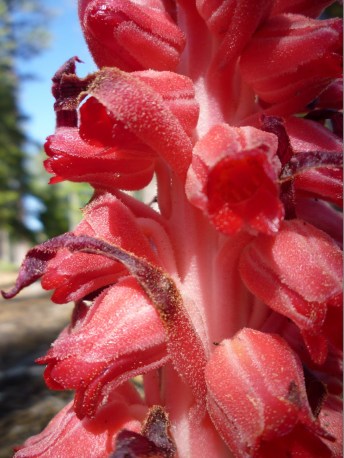
The snow plant is sarcodes sanguinea, the only species in the genus sarcodes, in the heath family. It is unable to photosynthesize its own food, “…a parasitic plant that derives sustenance and nutrients from mycorrhizal fungi that attach to roots of trees.” Now I can imagine the roots of these bright plants extending deeply into the world of tree roots. If we are lucky, perhaps the right conditions will in the future concur and surprise Mrs. C. with a burst of red.
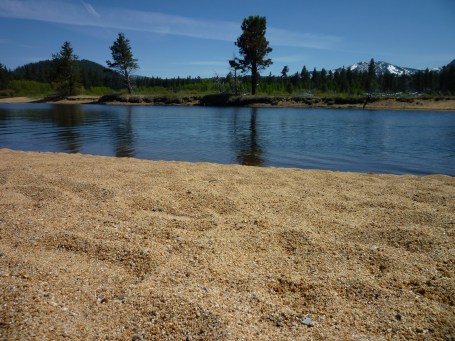
A lagoon by Kiva Beach

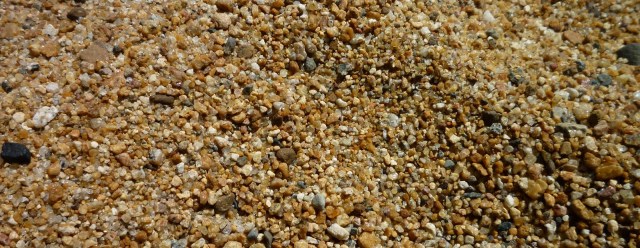
Another color that got my attention was the sand around Lake Tahoe. We took the yellow lab to swim and fetch and I sat on the shore and considered how all the grains of sand were warm golden tones, not like any ocean beach I’ve seen.

Wooly Mule’s Ears, also known as mountain mule’s ears, were in bloom, and I got a photo of them as in a perennial bed planted by Mother Nature, with a border of Squaw Carpet in front.

Wyethia mollis and Ceanothus prostratus

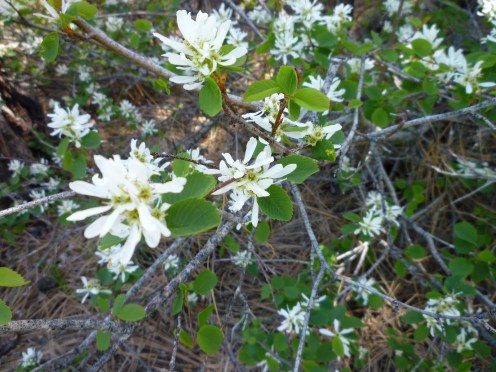
Here’s a nice flowering bush that I don’t know. Maybe someone reading this knows this plant? It grows in the forests on public land and in private yards. (Update: the same reader in a comment below is kind enough to tell us that this is Western Serviceberry.)
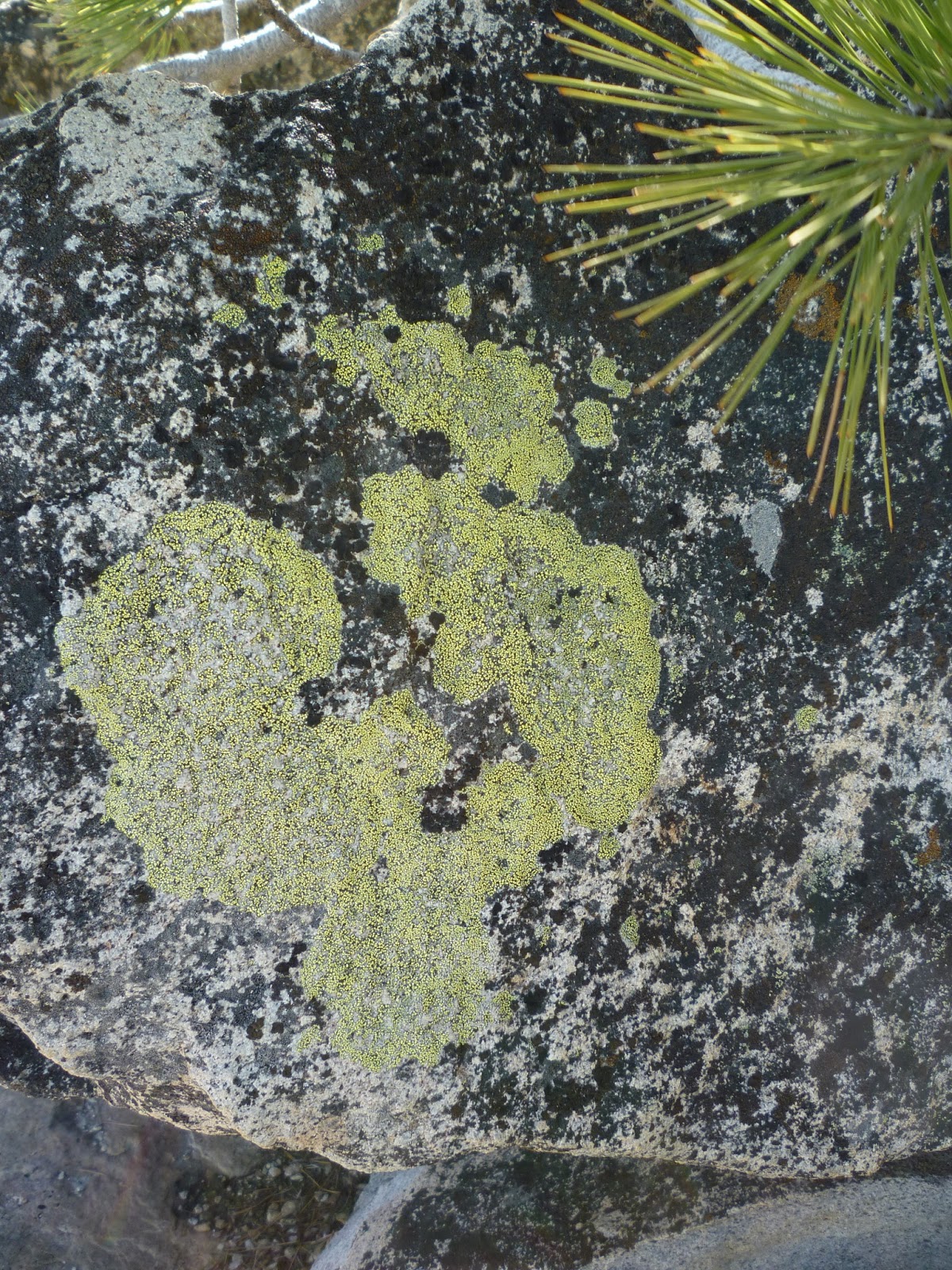
Did you ever do a Google image search of “lichen”? Amazing, amazing plants. Here is one of the more subtle designs, which we saw on a rock at the top of Cascade Falls, a lovely arrangement of vegetable and mineral and just one example of how God’s artwork is splashed all around the world for our pleasure and His glory. Thank You, Lord, for the refreshment.

Angora and Virginia

They sound as though they might be sisters, but really they are only linked by being part of an outing Mr. Glad and I had this week, up to Lake Tahoe to stay with our friends Mr. and Mrs. C. at their cabin. I took hardly any pictures — too conscious of my backlog of unsorted photos at home — and now regret it, because there are things worth sharing. So I found some pictures online to supplement my words.

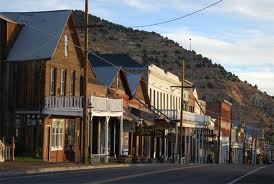
The wild horses were the first thing that made me want photos. We saw them at the end of the day in Virginia City, Nevada, through the window of the (I hesitate to tell you) Bucket of Blood Saloon.

We were the only customers on the day after Labor Day, so we had the best table, with a view down the hill to the lower parts of town and a panorama of the mostly sage-green slopes. About a dozen horses grazed a few blocks lower down, and colts reared up to play-fight with each other, then prance off.

I knew that herds of mustangs still roam in the West, but I only learned today that “The historic Virginia Range herd, over 1,400 strong, can be found living wild and free between Virginia City, Reno, Dayton and Carson City.” It comprises half of the wild horses in the nation. Getting a glimpse of this little group made for a highlight of the day for me.

We did a lot of browsing in shops, where I bought a dance skirt, and a bag of Sugar Babies for old time’s sake. Boy, were they a disappointment. Certainly it is the recipe and not my memory that has failed. The lovely way the candy coating would melt into crystals is not to be experienced anymore. Corn syrup does not equal sugar, for one thing.

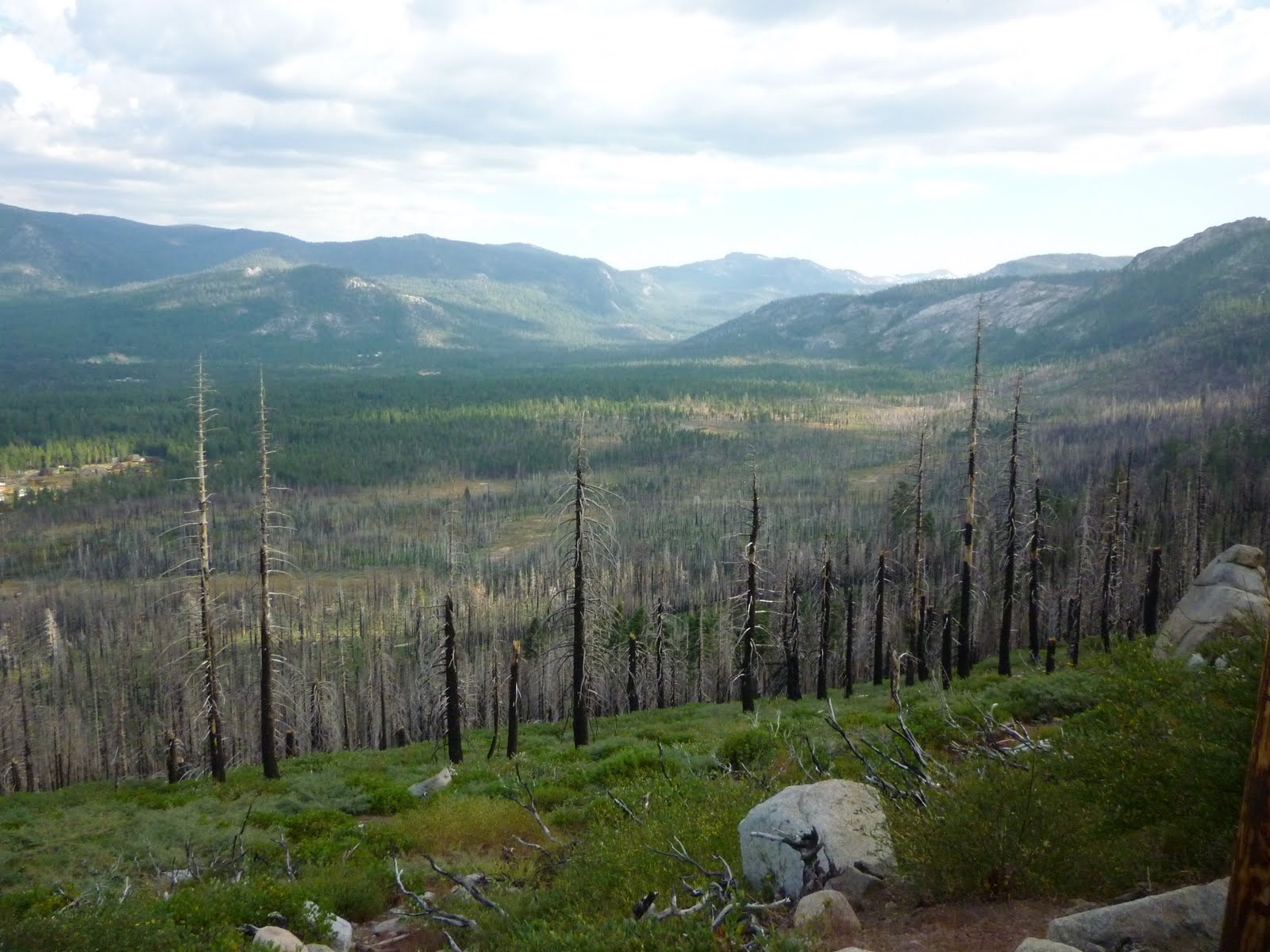
The next day our hosts introduced us to their family favorite Place to Go When at Tahoe: Angora Lake, or more precisely, Upper Angora Lake. These lakes gave their name to the Angora Fire that destroyed so much property here in 2007, on record as one of the top ten most costly fires in U.S. history. We approached the lake on a glacial moraine ridge, tree-lined Fallen Leaf Lake on our right and acres of burned-out forest on our left.

Looking south over the Angora Fire area (GJ photo)

After we reached the parking lot for the lake, we hiked another mile before reaching the lake and the sweet resort that sits next to it.

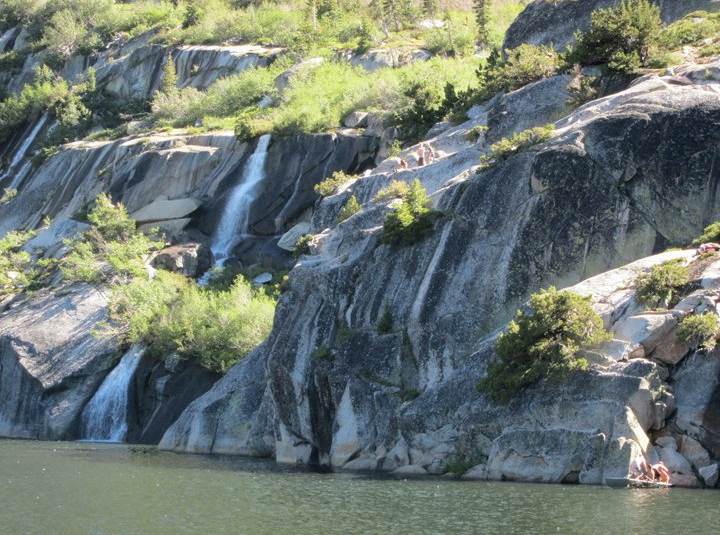
On one side of the bowl a wall of granite rises up, not too sheer, with plenty of ledges and crevices from which to high-jump into the deep waters. Mr. Glad was the only one of us who swam, but we ladies waded for quite a while and wiggled our toes in the fine granite gravel.

From top: Tahoe, Fallen Leaf, Lower and Upper Angora
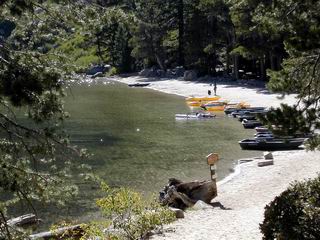
Upper Angora Lake Beach

The mister rented one of those rowboats in the photo so that he and I could enjoy a lazy time rowing around the lake and examining the lichens and berries that grow on or out of the granite cliff; we all spent a good while sitting in the sunshine when it got through the afternoon mountain clouds, reading our books, and watching chipmunks scurry around.

Sulfur Flower, sage, and Mr. G

On the way back I took my own photos, so among other things you can see my view as our little excursion, and our mini-vacation, drew to a close. You can’t see what a contented vacationer I was; you have to use your imagination for that.

California Mountains – Rivers and a Song

(This is the 3rd installment of my July vacation travelogue.)

Lake Tahoe sits on the California-Nevada state line, and the rivers in the surrounding mountains form the setting of the ballad “Darcy Farrow.” Ian and Sylvia were singing this song the first time I heard it, and I still think their rendition is the best. I heard many examples on YouTube while looking for one to post here.

As we drove down the highway south from the lake, we weren’t far from “where the Walker runs down to the Carson Valley plain,” and in fact we crossed all three rivers mentioned in the tale, the Truckee, the Carson, and the Walker. We even listened to Ian and Sylvia sing from the CD player at one point in our journey.

Of course I don’t like that Young Vandy put a bullet through his brain, but in comparing this story with other traditional songs I find I like it better than ones where the young man instead kills his beloved by accident or out of anger.

These rivers descend toward the east from from the northern Sierras and always refresh my mind as I watch them from the car. The Walker stays close to the highway longer than the others, and where it flows through desert-like terrain it captivates me by the contrast it gives to the sagebrush-covered banks. It’s fast and furious and carrying a lot of irrigation for the green fields of alfalfa grown farther east where the land flattens out. I recall those expanses of green and the beautiful Nevada cattle ranches in the shadow of the mountains — but we didn’t go that way this trip.

Four years ago we visited this area, and I wrote hasty notes in my journal as we sped along through ever changing layers of conifers, sagebrush, aspens and meadows, trying to preserve the moments of beauty. I didn’t get to catch my own photo of the rivers on either trip, but I found this one on the Web.

And below is one of ours, showing the mountains where the heavy snowpack from last winter is still melting and filling the rivers with icy water. On Hwy. 395 this far north the elevation is still above 5,000 feet so the summer temperatures don’t get extreme. The cattle looked content, and I know I was.