O hushed October morning mild, Thy leaves have ripened to the fall; Tomorrow’s wind, if it be wild, Should waste them all. The crows above the forest call; Tomorrow they may form and go. O hushed October morning mild, Begin the hours of this day slow. Make the day seem to us less brief. Hearts not averse to being beguiled, Beguile us in the way you know. Release one leaf at break of day; At noon release another leaf; One from our trees, one far away. Retard the sun with gentle mist; Enchant the land with amethyst. Slow, slow! For the grapes’ sake, if they were all, Whose leaves already are burnt with frost, Whose clustered fruit must else be lost— For the grapes’ sake along the wall.
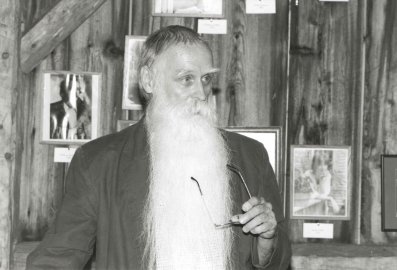
Some years ago Donald Sheehan’s widow Xenia shared on social media an excerpt from his book The Grace of Incorruption, a passage in which he links Robert Frost with St. Dionysius. She published it on the saint’s feast day in October, along with his icon below, but for re-posting Sheehan’s thoughts I have chosen today’s date, on which Robert Frost breathed his last, an appropriately wintry day in 1963. Xenia Sheehan:
This day the Orthodox Church celebrates St. Dionysius the Areopagite, 1st (or possibly 5th)-century poet of “Mystical Theology,” whom Donald Sheehan uniquely compares to American poet Robert Frost in his “deliberate turning out of all the lights of false knowing . . . in order to behold — in Dionysius’ astonishing words — ‘that darkness concealed from all the light among beings.'”
Don writes in The Grace of Incorruption that,
“…in order to know the personhood of another, we must unknow both the persona and the personality: we must let these lights go out. Again and again, in his finest poems, Robert Frost accomplishes precisely this unknowing, the deliberate extinguishing of all the false light, and a welcoming-in of the darkness in which true personhood can shine forth. And true personhood is, always, genuinely beautiful.
“I think what moves us so deeply about the poem ‘An Old Man’s Winter Night’ is Frost’s evocation of genuine personhood in the old man. The old man in Frost’s poem is not a persona nor a personality; he is, genuinely, a person. And as the lights go out in the poem, the more beautifully and movingly his personhood emerges. One vivid detail: when the log in the stove shifts with a jolt, we, too, are jolted into a deeper intimacy with the old man, an intimacy that gains in power because of the darkness.”
-Donald Sheehan
Text and icon from Donald’s widow Xenia Sheehan in 2018
AN OLD MAN’S WINTER NIGHT
All out-of-doors looked darkly in at him Through the thin frost, almost in separate stars, That gathers on the pane in empty rooms. What kept his eyes from giving back the gaze Was the lamp tilted near them in his hand. What kept him from remembering what it was That brought him to that creaking room was age. He stood with barrels round him—at a loss. And having scared the cellar under him In clomping there, he scared it once again In clomping off;—and scared the outer night, Which has its sounds, familiar, like the roar Of trees and crack of branches, common things, But nothing so like beating on a box. A light he was to no one but himself Where now he sat, concerned with he knew what, A quiet light, and then not even that. He consigned to the moon,—such as she was, So late-arising,—to the broken moon As better than the sun in any case For such a charge, his snow upon the roof, His icicles along the wall to keep; And slept. The log that shifted with a jolt Once in the stove, disturbed him and he shifted, And eased his heavy breathing, but still slept. One aged man—one man—can’t fill a house, A farm, a countryside, or if he can, It’s thus he does it of a winter night.
It’s the “false spring” one day, and the next, not. When I was at church to bake communion bread, it was spring for sure. Of course the dough knew it, and behaved accordingly.
Yesterday, the wind and various other factors contributed to further thaw the bones of my soul. While I was in my own garden trimming the lemon tree, pomegranate bushes, lavender and a few other plants, a series of great gusts came up suddenly, and made a clattering of doors and toys and other blowing-around stuff in the neighborhood.
The poem below doesn’t originate in my area of the country, so it will never perfectly fit the weather here, but I love the spirit of it, and I’m sure it will please a few of you in more northerly parts of the world. If you tend to be impatient with poems, try reading this one out loud.
TO THE THAWING WIND
Come with rain, O loud Southwester! Bring the singer, bring the nester; Give the buried flower a dream; Make the settled snowbank steam; Find the brown beneath the white; But whate’er you do tonight, Bathe my window, make it flow, Melt it as the ice will go; Melt the glass and leave the sticks Like a hermit’s crucifix; Burst into my narrow stall; Swing the picture on the wall; Run the rattling pages o’er; Scatter poems on the floor; Turn the poet out of door.
-Robert Frost
Because we haven’t had any rain in several weeks — or has it turned into months? — I had to put the hose on potted plants that aren’t on the automatic drip system. Hidden behind one big pot, this little great-grandbaby of a cactus I started was in full baby bloom. I brought her indoors to brighten up my kitchen, still lit also by the fairy lights, which are there for the days when spring is clearly not. yet.
HAPPINESS MAKES UP IN HEIGHT WHAT IT LACKS IN LENGTH
Oh, stormy stormy world,
The days you were not swirled
Around with mist and cloud,
Or wrapped as in a shroud,
And the sun’s brilliant ball
Was not in part or all
Obscured from mortal view —
Were days so very few
I can but wonder whence
I get the lasting sense
Of so much warmth and light.
If my mistrust is right
It may be altogether
From one day’s perfect weather,
When starting clear at dawn,
The day swept clearly on
To finish clear at eve.
I verily believe
My fair impression may
Be all from that one day.
No shadow crossed but ours
As through the blazing flowers
We went from house to wood
For change of solitude.






 Gladsome Lights