Tag Archives: Theotokos

The Celebration of Man in a Little Girl’s Birth


What a joy to be present at the “birthday party” for the beloved mother of our Lord! We began tonight, and will continue tomorrow, to rejoice at this first event of the church liturgical cycle, one of the 12 Great Feasts of the year. In honor and remembrance, I offer this sermon by:

Protopresbyter Alexander Schmemann
Sermon on the Nativity of the Theotokos September 8

The Church’s veneration of Mary has always been rooted in her obedience to God, her willing choice to accept a humanly impossible calling. The Orthodox Church has always emphasized Mary’s connection to humanity and delighted in her as the best, purest, most sublime fruition of human history and of man’s quest for God, for ultimate meaning, for ultimate content of human life.

If in Western Christianity veneration of Mary was centered upon her perpetual virginity, the heart of the Orthodox Christian East’s devotion, contemplation, and joyful delight has always been her Motherhood, her flesh and blood connection to Jesus Christ. The East rejoices that the human role in the divine plan is pivotal. The Son of God comes to earth, appears in order to redeem the world, He becomes human to incorporate man into His divine vocation, but humanity takes part in this. If it is understood that Christ’s “co-nature” with us is as a human being and not some phantom or bodiless apparition, that He is one of us and forever united to us through His humanity, then devotion to Mary also becomes understandable, for she is the one who gave Him His human nature, His flesh and blood. She is the one through whom Christ can always call Himself “The Son of Man.”

Son of God, Son of Man…God descending and becoming man so that man could become divine, could become partaker of the divine nature (2 Peter 1:4), or as the teachers of Church expressed it, “deified.” Precisely here, in this extraordinary revelation of man’s authentic nature and calling, is the source of that gratitude and tenderness which cherishes Mary as our link to Christ and, in Him, to God. And nowhere is this reflected more clearly that in the Nativity of the Mother of God.

Nothing about this event is mentioned anywhere in the Holy Scriptures. But why should it be? Is there anything remarkable, anything especially unique about the normal birth of a child, a birth like any other? The Church began to commemorate the event with a special feast…because, on the contrary, the very fact that it is routine discloses something fresh and radiant about everything we call routine and ordinary, it gives new depth to the unremarkable details of human life…And with each birth the world is itself in some sense created anew and given as a gift to this new human being to be his life, his path, his creation.

This feast therefore is first a general celebration of Man’s birth, and we no longer remember the anguish, as the Gospel says, “for joy that a human being is born into the world” (Jn. 16:21). Secondly, we now know whose particular birth, whose coming we celebrate: Mary’s. We know the uniqueness, the beauty, the grace of precisely this child, her destiny, her meaning for us and for the whole world. And thirdly, we celebrate all who prepared the way for Mary, who contributed to her inheritance of grace and beauty…And therefore the Feast of her Nativity is also a celebration of human history, a celebration of faith in man, a celebration of man.

Sadly, the inheritance of evil is far more visible and better known. There is so much evil around us that this faith in man, in his freedom, in the possibility of handing down a radiant inheritance of goodness has almost evaporated and been replaced by cynicism and suspicion. This hostile cynicism and discouraging suspicion are precisely what seduce us to distance ourselves from the Church when it celebrates with such joy and faith this birth of a little girl in whom are concentrated all the goodness, spiritual beauty, harmony and perfection that are elements of genuine human nature. Thus, in celebrating Mary’s birth we find ourselves already on the road to Bethlehem, moving toward the joyful mystery of Mary as the Mother to God.

Nativity of Theotokos contemporary


Thy nativity, O Virgin,
has proclaimed joy to
the whole universe!
The Sun of Righteousness,
Christ our God,
has shone on thee,
O Theotokos!
By annulling the curse,
He bestowed a blessing.
By destroying death,
He has granted us
Eternal Life.

Flowers and Love for This Mother

My Favorite Rockrose

I have loving gifts and greetings from my dear children all around me today, though I didn’t have any of them present in the flesh. My husband’s taking me out to dinner soon to celebrate — and this morning it was wonderful to be in church, and hear a homily about the Samaritan woman, whose heart was open to Christ and who became a missionary of the gospel.

Cerinthe grows like a weed.

After the Agape Meal that we always have after the service, we heard a guest speaker, a priest who helped translate a recent book about Elder Paisios of Mt. Athos, who reposed in the Lord in the 1990’s.

One thing Father Peter said that impressed me was about the different perspective that an Orthodox ethos gives a person. He said that in Greece, for example, where people are raised with this background, even if they are not currently living out a Christian faith, they may unselfconsciously have Christian ideas about some things.
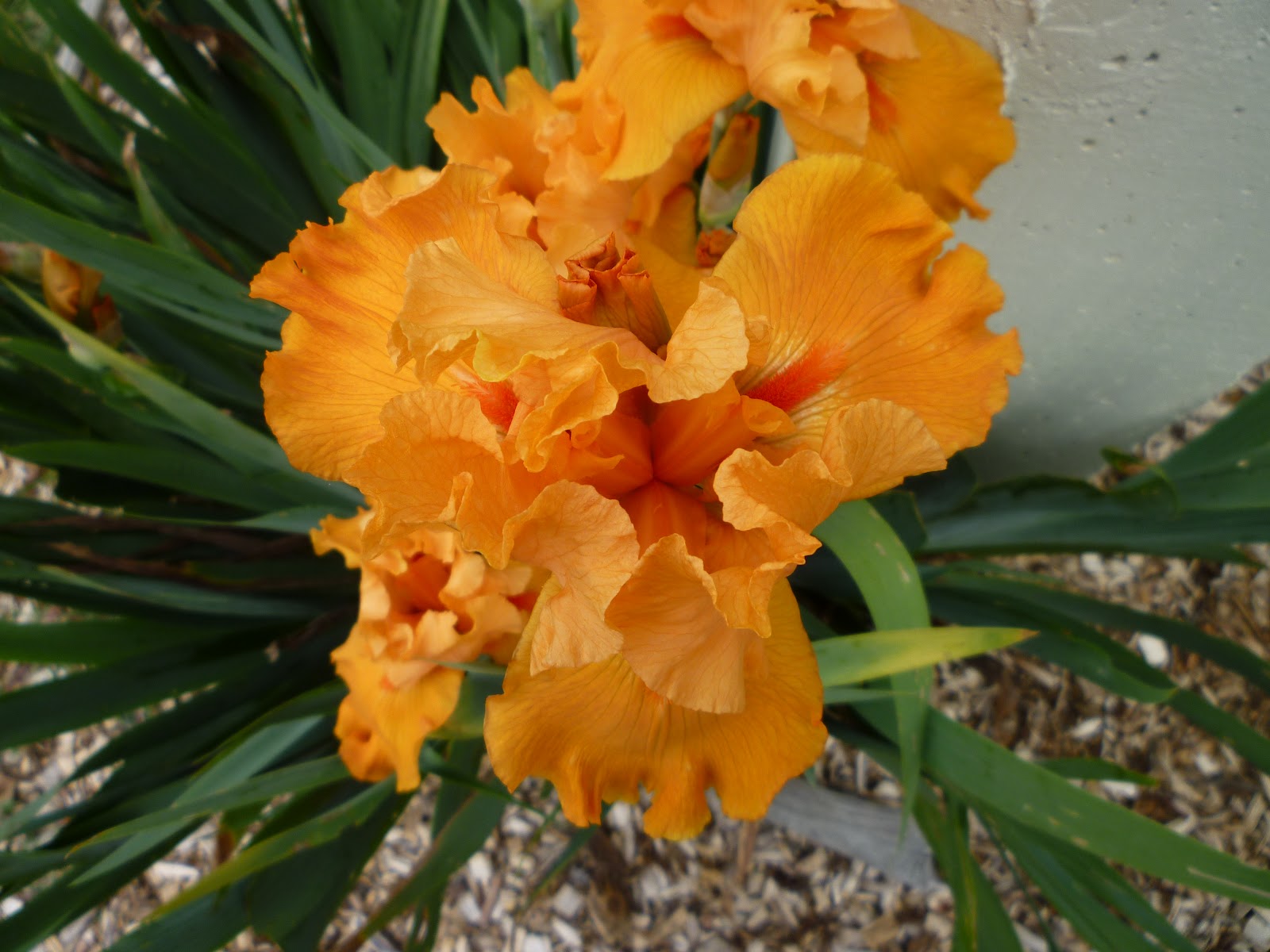
Bearded Iris

Modesty, for example. Here in the United States, the concept of modesty carries for many people connotations of old-fashioned or conservative, but when someone raised in a culture infused by the church thinks of modesty, he thinks immediately of Christ’s mother, the Theotokos — a person, and not a concept. What a blessing God gave me in this word on Mother’s Day!

Before church, and afterward, I couldn’t help but stop to take pictures of the flowers that I no longer have the job of caring for. Pearl sent me a vase of flowers for Mother’s Day, which I have on the table nearby, and God gave me these as well, just a few examples for today of the beautiful gifts he has given me my whole life through, including that of the experience of motherhood, the gifts of five children, and soon-to-be eleven grandchildren. What can I say about this except that it is astounding?

A (probably belated) blessed Mother’s Day to all of you!
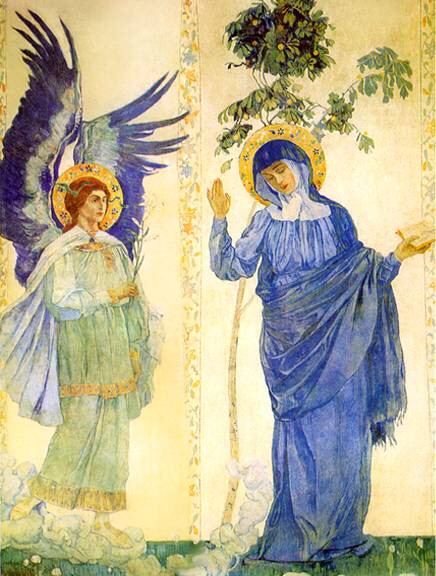
Annunciation

Today is the beginning of our salvation,
And the revelation of
the eternal mystery!
The Son of God becomes
the Son of the Virgin
As Gabriel announces
the coming of Grace.
Together with him let us cry
to the Theotokos:
“Rejoice, O Full of Grace,

the Lord is with you!”

The announcement by the Archangel Gabriel to the Virgin Mary that she would bear the Christ, the Son of God, is one of the twelve Great Feasts of the church year in Orthodoxy, and is celebrated exactly nine months before the celebration of the birth of the Christ Child, on March 25th. The words above are from a hymn that we sing on this feast.

Not long ago I read The Presence of Mary, a booklet by Fr. Alexander Schmemann in the St. Athanasius Study Series, published by Conciliar Press © 1988. In 26 pages the author discusses in depth the role of Christ’s mother in our salvation history, and sets it against “…the fundamental spiritual disease of our time [that] must be termed anthropological heresy.”

That last clause piqued my interest, too! I’ve been wanting to take the time to read the booklet again and write a real review about the truths that Fr. Schmemann helps to clarify, but that time is not now. However, the present moment and celebration does seem to be right for at least posting a quote from the book, as we contemplate her who is “blessed among women”:

“It is clear that an abstract and impersonal study of man posits a self-evident conclusion: man as total dependence. An equally abstract exaltation of man posits its a priori premise: man as total freedom. But both are revealed in the unique personal experience of Mary, an experience given to the Church and made into her experience, as one and the same truth about man.

“In Mary, the very notions of ‘dependence’ and ‘freedom’ cease to be opposed to one another as mutually exclusive. We are inclined to think that where there is dependence there can be no freedom, where there is freedom there can be no dependence. Mary, however, accepts, she obeys, she humbles herself before the living Truth itself, a Presence, a Beauty, a Life, a Call so overwhelmingly evident that it makes the notion of ‘dependence’ an empty one — or rather identical and coextensive with that of freedom. For as long as freedom is nothing but the other side of dependence — a protest, a rebellion against dependence — as long as freedom itself depends on dependence for its meaning, it is also an empty notion. Each time freedom chooses and accepts, it ceases to be freedom. Here, however, in the unique experience of Mary, freedom becomes the very content of dependence, the one eternally fulfilling itself in the other as life, joy, knowledge, communion, and fulness.

“Admittedly these are poor, inadequate, and clumsy human words about an experience, a vision, a reality which transcends all human words. But, having read them, look again at that woman who eternally stands at the very heart of the Church filling our hearts with a mysterious yet ineffable joy, making us repeat eternally that same salutation which she heard in the depth of her heart on the day of Annunciation: Rejoice!”

-Father Alexander Schmemann

(Icon by Mikhail Nesterov)

That Temple You Are

We have begun the celebration of the Feast of the Entrance of the Most Holy Theotokos into the Temple, focusing on an event that is not mentioned in the Bible, but is a story with important meaning.

As Fr. Thomas Hopko explains in The Winter Pascha, “Its purpose is not so much to commemorate an historical happening as to celebrate a dogmatic mystery of the Christian faith, namely, that every human being is made to be a living temple of God.

“The festal event is that the three-year-old Mary, in fulfillment of a promise made at her conception by her parents, Joachim and Anna, is offered by them to God in the temple at Jerusalem.”

And in the next chapter, “In the Orthodox Church the Virgin Mary is the image of those who are being saved….she shows how all people must be when they are sanctified by the Holy Spirit as servants of God and imitators of Christ.”

Lord, may we by your grace imitate your Mother in her glad obedience, and also by your grace live as becomes temples of your Holy Spirit.

“For God’s temple is holy, and that temple you are.”  I Corinthians 3:17