
By the end of the second novel in Rebecca West’s Aubrey Trilogy, This Real Night, the children are grown up, and our narrator Rose is often discussing with herself the meaning of world events and human behavior. The narrator’s inner dialogue is just one of the ways that I think the author expresses her own wonderings and certainties; the reader also learns from discussions between the characters, often in emphatic statements that one or another makes out loud or privately in silence, on any number of topics, from fashion to politics and philosophy, from the motives of others to the failings of herself.
 The constant revelation of what goes on in her highly analytical mind, her wanting to understand the meaning of things, and her sureness that there is something numinous behind the visible world, all draw me to the stories. (She makes me love just being with the characters — I never want to leave them — which is probably a greater reason, but it deserves its own post.)
I don’t know how to describe the elements of her prose style that makes every other sentence seem worth reading a second or third time — so I keep posting samples. I can say that each page is rich in metaphors that somehow are more than metaphorical: they convey an understanding that there is something more than meets the eye; much of the truth of things is underneath, and beyond.
She is quoted as having said, “Writing has nothing to do with communication between person and person, only with communication between different parts of a person’s mind.” She didn’t complete This Real Night until almost 30 years after The Fountain Overflows, and it was published in 1984, the year after her death. Here are a couple of passages from the last chapters:
 “We were not surprised when the war came, for we had heard our father prophesying it all through our childhood… We had also been warned by our music. Great music is in a sense serene; it is certain of the values it asserts. But it is also in terror, because those values are threatened, and it is not certain whether they will triumph in this world, and of course music is a missionary effort to colonise earth for imperialistic heaven. So we were not so sorely stricken by August, 1914, as many other people. Indeed we had our consolations. It was proved to us that music was not making a fuss about nothing, and that the faces of our parents had been distorted out of common placidity not by madness but by the genuine spirit of prophecy.”
Soon, however, their only brother Richard Quin enlists, and after a few months of training in England, during which his family sees him often, he ships off to the Continent, and they accompany him to Victoria Station in London.
“The space around the station had become one of those areas which, like cemeteries and the corridors of hospitals, are swinging on a turntable between the worlds… myri ads of men in uniform, deformed by the weight of the kitbags on their backs, of women and children scurrying by their sides, those also deformed, by the weight of grief and stoicism… Above, a great dimly lit illuminated clock said that this was the hour. The occasion was the annulment of life, for what is life but being able to move according to the will?
“But the people who got out of the taxis and cars, all the men bent under their kitbags, were doing what their will would never want them to do, which it could never let them do, were it not in the custody of something outside them not certified to be wise or loyal. The clock said that there was not time to start that argument….”
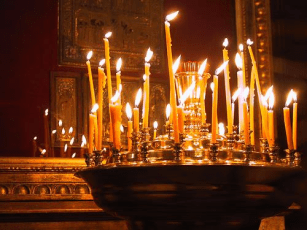 “Our lighted candles are a sign of the divine splendor of the one who comes to expel the dark shadows of evil and to make the whole universe radiant with the brilliance of his eternal light. Our candles also show how bright our souls should be when we go to meet Christ. The Mother of God, the most pure Virgin, carried the true light in her arms and brought him to those who lay in darkness. We too should carry a light for all to see and reflect the radiance of the true light as we hasten to meet him. The light has come and has shone upon a world enveloped in shadows; the Dayspring from on high has visited us and given light to those who lived in darkness. This, then, is our feast, and we join in procession with lighted candles to reveal the light that has shone upon us and the glory that is yet to come to us through him. So let us hasten all together to meet our God.
 splendor, and be so filled with it that no one remains in the darkness. Let us be shining ourselves as we go together to meet and to receive with the aged Simeon the light whose brilliance is eternal. Rejoicing with Simeon, let us sing a hymn of thanksgiving to God, the Father of the light, who sent the true light to dispel the darkness and to give us all a share in his splendor.

 Gladsome Lights