And so the Shortest Day came and the year died
And everywhere down the centuries of the snow-white world
Came people singing, dancing,
To drive the dark away.
They lighted candles in the winter trees;
They hung their homes with evergreen;
They burned beseeching fires all night long
To keep the year alive.
And when the new year’s sunshine blazed awake
They shouted, revelling.
Through all the frosty ages you can hear them
Echoing behind us – listen!
All the long echoes, sing the same delight,
This Shortest Day,
As promise wakens in the sleeping land:
They carol, feast, give thanks,
And dearly love their friends,
And hope for peace.
And now so do we, here, now,
This year and every year.
Welcome Yule!
Earlier this month we were reminded of the popularity of St. Nicholas in the Orthodox Church around the world. If you took a vote for the favorite saint, he would win. Another, more modern saint, who lived in the 19th century, is also remembered in December: St. John of Kronstadt. I see that he had some of the same qualities as St. Nicholas. This article tells how generous he was to the poor. Here is a small excerpt:
He would shop for food, go to the pharmacy for prescriptions, to the doctor for help, many times giving the poor his last few coins. The inhabitants of Kronstadt would see him returning home barefoot and without his cassock. Often parishioners would bring shoes to his wife, saying to her, “Your husband has given away his shoes to someone, and will come home barefoot.”
He seems to have had the gift of exhortation; he truly loved people, whether the upper classes or the criminals who were exiled to Kronstadt at the time, and would spend hours at a time in the shacks of the latter, “talking, encouraging, comforting, crying, and rejoicing together with them.”
His popularity has not waned, judging from the fact that between 1990 and 2016, “more than 60 new churches or altars in Russia alone were dedicated to him,” his flat in Kronstadt became a registered museum, his biography was published in a highly respected series, and monuments to St. John have been placed in cities not only in Russia and gifted to Orthodox communities around the world, including in Washington, D.C., in 2019.
This monument to him was installed last year in his home village of Sura, Arkhangelsk Province, in northwestern Russia, which in 2010 had a population of 727:
Because of his zealous love and spirit of encouragment, one can find many helpful quotes from the saint, and I have posted a few in the past. Here I pass on an exhortation from St. John that is a good reminder to us in the current era, of ultimate reality:
“There is nothing impossible unto those who believe; lively and unshaken faith can accomplish great miracles in the twinkling of an eye. Besides, even without our sincere and firm faith, miracles are accomplished, such as the miracles of the sacraments; for God’s Mystery is always accomplished, even though we were incredulous or unbelieving at the time of its celebration. ‘Shall their unbelief make the faith of God without effect?’ (Rom. 3:3). Our wickedness shall not overpower the unspeakable goodness and mercy of God; our dullness shall not overpower God’s wisdom, nor our infirmity God’s omnipotence.”
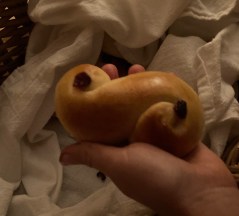
The first half of the week was a flurry of activity: First a Santa Lucia Eve procession that I was invited to, with a few families I have been getting to know because of my involvement in a homeschool group. With the eldest girl wearing a wreath studded with candles, we processed through the neighborhood singing “Santa Lucia” in Italian — I admit I was only humming the tune because I haven’t become that involved to have learned the words in Italian or even English. Then back at the house, we added “Stille Nacht” (Silent Night) in the original German. Tea and Santa Lucia buns in their delicious quintessential selves finished out the evening’s simple program. I took the picture three days later so the greenery is a bit dried out.
The next night our women’s book group at church got together. Originally that meeting was to be a soup dinner for 10 at my house, but the time and place got changed because of a funeral; it was a big relief for me, because as soon as December arrived, I couldn’t imagine getting ready for a party at the same time I was getting ready for a trip, which this year is the case: I’m headed to Soldier and Joy’s for Christmas.
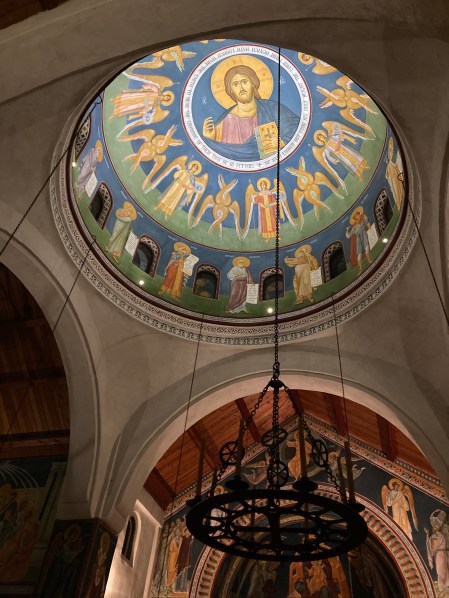
At the first part of the funeral, in the evening.
I made split pea soup, and we had a very festive group and evening, eating fish chowder, pumpkin soup and lentil tomato soups as well — plus accompaniments. Of course, cookies and vegan brownies, too! I don’t think I mentioned before what books we have been reading this time. They were Strength in Weakness by Archbishop Irenei Steenberg, and The Secret Garden by Frances Hodgson Burnett. I’d been wanting to gather my thoughts on The Secret Garden for about five years, so this was the impetus I needed to buckle down. I’ll share more about my resulting amateur analysis in the new year.
By Julia Morgan
Thursday I attended a tea party of about a dozen ladies and girls, several of whom I was meeting for the first time. Many of them are very accomplished, cultured and educated, and there was lots of fascinating conversation about our personal histories, world events, information about our local towns and the architecture of particular houses that were built by a relation of the woman sitting next to me. She was the only one there who is older than I, and she has been involved in our town’s history from way back, and continuing.
It was while this talk was flowing around me that the name of Julia Morgan, architect, made me pay closer attention; a bit more information about the time frame in which she worked, and I began to wonder if my grandfather was one of the contractors that she worked with in the San Francisco Bay Area; she designed more than 700 houses in California. I will be doing more research on that, but in the meantime I show you these photos of the Berkeley City Women’s Club building, in which my grandmother (on the other side of the family) was very active, and where she took us swimming when we visited her. That building has been called a “little Hearst Castle,” referring to the real (huge) Hearst Castle in San Simeon, California, the estate that Morgan designed with William Randolph Hearst.
Since the tea party I have switched gears and stayed home, slowly working on wrapping presents, packing bags and organizing my thoughts in preparation for my departure. One by one little things that need to be done come to mind and I do them, or write them down. It is not very systematic, and the whole process seems to require frequent attention to everyday tasks like building the fire and tending the frozen fountain. I guess it’s because I’m not systematic that I require banks of time for the creative flow to happen. As I am fond of quoting G.K. Chesterton:
“I am not absentminded. It is the presence of mind that makes me unaware of everything else.”
Even things I’ve been procrastinating on for months must be put off no longer, whether or not they have anything to do with the trip — like making a phone call. My daughter Kate says everyone does the same at the end of the year, finally sending in reports or contacting loved ones, I guess because they don’t want to come back from Christmas break with “old business,” whether it’s work or family related, dutiful or joyful.
Now that I’ve procrastinated enough to get another unnecessary thing done, the writing of this post, I will have to hustle a little bit and fold the clothes I laundered, to figure out what to take with me. Before I know it, these in-between days will have ended and I’ll be boarding an airplane and on my way to a happy reunion with several of my dear family. I hope that on Christmas Eve we will sing “Stille Nacht.”
I am my own geology, strata on strata of the imagination, tufa dreams, the limestone mind honeycombed by the running away of too much thought. Examine me, tap with your words’ hammer, awaken memories of fire. It is so long since I cooled. Inside me, stalactite and stalagmite, ideas have formed and become rigid. To the crowd I am all outside. To the pot-holing few there is a way in along passages that become narrower and narrower, that lead to the chamber too low to stand up in, where the breath condenses to the cold and locationless cloud we call truth. It is where I think.
-R.S. Thomas
I began to read a biography of R.S. Thomas a while back. Its tone was unsympathetic, and as with many biographies of writers, it didn’t facilitate my relationship with the poet. With Thomas, if you want to be any kind of friend, you have to accept his particular “geology,” which is full of rocks and stones and cold clouds, all waiting for that day when the sun will shine fully on the landscape, burn off the fog, and never set again. I am content to wait with him, and not to try to “figure him out” in this life.
Where I grew up our winters frequently featured cold fog. Foggy days such as I actually enjoy on the beach nearest me, when the thermometer stays above 50, are way different from the 27-degree tule fog of my youth, which can hang on and chill the spirit all day.
Thomas seems to be saying that those few people who stumble into his inside, where he thinks, will not find a comfortable place to rest. It’s a place without location, somehow. Whatever can be felt with the senses, it’s cold and cramped. There is little solace in abstract truth.
Even the request, “Examine me… tap… awaken memories of fire” refers to something of the mind: memories. But if this is a prayer, the real God who is not a memory or an idea, but is the only one who has Being in Himself, might come and be present in the present. Not just to revive memories of past events, but to create actual warmth and spaciousness in the soul. He has been called a consuming fire, and the Sun of Righteousness. He is definitely what the wintry and frozen soul needs.
“But for you who revere my name, the sun of righteousness will rise with healing in its wings. And you will go out and leap like calves released from the stall.”


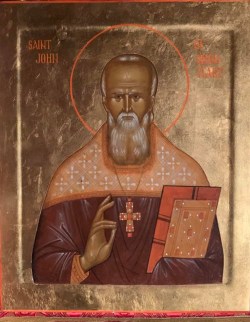 Earlier this month we were reminded of the popularity of St. Nicholas in the Orthodox Church around the world. If you took a vote for the favorite saint, he would win. Another, more modern saint, who lived in the 19th century, is also remembered in December: St. John of Kronstadt. I see that he had some of the same qualities as St. Nicholas.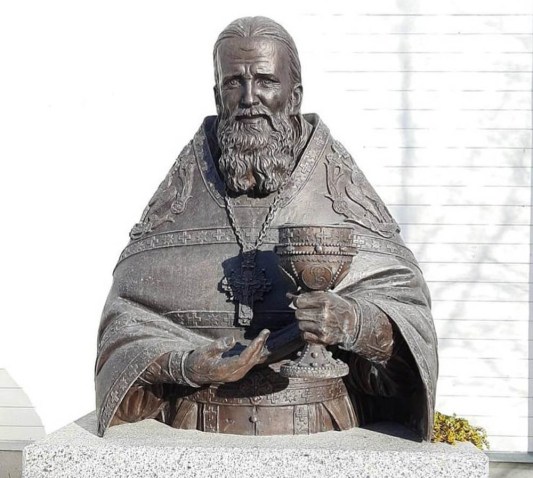





 Gladsome Lights