The glorious beheading of the Forerunner, became an act of divine dispensation, for he preached to those in hell the coming of the Savior. Let Herodias lament, for she entreated lawless murder, loving not the law of God, nor eternal life, but that which is false and temporal.
-Hymn for the Feast, of The Beheading of the Glorious Prophet, Forerunner and Baptist John.
St. Poimen (or Pimen, or Poemen) the Great was born in Egypt in about 340. He and his two brothers joined themselves to a monastery in Scetis. After raids on Scetis caused the monastics to disperse, they began to assemble the Sayings of the Desert Fathers (the Apophthegmata Patrum), in which St. Poimen is the abba or poemen (“shepherd”) most often quoted.
“For many of the monks, Saint Pimen was a spiritual guide and instructor. They wrote down his answers to serve for the edification of others besides themselves. A certain monk asked, ‘If I see my brother sinning, should I conceal his fault?’ The Elder answered, ‘If we reproach the sins of brothers, then God will reproach our sins. If you see a brother sinning, do not believe your eyes. Know that your own sin is like a beam of wood, but the sin of your brother is like a splinter (Mt. 7:3-5), and then you will not enter into distress or temptation.'”
“Once, a monk from another country came to the saint to receive his guidance. He began to speak about sublime matters difficult to grasp. The saint turned away from him and was silent. They explained to the bewildered monk that the saint did not like to speak of lofty matters. Then the monk began to ask him about the struggle with passions of soul. The saint turned to him with a joyful face, ‘Now you have spoken well, and I will answer.’ For a long while he provided instruction on how one ought to struggle with the passions and conquer them.
“Saint Pimen died at age 110, about the year 450. Soon after his death, he was acknowledged as a saint pleasing to God. He was called ‘the Great’ as a sign of his great humility, uprightness, ascetic struggles, and self-denying service to God.” oca
It seems I never wrote last summer about how I had to prune my asparagus early. I didn’t have time, because of how that project consumed me. The same phenomenon is forcing me to do it again this year: an infestation of aphids in the thick jungle of fronds. Last week I saw a few ladybugs on the plants, and thought, Oh, no, I bet it’s happening again. I looked more closely, but the invasion wasn’t obviously imminent.
Then today, as I was trimming the irises, I noticed that some of their leaves had the sticky “honeydew” sign of aphids. That’s exactly what I was doing last year when, as today, I looked up at the asparagus fronds bouncing off my head — Why oh why hadn’t I worn a hat? — and saw the shiny mess everywhere. I had taken a lot of pictures last year (including two I’m posting now), but never got around to sharing anything of that experience; there were immensely more pleasant things to tell about.
Searching online, I did not discover any tricks to prevent this happening every year, though I did learn that much of California is so mild that aphids are a problem with many crops; there are aphids specific to many plants, a fact I didn’t know before. Maybe I have the European Asparagus Aphids.
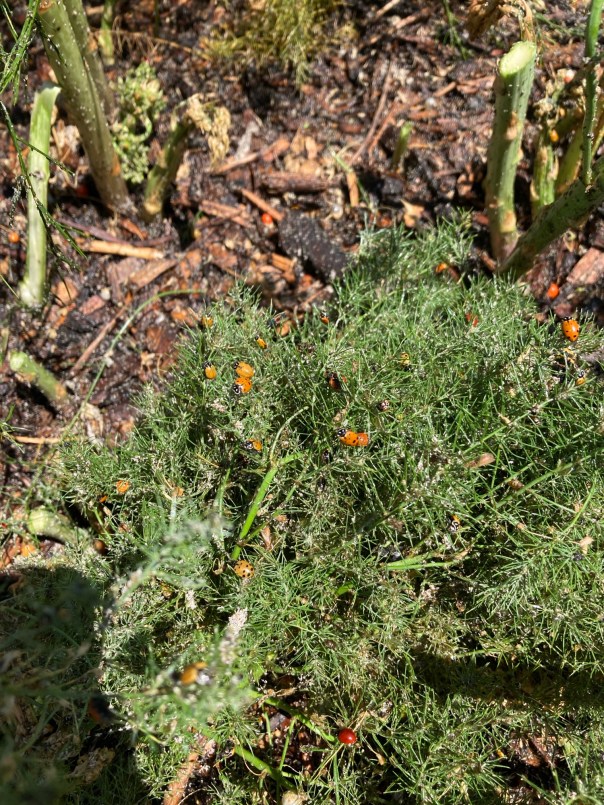
A single adult ladybug can eat up to 50 aphids per day, and the ones that arrived in my garden this month have feasted well, but they can’t keep up. One is supposed to wait to prune asparagus after cold weather makes the fronds turn brown, so that they have as long as possible to carry on photosynthesis. But if aphids are destroying them anyway, not much is lost by doing it early.
Ladybugs in ’24 after I took away much of their food.
Jacques the Gardener in San Diego shows in his video how he had the same problem I do, in his much smaller plot, and his reasoning about having to cut down the plants months before the usual time helped me to feel better about doing the same. Last year there were so many mild-weather months remaining after I removed the decimated fronds, a whole new crop of them sprouted, which I knew would start over the process of turning the fall sunshine into food for the crowns. Eventually they had to be cut off also. My spring crop following all that was pretty good this year, but it’s possible that a continued aphid plague will weaken the plants.
August 2024, after one of two beds had been cut back.
Today, I only cut off a few of the stalks, to clear the way for me to finish cleaning up the irises. In the process aphids and aphid carcasses drifted down on my hair and clothes. In the next couple of months I’m dividing and replanting the irises and changing things around in that area, so I think after cutting all the asparagus to the ground I’ll take the mulch off the whole space as well and start with fresh everything. I hope that might reduce next year’s aphid population a little.
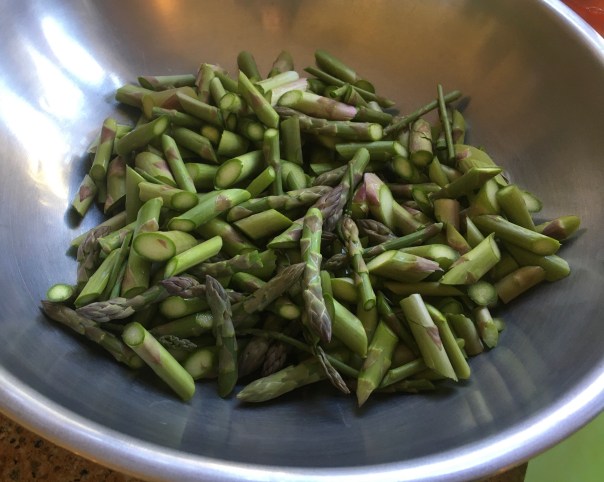
In the meantime, I will close with a more positive visual reminder of why I do all this work:





 Gladsome Lights