
It’s been an exciting week. I have to share the most wonderful happening first, which is that my grandson Pat’s wife just gave birth to their first baby. Glory to God! This is my fourth great-grandchild. So far among the Greats there are three boys and one girl. I’ll share a photo as soon as I get a suitable one. Welcome, Little Boy!
(In the meantime, here’s Pat at left, long before he was considering marriage and children.)

“The essential rectitude of our view of children lies in the fact that we feel them and their ways to be supernatural while, for some mysterious reason, we do not feel ourselves or our own ways to be supernatural. The very smallness of children makes it possible to regard them as marvels; we seem to be dealing with a new race, only to be seen through a microscope.
“I doubt if anyone of any tenderness or imagination can see the hand of a child and not be a little frightened of it. It is awful to think of the essential human energy moving so tiny a thing; it is like imagining that human nature could live in the wing of a butterfly or the leaf of a tree. When we look upon lives so human and yet so small, we feel as if we ourselves were enlarged to an embarrassing bigness of stature. We feel the same kind of obligation to these creatures that a deity might feel if he had created something that he could not understand.”
– G.K. Chesterton
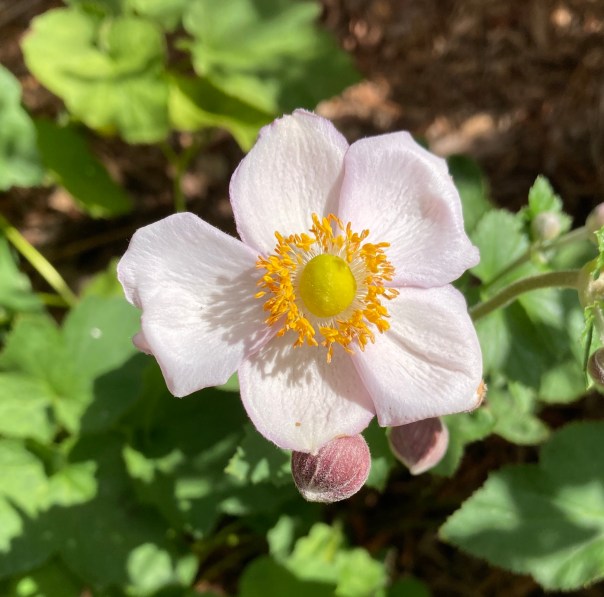
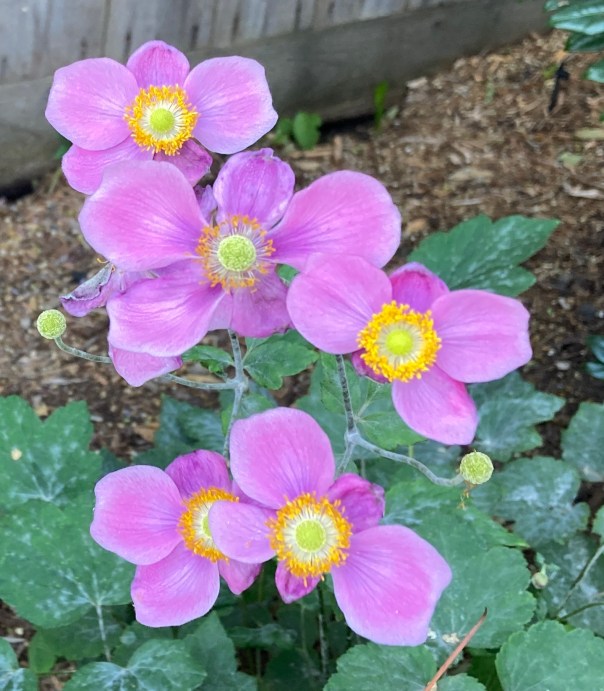
In the last year I’ve planted three different types/colors of Japanese anemones, and the second of these new groups, the pale pink, opened its first flower yesterday. My old white ones have been blooming for a few weeks, and the new dark pink flowers with a wonky petal pattern also. The dark pink ones are the most enthusiastic, thriving on the amount of sun and water they get; I’m hoping the mildew they have suffered is just from unusual weather this year, and won’t always happen.
Recently my daughter Pearl and I were talking about Elizabeth von Arnim’s books, as we often do, and she suggested I might like The Adventures of Elizabeth in Rügen. I got it right away and have been reading it on Kindle — many of von Arnim’s books are out of print — to great enjoyment. In her telling of her travels around the German island and among other tourists, Elizabeth often uses words such as happy, blessed, joy, light and radiance to convey how she feels when out of doors, particularly when the sun is shining. She is my kindred spirit for sure. Here is one excerpt that reminded me of my own joy this very week:
“ Oh blessed state, when mere quiet weather, trees and grass, sea and clouds, can make you forget that life has anything in it but rapture, can make you drink in heaven with every breath! How long will it last, this joy of living, this splendid ecstasy of the soul? I am more afraid of losing this, of losing even a little of this, of having so much as the edge of its radiance dimmed, than of parting with any other earthly possession.”
In other places her descriptions of the people she meets and the conversations among them are, as is usual with her, both insightful and very funny!
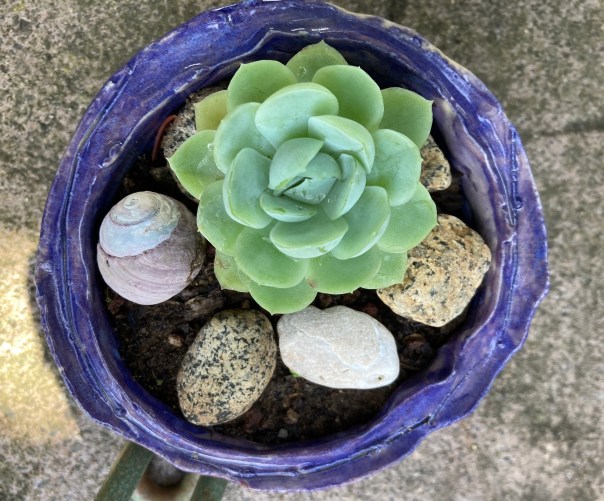
This little purple pot above was given to me by my granddaughter Ivy. It was the first thing she ever made of clay, and it has a convenient hole in the bottom so it can serve as a planter pot. It’s small, and just the right size and color to set off the beauty of a little chick type of succulent. When it becomes a hen I may have to substitute another chick in its place.
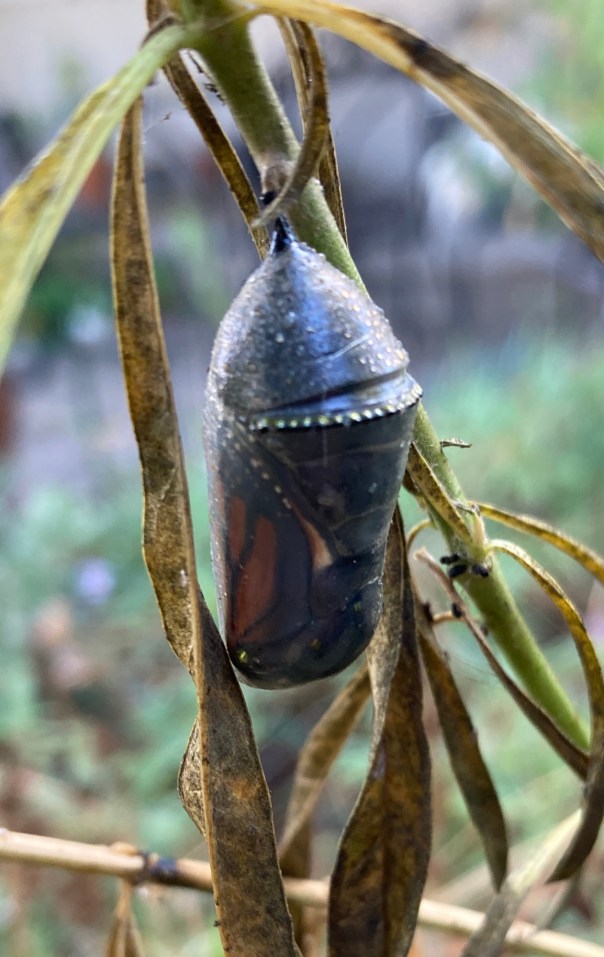 I had another super exciting day when the Monarch chrysalis we’ve been watching matured and the butterfly emerged. The pupa stage lasted about three weeks, which is on the long side, and I wondered if possibly the insect had died. But the delay was likely just due to the week of cool and drizzly weather we had recently; the case darkened, and I began to see the Monarch colors inside.
Early in the morning I went out to look, and it was a chrysalis. An hour later, still in my nightgown, I checked again, and the butterfly had broken out. (This makes a total of four Monarchs I have monitored closely, yet missed their big event.) He was clinging to the mostly-bare milkweed stem, his wings hanging behind, heavy and damp.
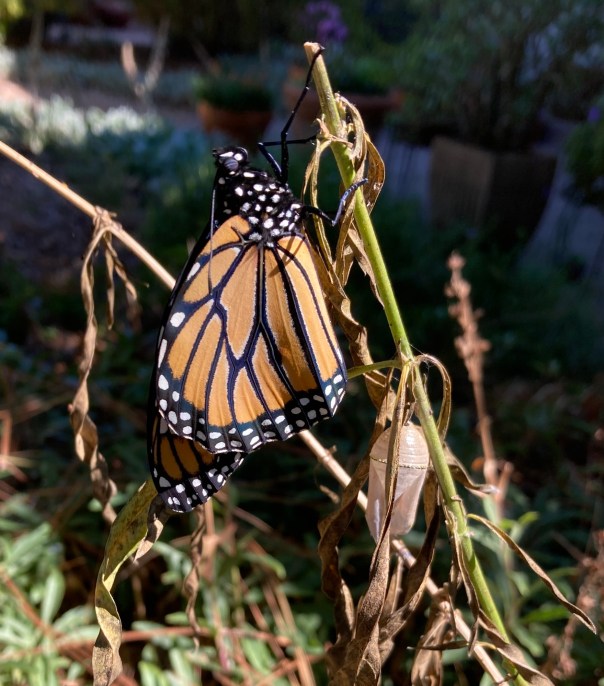
All along I’d been worried that there was not enough food on those plants to grow a caterpillar to sufficient size, especially since the aphids were devouring the leaves at a fast rate. Then when the caterpillar entered the pupa stage, I thought, “Isn’t that chrysalis kind of small? Maybe it’s undernourished….” Now I stared and stared some more, amazed at how such a creature could have been so tightly packed into the thin case. A full-sized Monarch!
The sunlight was weak, so we waited, Mr. Monarch and I, for his wings to dry; intermittently and gently he opened and closed them. Drops of meconium (I looked it up) fell from his body several times. After a couple of hours he began to flap them a lot and flew/fell into the twiggy penstemon patch.
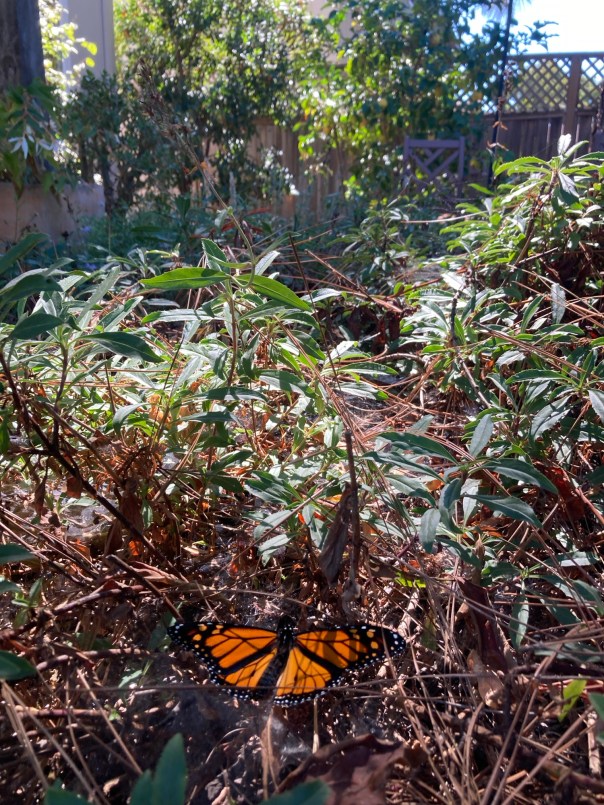
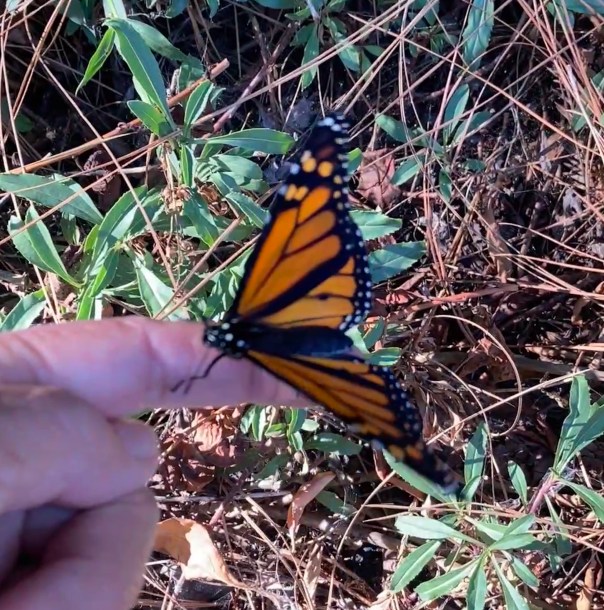
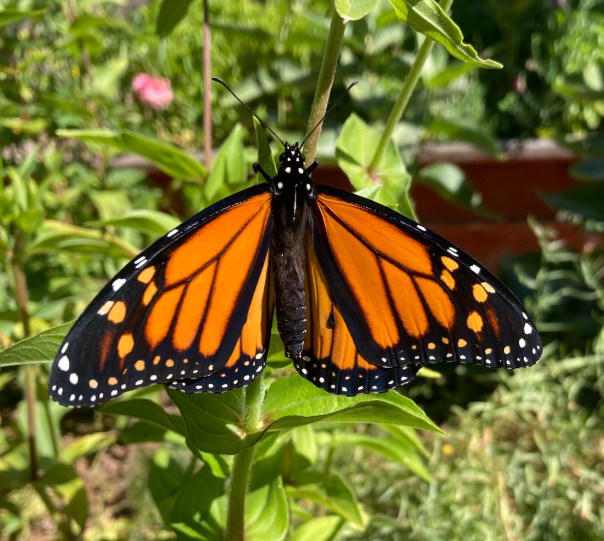
Down there I feared he’d dropped into a spider’s web, so as he struggled to walk out through the tangle, I put my finger near his head so he could climb onto it. Then I carried him, walking up my sleeve, to the zinnias in the planter box, where he was glad to attach himself to a stem.
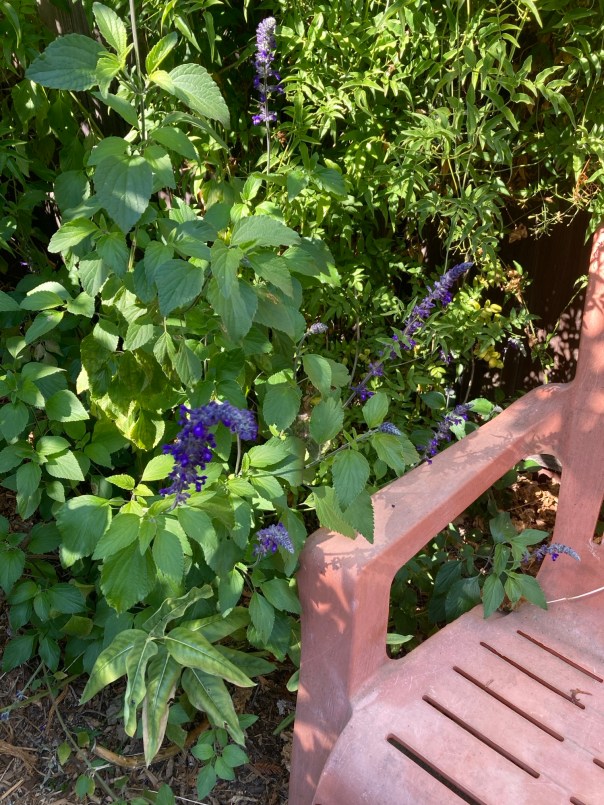
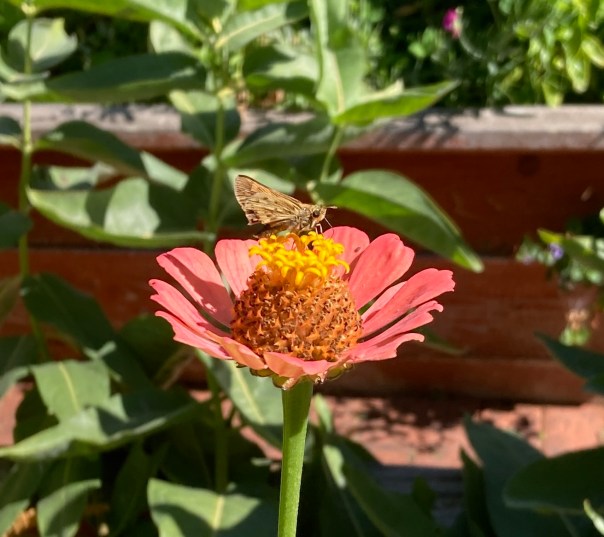
I sat for a while in this chair nearby, where the buzzing of the bees in the salvia made garden music for me. Skippers were all over the zinnias, too, but they are hard to catch at their business, they are so quick to take a drink on the fly.
The glorious Monarch stayed another full hour on his zinnia stem before he flew up and away, eventually to a perch high up in 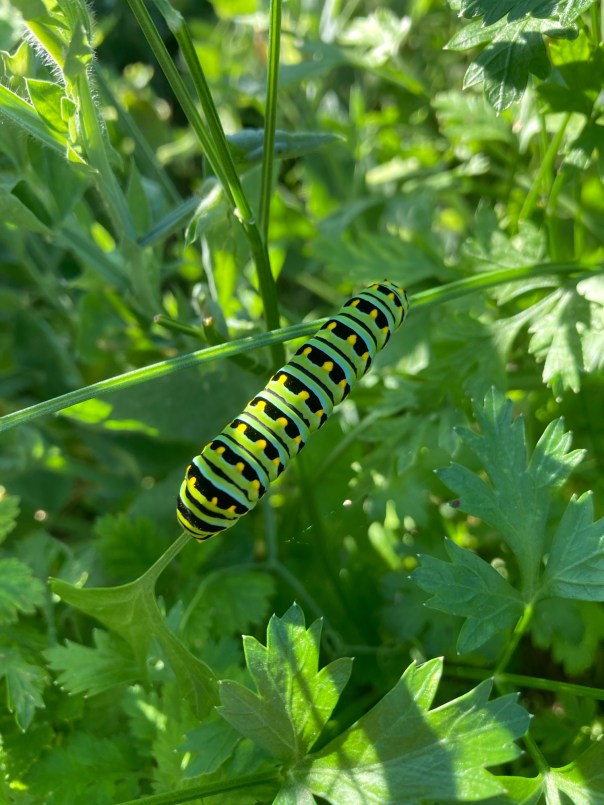 the neighbor’s redwood tree. There’s no flower nectar to drink there, so I imagine he came down soon, but by then I was very late in Getting On With My Day, and had to go in.
The Anise Swallowtail caterpillars Bea and I had seen a couple of weeks ago disappeared; I hope they are hidden away in their next stage of development somewhere. But two more of these gorgeous creatures can be seen feasting on the parsley now (at right).
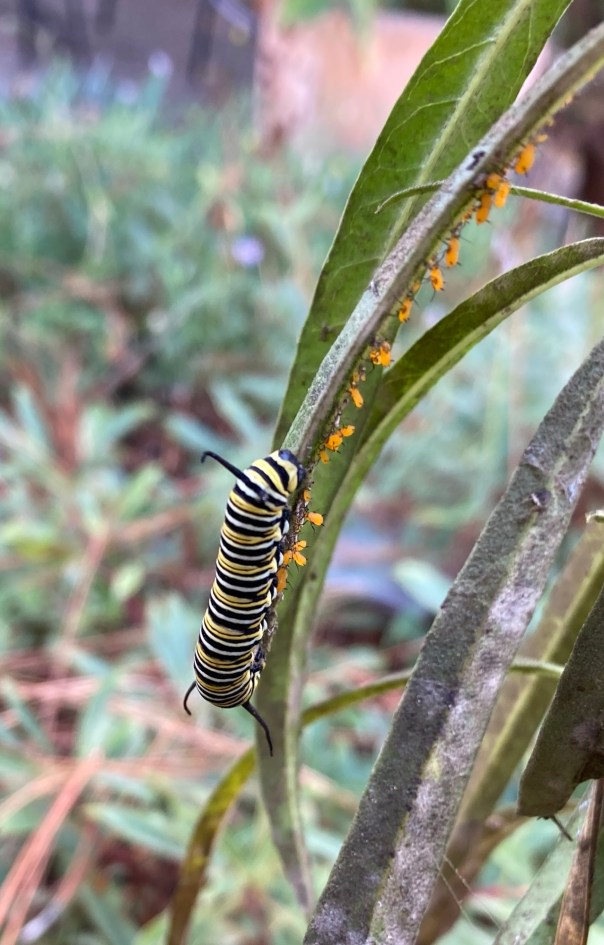
And there is another Monarch caterpillar not fourteen inches from where the one just emerged. It seems that there is indeed enough of the narrow milkweed leaves to support not only a large aphid population but at least one butterfly.
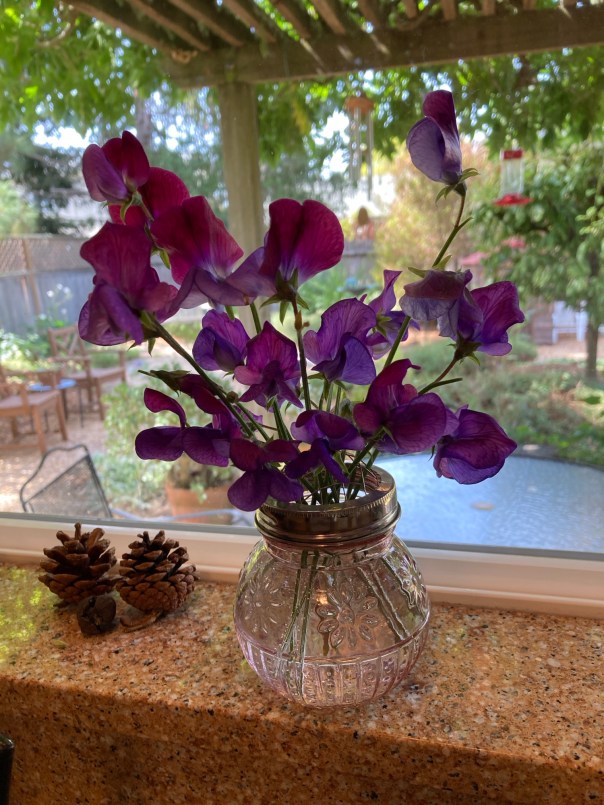
As you can see, the week was rich and full beyond the baby and the butterfly. But let me mention two more things that amazed me this week: Sweet peas blooming in September! Not many, but enough for a tiny bouquet. And the music of the piano.
I try not to talk overmuch here about my new housemate, so I will only say that a certain person has been playing my piano more than it’s been played in a very long time. Sometimes she plays morning and evening, and once I woke to the comforting sounds, and once it was as a lullaby when I went to sleep. This is a gift I never thought to ask for, but my Father thought to give it to me.
Do you suppose next week will be calmer?


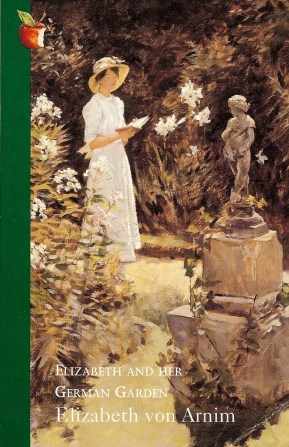
 Probably I should go back and read some of Elizabeth Von Arnim’s descriptions of gardens, to teach me how to convey the scene that makes me so happy. Not only in Elizabeth and Her German Garden but even more in The Enchanted April she expresses her love for this kind of overflowing, colorful and scented landscape, and gardens that are so prolific with blooms that bowls of them bless the rooms of the Italian castle in April (in April, too).
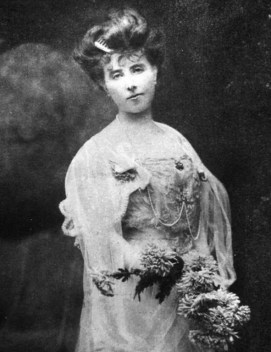 I just discovered that I have never once reviewed a book by Elizabeth von Arnim, or posted a quote by her, on my blog. I guess this is because my relationship with her as a person and writer is about much more than any one of her books; and isn’t it always somewhat of a mystery why we connect with particular authors? Mary Kathryn says it is the writer’s voice that she connects with, and it doesn’t matter what they write about, if one loves that particular voice.
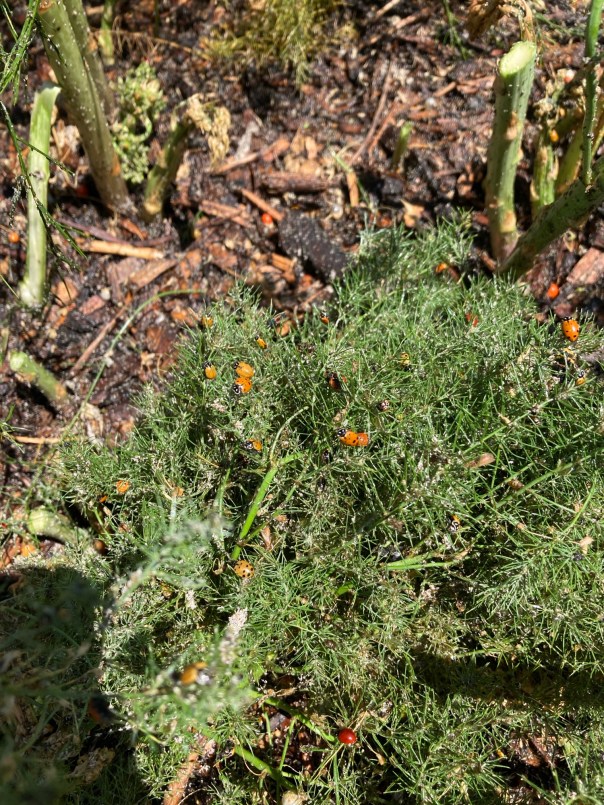
 Today when I went out to try for a picture of the Lambs Ears, I discovered that the Narrow-Leaf Milkweed flowers have started to open. These are the plants from which I collected Monarch butterfly eggs to incubate indoors, a few years ago. Aphids always decimate the plants, and after that first year’s destruction I realized that any hatched caterpillars would run out of food fast, because the leaves are literally slim pickings to begin with, and then the aphids suck all the life out of them. (By the way, you don’t want to bring in ladybugs to eat the aphids on your milkweed plants because ladybugs also eat Monarch eggs!!) Back then I had to feed my Monarch caterpillars from my Showy Milkweed plants which have large leaves and which the aphids don’t bother so much.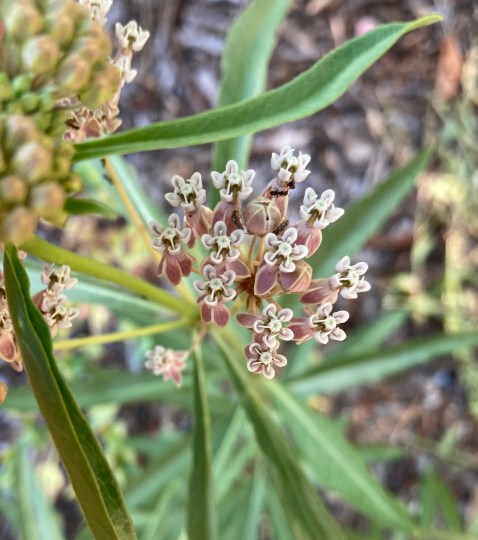
 When I got home from church this afternoon I baked a cheese tart from Trader Joe’s and ate it outdoors, and as the sun did not go behind a cloud, I read the Heritage Farm Companion and did some Spanish lessons. The Companion is a little magazine for members of the
  that situation as benign, whereas the aphids are a plague. Maybe there is a connection?
 Several times in the last week I’ve been able to sit in the warm garden, usually in the early afternoon. The morning is often overcast and around 55°; dinner times a cool marine breeze often drives us indoors. Today after I finished my tart I glanced behind me and saw that the toadflax is finally in full bloom. It looks pretty weedy most of the year, and even now 🙂 but the flowers are so cheery… I’d say it never looks better than today.
 their favorite flower around here. Come to think of it, there are blooming lamb’s ears right next to the aphid-infested milkweed… ? …but the hoverflies are mostly in the front yard… ? I need to think about this some more.

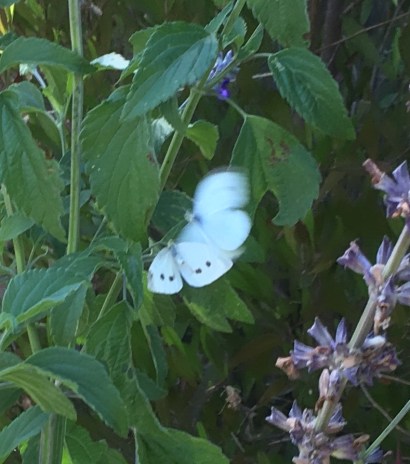
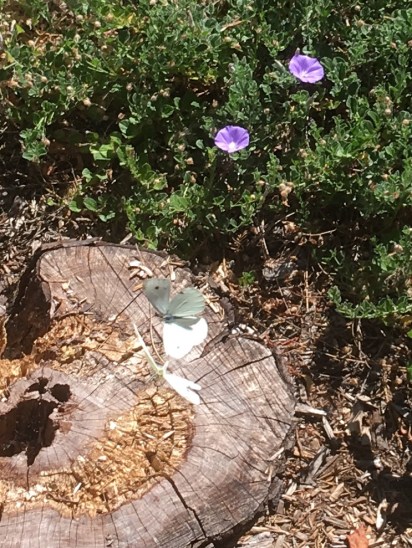
 A year or so ago I decided to study Spanish. In much of California it’s kind of crazy not to know Spanish, but I chose French in high school, and several other languages since then. I’ve had close friends who were Spanish majors, and four of my children studied Spanish for two or more years. When I started doing 5-minute lessons on my phone using the Duolingo app I discovered that I already knew quite a lot. It’s been more like play than work, because there are no humans to see my work, no shame in goofing up. I get points for doing the lessons no matter how many times I get something wrong. For six months I managed to do at least one five-minute lesson per day.
 When I was at Kate’s for three weeks I didn’t have any gardening or housework or church work to do, and I was able to do so many Spanish lessons one day that my brain grew weary. It occurred to me that there would be no harm in checking out the French course, to brush up on my French; in my youth I studied it first and the longest, so it’s probably stuck deep in the recesses of my mind… While mom and babies were napping, I did quite a few French lessons, and they were even more fun than Spanish. On Duolingo the first lessons of a language are short so you whip right through them — especially if they are ones you did when you were 13!
 So the next day what did I do? Turkish! I’ve had very little Turkish instruction, but I did spend six months total in that country, living with Turks, and it has been pure delight to do Turkish lessons. You may ask, what about my work, now that I am home again? It is mostly not stuff that anyone else cares if I do or not. And I’m still in a kind of limbo about my remodeling project, which makes it hard for me to know just what thing is the Next Thing. So I behave as though the maid is going to show up soon, and I am a woman of leisure with nothing more important to do than to read about seeds and learn a useless language.
