Tag Archives: Walter de la Mare

The very proof of me.

Walter de la Mare in the poem below does not sound sad for himself, that he should leave this world and go to a place without lamentation and darkness. But when he is removed from this earthly realm and will no longer be around to praise and wonder and delight in its beauties… will someone else take his place in that role? I’m intrigued by the idea he puts forth here, which sounds like “Beauty is in the eye of the beholder.” Beauty is somehow also personified, and passes on the legacy of wonderment from one generation to another.

I don’t believe that when we leave this earth, we will forget its beauties, though He Who is the source of all beauty will certainly consume our attention. But it is surely a sign of his great love, and most natural for him, that De La Mare wants to be sure that those earthly delights have admirers when he is gone.

I wasn’t familiar with the flower that the poet names, Traveler’s Joy, so I looked it up and found that yes, it’s a clematis that is famous in the U.K. for climbing to the tops of hedgerows. Late in the season it takes on the appearance that makes people call it Old Man’s Beard, as in the photo at the bottom.

FARE WELL

When I lie where shades of darkness
Shall no more assail mine eyes,
Nor the rain make lamentation
When the wind sighs;
How will fare the world whose wonder
Was the very proof of me?
Memory fades, must the remembered
Perishing be?

Oh, when this my dust surrenders
Hand, foot, lip, to dust again,
May these loved and loving faces
Please other men!
May the rusting harvest hedgerow
Still the Traveller’s Joy entwine,
And as happy children gather
Posies once mine.

Look thy last on all things lovely,
Every hour. Let no night
Seal thy sense in deathly slumber
Till to delight
Thou have paid thy utmost blessing;
Since that all things thou wouldst praise
Beauty took from those who loved them
In other days.

-Walter de la Mare

Photo by Phil Gates in The Guardian

A Widow’s Weeds

I doubt anyone would label me a “poor old widow,” but I can relate to many things in this little poem. It’s given me a brand new idea, too, of sewing in my garden. Today would be fine day for that…

A WIDOW’S WEEDS

A poor old Widow in her weeds
Sowed her garden with wild-flower seeds;
Not too shallow, and not too deep,
And down came April — drip — drip — drip.
Up shone May, like gold, and soon
Green as an arbour grew leafy June.
And now all summer she sits and sews
Where willow herb, comfrey, bugloss blows,
Teasle and tansy, meadowsweet,
Campion, toadflax, and rough hawksbit;
Brown bee orchis, and Peals of Bells;
Clover, burnet, and thyme she smells;
Like Oberon’s meadows her garden is
Drowsy from dawn till dusk with bees.
Weeps she never, but sometimes sighs,
And peeps at her garden with bright brown eyes;
And all she has is all she needs —-
A poor old Widow in her weeds.

-Walter de la Mare

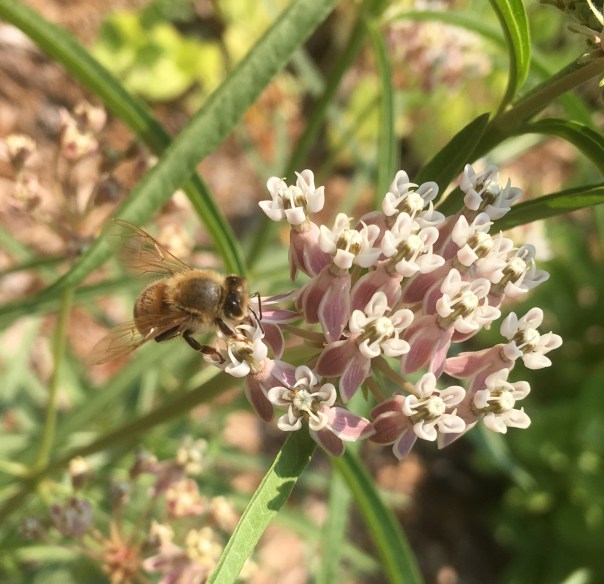
Bee on Narrow-Leaf Milkweed


Incense to solace the Princess.

These verses are fun when read aloud, especially if shared with a child.

THE BEES’ SONG

Thousandz of thornz there be
On the Rozez where gozez
The Zebra of Zee:
Sleek, striped, and hairy,
The steed of the Fairy
Princess of Zee.

Heavy with blossomz be
The Rozez that growzez
In the thickets of Zee.
Where grazez the Zebra,
Marked Abracadeeebra,
Of the Princess of Zee.

And he nozez that poziez
Of the Rozez that grozez
So luvez’m and free,
With an eye, dark and wary,
In search of a Fairy,
Whose Rozez he knowzez
Were not honeyed for he,
But to breathe a sweet incense
To solace the Princess
Of far-away Zee.

-Walter De La Mare,
from the collection for children,
Peacock Pie

Tiny things grow great and mighty.

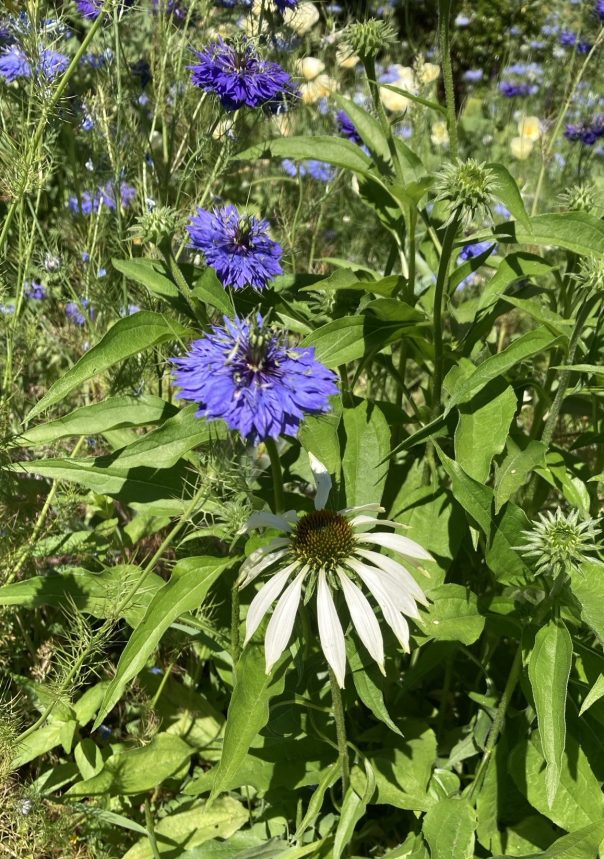
May is for flowers! The first white echinacea opened today, and many other lovelies are in full bloom, like the Chocolate Cosmos, and a fancy mullein I planted in the fall. I hope it gets tall like the wild ones. Sorry, I can’t seem to get a good picture of it yet.

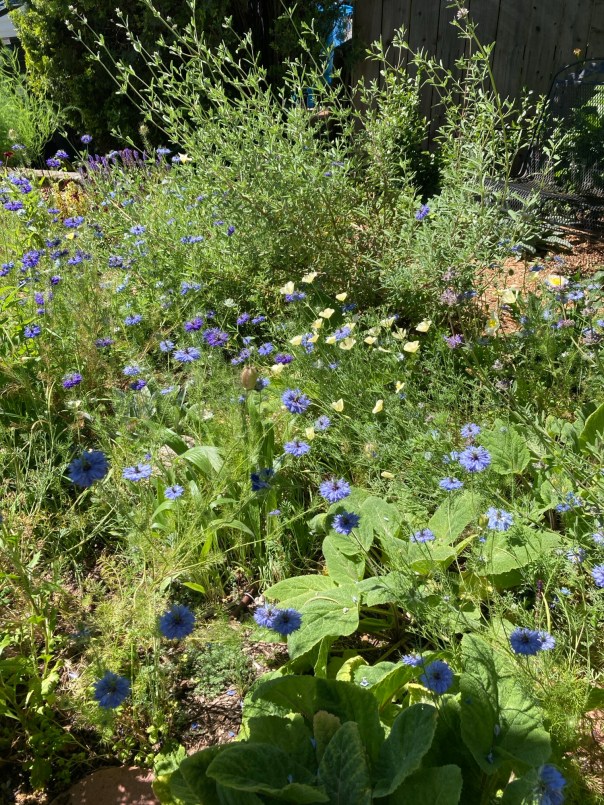
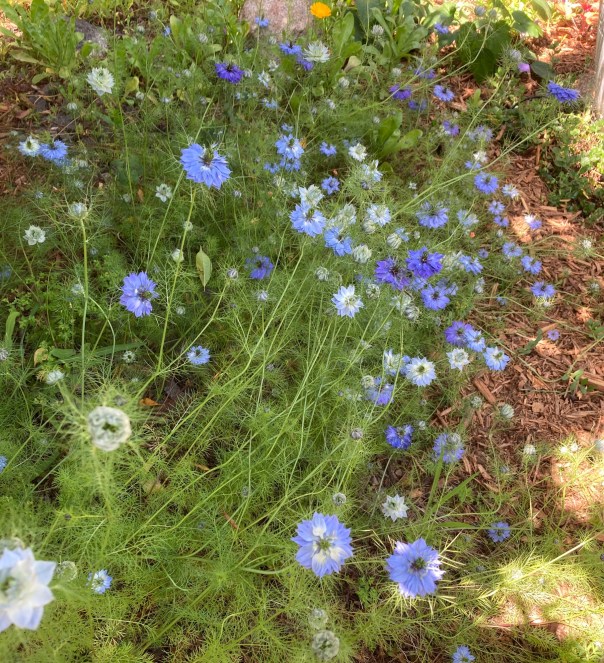
It’s the time of year when the poppies and nigella begin to look a mess, so I spent quite a while today pulling them out of the area by the front door. The picture above shows the situation “before.”  I also removed one of the three salvia clevelandii that live there; you can sort of see one at the back, reaching for the sky with its long branches. The latest landscaper was a hopeless over-planter, I am realizing every day. I love that salvia and its herby scent, but it gets big. One of them to “anchor” the bed would have been plenty. They are casting too much shade, and crowding the Clary Sage that will bloom next month.

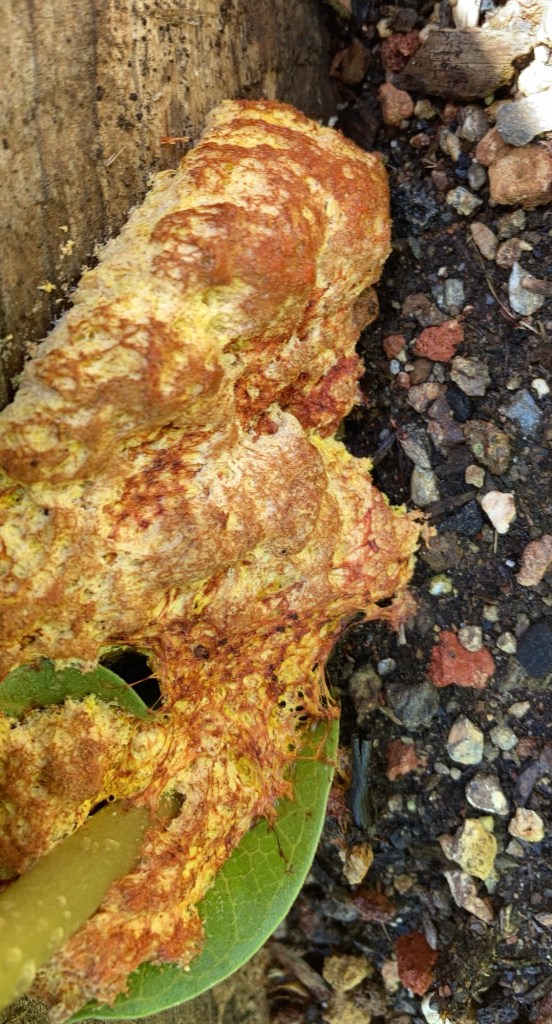
Fuligo septica

I discovered the above thing clinging to the inside of a planter box and a milkweed plant. I pointed my phone’s Seek app at it and it knew immediately what it was. The common name it gave me was too unpleasant for me to want to pass on, but it is a kind of slime mold. Probably some of my readers are familiar with it.

Nigella under the plum tree.

My zucchini, sunflower, and zinnia seeds have sprouted. And I think the amaranth, too, though the leaves I see are such tiny ones, I can’t be sure yet. It’s nice to be home enough that I can go out several times a day, set the hose nozzle to “shower” and moisten the ground for them. Here’s a little poem in praise of seeds.

Seeds

The seeds I sowed –
For week unseen –
Have pushed up pygmy
Shoots of green;
So frail you’d think
The tiniest stone
Would never let
A glimpse be shown.
But no; a pebble
Near them lies,
At least a cherry-stone
In size,
Which that mere sprout
Has heaved away,
To bask in sunshine,
See the Day.

-Walter de la Mare