Orthodox Christian, widowed in 2015; mother, grandmother. Love to read, garden, cook, write letters and a hundred other home-making activities.
View all posts by GretchenJoanna →
September rain falls on the house.
In the failing light, the old grandmother
sits in the kitchen with the child
beside the Little Marvel Stove,
reading the jokes from the almanac,
laughing and talking to hide her tears.
She thinks that her equinoctial tears
and the rain that beats on the roof of the house
were both foretold by the almanac,
but only known to a grandmother.
The iron kettle sings on the stove.
She cuts some bread and says to the child,
It’s time for tea now; but the child
is watching the teakettle’s small hard tears
dance like mad on the hot black stove,
the way the rain must dance on the house.
Tidying up, the old grandmother
hangs up the clever almanac
on its string. Birdlike, the almanac
hovers half open above the child,
hovers above the old grandmother
and her teacup full of dark brown tears.
She shivers and says she thinks the house
feels chilly, and puts more wood in the stove.
It was to be, says the Marvel Stove.
I know what I know, says the almanac.
With crayons the child draws a rigid house
and a winding pathway. Then the child
puts in a man with buttons like tears
and shows it proudly to the grandmother.
But secretly, while the grandmother
busies herself about the stove,
the little moons fall down like tears
from between the pages of the almanac
into the flower bed the child
has carefully placed in the front of the house.
Time to plant tears, says the almanac.
The grandmother sings to the marvelous stove
and the child draws another inscrutable house.
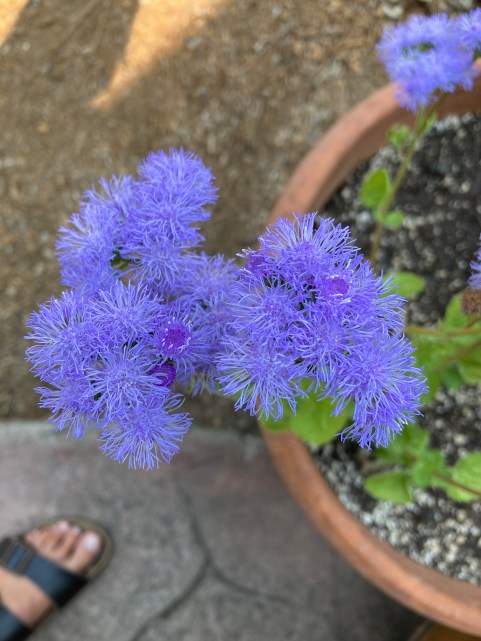
From my planter boxes I pulled up and cleaned out parsley, zucchini, chives and Love-in-a-Mist; butternut and pumpkin vines, and a volunteer zinnia. When I went after the sea of overgrown chamomile, its warm and bittersweet aroma comforted me in the midst of that violent afternoon’s work. I don’t think I used one leaf of basil this summer; I just wasn’t home enough to take care of the garden in general, or to use half of its produce.
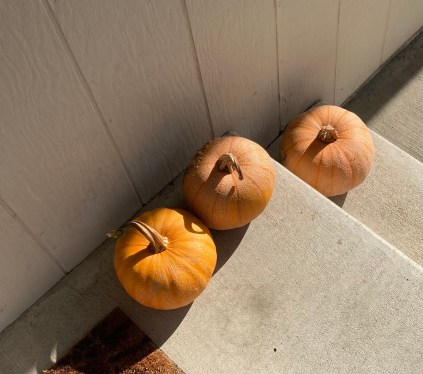
My pumpkins, grown from seed and nurtured in the greenhouse, were a complete flop! But one plant I gave to my neighbors produced 22 pumpkins, so one morning I found these on my doorstep:
Now I’ve sealed the boxes against winter, and added several inches of good soil. Still to do: organize and plant all those beautiful succulents that my friends gave me in the last few months, and put seeds into the dirt.
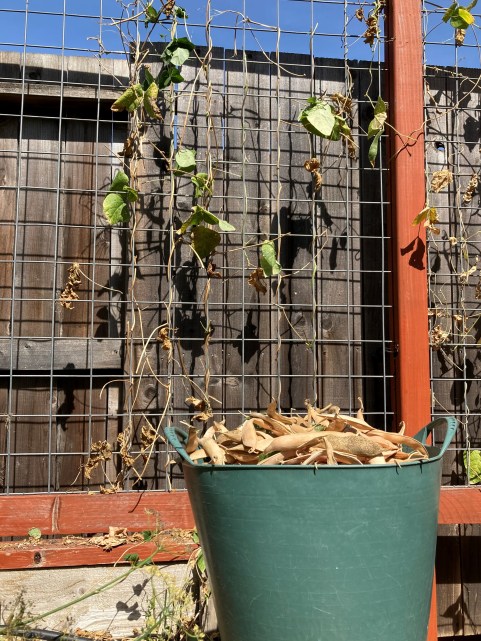
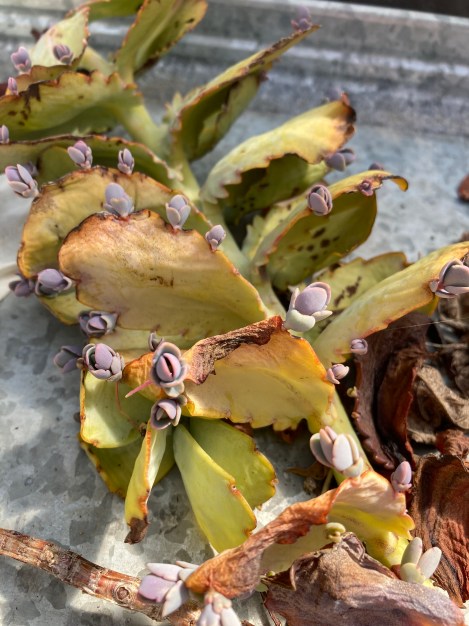
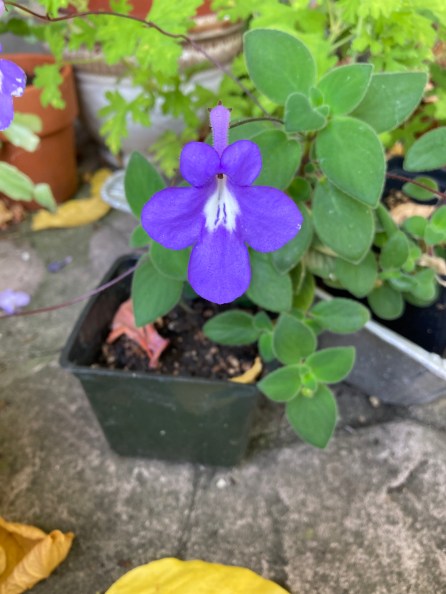
Trug full of Painted Lady runner beans.Succulent stem abandoned and unwatered — and undaunted.My first spider plant ever!Nodding Violet I propagated. If you want it, come and get it!
I had fun with Bella the other day at the community garden where she tends a plot. We always like to look around at what the other gardeners are doing, and to forage along the edges where people plant offerings to the whole community who farm there; you might find raspberries, or cutting flowers, or kale ready to harvest and take home.
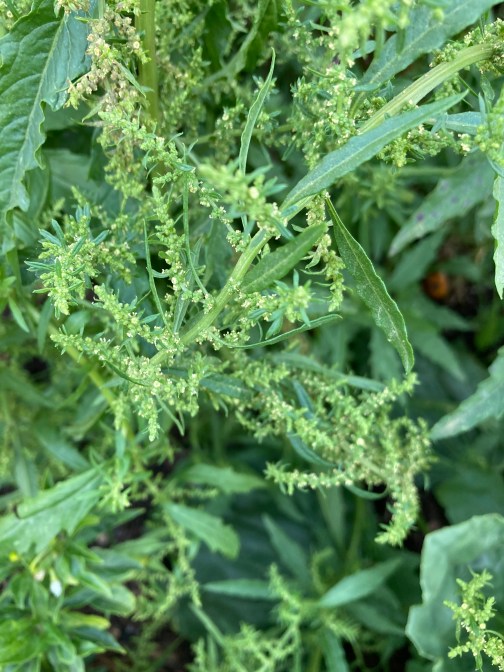
Some kind of amaranth…
Some kind of 10-ft glorious amaranth.
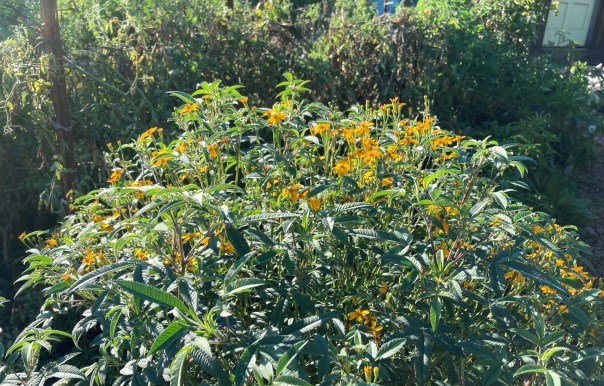
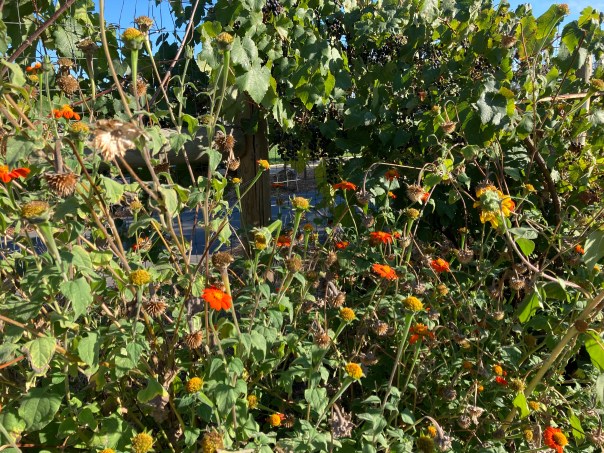
I brought home seeds from that community garden, too, of tithonia, in a handkerchief I happened to have in my purse:
These mild days with soft air are a balm to the soul. They always surprise me with their kindness, especially when they turn up between others that are by turn sunless and drizzly, then scorching. For two weeks I’ve had my bedroom and morning room windows wide open to the weather all day and night. A cross breeze rolls over me as I sleep.
Sometimes there’s been a bit of smoke, sometimes heat at midday. At night I often have to burrow under the blankets; I hear the traffic early in the morning, and occasionally the neighbors’ loud voices late at night. But it’s the best way I know to feel alive to the earth. Simply by being open to the weather and the air, I can be In Nature. It’s the most convenient month for that, here where I dwell. September is where it’s easy to feel at home….
But — September is leaving this very week, that change is in the air. I admit to being a little broken-hearted; essentially, I’m being evicted, and that’s harsh. There is nothing for it but to take inspiration from that budding succulent stem above, that will draw on its stored resources, and make the most of whatever sunlight burns through the fog. Those three little pumpkins will likely come in handy, too, because it’s time to start cozying up to October.
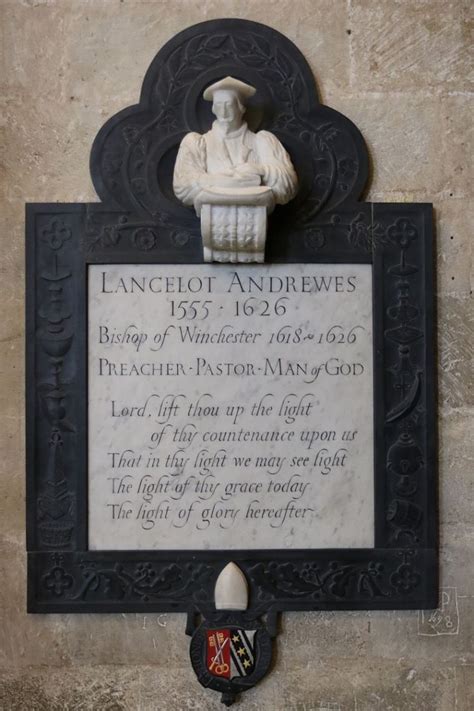
The Church of England remembers Lancelot Andrewes today, a good occasion for sharing Malcolm Guite’s love offering of a sonnet: “The Word and the Words.” Father Guite wrote his Doctoral thesis on this man, one of the church’s “greatest preachers and the man whose scholarship and gift for poetic phrasing was so central to the making of the King James Version of the Bible.” On the 400th anniversary of the King James Bible, Guite gave a talk on Andrewes, which audio file is on his site.
Father Guite mentions how influential Andrewes was in his own life; I am no expert and could not talk for five minutes on the subject, but in a previous era of my life his book of prayers kept me going.
LANCELOT ANDREWES
Your mind is fixed upon the sacred page, A candle lights your study through the night, The choicest wit, the scholar of the age, Seeking the light in which we see the light. Grace concentrates in you, your hand is firm, Tracing the line of truth in all its ways, Through you the great translation finds its form, ‘And still there are not tongues enough to praise.’ Your day began with uttering his name And when you close your eyes you rest in him, His constant star still draws you to your home, Our chosen stella praedicantium. You set us with the Magi on the Way And shine in Christ unto the rising day.
Mountains are giant, restful, absorbent. You can heave your spirit into a mountain, and the mountain will keep it, folded, and not throw it back as creeks will. The creeks are all the world with all its stimulus and beauty; I live there. But the mountains are home.
– Annie Dillard
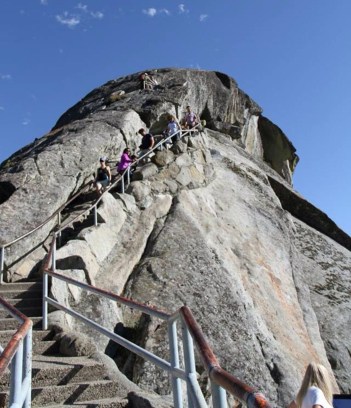
Moro Rock in Sequoia National Park – web photo
A granite dome was the focus of my mother’s most memorable hiking experience. She told me many times the story of how, at the urging of my father, she climbed Moro Rock when she was great with child (me). That is, so far, my only experience of it.
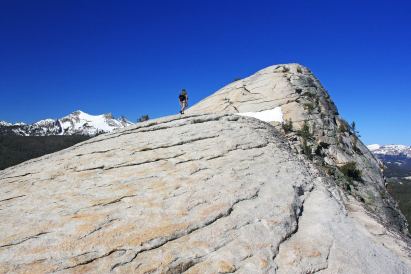
On our yearly camping trips decades later, my own children’s father would hike to the summits of other domes of rock with them, and a few of those times I was along. Lembert Dome was long my favorite, looming over Tuolumne Meadows on the Tioga Pass, in Yosemite National Park. Even at three years old Pippin could get to the top of it, with someone to hold her hand on the gradual ascent up the back slope.
Lembert Dome in Yosemite – web photo
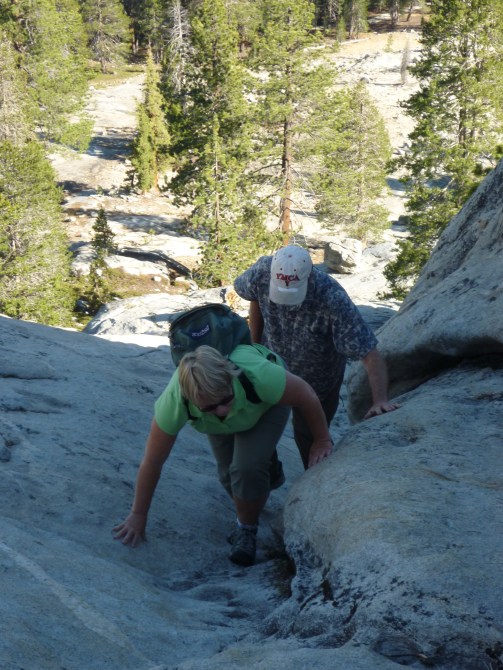
In the latter half of my life, my favorite dome is the one behind our mountain cabin. Several features of it make it accessible to me, the most important one being that I can walk to its base in a few minutes. I read recently that one summer, a small group of us climbed to the summit of this dome in the morning and again in the evening of the same day. My late husband took the picture below of our companions coming up behind him, about eight years ago. You can see why I wouldn’t want to try it alone.
During my recent mountain retreat, I set out one morning before breakfast, thinking that I would just walk over that way to get a view of the lake from the other side of what we have nicknamed Gumdrop Dome. Within ten minutes I had changed course and decided to approach from a different direction and to do a new thing: walk all the way around the base. I came through the trees to the north side, and headed to my right, around the west side of the rock. That side is a steep wall, decorated by veins of different colored minerals, and by lichens.
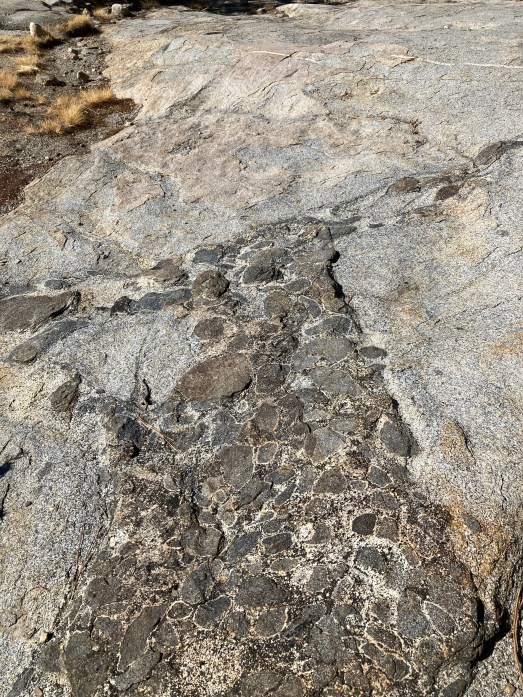
I refreshed my memory just now about different types of clast, or broken rock. I think what lies there at the bottom of the wall would not be classified talus or scree, but is just plain clast. On this side you can clearly make out where the base of the dome is.
I walked along in the clast, it moved under me, and then — whoopsie! Down I went on my behind. While I sat, I thought I should take advantage of the camera angle:
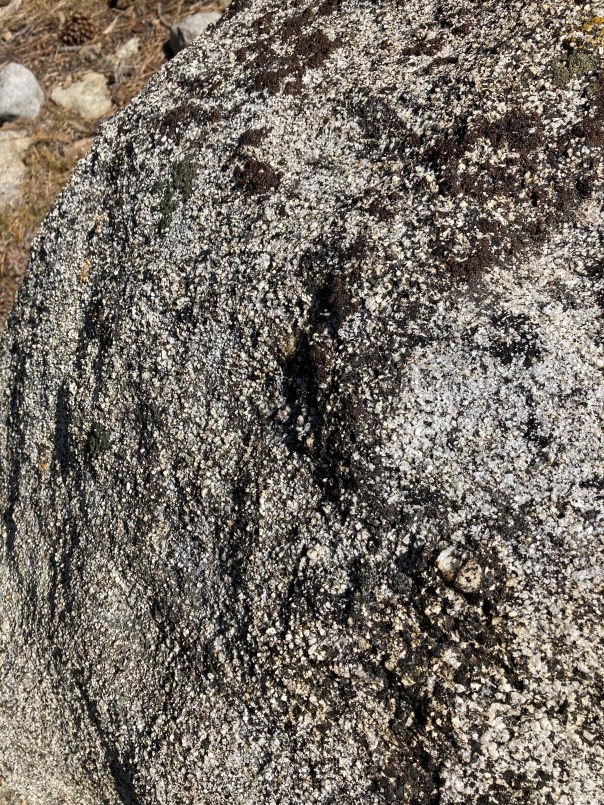
It wasn’t the only time I fell. A few minutes later I stumbled forward, and scraped my hand on some of that sharp granite. My euphoria was untouched; it was such incredible good fortune, that I should find myself completely alone, yet in rich company: God, and a friendly monster of a rock. Still, I navigated more carefully after that. The boulder to the right of the pine cones in the picture below is an example of the coarsest grit of granite imaginable; and the one below it, also.
I began to search for stones, keepsakes of my solitary walk around “Gumdrop.”
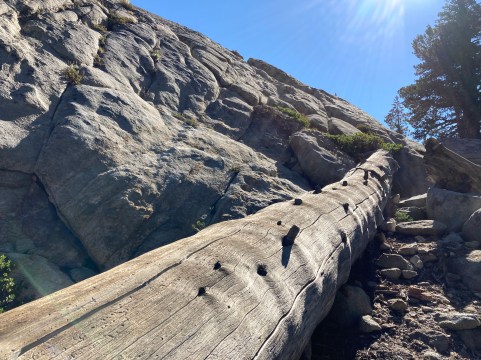
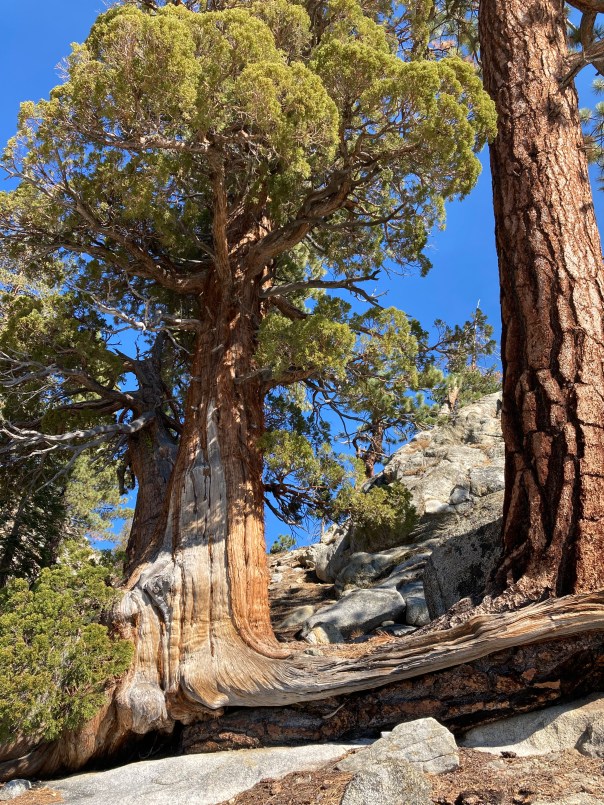
On the back side, the line between dome and not-dome is vague, as that granite face stretches away in an ever flattening grade, down into the trees. There is still lots of rock there, but giant conifers grow out of cracks in it, and their duff lies thickly on top. Granite domes like this are called bornhardts; there are several theories about how they form.
For a long time I gazed at the wide views from my high perch, a flattish boulder-bench, and felt the cool breeze growing warmer as the sun rose to my left.
“O, Lord, how manifold are Thy works! In wisdom hast Thou made them all.”
From here you can see other domes in the distance, but of course you can’t get a good idea of what the dome you are standing on looks like. The best vantage point I’ve ever had is from the lake, as in this picture that was taken some years ago:
This area below I call the amphitheater. It’s a good place from which to watch the show!
If I had brought a snack, I might have stayed hours longer. It was all delicious and satisfying as a feast for the soul, but pure bliss was not going to prevent me getting shaky (elevation about 8500′) if I kept putting off nourishment such as was waiting for me back at the cabin; so I stood up and continued my explorations.
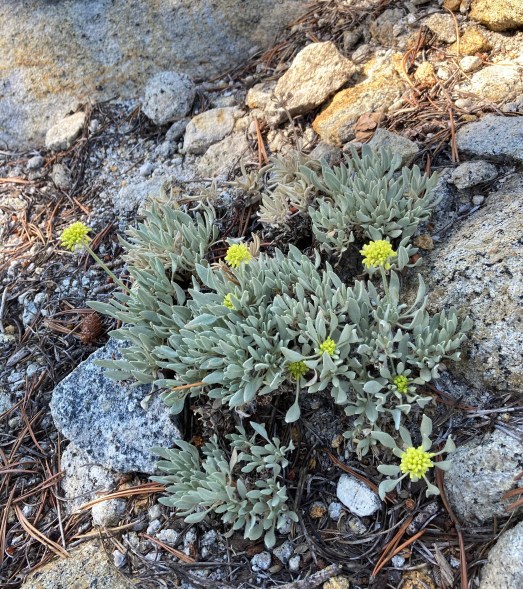
Frosted Buckwheat
This couplet below does not at all fit with the stones that I collected on the dome, as far as their smoothness, or the number of them. But the poet’s metaphor echoes somehow that of Annie Dillard at the top of this post, and they both understand what I left behind on that mountain dome, and what I brought home.
“may came home with a smooth round stone as small as a world and as large as alone.” -E.E. Cummings
Here is my last look at Gumdrop, when I had circled around to my starting place. From this angle it seems that it might not be impossible to climb that particular slope. I wonder…. Well, next time I have a companion, I’ll have to bring him or her to this place and give it a try! But for now, Good-bye Gumdrop! Good-bye mountains! Thank you for inviting me. I had a good time!










 Sometimes there’s been a bit of smoke, sometimes heat at midday. At night I often have to burrow under the blankets; I hear the traffic early in the morning, and occasionally the neighbors’ loud voices late at night. But it’s the best way I know to feel alive to the earth. Simply by being open to the weather and the air, I can be In Nature. It’s the most convenient month for that, here where I dwell. September is where it’s easy to feel at home….