My first sewing teacher used to tell me that she found sewing relaxing. I have never become skilled enough that I ever found that to be true for me. Even when I generally derived great satisfaction from sewing darling doll clothes, my neck would get stiff doing the tiny hand stitches at the end. It would never occur to me to pick up a needle and thread for fun or sustenance, during the days of preparation for a big expedition.
My usual way is to endanger my overall health by snacking and forgoing exercise as I become more anxious about setting off, so I was surprised at myself for taking several walks this week. This morning I even walked the whole two miles of what was formerly my daily routine. I saw a family of quail, and some old favorite plants, but it was too early for the bees.

 And now here I am working on yet another blog post, after reading and thinking and perusing this and that… one might think it a pretty inefficient use of my limited time, because I am up against looming deadlines. But, I am finding that these activities are as necessary to my overall well-being as the walking is to my legs and back — sometimes I think they are more so.
Evidently there is something about engaging in creative activity that is calming, and clears the mind. The preparations for a big social event also constitute a creative work, but that one is not my favorite, and requires a lot of extra oomph, plus a type of thinking that is a stretch for me. So I sustain myself with words and flowers. 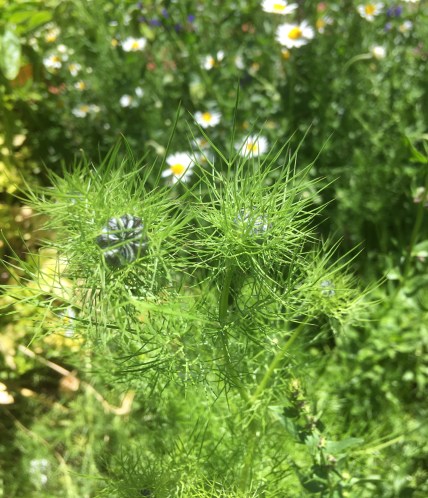

 My first Love-in-a-Mist flower bloomed today! This was a Big Event, a project that started off with my longstanding admiration for these flowers, and a desire to grow them myself. It took years, and the donation of seeds from two friends, and then a couple more years, before I got them planted in the greenhouse in the spring. I put them in three different places in the garden, and hope that they will self-sow at least a little and keep themselves going from now on.
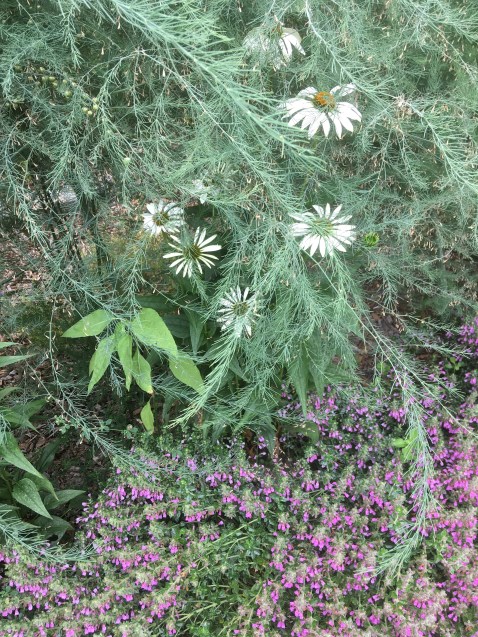
All the white echinacea are standing up tall and elegant, not losing their gracefulness even when the overeager asparagus fronds drape themselves on them.


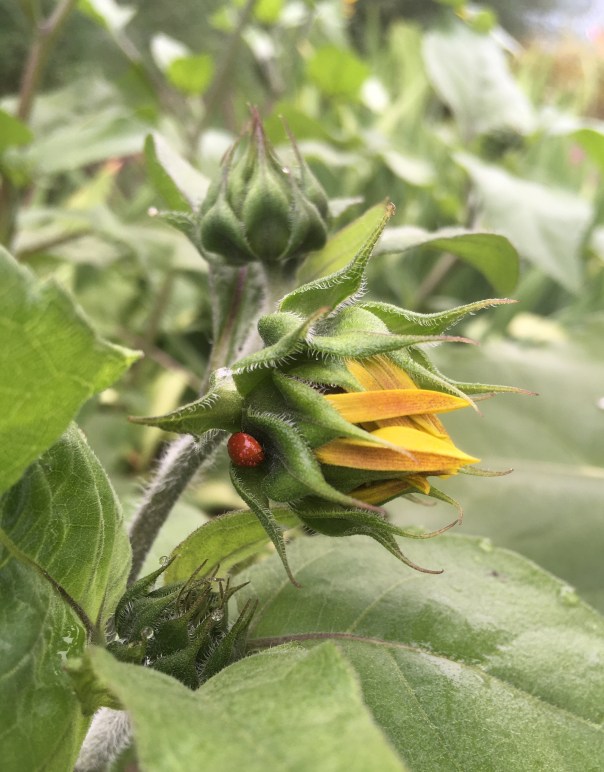
When the sunflower that the bee sleepers were using began to fade, they rearranged themselves on others. The three above were seen yesterday morning, but last night and today, no bees at all were bedded down in the open — only this small creature was nestled in a sunflower bud:
I am traveling next week, driving nearly to the bottom of the state, which I’ve never done before. My trip will involve lots of visiting with friends and family, a wedding, and a mountain cabin. I hope to tell you about some of the bloggy details as they emerge, but once I’ve torn myself away from my desktop and my garden, there’s no telling what might happen!

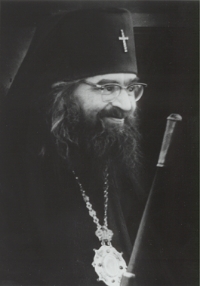 were coming to power there, he helped 5,000 of these expatriates to emigrate, eventually to the United States. Later still he established the cathedral in San Francisco where his incorrupt relics remain.

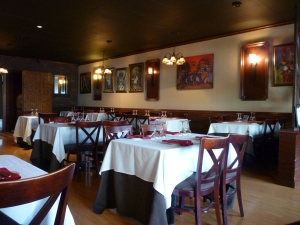 Afterward we needed lunch, so we followed the advice of the candle desk attendant at the cathedral and ate at a Russian restaurant called The Red Tavern that was also in that Richmond District neighborhood. We were the only people there, too, though from the name we half expected when we went through the door to see a group of Bolsheviks plotting in the back corner.
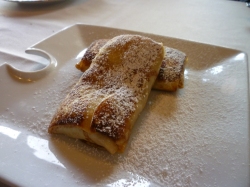 man only recently from Ukraine was our waitress and we enjoyed talking to her and eating the wonderful food. I didn’t think that I liked Russian food much, but everything I tasted was superb: dark brown bread scented with caraway, fresh cabbage salad with golden raisins and tomatoes; thinly sliced fried potatoes; and barley-mushroom soup with a complex and rich flavor. We all shared some Polish poppy seed dessert that we could tell had marzipan in the filling. We cut the two pieces into two more and ate them off these pretty dishes that the waitress said were their “dessert plates.”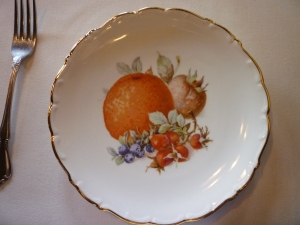

 Today it was Irrational Man, by William Barrett. Since I began reading it I’ve probably acquired a dozen more books, several of which I feel somewhat urgent about. But I’ve noticed that as days and months go by, this intensity of feeling shifts from one book to another, and waxes and wanes, often shrinking away completely to be replaced by an indefinable mood of summer that rules out urgency. The thoroughly warmed state of my bones is a contributing factor. We humans are composed of many parts not to be discounted. As Barrett says in the first chapter,
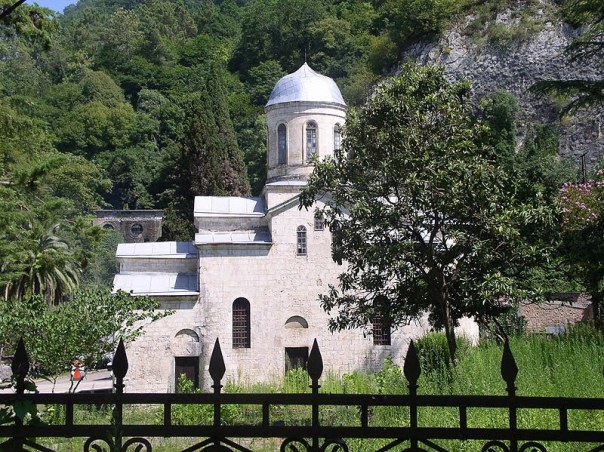
 It is believed by the Orthodox Church that our Lord’s disciple