I want to share an article that is a kind of conversion testimony; it was published earlier this year with the title For the Love, on the blog Persona. The author well conveys the gratitude I also feel for the Church that encourages us above all to love people, and gives us tools for doing that. Tools? What am I saying? The Church gives us The Holy Spirit, a Person of the Holy Trinity Who live in Love, who are the source of any love.
Soon we will be remembering my goddaughter in prayer and song, on the one-year anniversary of her repose in the Lord. These days it is natural for me to think often about the dead, and not only my husband. For that reason I also appreciate what what Fr. Stephen Freeman has to say about our relationship to the departed, and how, “With the radical individualism of the modern world, the mystery of communion and true participation (koinonia) have been forgotten….”
The witness that follows is of someone who is discovering koinonia. I join with the writer of Persona in thankfulness for the ways the Church helps me to continue loving my dear Kathleen.
FOR THE LOVE
I attended my first service in an Orthodox Church in December of 2010. In April of 2012 I was chrismated (confirmed) in the church. What I don’t know about the Church could still fill several books, and I’m not very good at being Orthodox.
It’s a tradition that appears confusing and Byzantine to outsiders, with all of its incense and strange pictures, its standing and prostrating and crossing oneself. It seems legalistic, with all of the fasting and written prayers and candle-lighting. Praying to saints and the Virgin Mary? To Protestants, these things are often red flags, warnings of impending Catholicism.
I was frightened when I was first exposed to Orthodoxy. I was educated in a Protestant seminary, where I took classes on the theology of Martin Luther and the spiritual development of women as my electives (I have layers). I found it much easier to read about spirituality than to actually pray. I calmed my doubts with well-reasoned arguments, and I weighed and measured every sermon I heard to assess the soundness of its doctrine. I loved God with my mind.
Yet what drew me to Orthodoxy was not, ultimately the soundness of its doctrine or the reasonableness of its apologetics. From my earliest exposure to the tradition I acknowledged that it was quite likely the oldest expression of Christianity. But what ultimately brought me into the church was not a well-reasoned argument on the merits of prayer to the saints or an articulate defense of the use of icons and veneration of the Theotokos (the Virgin Mary). What ultimately brought me to the church was, quite simply, love.
As I participated in the life of the church, I was moved again and again by the love of the people. Yes, I was attracted by the love shown to me by the priest in my parish, and the new friends I made there. But what changed me, what won me over was realizing that at the root of all the practices that I didn’t understand, that seemed superfluous or legalistic, was love.
The Orthodox do not pray to saints because they feel that they cannot go directly to God. They don’t venerate the Theotokos because they feel that Christ alone is not enough. They don’t prostrate or light candles or fast because they feel they must earn their salvation. The Orthodox Church does what it does because they love – the Trinity, each other, the departed, saints – the Church loves them all. More than that, the church understands that we all love, and it gives us concrete ways to express ourselves.
For me, this all became very real a few months before I became a catechumen and began my (formal) journey towards Orthodoxy. When I was a teenager, someone very close to me passed away. The anniversary of her death approached, and I was sad. When I told my priest, he told me that the Church gives us a prayer service that we can pray on the anniversary of a loved one’s death. I went to the church and we lit a candle and prayed for her, and those of us who loved her.

The Orthodox Church understands that we love people. It encourages us to love deeply. And then, when they’re gone, to be comforted by the love the Church has for them, and for us. At the death of a member of the church, listen to how they are spoken of – in glowing terms, seeing only the best, most beautiful parts of the brother or sister in the faith.
The Church invites us to look upon the saints with a similar love. They are not only examples to follow, but as beloved family members. Prayer, lighting candles, keeping their feast days are the ways that we express our love across time, across the chasm of death.
I told my mother recently that Orthodoxy speaks my love language. In Orthodoxy, faith moved from an intellectual proposition that I accepted to a radical love that changed me. I want to love in the way that the Church loves its people. I want to look at others and see the beautiful image of God and love them with fire and determination. I want to feel the genuine affection that I see for bishops and priests and monks. I want that love to move me outward, to serve and pray and be a better version of myself. I want others to know that they are loved.
I fail all the time. I’m not very good at being Orthodox. But I’d rather try and fail at this than succeed at almost anything else.
–from the blog Persona

 d still wrong.
 days previous I’d been getting enough soul-calming Down Time that I could feel relaxed about leaving all the work at home undone, and head over to the church garden to get my hands in the dirt there. Some of you will remember how I used to do that several times a week before my late husband retired.
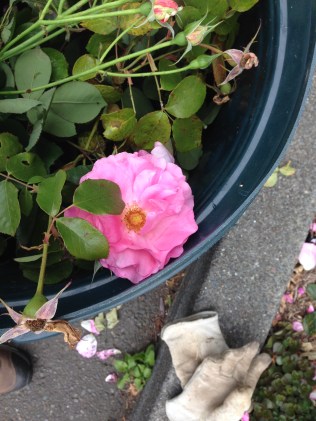 Two of the roses that I have tended so many times in the past have to be removed — their old canes are non-productive and the new canes are too small, or only suckers. That’s sad…but it’s happened to my lovely Pristine rose at home, too, and I’m taking it out.