Orthodox Christian, widowed in 2015; mother, grandmother. Love to read, garden, cook, write letters and a hundred other home-making activities.
View all posts by GretchenJoanna →
In my travels over the last nine days, I visited three of my children’s families and was able to be present for big events: the baptism of Annie last Sunday in Oregon, and the high school graduation of Pat in California, just yesterday evening.
While the first of 500+ graduates began walking across the stage to receive their diplomas, I felt my phone vibrating, and since I was expecting some news, I opened it up…. and found the announcement of a new grandchild entering the world, my eleventh grandson, born to Soldier and Joy. He is healthy and beautiful. 🙂
I haven’t had a chance to meet him yet, but I know already that he is like a bit of Heaven dropped down into our lives. His two brothers Liam and Laddie probably won’t see the new arrangement in quite that way, and will have to wait a while for Brodie to participate in their rough-and-tumble playtimes. Given that he is still small and tender, and in spite of the fact that his eyes aren’t likely to be blue, this poem from romantic (and Scottish) George MacDonald seems appropriate to express my thoughts and to accompany our celebrations:
BABY
Where did you come from, baby dear?
Out of the everywhere into the here.
Where did you get those eyes so blue?
Out of the sky as I came through.
What makes the light in them sparkle and spin?
Some of the starry twinkles left in.
Where did you get that little tear?
I found it waiting when I got here.
What makes your forehead so smooth and high?
A soft hand stroked it as I went by.
What makes your cheek like a warm white rose?
I saw something better than any one knows.
Whence that three-cornered smile of bliss?
Three angels gave me at once a kiss.
Where did you get this pearly ear?
God spoke, and it came out to hear.
Where did you get those arms and hands?
Love made itself into bonds and bands.
Feet, whence did you come, you darling things?
From the same box as the cherubs’ wings.
How did they all just come to be you?
God thought about me, and so I grew.
But how did you come to us, you dear?
God thought about you, and so I am here.
–George MacDonald from At the Back of the North Wind
Today I read the early reader Mouse Soup to the grandchildren. In the first pages a mouse is caught by a badger who is planning to make soup out of him. But the mouse thinks fast and tells the badger, “This soup will not taste good. It has no stories in it. Mouse soup must be mixed with stories to make it taste really good.”
Stories do make life tasty. I wish I had the skill to share the many humorous and heartwarming stories that have filled my days this week while I am at Pippin’s in the northern reaches of our fair state. Many people who haven’t been to California have the impression that there is not much northward beyond the San Francisco Bay Area, but I live beyond that, and I still have to drive six hours to get to Oregon. It’s about five hours to Pippin’s.
The weather has been a constant source of interest and conversation, of course, being the thing we live in, assaulting or caressing or charming my senses by turn. There was the melting day of my arrival when it was 105°, all the way to refreshing thundershowers that started a cooling trend, so that this week the highs have been in the 80’s and 90’s.
The cats are draped all over the house because it’s a bit cooler indoors. Duncan considers Jamie his special responsibility and often sleeps on the changing table. If Jamie were comfortable lying on such a lump, the cat would be content to stay in place while I change the baby. But Jamie complained, so I shoved Duncan to the side.
When I step outdoors at night I start to imagine that it is 30 years ago and our family is camping in the mountains, because in the warmth the trees are expressing their individual and familiar flavors, taking me back. The stars are just as bright, too — and I don’t even have to sleep in a tent.
It was Sunday upon returning from Oregon and Pathfinders’ family that the thunder and lightning foretold the dumping of rain. It splashed down just after we got the sleepy children in the door. That gave Pippin some help in keeping the zinnia seedlings watered.
I might yet do that job, but for several days I’ve been barely keeping up with my main reason for being here, to mind the children ages 6, 3, and 1. Today was my last day of being the only adult on duty for twelve hours at a time.
The six-year-old is the sort of person A.A. Milne was writing about in the poem in Now We Are Six: “Now that I’m six, I’m as clever as clever. I think I’ll be six now for ever and ever.” I could see that if I didn’t want to be constantly on the receiving end of his management, carrying out his ideas, I had to have a plan of my own.
So I told Scout we were going to have Grandma Camp for three days. He insisted on changing the name of the program, to something like Grandma Half-Camp, and I conceded that it was not what one normally thinks of as camp, given that activities have to accommodate the shifting needs and schedule of a toddler.
I stayed up late the night before Day 1 planning our activities: periods of quiet, such as me reading to the children, or them playing with play dough, alternating with dancing or jumping on the trampoline. We would take walks, maybe two a day, for Grandma’s sake mostly.
Jamie peruses Bearskin.
Scout does not enjoy Alone Time, though his home here in the forest and his liberty to explore would be any boy’s dream. Even jumping on the trampoline is only fun if someone is throwing balls at you or providing a listening ear to the expounding of your thoughts. It’s a challenge to meet the needs of other members of the family when someone like that is sucking all the attention and airspace.
One of my favorite things to do with children is to read aloud, so I made sure to schedule in lots of time for that. This week we have read dozens of books, including many fairy tales, some of which were not very familiar to me, like a lovely version of The Snow Queen by Susan Jeffers, Sir Gawain and the Green Knight, and Bearskin by Howard Pyle.
Ivy loves the book of nursery rhymes Pocketful of Posies, illustrated by the amazing Sally Mavor, and we like to examine the details of the pictures, like the flower petals and leaves that make up skirts of many of the ladies, especially Mary, Mary’s “pretty maids all in a row.” It was the selection for our Poetry Time one morning, which followed Prayer and Bible and me trying to teach them the simple song, “Isaiah Heard the Voice of the Lord.”
A Far-Fetched Story by Karin Cates is a favorite of mine since I gave it to this family four years ago. It’s actually more appropriate to read in the fall, because the story revolves around the gathering of firewood in preparation for winter. But it’s a lot of fun, and if my husband had read it he’d have said I am like the woman of whom we hear in the first paragraph:
“Early one autumn, long ago and far away, the woodpile was higher than the windowsills. But even so, there was not enough firewood to suit Grandmother.” When one after another of her family sent to get a few more pieces for the wood box come back with nothing more than a tall tale, she says, “Well, that’s a far-fetched story!” Now Ivy has taken to trying out this comment in various conversations.
We only took one walk — so far. It was too hot much of the time, and at other times it seemed that either Ivy or Jamie was napping. But on that walk Scout found lots of lichens that he laid in a row on the back of the stroller along with a branch that Ivy said looked like a seahorse.
I danced most days with the children to some rousing instrumental music from the 50’s, 60’s and 70’s, as is their routine. Their style is quite untaught and hyperkinetic, involving lots of running around the perimeter of a rug in the living room.
But this evening they were dancing without me, and after a while Scout came proudly into the kitchen where I was making dinner, wanting to show me the results of his efforts. “Grandma, feel the back of my head!” I felt his damp hair. “Does it feel wet? That’s just my sweat, from dancing! It’s Swinging Man Sweat!” And off he went to swing some more.
My pace of life of late, combined with my inability to understand my various mobile devices, have frustrated my documentarian desires, and I had to stay up till midnight, after both parents returned, to get this post done. I may have some more “stories” to tell before I go home, and I hope they will be good food for our souls.
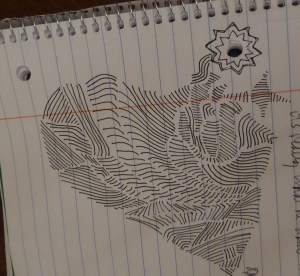
In one of my peaceful hours of the last week I talked a long time on the phone with Kate. I had a notepad handy to write down important upcoming dates in her life, and I used my pen to create one of the abstract messes that decorate my phone notebooks.
After we hung up, I realized it had turned into a heart, and was fun to look at. When I aimed my camera at it and tilted it this way and that, the autofocus could not decide what to do, and made the lines all shimmery.
What a strange day… starting with a strange night, during which I was awake for four hours. What? At first I tried to pray and go back to sleep at the same time, but after an hour or so of that I switched on the light and sat in bed writing in my journal. I didn’t turn on my phone – yay for me! But if I had I might have been able to talk with my dear cousin who was wishing from the East Coast that she could talk to me, as she wrote, “I wish you were not still asleep.” Little did she guess that I was not.
Mexican Bush Sage
Eventually I slept a little more, and got up late. Today is sunnier than in a long time, and I noticed out the window the hopbushes that line the fences, also looking brighter than ever decked in their flowers. I took my lunch outside to eat under the umbrella, with my back out of the shady area and baking, but as in a very slow oven, so I remained in place.
I conversed with friends blog-style about moments and fleeting time and what happens to those moments: Are they like the picture Annie Dillard paints in words for us, “…a freely given canvas… constantly being ripped apart and washed downstream….” ? The violence of her image doesn’t set well with me now, but just a few months ago its tone would have matched what I was feeling, not about a moment but about the entire lifetime of my husband.
Now here I am, in a lovely moment, a warm and springy afternoon with birds and insects crossing paths in the air around me. The bird bath has water in it and the towhees are taking advantage of that — or is it just one towhee who has a daily bath, and a long one at that? He splashes around for about five minutes while I watch and wait from the kitchen window, because I know that when he’s satisfied I will need to refill the bowl.
Near the birdbath is one of my two remaining Mexican Bush Sage plants. The old one at which I used to watch hummingbirds out my window for several months of the year was dug up and divided into six plants. The one we transplanted into the new garden died, and the others spent the winter in pots, three of which I gave away on Freecycle this week. I always forget until I get up close, how furry the flowers of this plant are.
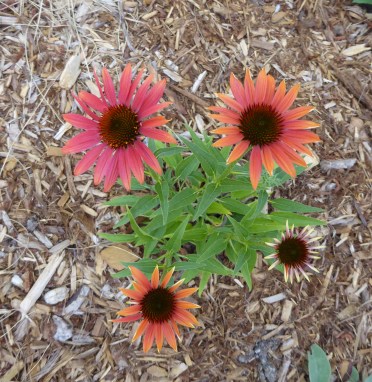
echinacea – Cheyenne Spirit
And the echinacea are already blooming. At this time I have six of this variety, but no traditional purple ones. I was planning to buy a purple one to replace one that was eaten by snails, but didn’t find one anywhere.
As I bask in this moment of an hour or more I am writing, yes, because that is what I do with many of my moments and minutes and hours. It isn’t often that I am enjoying a space other than my computer corner while I write, but today I’ve written in two other places. Because I took the trouble to move myself out here to the spot in my garden where I have the wide view of everything from Margarita Manzanita to the bird feeders to the greenhouse, my moment seems to expand into deliciousness. And this isn’t the time to wonder where it has gone, poof!
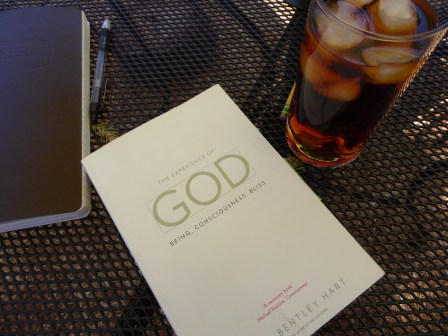
I was planning to sit out here and read this book that I haven’t given up on by any means, but have been neglecting. Then I looked aside and saw the first calendula flower, and this is what happened. But now I will get down to business.


 Today I read the early reader Mouse Soup to the grandchildren. In the first pages a mouse is caught by a badger who is planning to make soup out of him. But the mouse thinks fast and tells the badger, “This soup will not taste good. It has no stories in it. Mouse soup must be mixed with stories to make it taste really good.”
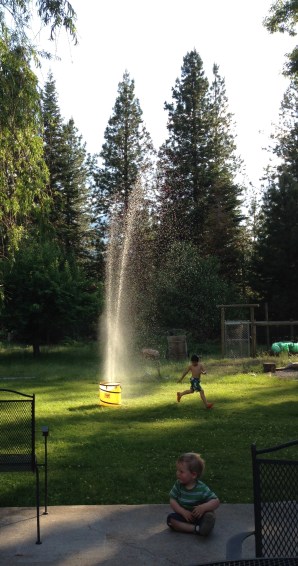 It was Sunday upon returning from Oregon and Pathfinders’ family that the thunder and lightning foretold the dumping of rain. It splashed down just after we got the sleepy children in the door. That gave Pippin some help in keeping the zinnia seedlings watered.
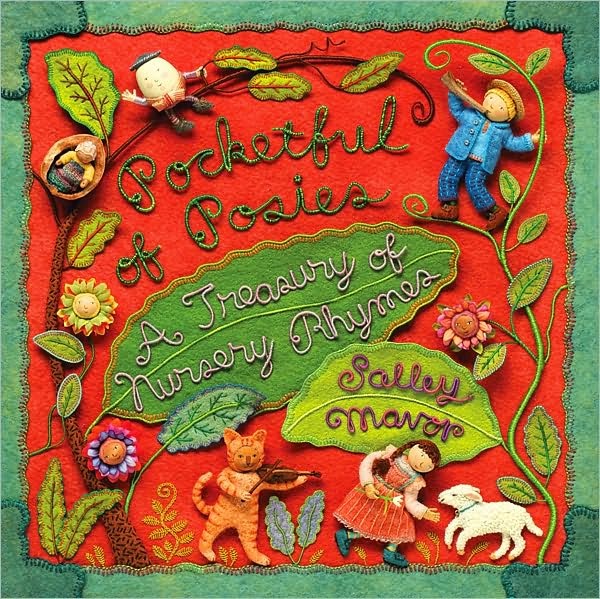 Ivy loves the book of nursery rhymes Pocketful of Posies, illustrated by the amazing Sally Mavor, and we like to examine the details of the pictures, like the flower petals and leaves that make up skirts of many of the ladies, especially Mary, Mary’s “pretty maids all in a row.” It was the selection for our Poetry Time one morning, which followed Prayer and Bible and me trying to teach them the simple song, “Isaiah Heard the Voice of the Lord.”
 A Far-Fetched Story by Karin Cates is a favorite of mine since I gave it to this family four years ago. It’s actually more appropriate to read in the fall, because the story revolves around the gathering of firewood in preparation for winter. But it’s a lot of fun, and if my husband had read it he’d have said I am like the woman of whom we hear in the first paragraph: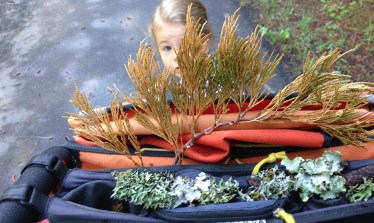
 peaceful hours of the last week I talked a long time on the phone with Kate. I had a notepad handy to write down important upcoming dates in her life, and I used my pen to create one of the abstract messes that decorate my phone notebooks.