Tove Jansson is an author I only recently became acquainted with on Anna’s Peacocks and Sunflowers blog. The way Anna wrote about Jansson’s books makes you want to go to a Finnish island with a few volumes of this writer’s work in your suitcase. In the summer, naturally. It’s going to take me a long time to tell all I want about two little books, so if you are jealous of your last hours and days of summer, don’t waste them here. Come back later, in the winter perhaps, and go play outdoors now!
As soon as I learned about Tove Jansson I visited my local library and came home with a couple of books, to look at briefly to see if I wanted to order them. When I try to read borrowed books I feel the time pressure so heavily it too often squelches my interest and I end up returning the books unread. 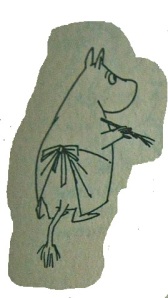
But in the first pages of Finn Family Moomintroll (c. 1954, 55) I met a character to whom in my ideal self I could instantly relate: Moominmamma, “The center of the family, highly moral but broad-minded.” This is her picture at left, with the distinctive Moomin physique.
She soon demonstrates what is meant by her character description, in the preface when the whole lot of these creatures are bedding down for winter, at the first snowfall. “All Moomintrolls go to sleep about November. This is a good idea, too, if you don’t like the cold and the long winter darkness.”
Moominmamma makes the bed assignments, to her own children and to all the friends their family has hospitably collected. Son Moomintroll objects, “But Sniff snores so horribly; couldn’t I sleep with Snufkin [his best friend] instead?”
“As you like, dear,” said Moominmamma. She changes Sniff’s assignment. Now isn’t that gracious of her? In my early years of parenting, I remember people telling us, Don’t be quick to say “No” to your children. In other words, be liberal. Is that the same as “broad-minded”?
I suppose it’s not surprising that Moominmamma was my favorite character in this children’s book. Many other creatures, after they wake up in Spring, in Chapter 1, populate the pages and have adventures together all over the forest and in the water, the kids sleeping in a cave and everyone sailing to an island for a camping trip that is made more exciting by wild weather.
A magic hat causes things to randomly change identity or grow to horror-movie proportions, as when the mamma wakes to find that tendrils and shoots of a “poisonous pink perennial” have invaded her house and “In the damp air flowers came out and fruit began to ripen, and huge leafy shoots blotted out the stairs, pushed their way between the legs of the furniture, and hung in festoons from the chandelier.”
This is the kind of plot element that gets my attention, mixing up horticulture and housekeeping. When Moominmamma first sees the room “full of small, white flowers, hanging down from the ceiling in leafy garlands…’Oh, how beautiful,’ she said.”
The story is full of goodwill and good sports, and the characters show great patience and kindness in problem-solving and relational issues. I would be happy to read this to my grandchildren, and I wouldn’t mind exploring some of the other Moomintroll books.
So far, though, I’ve only read one other book by Jansson, and that was The Summer Book, which is a short one for adults, as I assume, as one of the two main characters is the grandmother who is not your typical storybook grandma, nor one that my grandchildren could appreciate. She serves very well as the needed grandmother in this story, however.
We get introduced to Grandmother and Sophia quickly; on the first page Grandmother has lost her false teeth in the grass and when Sophia finds them she won’t give them back until Grandmother promises to let her watch her put them in her mouth. Then Grandmother refuses to continue a discussion about when she is going to die, and starts walking toward the ravine.
“We’re not allowed out there!” Sophia screamed.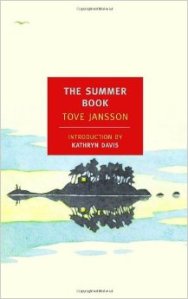
“I know,” the old woman answered disdainfully. “Your father won’t let either one of us go out to the ravine, but we’re going anyway, because your father is asleep and he won’t know.”
When they walk out on a promontory Sophia is surprised when her grandmother doesn’t oppose the idea of swimming, and she gets in up to her waist. “‘Swim,’ her grandmother said. ‘You can swim.'” When Sophia notices how deep the water is, she thinks, “She forgets I’ve never swum in deep water unless somebody was with me.”
Sophia, the book cover says, is six years old, but I didn’t read that until after I’d completed the book. All through the book I was trying to figure out how old the granddaughter is; much of the time she seems younger than six, and sometimes not younger than ten. We learn that Sophia’s mother has recently died, and she and Grandmother and her father — mostly absent in the story — are on an island off the coast of Finland in their summer house.
So her anger and confusion are understandable. Spending a summer with a no-nonsense grandmother who’s trying to deal with her own issues at the other end of a lifespan seems not to be a bad thing. Grandmother is usually willing to answer the girl’s questions about God or anything else, to put up with Sophia’s screaming and disrespect, and to be her companion all over the island.
It’s hard to say just what is bothering Grandmother. Probably lots of things. She will not get old without a fight. Once Sophia says, Don’t go to sleep; you have to tell me about being a Scout. “A very long time ago, Grandmother had wanted to tell about all the things they did, but no one had bothered to ask. And now she had lost the urge. ‘We had campfires,” she answered briefly, and suddenly she felt sad.'”
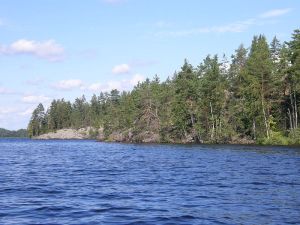
Grandmother does tend to take naps if she and Sophia are waiting on the beach for Sophia’s father to come back from setting fishing nets or something like that. When they visit another island Sophia asks, “When are we going to walk around the island? Do we get to eat and go swimming, or don’t you ever do anything but sleep?”
Soon both adults are asleep outdoors in the warm and heavy air, and Sophia has to walk by herself around the shoreline. When she returns, “‘Dear God, let something happen,’ Sophia prayed. “God, if you love me. I’m bored to death. Amen.’
“Perhaps the change began when the swallows went silent. The shimmering sky was suddenly empty, and there were no more birds. Sophia waited. The answer to her prayers was in the air. She looked out to sea and saw the horizon turn black. The blackness spread, and the water shivered in dread and expectation. It came closer. The wind reached the island in a high, sighing whisper and swept on by. It was quiet again. Sophia stood waiting on the shore, where the grass lay stretched on the ground like a light-colored pelt. And now a new darkness came sweeping over the water — the great storm itself! She ran toward it and was embraced by the wind. She was cold and fiery at the same time, and she shouted loudly, ‘It’s the wind! It’s the wind!’ God had sent her a storm of her own. In His immense benevolence, He thrust huge masses of water in toward land, and they rose above the rocky shore and the grass and the moss and roared in among the junipers, and Sophia’s hard summer feet thumped across the ground as she ran back and forth praising God! The world was quick and sharp again. Finally, something was happening.”
There is a lot of weather and botany and wildlife in this book, with which the characters interact and which forms the backdrop of their quiet drama. After that storm, Sophia said, “I always feel like such a nice girl whenever there’s a storm.” Which makes her grandmother muse to herself, “I’m certainly not nice. The best you could say of me is that I’m interested.”
The grandmother in me, the camper, and the horticulturalist in me found plenty of interest in this book. I share just one more favorite passage:
“A small island…takes care of itself. It drinks melting snow and spring rain and, finally, dew, and if there is a drought, the island waits for the next summer and grows its flowers then instead. The flowers are used to it, and wait quietly in their roots. There’s no need to feel sorry for the flowers, Grandmother said.”
Nor for the humans. Patience. Bravery. Family. These will help us to persevere through our own storms and to remain fully alive.