Today is Saturday, and I am attending a wedding, which is a cause for joy. According to statistics, 70% of weddings are held on Saturdays these days, but in the Orthodox Church Sunday is the preferred day. Sunday is The Lord’s Day since the Resurrection, and the day for celebration and feasting, while Saturday is the day of rest, when we remember those who have fallen asleep in death and rest in their graves. Here is another poem that ties the remembrance of death to the season, and to the One who mitigates our sorrow over it.
AUTUMN
The leaves are falling, falling as from far off, as though far gardens withered in the skies; they are falling with denying gestures.
And in the nights the heavy earth is falling from all the stars down into loneliness.
We are all falling. This hand falls. And look at others; it is in them all.
And yet there is One who holds this falling endlessly gently in his hands.
For it is the God who commanded the light to shine out of darkness, who has shone in our hearts to give the light of the knowledge of the glory of God in the face of Jesus Christ. -II Corinthians 4:6
My priest mentioned in a homily recently that the verse above was his favorite; of course that made me pay close attention to it. Soon afterward I read an article by the iconographer Aidan Hart, “Lighting in Orthodox Churches: Liturgical Principles and Practical Ideas,” which has kept me thinking on this Light … and I’m certain I could benefit from further meditation on Hart’s ideas — because they flow from the truth that Christ Himself stated, that He is The Light of the World.
How do we reflect this reality symbolically when choosing physical lighting for our churches? And how might lighting help us to worship or distract us? If any of these questions is interesting to you, you might like to read the whole article, which I have linked above and below. Or skip the text and look only at the more than two dozen photographs of most beautiful churches and monasteries — and one mosque — illustrating the principles that Hart discusses. I especially loved the photo showing alabaster windows such as this one:
Mausoleum of Galla Placidia, Ravenna
Hart reminds us that “The Church is ultimately a community of persons and not a building.” It follows that “Its light should illuminate the personal rather than the abstract.” He compares the needs of monasteries to those of parish churches, and The Blue Mosque to Hagia Sophia. The pros and cons of natural light, candles, oil lamps and electric lights are discussed; he explains how an environment with quiet light can help us to “learn the art of stillness, watchfulness, interiority.”
I’ll close with one paragraph that is rich with theological principles worth musing on, and leave you to click on the link for the whole article:
The second century neo-Platonist Plotinus wrote that “beauty is symmetry irradiated by life”. This was interpreted by the Byzantines as symmetry irradiated by light, for light was regarded an image of divine, animating and transfiguring life. But this Byzantine aesthetic of moving rather than static light was ultimately rooted in Trinitarian theology. The uncreated light of divine love is One, but it is also dynamic, moving within the Trinity and moving down to creation. Of course the term moving is a human concept and is ultimately inapplicable to God, who has no need to move from place to place. But the term is applicable inasmuch as it reminds us that God is not a single monad, that God is love because He is Three. Christian beauty is therefore rooted in relationship rather than an abstract and static ideal. And this can be reflected in church lighting.
First there was the mega mega gardening week, when I dug chicken manure into 23 little holes and dropped in starts of four different leafy greens; I wrestled with juniper roots to reclaim space; and put back into the ground eleven iris rhizomes of the dozens I’d lifted a month before — and hours upon hours of other such work. It was thoroughly happy-making.
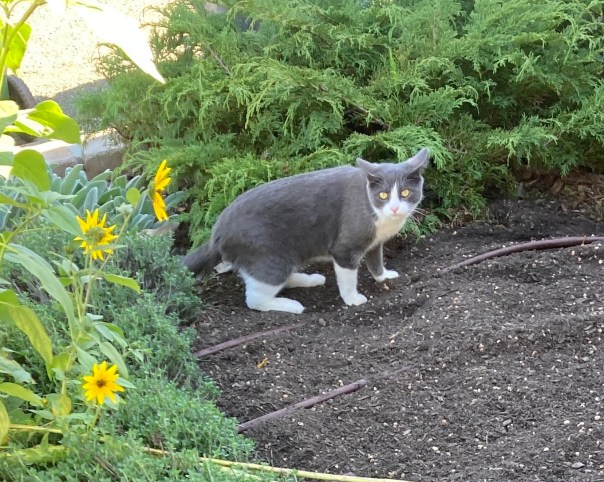
The yard worker had brought in and spread 1.5 yards of soil during my last absence, so that I would be ready to plant when I got home. This neighbor cat thinks its for her potty purposes:
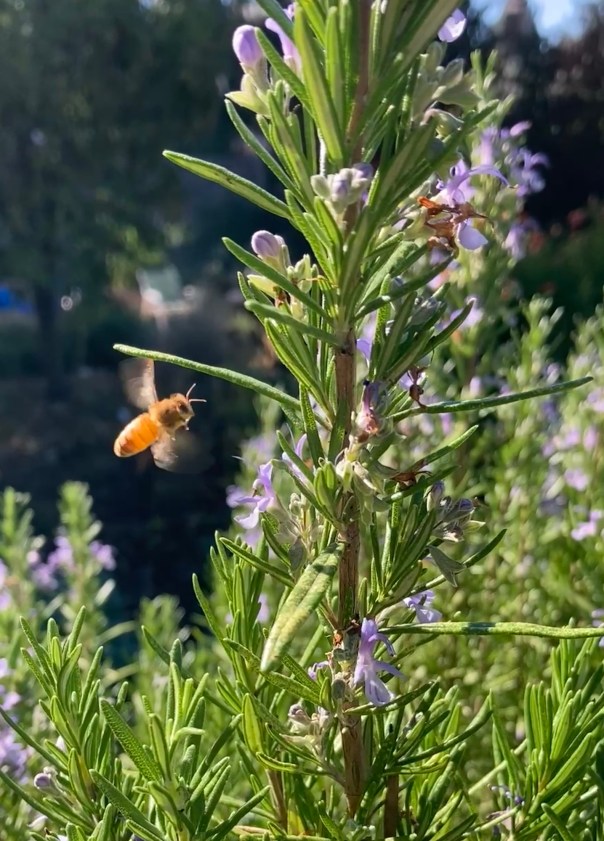
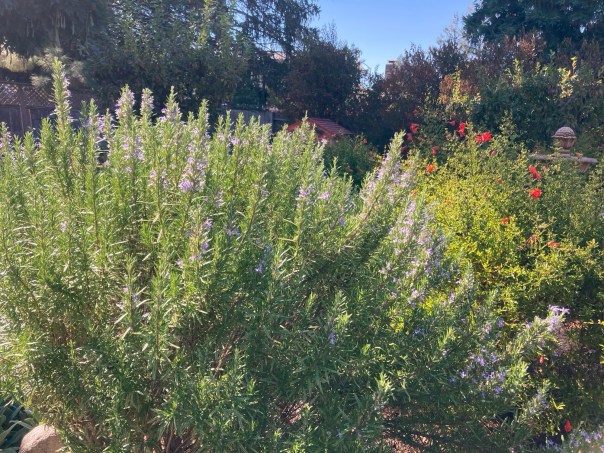
Rosemary and Pomegranate
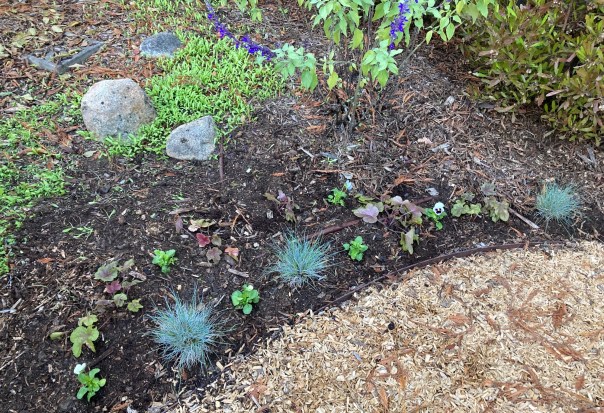
It must have been extra grace and strength God bestowed on me for the week, because every day I was at it again; the nights gave sound sleep, and that surely helped. I moved heuchera that were languishing in deep shade, to be near my umbrella table corner, where they will likely do better in partial shade.
In that area where I like to sit with guests it’s been hard to find flowers that do well, but since I’ve realized that the increased shadiness of the back garden is the problem, I hope to improve the situation by using more appropriate species. I set out pansies along there, too, for the winter, and in the spring I plan to add Japanese anemones. The goal is to have something blooming most of the year.
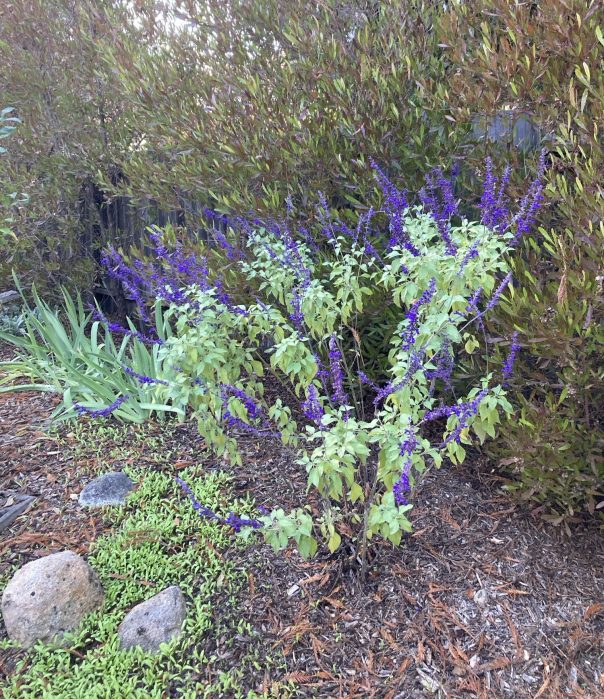
SalviaAbelia with comfrey.Nodding Violet
Propagation is a joy! I finally dug out at least some of the comfrey that has been shooting up from under the abelia, and put three pieces in nursery pots; if they grow I will stick them against a fence somewhere. I know they do fine in deep shade; when I first brought a start from my former garden in 1990 it grew for years under the osmanthus. But since the osmanthus is gone the comfrey has planted itself in undesirable places nearby.
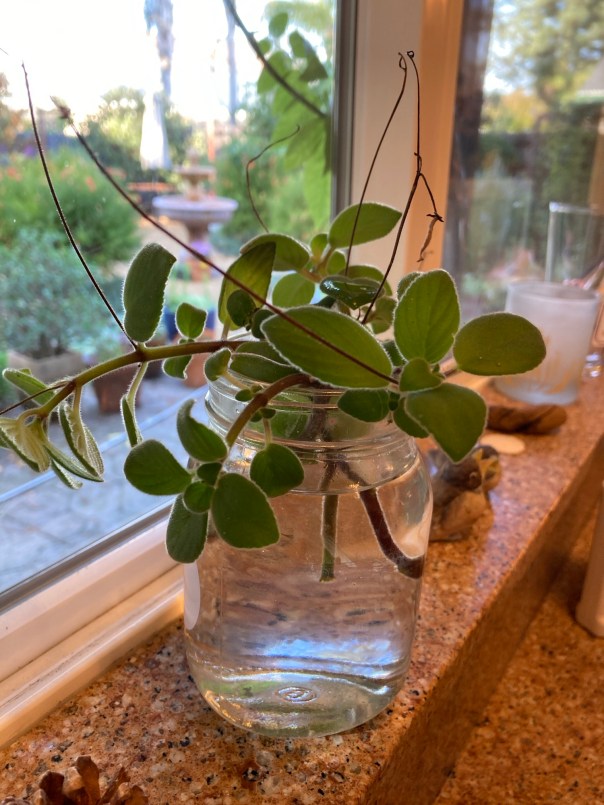
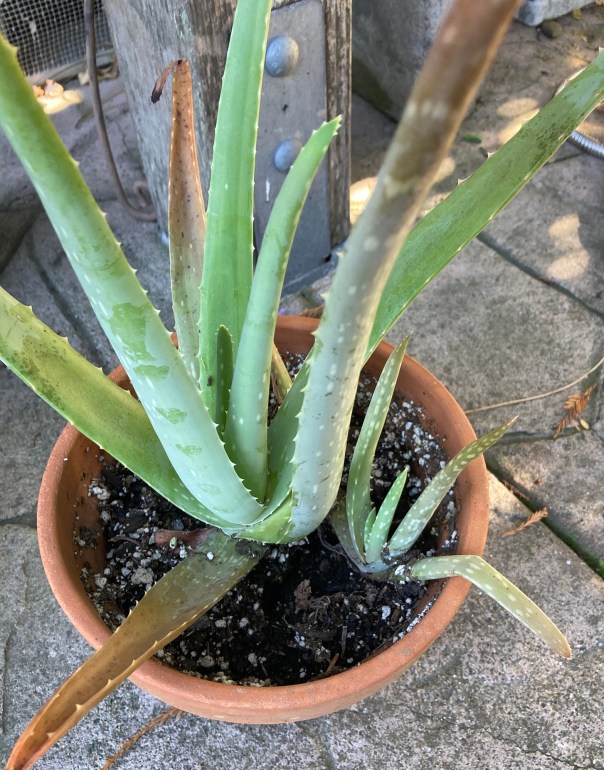
A friend told me that her Christmas cactus and aloe vera had died, and I happened to have a small Christmas cactus that I had propagated a year or two ago to give her. Also I have three aloe vera plants in pots and they all have babies right now, so I potted one up for her. When I trimmed the apple mint and rose geranium and nodding violet I stuck a few stems in water, where they are likely to send out roots.
Aloe Vera offering her child.
It’s been fun visiting nurseries at this time of year, though I do have pangs of (I hope false) guilt that I am tempting myself to plant gluttony. I always forget about Iceland poppies until I see them in the nurseries… and let’s see, what else did I find that I wasn’t expecting? English daisies. They do well in part-shade, also. At the moment I haven’t figured out where to put those daisies.
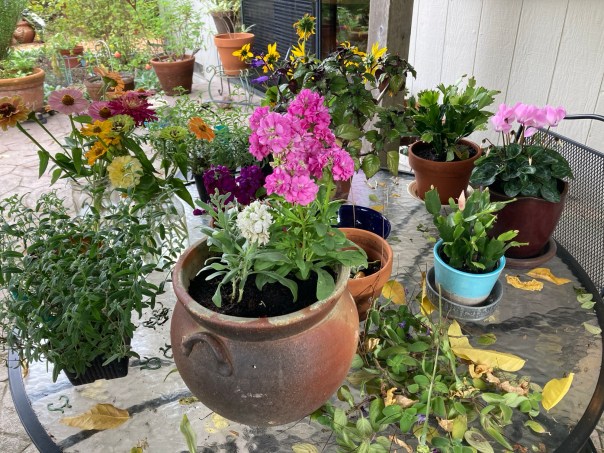
Above is one of my work tables, showing another of my finds at the nursery: stock. I put three plants in a pot to have ready when the asters stop blooming: then I can remove their pot and put this one by the front door.
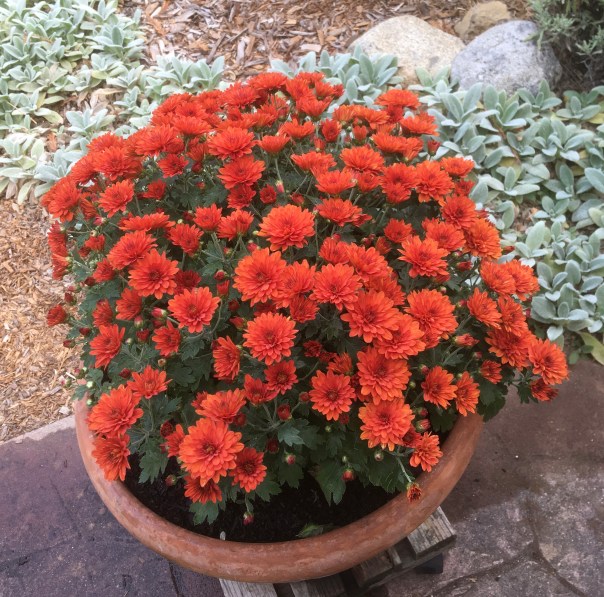
The gardening spree hasn’t ended, and probably won’t for another few weeks. In the meantime the garden as a whole is a paradise to walk around in, and just look at. In the middle of the afternoon when the sun is shining, the bees are busy still, but they get up late and go to bed early now. The multitude of plants that don’t need attention of any kind at the moment appear especially lovely; they are contented in their slowing down. The atmosphere is quieter and less bright, more meditative.
Pineapple guavas are still tiny, but growing.
In the rain.
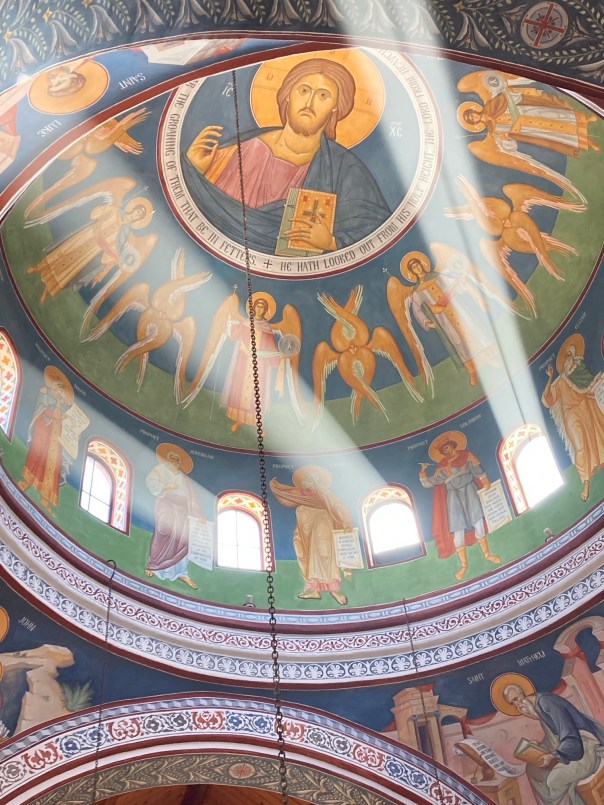
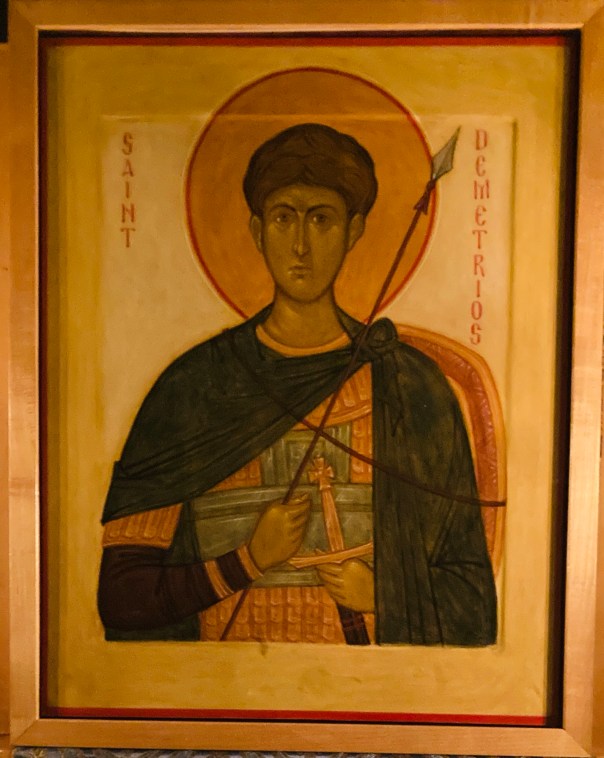
Last week I was racing the rain, which arrived Friday night. I could hardly walk Saturday morning anyway, so that marked the end of the most strenuous week, and ushered in the glorious weekend. From Saturday evening to Monday morning it was again and again granted to me to be in my other happy place, the Orthodox church temple where I worship. First the feast of St. Demetrios, the first celebration of that event since I visited Thessaloniki in June, at which time I had became better acquainted with the saint. He is wonderful.
The next day was the first commemoration since her canonization, of our 20th century American saint Olga of Alaska, Mother Olga Michael. It was especially significant for me, because our parish is suffering alongside a family whose wife and mother is in the hospital; we all are needing extra mothering of the consoling and encouraging sort Saint Olga is famous for.
“Her name in the Yup’ik language was Arrsamquq, a name meaning lowly, hidden, or unadorned—like the seed sown quietly in the earth. It was a name that would prophetically mark her life, for she lived not in boastfulness or acclaim, but in humility, reverence, and love.”
Stories abound of Mother Olga’s loving midwifery, how she helped women sufferers of abuse, and was overall a calming and motherly presence to her own children and everyone around her. You can read the source of these quotes and more about her here: “Righteous Mother Olga of Kwethluk.”
“As she matured, she married Nicolai Michael, the village storekeeper and postmaster, who would later be ordained to the holy priesthood. In time, she would become known not only as Olga, but as Matushka Olga—a mother to thirteen children of her own, and a spiritual mother to an entire village. Quiet, gentle, and strong, she became a pillar of warmth and grace in Kwethluk.”
“The Yup’ik elders say: ‘A real person does not disappear, but remains in the hearts of those they have loved.’ In the Church, we say more: A real person in Christ becomes a saint, and the hearts they have loved, in communion with the Lord, become the Church, the living body of Christ in the world.”
The presence of Mother Olga was a Happy Place for many people.
May we all lean into the Lord,
and into becoming our real, personal selves.
Let us seek and find and live in
the Kingdom of God.
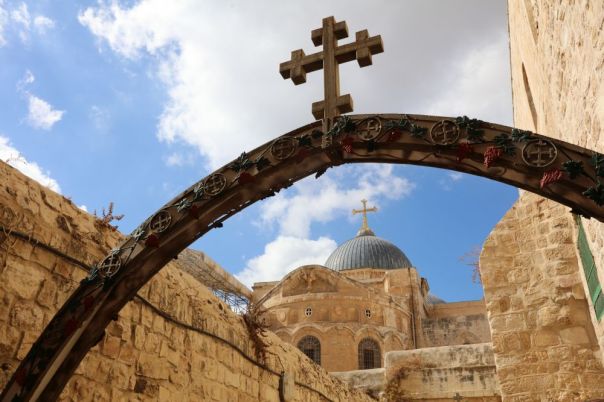
We are celebrating the Feast of the Elevation (or Exaltation) of the Holy Cross. This is a commemoration of historic events in the Orthodox Church, and an opportunity to ask ourselves what these outward expressions of faith have to do with our lives in the current age. The original events are more than a thousand years distant from us, but the human condition is unchanged.
“The Exaltation of the Lord’s Cross has arrived. Then, the Cross was erected on a high place, so that the people could see it and render honor to it. Now, the cross is raised in the churches and monasteries. But this is all external. There is a spiritual exaltation of the cross in the heart. It happens when one firmly resolves to crucify himself, or to mortify his passions—something so essential in Christians that, according to the Apostle, they only are Christ’s who have crucified their flesh with its passions and lusts (cf. Gal. 5:24). Having raised this cross in themselves, Christians hold it exalted all their lives. Let every Christian soul ask himself if this is how it is, and let him hearken to the answer that his conscience gives him in his heart.”
-St. Theophan the Recluse, Letters on the Spiritual Life







 Last week I was racing the rain, which arrived Friday night. I could hardly walk Saturday morning anyway, so that marked the end of the most strenuous week, and ushered in the glorious weekend. From Saturday evening to Monday morning it was again and again granted to me to be in my other happy place, the Orthodox church temple where I worship. First the feast of St. Demetrios, the first celebration of that event since I visited Thessaloniki in June, at which time I had became better acquainted with the saint. He is wonderful.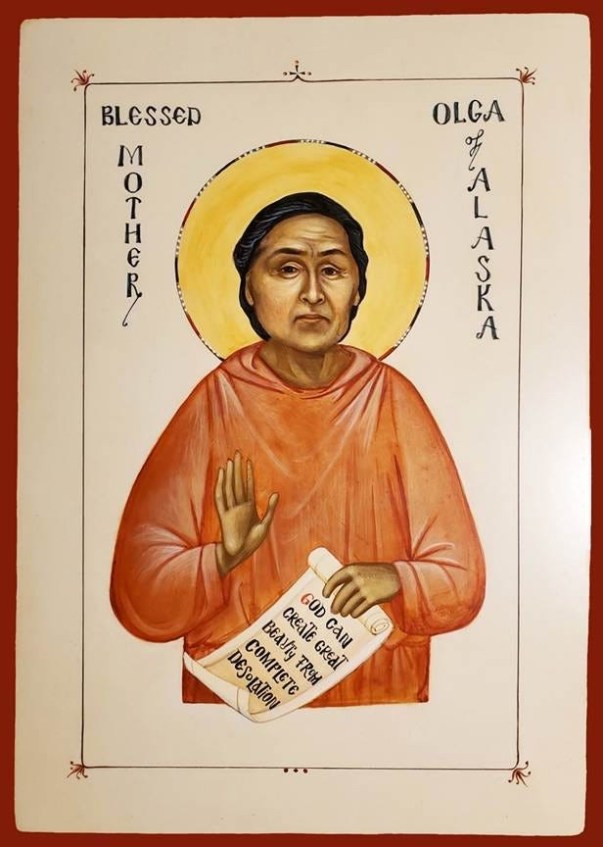

 Gladsome Lights