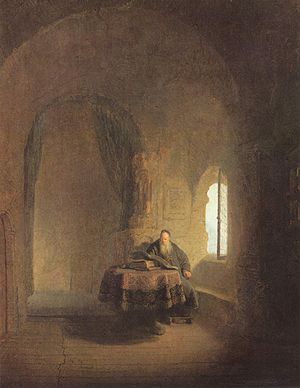
It’s quite cold today, and my feet are feeling it even though I am indoors; I didn’t turn the heat on before I went to church, so now it will take a long time for the house to get warmed by the wood fire I built. And the computer is in the coldest corner. As I sit here with my cold feet and three layers of wool sweaters, blankets of snow can be seen on the surrounding foothills. Maria has a theme of children on her blog this month, and today she posted a lovely painting of a girl reading.
All of these factors combined to spur me into writing about a story that captivated me as a child and that became a foundational piece of furniture of my mind. When people suggest sharing a list of the books that were formative in our lives, I often think that only God could say what they are. I’m pretty sure that we don’t remember in our intellect everything that our hearts know.
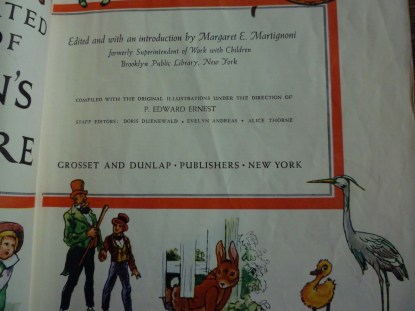
But “The Little Match Girl,” by Hans Christian Andersen, is the one story I know would be on my list. It was in the anthology that provided most of my reading material when I was about 5-10 years old, which my children also read, and which now sits on my shelf in its duct tape bandage.
What did I get from this story, and why did I love reading it over and over? I lived a comfortable life, so it wasn’t empathy with the poor and freezing child that held my attention. It must have been the attractiveness of God Himself, Who I understood was taking the child to be with Him, where she would also be with her grandmother. I learned from this story something about Heaven and death, and that suffering and neglected children aren’t entirely alone. Indeed, they can have spiritual experiences that adults know nothing about and with which no one can interfere.
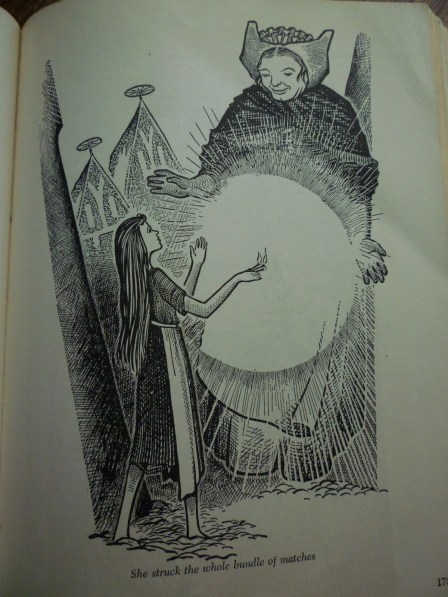
I easily found the text of the story online, in slightly different wording, but I couldn’t find an illustration that seemed right. They all showed a girl of the wrong age, or they were too cute, or irreverent. Finally I took a picture with my camera of the picture in the book, but as I look at it I see that even it doesn’t equal the much richer, if vague, images I retain from reading the words.
Evidently there have been movies telling the story, and perhaps most everyone is familiar with several versions of this tale, but I’ve never gone beyond that first encounter. For anyone wanting to read it once more — or perhaps for the first time! — I post it here.
The Little Match Girl
Most terribly cold it was; it snowed, and was nearly quite dark, and evening– the last evening of the year. In this cold and darkness there went along the street a poor little girl, bareheaded, and with naked feet. When she left home she had slippers on, it is true; but what was the good of that? They were very large slippers, which her mother had hitherto worn; so large were they; and the poor little thing lost them as she scuffled away across the street, because of two carriages that rolled by dreadfully fast.
One slipper was nowhere to be found; the other had been laid hold of by an urchin, and off he ran with it; he thought it would do capitally for a cradle when he some day or other should have children himself. So the little maiden walked on with her tiny naked feet, that were quite red and blue from cold. She carried a quantity of matches in an old apron, and she held a bundle of them in her hand. Nobody had bought anything of her the whole livelong day; no one had given her a single farthing.
She crept along trembling with cold and hunger–a very picture of sorrow, the poor little thing!
The flakes of snow covered her long fair hair, which fell in beautiful curls around her neck; but of that, of course, she never once now thought. From all the windows the candles were gleaming, and it smelt so deliciously of roast goose, for you know it was New Year’s Eve; yes, of that she thought.
In a corner formed by two houses, of which one advanced more than the other, she seated herself down and cowered together. Her little feet she had drawn close up to her, but she grew colder and colder, and to go home she did not venture, for she had not sold any matches and could not bring a farthing of money: from her father she would certainly get blows, and at home it was cold too, for above her she had only the roof, through which the wind whistled, even though the largest cracks were stopped up with straw and rags.
Her little hands were almost numbed with cold. Oh! a match might afford her a world of comfort, if she only dared take a single one out of the bundle, draw it against the wall, and warm her fingers by it. She drew one out. “Rischt!” how it blazed, how it burnt! It was a warm, bright flame, like a candle, as she held her hands over it: it was a wonderful light. It seemed really to the little maiden as though she were sitting before a large iron stove, with burnished brass feet and a brass ornament at top. The fire burned with such blessed influence; it warmed so delightfully. The little girl had already stretched out her feet to warm them too; but–the small flame went out, the stove vanished: she had only the remains of the burnt-out match in her hand.
She rubbed another against the wall: it burned brightly, and where the light fell on the wall, there the wall became transparent like a veil, so that she could see into the room. On the table was spread a snow-white tablecloth; upon it was a splendid porcelain service, and the roast goose was steaming famously with its stuffing of apple and dried plums. And what was still more capital to behold was, the goose hopped down from the dish, reeled about on the floor with knife and fork in its breast, till it came up to the poor little girl; when–the match went out and nothing but the thick, cold, damp wall was left behind. She lighted another match. Now there she was sitting under the most magnificent Christmas tree: it was still larger, and more decorated than the one which she had seen through the glass door in the rich merchant’s house.
Thousands of lights were burning on the green branches, and gaily-colored pictures, such as she had seen in the shop-windows, looked down upon her. The little maiden stretched out her hands towards them when–the match went out. The lights of the Christmas tree rose higher and higher, she saw them now as stars in heaven; one fell down and formed a long trail of fire.
“Someone is just dead!” said the little girl; for her old grandmother, the only person who had loved her, and who was now no more, had told her, that when a star falls, a soul ascends to God.
She drew another match against the wall: it was again light, and in the lustre there stood the old grandmother, so bright and radiant, so mild, and with such an expression of love.
“Grandmother!” cried the little one. “Oh, take me with you! You go away when the match burns out; you vanish like the warm stove, like the delicious roast goose, and like the magnificent Christmas tree!” And she rubbed the whole bundle of matches quickly against the wall, for she wanted to be quite sure of keeping her grandmother near her. And the matches gave such a brilliant light that it was brighter than at noon-day: never formerly had the grandmother been so beautiful and so tall. She took the little maiden, on her arm, and both flew in brightness and in joy so high, so very high, and then above was neither cold, nor hunger, nor anxiety–they were with God.
But in the corner, at the cold hour of dawn, sat the poor girl, with rosy cheeks and with a smiling mouth, leaning against the wall–frozen to death on the last evening of the old year. Stiff and stark sat the child there with her matches, of which one bundle had been burnt. “She wanted to warm herself,” people said. No one had the slightest suspicion of what beautiful things she had seen; no one even dreamed of the splendor in which, with her grandmother she had entered on the joys of a new year.
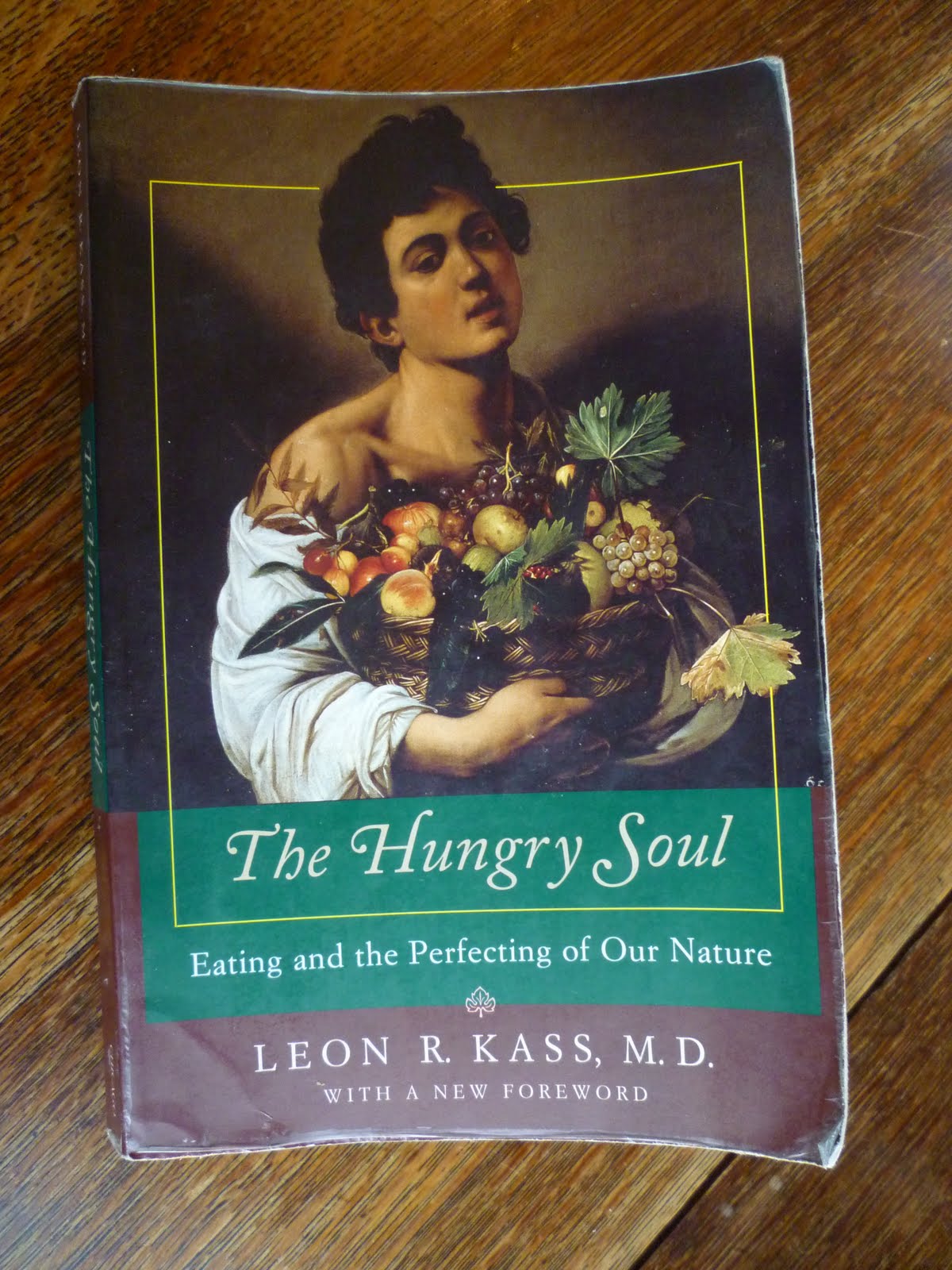 Any self-conscious emotional eater might take notice of a title like The Hungry Soul: Eating and the Perfecting of our Nature. I had the added attraction to the book that came from having heard the author’s warm and thoughtful voice on the Mars Hill Audio Journal as he was being interviewed on an altogether different topic.
 I really think I could come back to The Hungry Soul again and again and find more philosophical paths to explore, but if I wait to share my discoveries I’m afraid the tale will never be told. So I will begin the telling, even though I’m pretty sure I haven’t chewed on these ideas enough to do justice to what the most eminent reviewers hail as “an intellectual feast” and “a profound and brilliant exploration.”