Category Archives: nature

Scouting Around

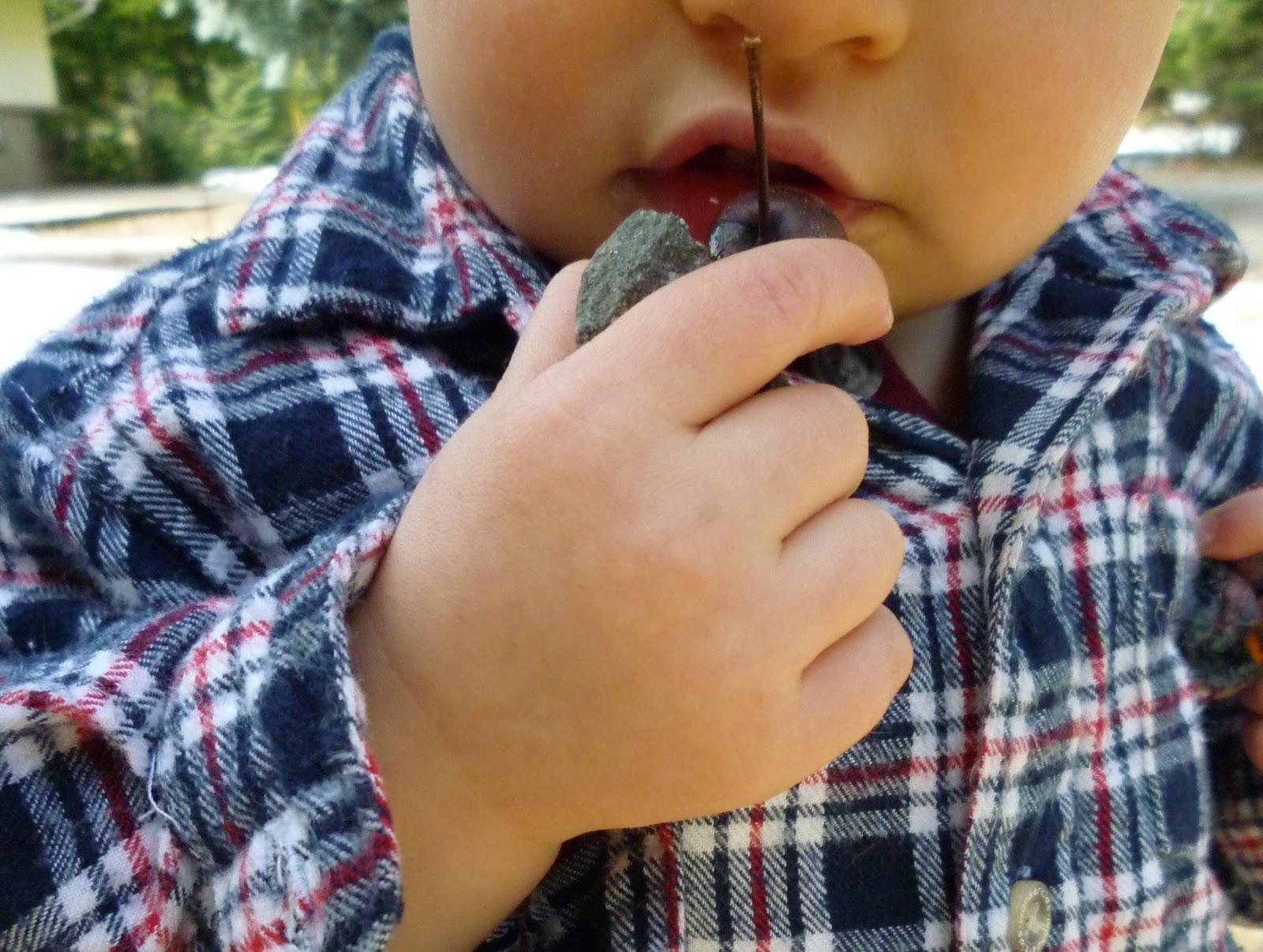
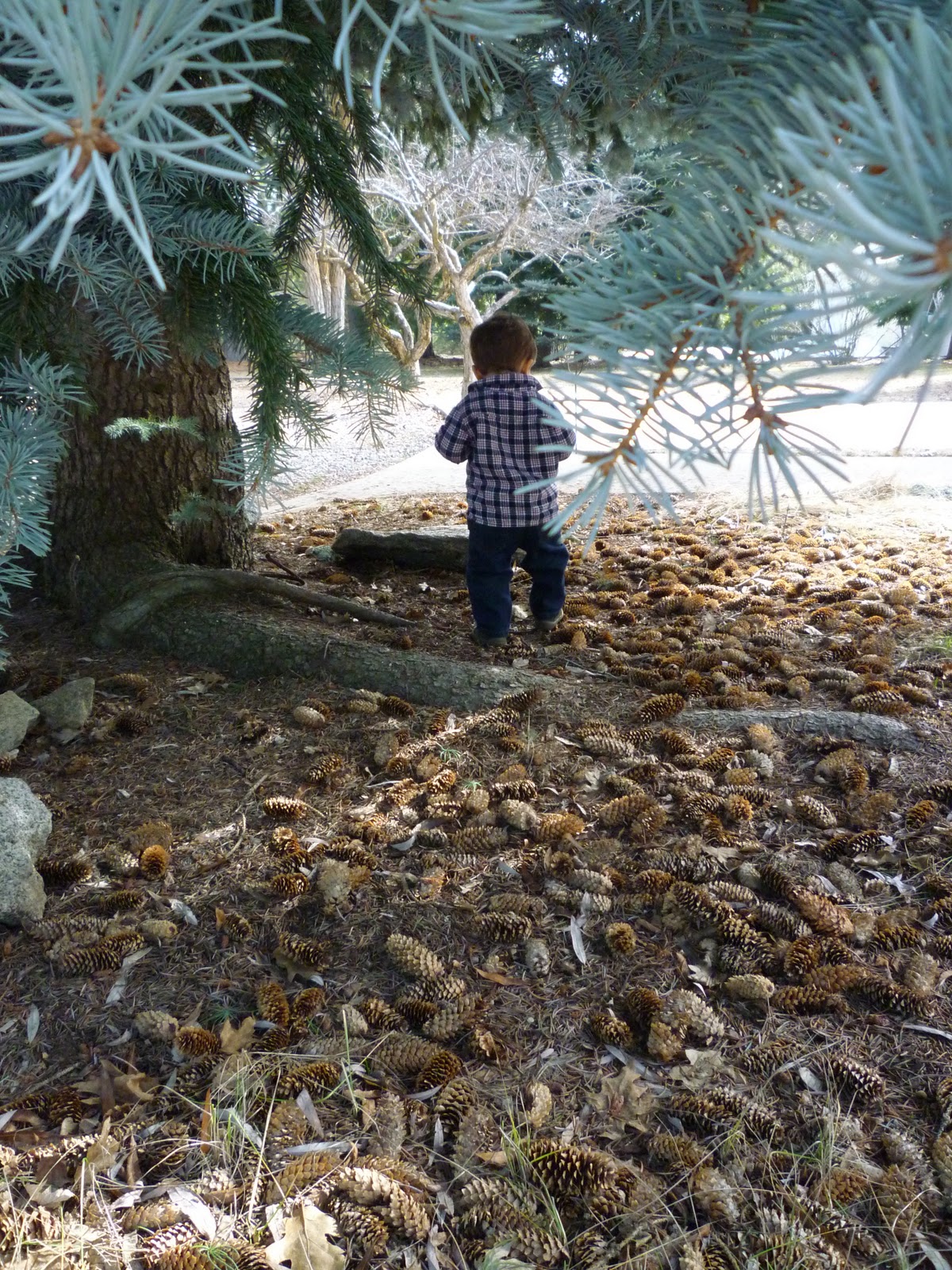
It was great fun to follow little Scout around the yard for an hour while he explored his world. I took a slew of pictures trying to catch something of the Serious Scientist and Joyful Naturalist I was observing.

He is so good at walking on icy snow…I wonder how it feels to be so close to the surface and have a short toddly stride. Evidently pretty secure. Walking on snow was part of the adventure he was enjoying, and he never once slipped.


Scout is also an expert at recognizing a crabapple, even if it has lain under the snow for a few months and doesn’t look like its former self. He can get one into his mouth, avoiding the large piece of gravel that is also in his fist, and calmly remove the pit, enjoying what little “fruit” was left. I was a bit concerned when he picked up a specimen that had decomposed to an ugly state, but after squeezing it through his fingers for half a minute he rejected that one.

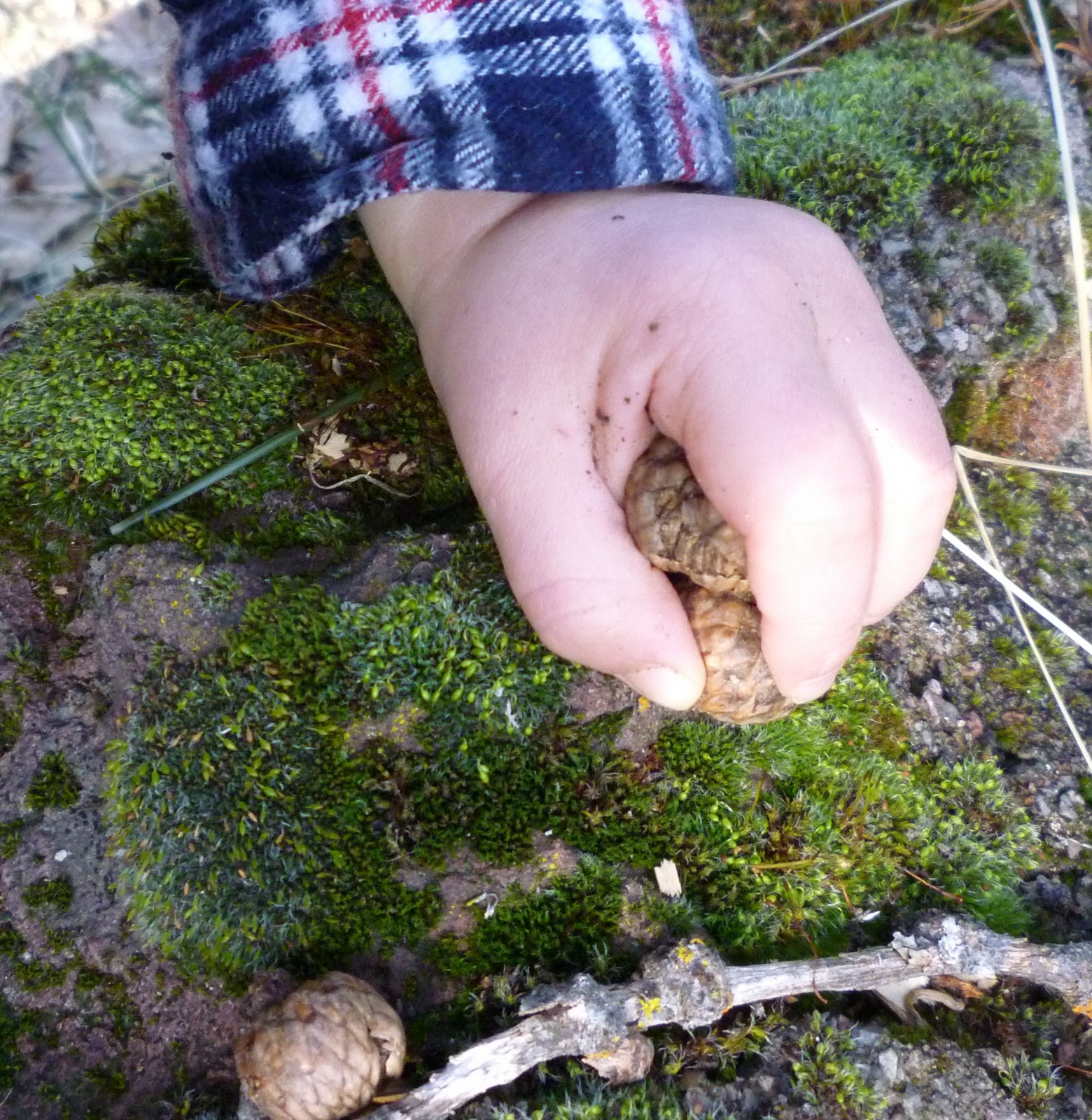
The main project of the hour was picking up stones, acorns, pine cones and sticks. He’s not yet at the age when sticks are preeminent, but he did carry a few for a while, which meant that his capacity for rocks was less.


But when he found the field of acorns, the sticks were dropped.The question is, how many acorns can fit in one little fist?

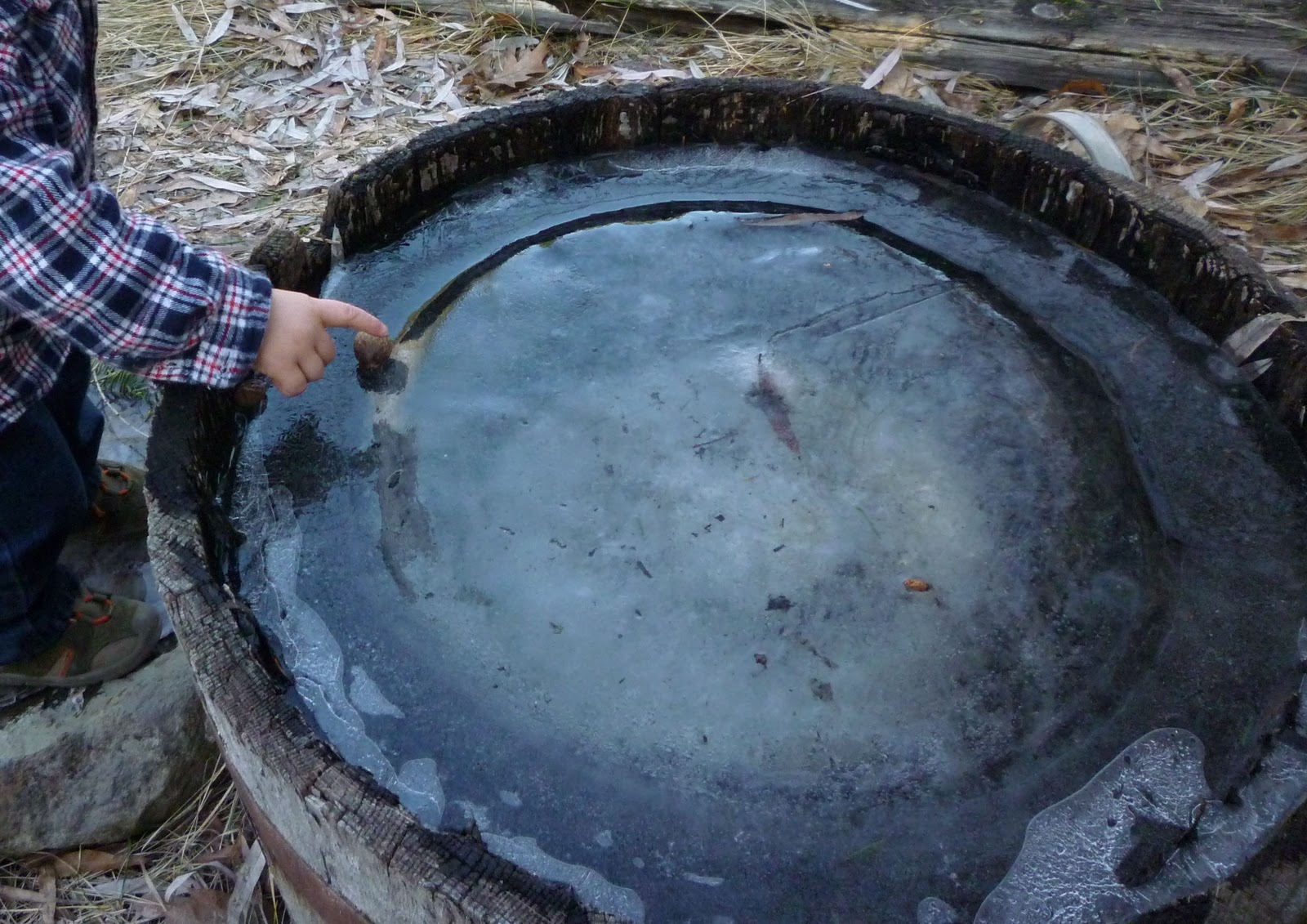
In spite of the sun, I’m sure his hands felt pretty cold after splashing in little puddles and patting ice, but he was oblivious to anything that would distract him from his Purpose.

However, Grandma did feel the chill, so we went inside and took a few acorns with us.


New Friends on the Way

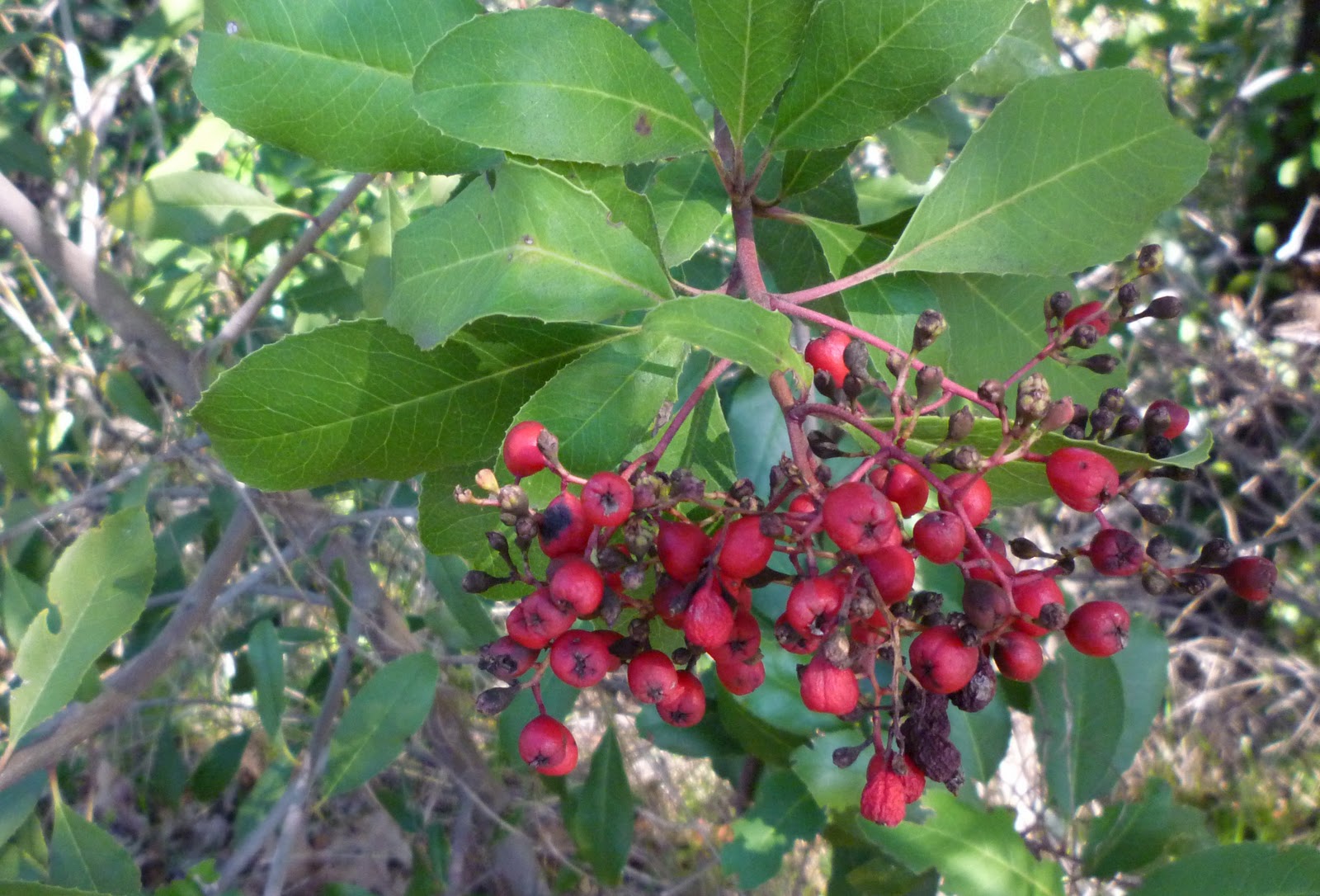
Heteromeles arbutifolia – toyon

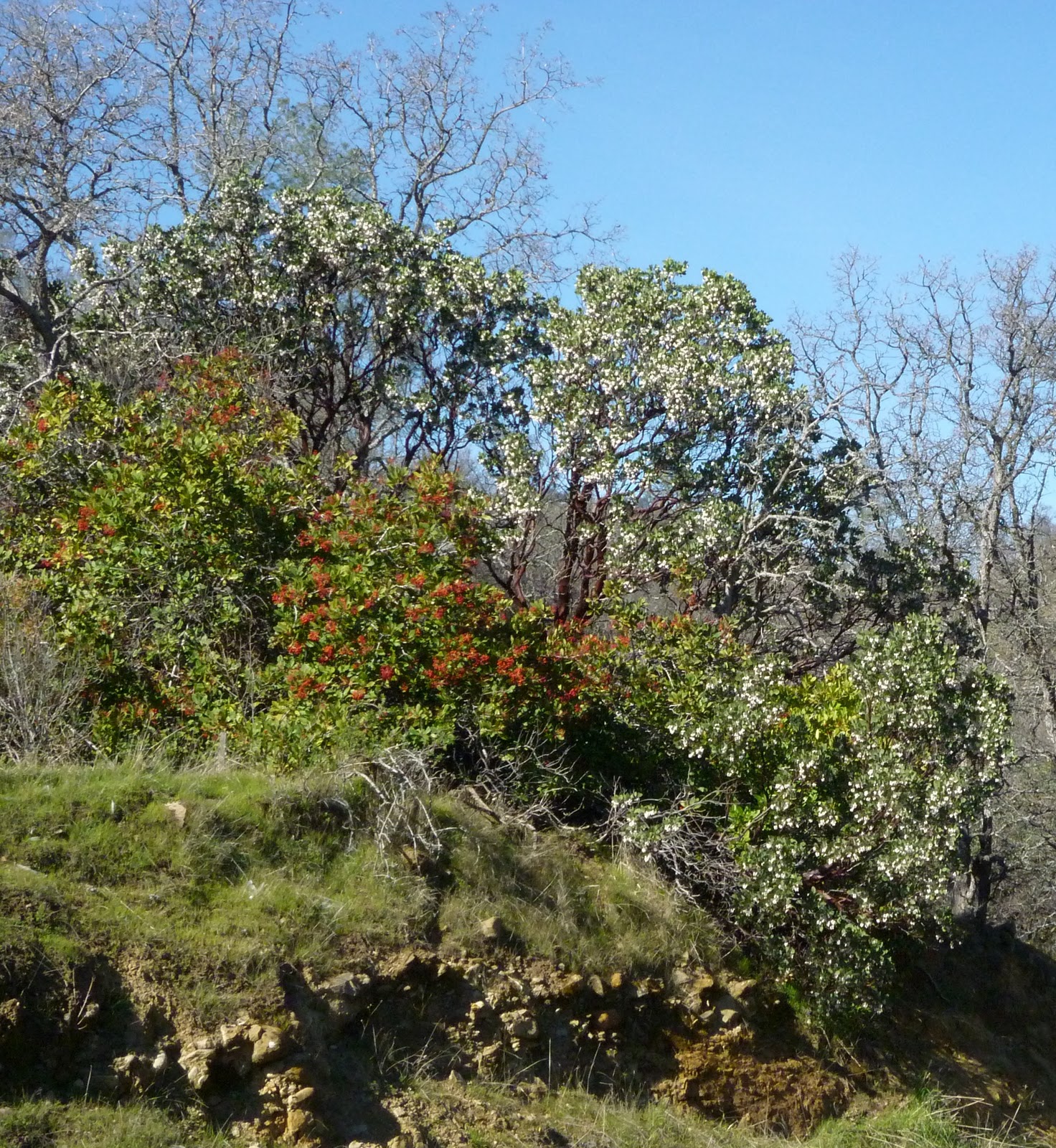
On my way to visit Pippin, The Professor, and Scout last week I stopped to see some of my tree friends. The lovely bay tree was blooming, all tangled up with the madrone, whose berries were almost gone.

toyon with manzanita behind

Also in the jumble was the toyon, with slightly fresher berries. I read in Pippin’s tree book that toyon is the only species in its genus, and it grows only in California and Baja California. Though I’d been introduced to Mr. Toyon many times in the last 40 years, I didn’t seem to pay much attention to him. I think we’ll be friends now. On this occasion I had the time and Google to help me focus and learn more, and I also have a blog where I can find him again if my memory fails.

another view of toyon

I did see quite a few of my most beloved manzanitas as well. Manzanita means “little apple.” The botanical name arctostaphylos means “bear berry,” though of course other animals also feed on these fruits. The common name of some varieties is also bearberry.

Right now the bushes are in bloom (so is the one in my yard); I saw pink- and white-flowered variations. There are about 60 species total, and most of those are native to California, so it’s a hard one to pin down as to which species you are seeing.

manzanita

Many of the trees I saw on this outing are growing on the slopes of that volcanic mountain I told about before, Mt. Saint Helena, in Napa County. On the weekend scores of cars were parked at the trailhead for hikes up to the top. The spot is in Robert Louis Stevenson State Park, so named because the author and his wife honeymooned on this mountain in 1880. He went on to use it as the model for Spyglass Peak in Treasure Island. One New Year’s Day a decade ago our whole family made the trek up and got amazing views.

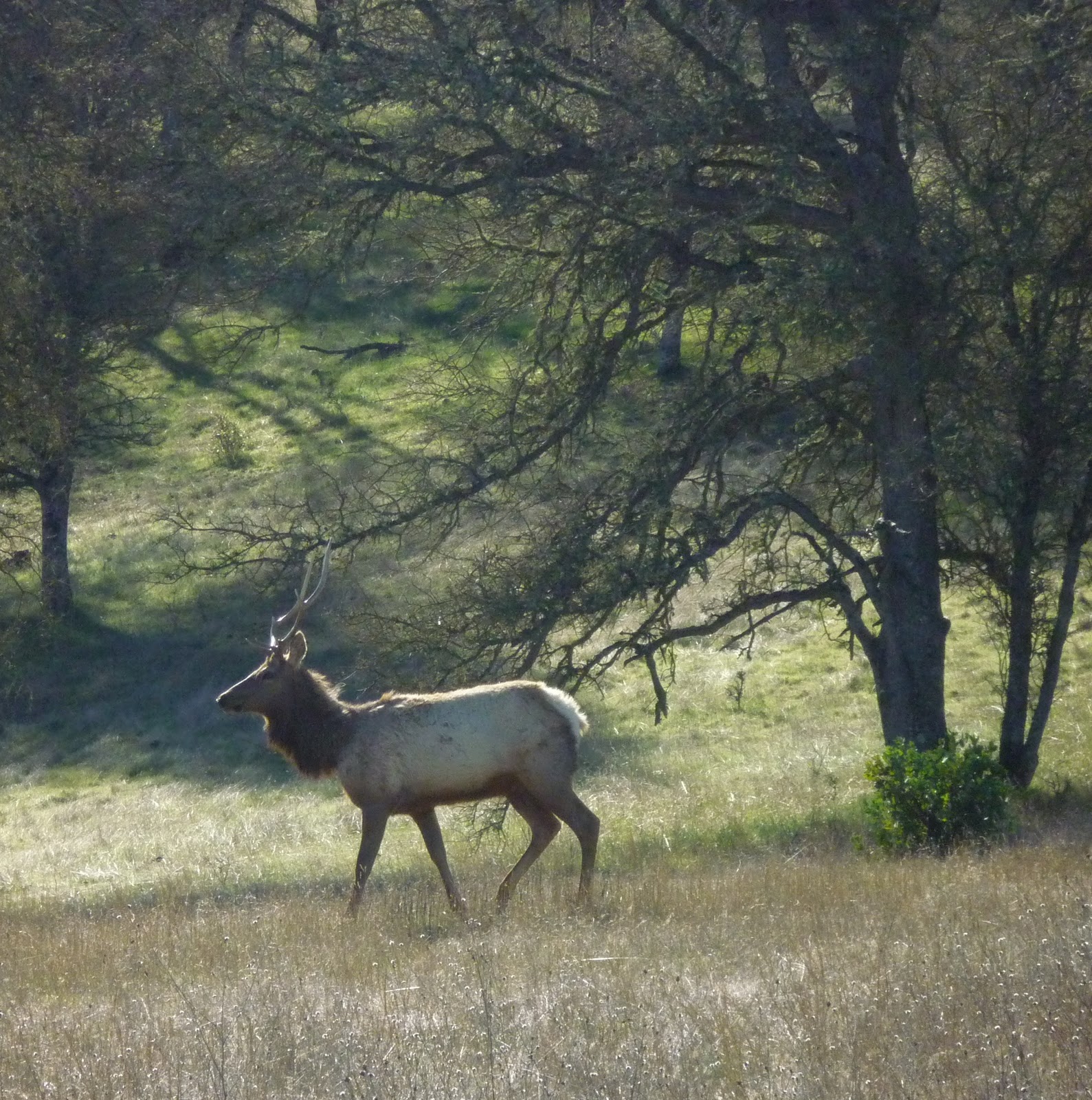
I left the forest and after driving a while longer I caught a glimpse of something off the highway that made me flip a U across three lanes to go back and take a second look. I was lucky there was a turnout right opposite the meadow where 20 elk were grazing!

Later The Professor told me that he had seen this herd of tule elk many times over the years, in this their winter home; it is the largest migratory elk herd in California. Tule elk are a subspecies of elk only half the size of Roosevelt elk, whose habitat is even more narrow than the toyon: they only live in California. I stumbled through the star thistles and got my socks full of prickles, trying to get as close as possible and watch them for a few minutes before they escaped.

On the way home I looked and looked for the spot where I’d pulled over three days before, but I couldn’t even find the turnout across from the meadow, much less see any animals. If I can get a view of the elk another time or two, I might put them in the category of friends, though they didn’t show any signs of wanting to get to know me. So far I’m content to thank God for this happy meeting.

Journal of October Trip South

As we were getting ready to go on a weekend trip, I was more calm than usual, because we’d only be gone one night, then home again. And it appeared to be the last trip I would make for months to come. The occasion was a gathering with my sisters and brother, in a countryside place spread with orange groves. One brother and sister live within a couple of miles of each other, but with mailing addresses in different towns, and neither of them close to even a village. We drove south, instead of my more frequent northward to Pippin’s, but about the same distance, 5+ hours.

Mr. Glad and I stayed overnight with my brother, who lives in the house my dad built over 50 years ago, where I mostly grew up. This morning I got up early and sat in a big stuffed chair in the living room, tucking my feet under me the way I used to as a girl. The house feels so quietly solid. It’s a wood-frame stucco house on a concrete slab, and you never hear any creaks walking around the ranch-style layout. A big picture window looks out on the foothills that are dotted with oaks, and behind them shady layers of taller and taller mountains forming the Sierra Nevada. Curving grids of trees like dark green pom poms hug the lower slopes nearby. The first time I went home after living in Northern California for a while, I was struck with how short all the orange trees were, not even as tall as nut trees or peach trees, but certainly dwarfed by the Coast Redwoods and other tall trees we have up here where the rainfall is doubled.

The net effect is of a lush but flattish scene, house and orchards keeping close to the earth. The sky is bigger therefore. This October we got quite a bit of rain; all the autumn landscapes were more beautiful having been washed by the rains, making every tree and bush stand out brightly against the background of greening fields. I had my usual thrill of watching the cloud performances all the way down and up the center of the state. We saw black cattle grazing in a pasture, and in the middle of the herd, a white egret standing at attention.

Over a big dinner, we siblings talked about our mountain cabin and how to manage things as the new owners since our father passed it to us just over a year ago. We hadn’t all been together for more than a year, and we aren’t big phone or e-mail users, so we had a good time catching up. We always have to hear as well the news of our mutual old school and neighborhood friends, and the goings-on of the farming community there.

Some citrus crops are being picked already, by crews of Mexican farm workers. And olives are at the peak of harvest in the same general area. Cell phones have created changes in the way the picking crews operate. You might say they have created some degree of anarchy, or at least free-lance options that didn’t exist before. My sister Farmer Woman told us about how some growers were having difficulties getting enough pickers for the oranges, because they could make more money in olive-picking, at least until the frost cuts off that opportunity.

Because of the shortage, a crew was enlisted one day to drive down from the county to the north, in several cars. At least one car-full never arrived, because on the way someone got a call on his cell phone with a tip from a friend, that a different grower was paying $1 more per box, so they detoured that way. This sort of thing happens all the time now.

Dinner was over, and we were sitting lazily around a big table when Farmer Woman’s cell phone rang. The screen said it was her nephew, our Soldier, who was calling. As she talked to him it became apparent that he and Joy were in the area, too, having been to a wedding nearby. Neither of us had told the other that we were making a trip down there this weekend, so it was a pleasant surprise for everyone when they were able to join us for breakfast this morning, and a bigger family get-together than they had hoped for.

After that, they took off northwesterly, and we more to the north, but evidently we both wandered around the next city of over 100,000 population for a while, getting fueled up or something, because when we were leaving town, there we were driving alongside one another. Twenty minutes later, merging on to the interstate, we were right behind them. It was the kind of happenstance that would make a child happy, and it did me, too.

On the way home I read the Forward, the Introduction, and the Preface to a book by Leon Kass that I plan to write about at length later on. It’s philosophy, and as I had nothing much else to do, I could put the book down every few minutes and chew on the ideas. I read it two years ago and might need to read the whole thing again before I’ll be able to know and express why I love it so much.

Then I dozed for a while, and when I woke up my husband was playing parts of his iPod collection. I asked again, for the fortieth time, “Who is singing that song?” It was Police. So I worked on a mnemonic that would make me learn this fact for once and forever. They were singing, “There’s a little black spot on the sun today,” so I imagined that the black spot was a black Police car driving around. I watched them in my mind for a few minutes, and then on the iPod they were singing a different song, “Every little thing she does is magic,” very ardently, so I amplified my image so that the Police car driving over the sun’s surface was full of Policemen who were loudly singing these very words about a magical woman. I can’t lose it now.

Getting closer to home, I was more and more excited about the beauty of the world. Rows of eucalyptus trees form windbreaks here and there, and beneath them the colors of a dahlia farm don’t seem to have faded in the rains.  On the slopes in our county it’s the vineyards that catch your eye, and they are starting to turn gold and orange. Flocks of starlings were swooping like fluttered polka dots. I understand that they are eating insects as they do their dances. That reminded me of my book, which is about eating, nature, our souls, the unity of reality. There is a wholeness to life, because God in His Holy Spirit fills all things.

I guess that’s the reason I’m content to write about our trip without trying to find a theme for it. The entire weekend seems of a piece, a large piece of joy.

Washington – The Rain Forest

The rain forest surprised me. It wasn’t chilly, even though it was cool; perhaps the humidity served as a blanket. The towering complexity wasn’t too overwhelming, because my camera helped me to isolate and literally focus on various particulars.

My favorite plants were the exotic fungi, because they stood out from the multitude of mostly green colors.

They say there are several thousand plant species in there, and I imagined it would be a trial to take a day hike through all that jumble and jungle of green sameness. Instead, it was strangely invigorating. Is there more oxygen than average in a rain forest, what with all those plants exhaling? It was as exciting as the beach.

We had the slightest drizzle as we entered, but not enough to warrant covering my head. Even that amount of moisture waned and my hair didn’t get wet — only pleasantly fluffy, a welcome relief from the usual flat.

Autumn was beginning to give some color accents, especially in the form of the big leaf maples that arch throughout the canopy and drop their leaves over everything.

Hoh….the very name of this forest is like a mother’s calming hush, or a version of the meditative Ohm. I got to thinking of the shape of the letters themselves as the circumference of a Sitka Spruce trunk with branches on the sides.

It seems that the word Hoh by itself has endless possibilities, but in any case it seems to be the only name possible for this place, so quiet and deep. The Hoh River runs through it.

Wherever a stump stands, several plants will use it for a seedbed, so that a conifer, a fern and a deciduous tree will often make a bouquet on the stump. But a log lying horizontal becomes a pasture of low and thick lichens and moss.

Below: Gray leaf lichens were in abundance, lying around everywhere, and also growing on trees. If there were a contest for the brightest fungi, the yellow one would get my vote.

This area of the world boasts the tallest (Sitka) spruce tree and the tallest (Red) cedar tree in the world. I couldn’t guess what most of the evergreens were, their lowest branches were so high up, and everything blanketed with spongy green lace. But I think this one is a Douglas-fir (it’s written like that because it’s not a true fir.)

 Leafy lichens abound. I guess this is one?

I was surprised when Mr. Glad said we should turn around and go back out. We’d been hiking two hours and it didn’t seem to have been more than about 40 minutes. By that time I wasn’t living in the moment, though. Time was flying because I had caught a whiff of the moist rain forest scents. Funny I didn’t notice right away. But when I did, I couldn’t just enjoy the mystery and deliciousness of these smells, but I had to start thinking about how I would describe them, if only to myself, so I could remember them.

I will probably never come back here! was my thought, and I will never smell this again. So why did I waste time thinking about it, I now wonder. Why not just drink of the thrilling sensory Now? And why were the disciples not content to just be in Christ’s presence at His transfiguration?

They were trying to make provision for the future, and prolong the experience, as I was hoping to provide myself with some words to take with me. I couldn’t hope to make the moment last, as we were walking fairly briskly by then, getting closer and closer to the outside where the opportunity would be gone.  I was lagging behind and noticing that the mix of wild aromas changed with the changing terrain, but they were always bewitching. Do people get addicted to smells? It could happen here.

Time was running out, and it did run out, ten days ago now. I kept thinking about the words for several days, but as expected, there was no way to improve on whatever poor metaphors I came up with while my senses were being bombarded.

The smell of the rain forest was something like eating a cookie fresh from the oven, a cookie made of fermented wild mushrooms and hazelnuts, with one’s head in a bucket of vanilla ice cream.

This was a new smell for me, with no links to my grandmother or anything in my past. There was no way to focus on it the way a camera helps one to focus visually — and no way to deliberately preserve it, though my mind has no doubt filed this input in a purer form than the silly image I worked so hard to invent. Perhaps elements of that exotic forest atmosphere exist elsewhere, and if so, they might someday come to me on a moist breeze and I’ll be taken back to the Hoh.