Category Archives: Pascha

An Olive Tree is More Than Interesting

In a recent post I said that my birthday olive tree was “an interesting gift.” I suppose it was because I was dead tired that I couldn’t think of a more telling word. I’m embarrassed to use such an uninteresting word as interesting. Ugh. The truth is, to receive the gift of an olive tree on the occasion of getting older made a huge impression on me. If I hadn’t needed to finish that post quickly and make dinner…well, enough of the excuses.

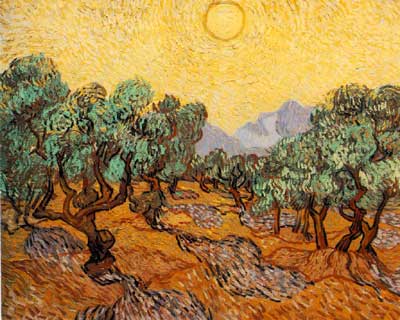
I love to look at these trees, so as I was browsing them on the Internet I pasted some pictures here. Vincent Van Gogh painted several scenes of olives.
A post about olive trees was one of the first in my string of blogs. And recently on my tree-rich trip I saw old California orchards. My childhood was near the groves that made Lindsay Ripe Olives famous, though as I have mentioned, I don’t like the fruits, and my family never had an olive tree on our property. Olive oil gelato? Very West-Coast, and I would be willing to give that a try.

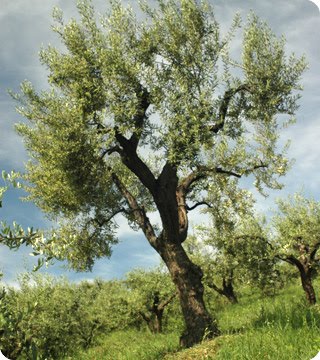
You can adopt an olive tree growing in Italy, like the one at top, and then receive its produce for a year. I suppose you have to adopt it, or a different one, again the next year. Not very good parenting.

Montenegro is the home of this pocked giant, which is reputed to be 2000 years old. The longevity intrigues me, along with all the Biblical references, which I haven’t even begun to think about. Mention of them often goes along with general descriptions of abundance and productivity of gardens, and with pomegranates and figs and vineyards.

There’s a story of the olive tree who was asked to be king, and the olive branch in the dove’s mouth after The Flood. Doors for the Temple were carved in olive wood. Many people make reference to it being the tree of Peace, and God knows I need that–I need Him.

What does it mean, “I am like a green olive plant in the house of my God.” ?  It means alive, if it is green. Let me flourish in Your House, O Lord. Let me live in You.

Getting back to the trees themselves, the grove I would most like to visit is this idyllic one in Turkey , the fifth-largest seller of olive oil in the world– but trying to get to second place. Olive oil I do much appreciate, and can imagine having a picnic on the warm yellow grass, of bread dipped in oil, sitting on a blanket under the sun. Once during my sojourns in that very country, I helped women in shalvar* gather olives from the ground where they’d fallen. I even sampled one of the wrinkly brined olives they cured in flat pans spread around under the trees, and had to restrain myself from immediately spitting it out.

*(I tried in vain to find a picture of these baggy pants that so many women still wore in Turkey in the 60’s and 70’s. These days a version has become high fashion, and the ones worn by chic models are not the ones I saw and wore. Perhaps this will be be the subject of a future post.)
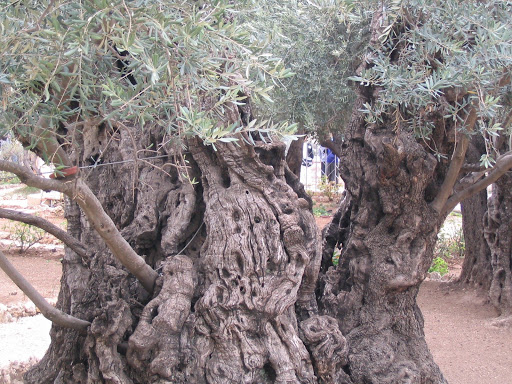

The Garden of Gethsemane figures prominently in the events of our salvation history, into which we entered last week through the services and events leading up to Pascha. And this tree lives there. What if it is also 2,000 years old?

I planned to post this blog before Pascha, but now here we are post-Gethsemane, post-Golgotha. Wherever olive trees, any trees, are living, this week they are dancing.

Bright Monday–Christ is Risen!

Today is Bright Monday, one of the many “most blessed” days of the church year. Our temple was beautiful in the morning light, and in the light of the parishoners’ peacefulness, decorated with white Easter lilies and the priests in white vestments, the altar open and letting more sunshine from outside flow into the nave. Wide beams of fuzzy sunlight also streamed down from the windows just below the dome, when thundershower cells were not passing by, and all the candles on the chandelier were lit, even though they weren’t “needed.” Here is a zoomed-in glimpse of my view.

I love that in the Orthodox Church we have a whole Bright Week to bask in the high joy of Pascha, before we descend slightly into the lesser heights of the 50-day Paschal season on our way to Pentecost. Throughout this period we get to greet each other every day not with a mere “hello!” but with that proclamation that is shouted in many languages on Pascha night, “Christ is risen!” Fr Stephen posted a lovely short video on his blog, one that captures the pervasive blessing of Christ’s Resurrection.

He also posts a translation of the words sung in the film, and though I don’t know how to link to the video directly, I can at least put the words here:

People rejoice, nations hear:
Christ is risen, and brings the joy!
Stars dance, mountains sing:
Christ is risen, and brings the joy!
Forests murmur, winds hum:
Christ is risen, and brings the joy!
Seas bow*, animals roar:
Christ is risen, and brings the joy!
Bees swarm, and the birds sing:
Christ is risen, and brings the joy!
Angels stand, triple the song:
Christ is risen, and brings the joy!
Sky humble yourself, and elevate the earth:
Christ is risen, and brings the joy!
Bells chime, and tell to all:
Christ is risen, and brings the joy!
Glory to You God, everything is possible to You,
Christ is risen, and brings the joy!

In my parish we had nine services between Holy Thursday and today, Bright Monday. I made six of them this year, and I doubt I’ve ever attended more–even though this year I felt the strain of trying to navigate my daily path through my strange house (torn up for remodeling) and several children coming in at various times for an Easter reunion of sorts.

Tonight I am filled to the brim with all the love of my children and husband, and thankfulness that they all wanted to be here and be together… and filled with Paschal joy, too! I noticed that even the sorrowful days leading up to Sunday have their own joy in anticipation of Christ’s rising from the dead. For example, these words from a hymn: “We worship Thy passion, O Christ; show us also Thy Holy Resurrection.”

Holy Friday is to be a day of strict fasting and quietness as much as possible, remembering His suffering and sacrifice, and because I had non-Orthodox family around I couldn’t plan ahead as to whether I would attend all the services that day: Royal Hours, Vespers of Holy Friday, and Matins of Holy Saturday. In the end, I wasn’t needed at home, and I realized that the best way to remain prayerful that day was to remain in church! So I spent most of the day there, and it was probably the richest Good Friday I’ve ever had. Not until I attended my first of these longish services that dwell deeply on the Cross of Christ did the event and its significance really sink into my heart.

The Vesperal Liturgy of Holy Saturday features 15 readings from the Old Testament, some of them pretty long, like the whole book of Jonah. And two or three of them feature extended congregational singing of choruses. Then–a baptism! It was in the middle of this service that I was baptized into the church three years ago. After I have listened to so much history of God’s dealings with His people, the baptism ritual is quite overwhelming. Just as God is lavish in His grace and forgiveness, His provision for our salvation, the ceremony is an extravagance of olive oil poured in water and holy chrism anointing hands, feet, ears and head. The “newly illumined” parishioner wears a white gown and carries a candle, wearing a cross that has also been dipped, baptized in the font.

I did happily remember my own baptism (that’s me in the photo), but it wasn’t only a personal nostalgia that brought me to tears; much more than that it was gratefulness for the whole plan of God, executed in a saga of faithfulness that we can’t even comprehend, much less tell adequately. If, as the apostle says in John 21:25, “…there are also many other things which Jesus did, the which, if they should be written every one, I suppose that even the world itself could not contain the books that should be written. Amen.”–then we also could not utter enough words to proclaim the implication of baptism, much less do a thorough job of “praising the LORD for his goodness, and for his wonderful works to the children of men!” Ps 107:8

Listening to the Orthodox prayers and hymns, it seems that the Church is trying anyway. A stranger to these proceedings might think that the priest goes overboard in prayers for the new member and prayers of thanksgiving to God. Part of me also thinks this, sometimes, at various services, it is true. But the other part of me says, “Hasn’t God filled our cups to overflowing? Didn’t he do everything He could to save us? Remember yesterday–Good Friday? Are you so soon bored with thanking Him?”

Truly the spirit is willing, but the flesh is weak. Which is why I didn’t even go to the glorious Paschal Matins and Liturgy at midnight. We were going to have a big family gathering in my house-with-no-kitchen the next day, and I was already worn out, so I needed to sleep that night. That Vesperal Liturgy is the beginning of our Resurrection celebrations, though, as in the middle somewhere we change the vestments and altar cloths to white, and we partake of Holy Communion, always a festal event.

While many of my family went to a brunch Sunday morning, I made signs for the bare walls in the living room, using crayons on some remnant rolls of newsprint I got about 30 years ago from the recycling center. Of course, they said, “Christ is risen!” and “Indeed He is risen!” I had brought in enough calla lilies from the back yard the day before to fill three vases stuck around the room amid the camping clutter and oddly-arranged furniture.

It was a blessed day of feasting and reunion, with yummy things from the deli. This morning was the buoyant liturgy , and now I will hope not to deflate too quickly, but to float airily on through this Bright Week.

What I Did on Zacchaeus Sunday

In the Orthodox Church Lent is a long and sweet, helpful preparation for Easter, Resurrection Sunday, PASCHA! But four weeks before Lent we get to start preparing for the preparation, you might say, by means of four thematic Sundays. I’m so glad Deb wrote about this, better than I could have. But what I would like to mention is that it was on Zacchaeus Sunday, which was yesterday, that I became an official catechumen three years ago.

I had been a sort of unofficial catechumen for about seven years before that, so my official period was not long–just about long enough to get ready for Lent, and then enter into its “joy-creating sorrow” and finally be baptized on Holy Saturday. Every Pascha, indeed every Sunday, I remember that event of fully entering the Church, but I mark my first formal commitment with every Zacchaeus Sunday.

Joy in the Holy Spirit — Pentecost

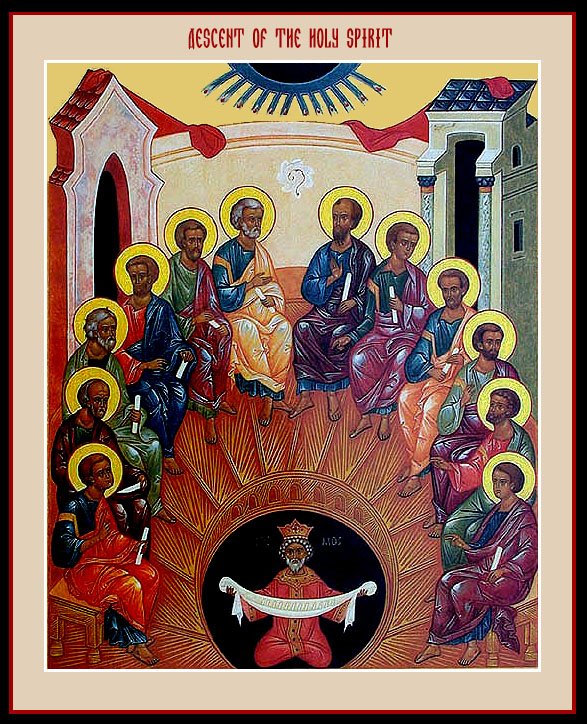
Today the church is decorated with green–ferns, birch branches, palm fronds, hanging from the chandelier and draped over everything. Lilies frame the icon that portrays the pouring out of the Holy Spirit 50 days after the Resurrection. The vestments and other cloths are green now as well. This passage from Alexander Schmemann’s For the Life of the World explains why we Orthodox take so much trouble for the sake of the appearance of our temple:

The liturgy [Communion service] is, before everything else, the joyous gathering of those who are to meet the risen Lord and to enter with Him into the bridal chamber. And it is this joy of expectation and expectation of joy that are expressed in singing and ritual, in vestments and in censing, in that whole “beauty” of the liturgy which has so often been denounced as unnecessary and even sinful.

Unnecessary it is indeed, for we are beyond the categories of the “necessary.” Beauty is never “necessary,” “functional” or “useful.” And when, expecting someone whom we love, we put a beautiful tablecloth on the table and decorate it with candles and flowers, we do all this not out of necessity, but out of love. And the Church is love, expectation and joy. It is Heaven on earth, according to our Orthodox tradition; it is the joy of recovered childhood, that free, unconditioned, and disinterested joy which alone is capable of transforming the world. In our adult, serious piety we ask for definitions and justifications, and they are rooted in fear–fear of corruption, deviation, “pagan influences,” whatnot. But “he that feareth is not made perfect in love “(I John 4:18). As long as Christians will love the Kingdom of God, and not only discuss it, they will “represent” it and signify it, in art and beauty. And the celebrant of the sacrament of joy will appear in a beautiful [robe], because he
is vested in the glory of the Kingdom….

Today is Pentecost, or Holy Trinity Sunday, so named because all the Persons of the Trinity are remembered–Christ sent the Holy Spirit from the Father. This event is, as our rector reminded us, the seal and crown and joy of Pascha, and our salvation. It is a feast second only to Pascha, to the Resurrection itself, and there is so much to celebrate that we have another Divine Liturgy tomorrow, on Holy Spirit Day.

During the time between Pascha and Pentecost, we withheld the prayer about the Holy Comforter from our daily selections, as we entered into a period of “waiting” for the Spirit to be given. Now its restoration imparts the reality of Pentecost as a historic event which has been given to us in Christ, and we pray:

O Heavenly King,
The Comforter, The Spirit of Truth,
Who art everywhere present and filleth all things,
Treasury of Blessing, and Giver of Life,
Come and abide in us,
And cleanse us from every impurity,
And save our souls, O Good One.