Category Archives: the language

Minding your itses and it’ses.

This article from Stan Carey at the Sentence First blog,  Its, it’s: It’s a problem should help you clear up any hesitation or confusion you have about when to put an apostrophe in its. It’s the most thorough treatment of the problem I have read, with 40 ! surprising and cringeworthy examples of misuse photographed from original documents or screens, even in the edited prose of such publications as The New York Times and The Economist. Using it’s when its is called for is the most way these two are mixed up — I think even more so now than when he wrote this article. Anits 2d still wrong.

To be fair I should mention that Mr. Carey is generally in the descriptive linguistic camp, but he says this issue is a pet peeve of his. He admits that the scale of the its-it’s problem is not cosmic, “But careful readers will notice the mistake and consider it a sign of inattention, sloppiness, ignorance, or even illiteracy – especially if it’s repeated. So if you value good communication, it’s a distinction you ought to make, and make consistently.”

If you don’t want to read any of his article, here is a key point to remember, which alone may correct the tendency to follow the maddening crowds: It’s always, always is a contraction for it is or it has. If you start to type it’s, ask yourself if you could say one of those phrases instead. No? Then leave out the apostrophe.

Another thing that helps is to keep a list in your mind of all the possessive pronouns (noting that its is one of them), none of which have apostrophes: my, yours, his, hers, its, theirs, etc. See, even the ones ending in s do not have apostrophes. Its behaves like its siblings.it's 2

But I hope you will at least scan the article – it’s fun to take instruction from examples of professional writers goofing up, and it will freshen and reinforce your language skills so that no one will think you are sloppy or illiterate — at least not over this little word.

Attention to gnats and devils.

pig IMG_5528One of the books that Richard Wilbur wrote for children is Pig in the Spigot, which any lover of words should enjoy, whether you are a child or not. I can see reading it with a child who is well on the way to reading, but when I was homeschooling I often would introduce material “too early,” and that can work, too. If used with a notepad and pencil, I bet I could make this book serve as reading/phonics lessons for at least a week.
One of my favorite elementary school assignments was when the teacher would write a word on the blackboard, and tell us students to make as many more words as we could, using those letters. I always won this contest! Wilbur’s exercise is more stringent, but that only gives him the chance to show his poet’s skill in imagining the logical ramifications should the words within words become literal.

The illustrator must have had fun coming up with the sometimes-wacky pictures to go with the stories that one can create with this kind of activity. Here are a few of the examples of fun verses that often carry some even deeper implications.

The Devil is at home, as you can see,
In Mandeville, Louisiana, but he
Is often on the road, and in the line
Of work he visits both your town and mine.

Some tiny insects make a seething sound,
And swarm and jitter furiously around,
Which seems to me sufficient explanation
Of why there is a gnat in indignation.

pig IMG_5523

Moms weep when children don’t do as they say.
That’s why there is a sob in disobey.

I just noticed that the mother in this last picture is wearing a cross. There are many other interesting details to be explored in the images, but it’s the language of words that I get excited about. Anything that helps children slow down and pay attention to the details of letters and sounds will help them to be good readers and writers — and spellers!

But I don’t want to sound too pragmatic, even if the level of literacy in the country is dismal. John Holt said that it is not good methods but good books that make good readers, and here is an example of what he was talking about. What makes me happy is the knowledge that good readers will read more because they enjoy it, and if they keep reading good books their inner worlds will grow ever larger. They are more likely to become good writers and thinkers, and maybe they will write some more good books for children that are fun for me to read.

Gleanings – What is Man?

Anthony Esolen reflects on the significance of Catholics dropping the word “man” from the Ash Wednesday service:

A little consideration shows that there is no substitute in English for man. None of the alternatives do the necessary work. Human being is singular and somewhat personal, but it is not a universal term; we do not conceive of the fall of human being. Humanity is abstract and impersonal, and names a quality rather than a being. People is plural, and not necessarily universal; I am not people, and the sin of people might mean the sin of John and Mary and Agnes and Bill, but not the sin of all people considered as one. Mankind is a universal, but not personal. The priest could never say, “Remember, mankind, that thou art dust,” because he would then seem to be speaking not to the penitent, but to a vast generality. Men and women is not universal—it excludes children!—and introduces an irrelevant distinction of sex. Person is singular but not universal, and is in any case not limited to man; angels, too, have personal being, as do the Persons of the Holy Trinity.

…why should we not have a word that corresponds to our mysterious sense that each one of us carries the burden of all, and that the good of all is oriented towards the good of each?

-Anthony Esolen

Read the whole article in the Jan/Feb 2012 issue of Touchstone

In this new era, quotes with gnomes.

gnome gnotebook 1st page 2015

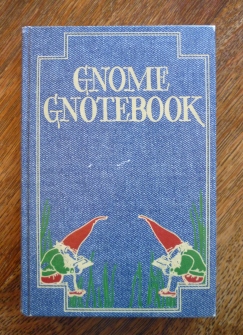
It was only a few weeks ago that I told you about my late friend Bird’s Gnome Gnotebook, the contents of which I was so glad to receive in the form of a fat photocopied packet. One of you alerted me to the fact that one can buy empty versions of these notebooks online, and I quickly sent off for one, as a remembrance of my beloved friend.

P1120297

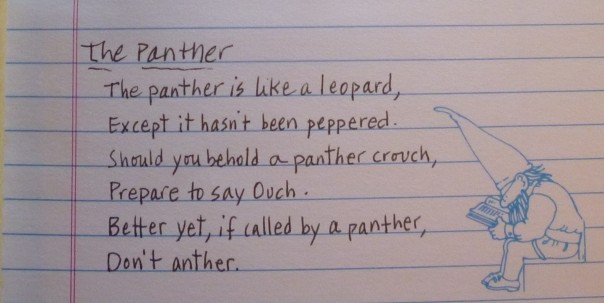
And to keep quotes in, of course! Anastasia recently shared this fun Ogden Nash verse (above) and I copied it at the bottom of the first page, where the gnome sits with his nose in a book. These contemplative gnomes will keep company with whatever I write here, on every page.

I must have a thousand quotes in computer documents, and another few hundred on papers bursting out of a manila folder. For years I used some very efficient software to help me in sad face outlinemy collecting, called Smart Quote Organizer. But it eventually proved too hard for someone with my lack of computer savvy to maintain; every time we got a new computer or made major changes, I almost lost that data. Finally I did lose it, I lost all those hundreds of good quotes and was fairly deflated — for a few minutes. I realize that even the most excellent examples of pithy sentences are just representatives of truth and wit and wisdom. The substance remains with humankind. But I decided to return to more primitive methods of storage, while not abandoning my simple Windows document folders.
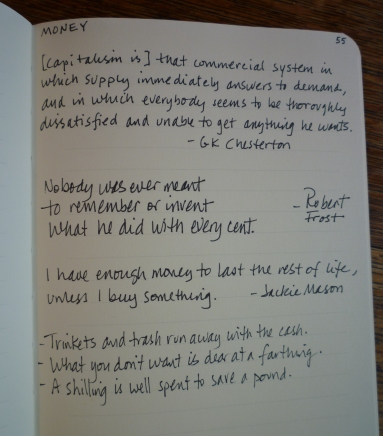
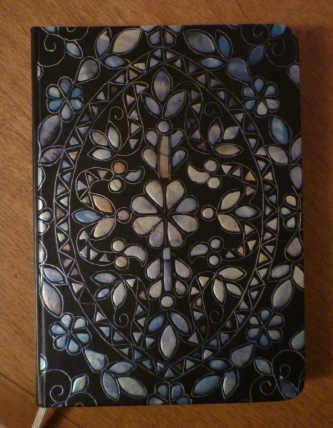
At left is a page in quotes money qbmy first quotes notebook, which I arranged alphabetically in subject categories. Some pages are full and some are still completely blank, so I probably shouldn’t give up on it yet.
Of course I wouldn’t think of giving up reading it. Just now the words on this page with the heading Money have made me muse on whether I have violated any of my principles by spending on my new (technically “used,” though not written in) Gnome Gnotebook. I don’t think so.

Bird didn’t have her jottings in any particular order and I don’t plan to worry about that with my new book, either.

P1120375 old quotes crp

Above is the old notebook with the quotes all hidden inside, waiting to be pored over and contemplated. And here is another page from that book. Clearly I gave more attention to good handwriting in that previous era a decade ago, which is about when I started using this book that was gift from son Pathfinder’s family.

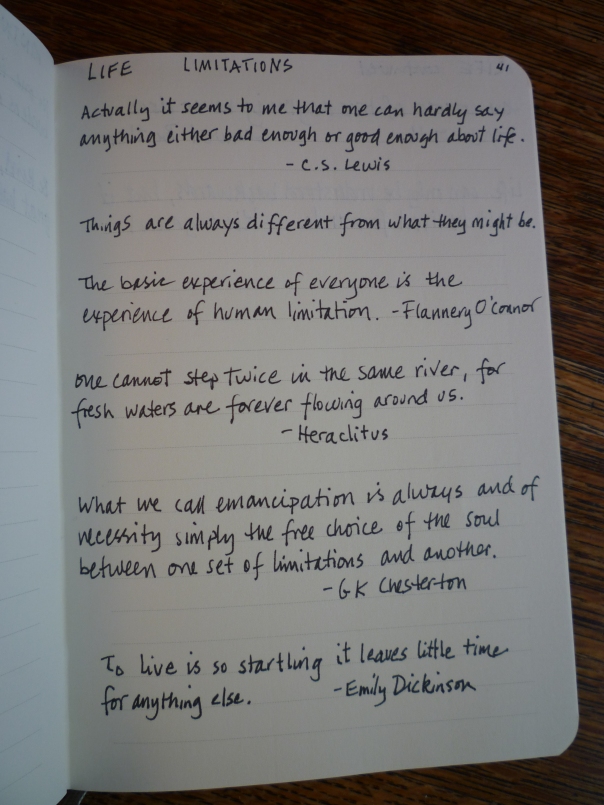
quotes life & limitations qb

Many of these quotes on Life and Limitations immediately apply themselves to what could be called my hobby of collecting quotes – especially the reality of limitations. The Bible says that “of the making of books there is no end” (Ecclesiastes 12:12), and I don’t think I will run out of (quality – they must be quality) quotable excerpts from those books, or other writings or speeches or folksy proverbs.

I, however, am very limited in my time, my life span, and yes, my mental abilities. I am limited in how many quotes I can publish on my blog and still maintain good standing in the eyes of my readers. So that’s all for now, folks. Have fun with these!