Category Archives: the language

I sip nectar with the tiniest.

I sat in my garden reading Penelope Lively, who when writing about garden fashions that come and go, kept using the word “rill.” I picked up my phone to look up that word and see what the British might mean by it, and quick as a wink a tiny fly, almost too tiny to see without reading glasses, lit on the screen, with its wings open for about one second, a flash of shimmering rainbows.

Then it fell off, on to my book. Was that the fly, merely a black gnat? I got him to crawl on to my finger and back on to the screen, where he was kind enough to display his bright wings again for a moment, and then took flight.

On my walk yesterday I saw just one insect in a sea of catsear blooms. And I worked hard to get a picture of a flower with him on it. Not like most years of my photography, when I tried to avoid bugs on blooms, and would be disappointed if my flower were spoiled by a spider or something I hadn’t noticed when I clicked. But most of those critters had come out blurry anyway. No, getting a sharp image of an insect is not easy with a little phone camera. But I have time, don’t I? And a lot of digital storage, too, in case I don’t get around to deleting all those blurry pictures.

I started looking for flowers with insects, and of course, there were bees! It was so warm by this time, they were flying fast and furious, and couldn’t decide which of many privet or blackberry blooms to drink from, like kids in a candy store. The best shot I got was of one flying away with her loot. And I found a near relation to catsear beetle closer to home, descending a wide staircase of rose petals.

Obviously, I also am a kid in my own candy store, and can’t choose just one or two pieces of ambrosia to gaze upon or aim my camera at or share with you. If the temperature were constantly mild when I sit out in that paradise, I think I would fill to bursting with the joy of the place. But usually I get too hot or too chilly or find a task to do, so I don’t get dangerously stretched.

In my front garden many insects are buzzing back and forth and not lighting on any flower. I think they are just hanging around, or more precisely, swooping around — coming back to check every few minutes, so they can be the first to drink at the ocean of teucrium flowers that are going to start opening any minute now. I’m not sure that walkway will be wide enough for human feet to walk without colliding with honeybee wings.

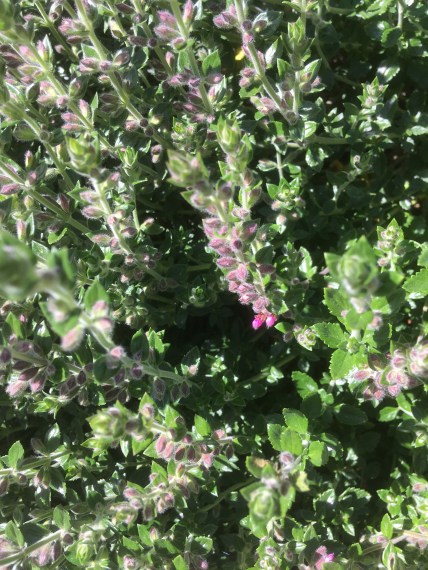
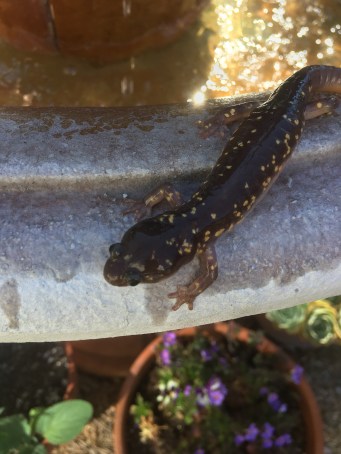
Many of the cistus, Jerusalem sage and helianthemum already need shearing! Alejandro my sometimes gardener was here yesterday and we moved one of the big pots that hold olive trees, and found two salamanders underneath! How they ended up in this droughty place I don’t understand, but I didn’t think about that at the time.
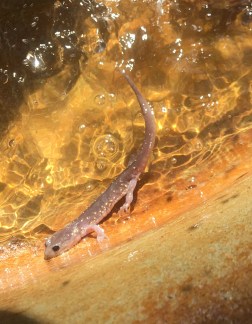
I grabbed the two of them, who looked like Mama and Baby, and put them to swim in the fountain for a minute while I ran into the house for my camera. Then I released them near a faucet with good luck wishes. Maybe I should have carried them to the creek? (Which reminds me, a rill in a British garden is a water feature.)
 

Back to the insect kingdom and their food… The word nectar carries a heady meaning. Drink of the gods – delicious. But the origin of the word is also pretty tasty if you like words: The first step back is to the Greek nektar (we’re talking about Greek gods, after all), “which is perhaps an ancient Indo-European poetic compound of nek- ‘death’ + -tar ‘overcoming,’ ‘cross over, pass through, overcome.'” No one used this word for the sweet liquid in flowers until about 1600.

Those links to the thought of overcoming of death could lead to an intellectual/writing exercise about how it’s all connected, but I’m not willing for that kind of workout today. I just want to join my fellow creatures in imbibing the sweets.

 

He made comely poems.

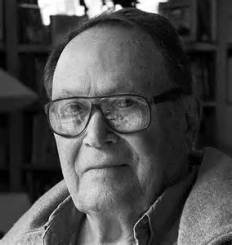
I was so sorry to hear a couple of weeks after the event that the poet Richard Wilbur had fallen asleep in death. It’s interesting to read about the ambivalence within the community of literary critics regarding his work throughout his career and now at his passing.

The New York Times quotes its own reviewer David Orr who mused that “Mr. Wilbur had ‘spent most of his career being alternately praised and condemned for the same three things’ — for his formal virtuosity; for his being, ‘depending on your preference, courtly or cautious, civilized or old-fashioned, reasonable or kind of dull’; and finally for his resisting a tendency in American poetry toward ‘conspicuous self-dramatization.’”

Might it be that one’s opinion about Wilbur’s poetry has something to do with whether you appreciate his perspective on things? If when you read his poems you find they quicken your own love for life and the cosmos? In another quote from the New York Times: “’I feel that the universe is full of glorious energy,’ he said in an interview with The Paris Review, ‘that the energy tends to take pattern and shape, and that the ultimate character of things is comely and good.'” My favorite not-so-recent article on Wilbur draws attention to his Christian vision and is found in First Things.

Over the life of my blog many of Wilbur’s poems have shown up here — which you might find by putting his name in the search box on the right —  and I’ve been wanting to post his poem “Worlds” for a year or more now. I first read it when David Bentley Hart’s book The Experience of God was fresher in my mind, and I had some brilliant idea that linked the two philosophers… that thought has dimmed to the vanishing point. Now I offer the poem as a picture of two ways of looking at the world, represented by Alexander the Great and Isaac Newton. If Richard Wilbur imagined himself in this poem, I’m sure he would hope to be found serenely playing alongside Newton, another man of faith and great vision. May God grant him the Kingdom.

WORLDS

For Alexander there was no Far East,
because he thought the Asian continent
ended with India.
Free Cathay at least
did not contribute to his discontent.

But Newton, who had grasped all space, was more serene.
To him it seemed that he’d but played
With a few shells and pebbles on the shore
Of that profundity he had not made.

– Richard Wilbur


Words have skins like amber.

“Ralph Waldo Emerson once declared that language is fossil poetry. Many words that we use carelessly have, embedded within their amber-like exterior, the remnants of long lost perceptions and intuitions. When received thoughtfully and with some delicacy, words have the capacity to allow us to travel back in time, to imagine how and what the world meant to our ancestors. But unlike the insects, or dinosaur DNA fixed in amber, the meanings within words are changing, evolving, as human perceptions change.”

-Ken Myers on Mars Hill Audio Journal, introducing his interview of John Durham Peters about his new book, The Marvelous Clouds: Toward a Philosophy of Elemental Media.

I listened to this interview and have ordered the book, though I fear it will be above my head, like clouds. The author was not hard to understand when he was talking, and he spoke of so many things that I would like to “hear” him discuss further, after I get the book and can read the words on paper, and flip back and forth and underline a phrase here and there of his meaningful prose. How can I resist a book that contains all together in its title the words Marvelous, Philosophy, and Clouds?

Only to a degree expressible.

I’ve shared four poems by W.S. Merwin on my blog over the years. He is a poet who doesn’t use punctuation in his poems. I recently read an interview with him, given five years ago. Here I’m posting a short excerpt in which he talks about his eschewing punctuation, and about the uses and challenges of poetry generally.W.S. Merwin_NewBioImage

If you stop using punctuation, that’s a kind of formality. I mean you have to be very conscious of the grammar and the syntax and how the sentence is put together; otherwise it’ll be just so ambiguous and confusing you just won’t be able to read it. The other thing I think it does is to make the separation between poetry and prose. I thought, punctuation is very convenient, but it was really invented in the seventeenth century for prose. Not for poetry at all. The punctuation of Shakespeare texts is whatever seemed convenient. There weren’t any particular rules that he was following that I can see. I mean it changed in the course of the plays. But above all, I thought that having no punctuation made you listen to the poem. That’s the important thing.
….
Poetry, like the imagination itself, must be limitless. And there must be other ways of expressing the inexpressible, which is what—poetry is just that. Prose is about what can be said and what is known and so on. Poetry is about what cannot be expressed. I mean, terrible grief, or intense erotic feeling, or even unspeakable anger are all inexpressible. You can’t put them in words and that’s why you try to put them in words. Because that’s all you’ve got. That’s another reason why I think that poetry is as ancient as language itself, because I think language must come out of an urge for which there was no expression, no way of doing it. I mean grief or fear or rage or whatever it was. It goes from one roar or one scream or one terrible sound of pain to starting to articulate it. It’s the articulating that becomes poetry. But it doesn’t become information at that point. It’s closer to translation. It’s translating something that’s there, that is only to a degree expressible.

-W.S. Merwin in Guernica magazine interview