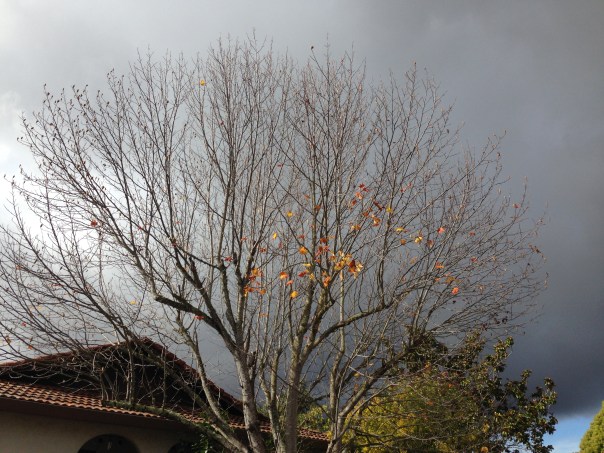
Another tree I have known.

November 2015

This morning I got out into the fresh fresh, rain washed air, still damp and loaded with nourishment from a mysterious and secret recipe, and I walked to and along the creek, and heard an unfamiliar and curious bird song. I wasn’t prepared for that, not having my phone and its Merlin bird app with me — I was trying to be a little bit un-modern.

I heard several bird songs, as it turned out, and saw a flurry of tiny birds on the paved path, scurrying under the privets. There was to be no sunshine today, but I still felt the pull of the reality, “Light of Light, True God of True God,” my own Source of Life.

I looked forward to a lunch date in a short while, so I couldn’t explore as long as I’d have liked; I turned back, along my usual route, past the pineapple guava that I have known and noticed for as long as I can remember. Many huge fruits were on the ground, much larger than anything mine ever produces… probably because it gets full sun all day long. I bent over to pick up one that hadn’t been bruised, but it was hard. Odd, that it hadn’t ripened….  and then I saw, a few feet away, the horror: the whole tree had been hacked to the ground, and I became aware of a large empty space above me.

Construction workers — or was it a demolition crew? — were in the driveway of the property on which the tree had lived, modestly, on the very corner of the lot, where it was not in the way of anything. Maybe a new owner was starting Something New. There the Modern attitude hit me where it had hit the feijoa, the idea we have of thinking that the best way is, Cut it all down and start over.

I looked through my old posts just now for a picture of that tall bush. I had mentioned it several times, but never took its picture. The owner of the property did not live in the house on that property, I learned that much some years ago. I also know that he never appreciated the guava for what it was; he always pruned it at exactly the wrong time, so that it rarely had a chance to show how many fruits all that sunshine could have sweetened to lusciousness.

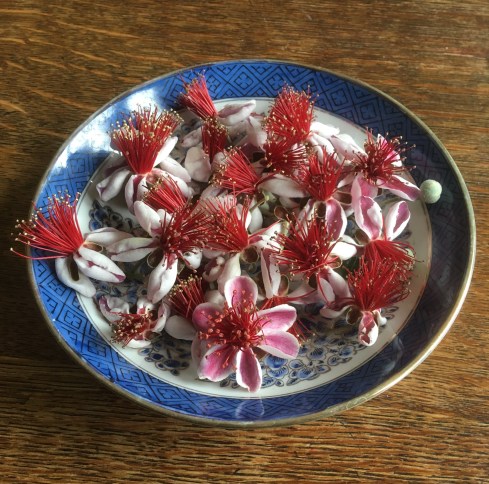
I did love that tree. A few times I gathered a few of its fruits off the ground, and once my grandson and I picked its blooms to take home and add to our breakfast. I wonder if anyone else in the neighborhood will notice its absence?
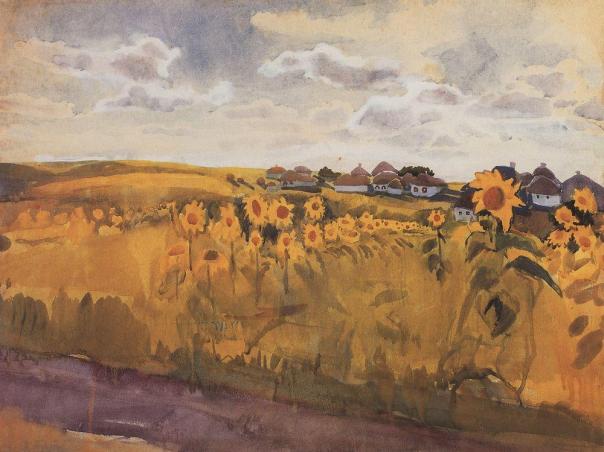
After the rushing of wings.

THE GEESE

My father was the first to hear
The passage of the geese each fall,
Passing above the house so near,
He’d hear within his heart their call.

And then at breakfast time he’d say:
“The geese were heading south last night,”
For he had lain awake till day,
Feeling his earthbound soul take flight.

Knowing that winter’s wind comes soon
After the rushing of those wings,
Seeing them pass before the moon,
Recalling the lure of far-off things.

-Richard Peck

Zinaida Serebriakova, Autumn, 1910

From Uncreated Light to electrics.

For it is the God who commanded the light to shine out of darkness, who has shone in our hearts to give the light of the knowledge of the glory of God in the face of Jesus Christ.
-II Corinthians 4:6

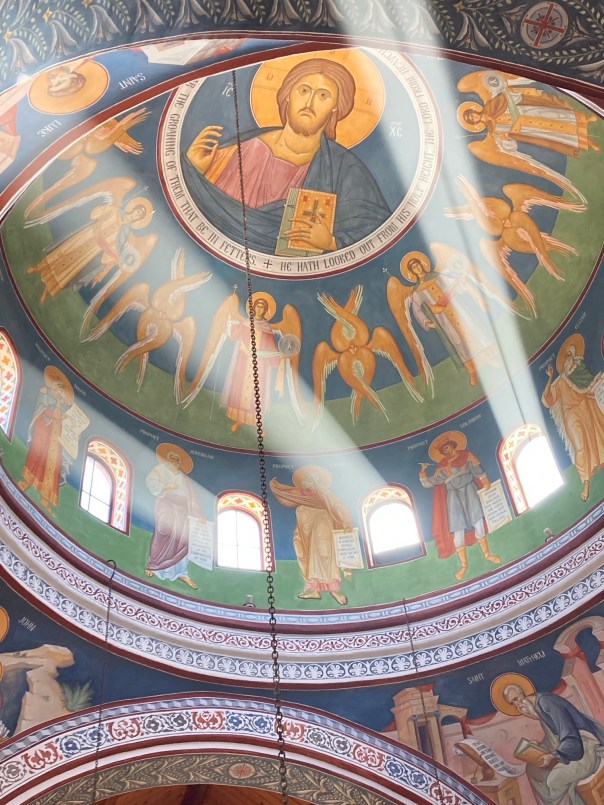
My priest mentioned in a homily recently that the verse above was his favorite; of course that made me pay close attention to it. Soon afterward I read an article by the iconographer Aidan Hart, “Lighting in Orthodox Churches: Liturgical Principles and Practical Ideas,” which has kept me thinking on this Light … and I’m certain I could benefit from further meditation on Hart’s ideas — because they flow from the truth that Christ Himself stated, that He is The Light of the World.

How do we reflect this reality symbolically when choosing physical lighting for our churches? And how might lighting help us to worship or distract us? If any of these questions is interesting to you, you might like to read the whole article, which I have linked above and below. Or skip the text and look only at the more than two dozen photographs of most beautiful churches and monasteries — and one mosque — illustrating the principles that Hart discusses. I especially loved the photo showing alabaster windows such as this one:

Mausoleum of Galla Placidia, Ravenna

Hart reminds us that “The Church is ultimately a community of persons and not a building.” It follows that “Its light should illuminate the personal rather than the abstract.” He compares the needs of monasteries to those of parish churches, and The Blue Mosque to Hagia Sophia. The pros and cons of natural light, candles, oil lamps and electric lights are discussed; he explains how an environment with quiet light can help us to “learn the art of stillness, watchfulness, interiority.”

I’ll close with one paragraph that is rich with theological principles worth musing on, and leave you to click on the link for the whole article:

The second century neo-Platonist Plotinus wrote that “beauty is symmetry irradiated by life”. This was interpreted by the Byzantines as symmetry irradiated by light, for light was regarded an image of divine, animating and transfiguring life. But this Byzantine aesthetic of moving rather than static light was ultimately rooted in Trinitarian theology. The uncreated light of divine love is One, but it is also dynamic, moving within the Trinity and moving down to creation. Of course the term moving is a human concept and is ultimately inapplicable to God, who has no need to move from place to place. But the term is applicable inasmuch as it reminds us that God is not a single monad, that God is love because He is Three. Christian beauty is therefore rooted in relationship rather than an abstract and static ideal. And this can be reflected in church lighting.

-Aidan Hart, “Lighting in Orthodox Churches: Liturgical Principles and Practical Ideas”

St Demetrios Church, Thessaloniki (not taken by me)