An afternoon in South Mumbai.

I’m staying with Kate and Tom in the Suburban District of Mumbai, which is the larger part of the city and brimming with things to see and do. After spending my first ten days here, I had my first brief experience of the downtown hub of South Mumbai one afternoon when Tom and I made the trip with a few small goals in mind. The excursion was fun for me even though it was somewhat unsuccessful in the first stages.

We thought we’d visit the tip of the island, where in 1858 the British consecrated the Church of St. John the Evangelist as a memorial to soldiers slain in the First Afghan War of 1838. I had seen it on a list of The Ten Most Architecturally Interesting Churches in Mumbai. It is known as The Afghan Church

The church sits in the middle of an area of military buildings, a little remote from the busiest part of the city. Tom hadn’t yet been this far south. In this photo I found online, you can see the two towers of the Mumbai World Trade Centre in the background with the church spire in front. As we approached, a couple of British hippies were leaving, and they told us that it was locked, and “spooky.”

We walked around the building and noticed the wall stones stained black, unkempt landscape, and old signs lying randomly around, and could well believe that it was locked and never used. How sad, that no one, or at least no one who had the means to do anything about it, cared about this church that had a beautiful design and holy purpose. I took a picture of the detail on the base of a large stone cross in front of the church, which is my favorite image from my visit.

As we were walking out the gate again a small boy wandered over to us from a little house nearby and told Tom that he had the key to the church. I at least was not interested enough to take him seriously; I had given up on the Afghan Church at that point. We read online later that “Visitors may obtain access to view the historic church interior from the [lax] on-site custodian.” The website also said that a small congregation there holds services.

We stopped by another venerable building, the General Post Office, because we’d heard that they sold postcards, but no. Whether they normally sell them or not we never learned. We visited a room where several people seemed to be at work, but they wouldn’t, or couldn’t, tell us anything but that they were closed. I haven’t given up hope that I will find some postcards in time to mail them before I go home — maybe when I visit a more touristy spot?

Our last stop was exciting and satisfying, the iconic Victoria Terminus of Bombay, known simply as CST now, for Chhatrapati Shivaji Terminus of Mumbai. Over 1,000 trains come and go every day from 18 platforms in this huge building, and for a watching companion I had my son-in-law who is the best guide possible, fascinated as he is — and knowledgeable about — railways all over the world. We enjoyed taking videos in both slow-motion and time-lapse modes, of the swarms of people flowing into and hopping out of the cars. Two million passengers pass through daily! I could have stared at that scene for hours.

This station was planned as a commemoration the Golden Jubilee of Queen Victoria, and took ten years to build from the beginning of the project in 1848. It is said to be “a fusion of influences from Victorian Italianate Gothic Revival architecture and classical Indian architecture.” It is so grand, it is often mistaken for a palace or a cathedral.
 
The lights that have been installed on the exterior seem to me to contribute to an ongoing fusion of style. 16 million lights in different colors are available to create an ever-changing display according to the different festivals throughout the calendar. As we were driving away at dusk, I was surprised to see lavender hues that hadn’t been there in my first photos, and the next day I read about the lights and found examples of the most brilliant displays to show Kate.

Since our visit I’ve also seen unbelievable and scary train scenes from Tom’s phone, that he recorded previously and of the sort I’ll never have the opportunity to witness firsthand. My acquaintance with Indian railways and trains is certainly minuscule at this point; I hope to actually ride a train before I’m done, and afterward I should have more to tell.

Here’s a car with the picture on the side showing that it is reserved for women. I won’t be riding in one of those, because if I go, it won’t be without my competent male guide along. For now, if any of you has a tale to tell of Indian train rides, I’d love to hear!

Indian cooking – Egg Bhurji

On my first morning in India I ate a spicy scrambled egg dish that I loved very much. It had been cooked the day before by the housekeeper Kareena. Eggs that are delicious and cooked 24 hours ahead? That’s a recipe I need. I asked if she would show me how to make those “breakfast eggs” sometime, and she said she’d be happy to. Yesterday was my lucky day.

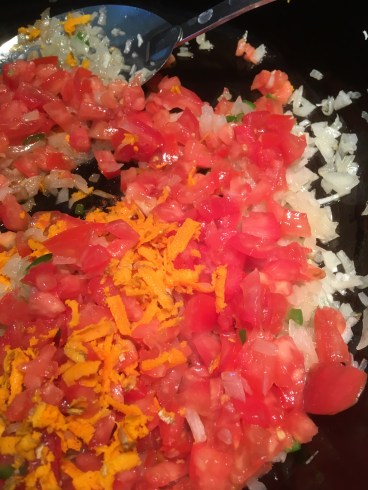
When I noticed how her kurta was the same color as the onions,
I knew I must take pictures.

And I took notes on the process, and the approximate amount of ingredients. It’s essentially a spicy Indian version of a vegetable scramble, with variations as many as there are cooks, as you can see for yourself if you want to browse recipes online.

My teacher went to the refrigerator to get one of the slender green Indian chilis, and was disappointed to find them all gone. She said she could make the dish with dried chili powder for us, but if she were making it at home she’d just wait until she went to the market again; because fresh is best.


This is the powder she substituted>>

I read that if you want to approximate this dried chili powder you can blend 3 parts paprika to one part cayenne.


This morning Tom went shopping and resupplied us with chilis, which are here drying after being soaked in a disinfecting bath.

It is amazing how many vegetables are in this dish. Kareena’s style is to make sure all the vegetables are in very small pieces by the time you mix the eggs in. The bright red color comes from the chili powder; what I ate that first morning had been made with a fresh green chili and it wasn’t red at all.

Kareena’s EGG BHURJI

3 small onions, diced small
1 tablespoon fresh curry leaves
2-3 tablespoons oil
1-2 teaspoons turmeric
1/2 teaspoon salt
3 small tomatoes, diced small
1 long thin hot chili, minced (or 1-2 teaspoons Kashmiri chili powder)
½-1 cup fresh cilantro leaves, minced
6 eggs

In a large broad skillet heat the oil, then throw in the whole curry leaves and stir them a few seconds to sizzle before adding the onions. Cook the onions over medium heat until golden brown. You may add the fresh chili pepper at this point, or wait.

Add the tomatoes, turmeric, (chili powder if you didn’t have fresh chili, fresh chili if you waited), and salt. Stir and cook together for a few minutes, then put a lid on and cook for another 10 minutes or so to break down the tomatoes. Mash them some more with the back of the wooden spoon.

Break the eggs into the pan and scramble with all the vegetables until partially cooked; add most of the cilantro, saving some for garnish. Scramble until all cooked and crumbly. Taste and adjust salt if necessary. Serve, sprinkling with remaining cilantro.

The best way to eat these eggs is with one of Kareena’s chapatis fresh off the griddle, but a pile of Bhurji is great all by itself, too.

When I return home, I’d like to have a tablecloth after the fashion of Kareena’s kurta for my dining table, so that when I sit down to eat my Anda Bhurji it would all add up to the perfect and colorful Indian breakfast.

Shopping with pani puri.

Tom took me along on his shopping trip yesterday, to a few stores and shops including a multi-story big box that had features of a Super Wal-Mart, Costco, and a department store. The escalators were ramps that accommodated shopping carts, and we visited all the floors and departments, but never found a C-battery or anyone who knew what that was. Tom wasn’t very sure himself, but some new baby equipment wants them. Oh well.

I was fascinated by the many varieties of basmati rice, both packaged and in large bins where women in pretty clothes were scooping up their favorite type. I love basmati rice and used to buy it in 25# bags myself; I came home with a jar of the Brown Basmati.

The packaged rice is one of many products and ads that feature a photo of a famous movie star, often a Khan, or the “Big B,” Amitabh Bachchan. I don’t have a hope of keeping all these celebrities straight, but a couple of them have leading roles in an unusually good Bollywood movie we are currently watching here (over the course of three nights, because it’s close to four hours long): “Lagaan.” Oh, and on the route between the different shops, whose car did our driver point out but that of the very Aamir Khan himself. Mumbai is the center of Bollywood, did you know?

Women were also filling bags with large-crystal sugar from a great bulk bin.


We ate several pani puri snacks and another type of snack at a stand in the food department of the store. For us to take our fill of those savory treats cost less than 100 rupees which Tom said was about $1.10.


From this store we drove to that quiet neighborhood Tom introduced me to on my first day here, where is found their favorite market.

The shopkeepers know at least the names of vegetables and how to count in English so I was able to complete the purchase of some carrots, zucchini, peppers and broccoli while Tom went to the next stand where we found leeks and potatoes from which he is going to make soup.

Are those red carrots really carrots? I’ll cook them today and find out.

We brought all our loot home and then Tom cooked up a big delicious dinner featuring mutton chops, pesto green beans, tomato salad and more. It was the first meal of not particularly Indian food that I’ve had in ten days.

Baby “Raj” had stayed home with his mama. They are eating well and building strength and we are all enjoying the early Getting to Know You period. Well, not quite all: Huckleberry Cat has led a very sheltered life until this point and he doesn’t feel entirely positive about the strange creature who suddenly showed up.

As I write, it is a lazy Sunday afternoon. I’ve been holding a sleeping baby for an hour while chatting with Kate and Tom about so many things India, seeds that could germinate into future blog posts. Now I’m back here typing with two fingers to finish this one. My mind will immediately and irresistibly start gathering threads of images and impressions to weave into the next scrap of cloth I hope to share with you, of this colorful tapestry that is Bombay.

The cows are back.

Housekeeper Kareena went out to do the grocery shopping yesterday morning and came back empty-handed. The shops and produce stands were all shut up. It was the latest development in the strife between the Dalits and the Hindu Nationalists.

I can’t really say more than that without revealing my ignorance and no doubt also over-simplifying one of the many complex and interrelated issues troubling this country with so many cultures, languages, and religions clashing and blending and layering over the centuries. I know little about it but now I am living in it for a time. It feels like a lot of excitement for only my first week.

The photo above shows some Dalit demonstrators in our neighborhood, the only thing happening in the emptied streets. Tom took this one, and it is blurry because he didn’t want to get too close to the action.

He and I had been planning to buy lunch out before going to visit Baby Boy and his mom, but all of the  eateries were closed, too, so we ate some leftovers from last week, and then walked back to the hospital.

I had become familiar with this intersection from our trips to the hospital over the last couple of days. The same man was constant in roasting sweet potatoes on the corner near our apartment building, and at the side of the road across the street from the hospital, several cows always stood with their keepers in two groups, three cows and two cows.

But the sweet potato roaster was not to be seen, and even the cows were gone. Rickshaw drivers slept in their vehicles, shopkeepers slept outside their shops, and for the first time I had to walk around a man sleeping on the sidewalk. The street in the picture below is normally filled with hundreds of cars, rickshaws and pedestrians all flowing around each other in close and chaotic streams.

By the end of the day someone in power had met for talks with the police, and the Dalits called off further protests. I have been too busy holding a baby to read much about the situation (This is the article I am starting with), but we were all glad that last night the shops had opened again, and this morning the shopping got done and we now have spinach paneer and chicken tikka masala in the house, with fresh chapatis. The cows are back in their place.

On our walk home from the hospital after dark, the neighborhood church was in the middle of serving food to the poor. Its Light and its lights had not stopped shining for even one day.

ST church lights