Tag Archives: Bridegroom Matins

The mood and the glow.

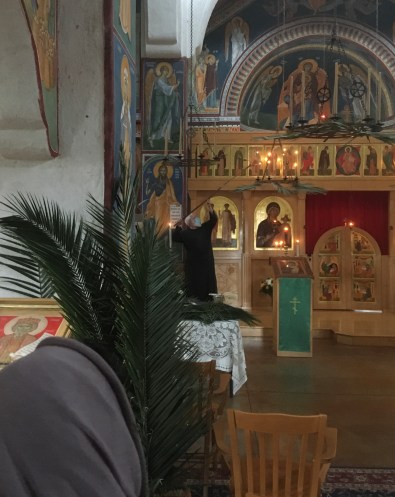
Today was Palm Sunday for us Orthodox Christians, and tonight I attended the first of the Bridegroom Matins services. Until this year, at least as long as I’ve been a member, our parish has held this service in the morning, but this year we are doing it in the evening. Here is an explanation of the tradition:

“Bridegroom Matins is a service specific to the first four evenings of Holy Week and commemorates the last days in the earthly life of the Lord. Incorporated into these services is the theme of the first three days of Holy Week; which is the last teachings of Christ to his disciples. As such, these services incorporate readings and hymns inspiring this theme. The mood of the services is to experience sorrow and to feel Christ’s voluntary submission to His passions and highlight the purpose behind the evil that is about to take place against the Lord. The atmosphere is one of mourning (for sins) and is symbolic of the shame the Christian should feel for the Fall of Adam and Eve, the depths of hell, the lost Paradise and the absence of God.”

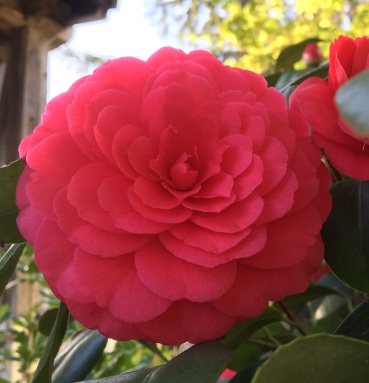
Those mornings that seem so long ago, I would arrive in the dark, and come out from the service after the sun had risen; many times I’d walk around the church property and take pictures before driving home. This evening, I came straight home and visited my own garden, which was radiant with the setting sun after a rainy day.

One of the Gospel stories featured in today’s Matins service is the parable of the barren fig tree. Here is my own tree, that is not likely to be fully illustrative of that parable, come fall.

At least seven Psalms are read at every Orthodox Matins service, and tonight two more were read, including this one:

Psalm 19 (20)

May the Lord hear thee in the day of tribulation:
may the Name of the God of Jacob protect thee.

May he send thee help from the sanctuary:
and defend thee out of Zion.

May he be mindful of all thy sacrifices:
and may thy whole burnt offering be made fat.

May he give thee according to thine own heart;
and confirm all thy counsels.

We will rejoice in thy salvation;
and in the Name of our God we shall be exalted.

The Lord fulfill all thy petitions:
now have I known that the Lord hath saved his anointed.

He will hear him from his holy heaven:
the salvation of his right hand is in powers.

Some trust in chariots, and some in horses:
but we will call upon the Name of the Lord our God.

They are bound, and have fallen,
but we are risen, and are set upright.

O Lord, save the king:
and hear us in the day that we shall call upon thee.

Roused out of dreams.

This morning I attended the lovely Bridegroom Matins of Holy Week, cherished because it uniquely expresses the “bright sadness” of our preparations for the joy and victory of Pascha. In my parish we are able to hold these penitential services early in the morning, at a time when people might be able to attend before going to work. Even on my drive to church I felt the grace of the clear sky, a pre-dawn blue, with a friendly gibbous moon shining down on me.


Eight years ago after attending this very service I wrote a blog post about laziness, standing up straight, and what it means to be human. Whew! I feel a bit lazier of mind these days, so that I am amazed at all I learned from Lazy Tommy Pumpkinhead and from just one chapter of Leon Kass’s book The Hungry Soul. I do often still remember the gist of the lesson, mostly when I am standing in church. If you don’t remember it well, I urge you to read it.

The article focuses on being physically upright, which helps us to be alert and attentive, ultimately to God and His will. It’s not hard to get distracted even in church, but at least we have in the Orthodox services many things to bring us back; for me it’s often necessary every minute or two, as I might simultaneously remember to put my shoulders back again and fix my gaze toward the altar. And especially during this week when we follow Christ to His voluntary sacrifice, our reverent attentiveness is facilitated by prostrating ourselves before God, which, though it is not upright posture, is the opposite of reclining in bed or watching whatever’s on TV.

When we are not in church, our Enemy probably has an easier time helping us to slouch away from Life, his methods so vividly portrayed in C.S. Lewis’s tale of correspondence between devils:

“You no longer need a good book, which he really likes, to keep [your target] from his prayers or his work or his sleep; a column of advertisements in yesterday’s paper will do…. You can keep him up late at night, not roistering, but staring at a dead fire in a cold room. All the healthy and outgoing activities which we want him to avoid can be inhibited and nothing given in return, so that at last he may say… ‘I now see that I spent most of my life in doing neither what I ought nor what I liked.’”

One theme of Holy Week comes from Christ’s cursing of the barren fig tree, in the days just preceding his crucifixion. We exhort our own souls in the hymns of Bridegroom Matins:

Why art thou idle, my wretched soul?
What useless cares cause thee to be lost in dreams?
Why busy thyself with things that pass away?
The last hour is at hand, and we shall be parted from all earthly things.
Therefore, while there is time, rouse thyself and cry:
“I have sinned before Thee, O my Savior!
Do not cut me off like the barren fig tree!”
In Thy compassion, O Christ, take pity on me who call out in fear:
Let us not remain outside the bridal chamber of Christ!”

Busying myself “with things that pass away”... yes… I mean, No! I don’t want to do that. Lord, help me to rouse myself!

After the service — I’ve also done this before and made a blog post out of it! — I walked around the church gardens and took pictures, with which I decorated this page. Wherever you are in your liturgical cycle or in your heart’s journey, I pray that your souls may flower and bear fruit after the manner of these beautiful blooms.