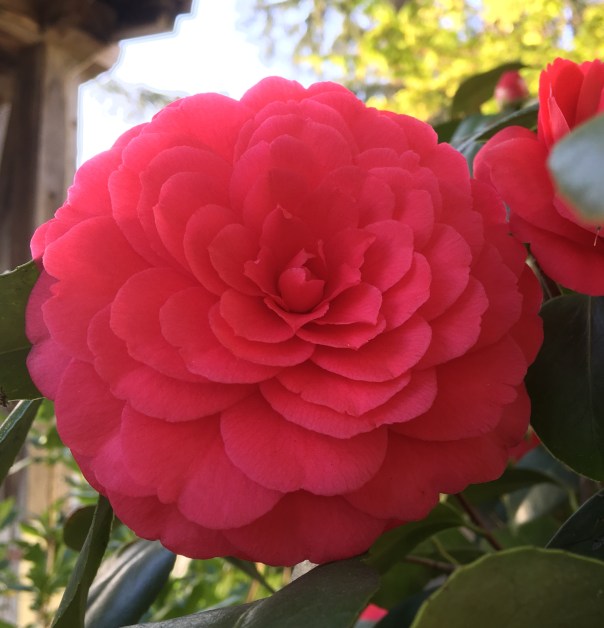
For Orthodox Christians, today is the first day of the liturgical year, and also the Feast of Creation. The perfect day to think on this:
“Who is it that forms the flowers so wisely, so delicately, arranges so splendidly, and gives form to the disordered, i.e., the shapeless, formless substances of the earth? Who gives it such wonderful form? O Creator, grant us the opportunity through flowers to embrace Thy wisdom, Thy benevolence, and Thine almighty power.”
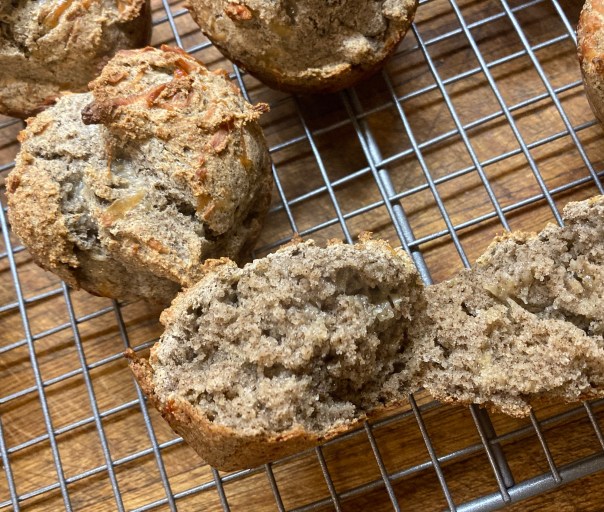
This month I had two occasions when friends visited me for one or two nights, two different friends each time. It was fun to have people to cook for. About an hour before the first pair of guests were to arrive I found out that one of them couldn’t eat the bread I had planned to serve with soup, because of gluten intolerance. I have just enough time to make muffins, I thought, using Bob’s Red Mill gluten-free flour again. I mixed up the wet ingredients, and then — could not find that flour anywhere.
Though I rarely bake anymore, I have a dozen sorts of flours in a refrigerator in the garage. I rummaged through those and decided to use one cup of cassava flour and one cup of buckwheat flour. The latter was the sort one would use for buckwheat pancakes, that is, from roasted groats. Some people don’t like that flavor, so I was taking a chance that my guests would.
The muffins turned out very nice, we all thought. But the cassava flour is a little heavy, and I think if I try this again, I’ll use more buckwheat and less cassava. That very evening I discovered the missing flour, in the wrong refrigerator.
The last time I made pancakes I did not use buckwheat flour, but I did use this beautiful batter bowl that I received as a Christmas gift. It holds an amount of batter that is just right for one person, and its presence on my kitchen counter has encouraged me to make pancakes for just myself, for the first time ever.
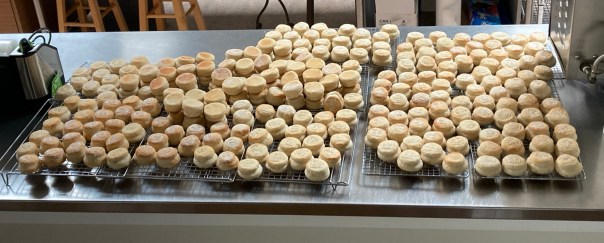
Another type of bread I helped to bake recently was the little prosphora that our parish uses as one type of altar bread at Divine Liturgy. That day we only made these small ones, and two people prepared dough. One of the dough makers used more flour than usual, and we ended up with a record number of prosphora — so while they were cooling I took their picture:
Lent is coming right up — for us Orthodox it begins on Monday. Many people I know like to choose some “spiritual reading” for Lent, and I have done that many times. Our women’s book group has often chosen a book to read together and discuss after Pascha. But this year we didn’t; we still haven’t discussed the last book we chose, to read during Advent.
At one point I thought I would read The Seer: The Life of the Prophet Samuel and its Relevance Today during this season. And then I looked around my house and noticed so many other worthy titles. Maybe I would cast lots among these below, and let God decide for me:
But the finality of that action frightened me. It’s not likely that I will finish any of these big books during Lent anyway, because I always seem to use any extra time to attend the lovely Lenten services at church. So in the end I decided to read (from) all of them, and I’ve stacked them up next to my reading chairs as my Lenten Library; my plan is to read at least a little from one or two of them every day. Being goal-oriented does not come naturally!
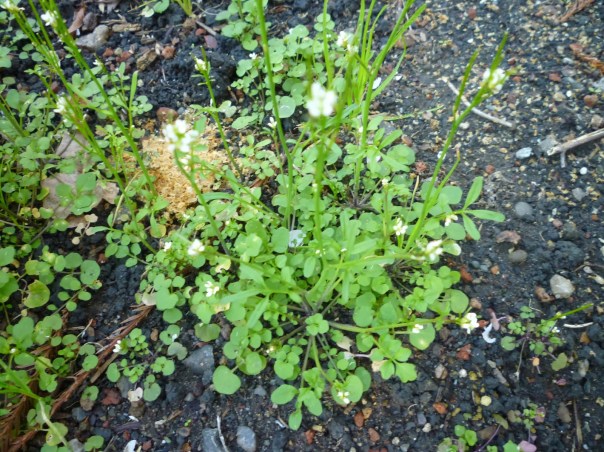
hairy bittercress
The last couple of days have been sunny at times, and the weeds in the garden are getting my attention, as they grow like weeds in springtime. So I got out there and pulled a bunch. I try to keep a thick layer of mulch on my garden to prevent weeds, but I guess I got behind in adding to that layer. I’m hoping to do that this week.
The anemones and crocuses that I planted at the end of November are starting to bloom, and the muscari and daffodils are showing leaves; obviously so late in the fall was not optimal for getting them in the ground. One reason I got busy weeding was to make sure they won’t be hindered from lifting their pretty faces to the sun. Of course, it’s good for me to do that with my own face when I get the chance, and I trust that will be the case more and more as springtime unfolds, in the earth and the air, and in these anemones.
Some men never think of it. You did. You’d come along And say you’d nearly brought me flowers But something had gone wrong. The shop was closed. Or you had doubts – The sort that minds like ours Dream up incessantly. You thought I might not want your flowers. It made me smile and hug you then. Now I can only smile. But, look, the flowers you nearly brought Have lasted all this while.
This morning I attended the lovely Bridegroom Matins of Holy Week, cherished because it uniquely expresses the “bright sadness” of our preparations for the joy and victory of Pascha. In my parish we are able to hold these penitential services early in the morning, at a time when people might be able to attend before going to work. Even on my drive to church I felt the grace of the clear sky, a pre-dawn blue, with a friendly gibbous moon shining down on me.
Eight years ago after attending this very service I wrote a blog post about laziness, standing up straight, and what it means to be human. Whew! I feel a bit lazier of mind these days, so that I am amazed at all I learned from Lazy Tommy Pumpkinhead and from just one chapter of Leon Kass’s book The Hungry Soul. I do often still remember the gist of the lesson, mostly when I am standing in church. If you don’t remember it well, I urge you to read it.
The article focuses on being physically upright, which helps us to be alert and attentive, ultimately to God and His will. It’s not hard to get distracted even in church, but at least we have in the Orthodox services many things to bring us back; for me it’s often necessary every minute or two, as I might simultaneously remember to put my shoulders back again and fix my gaze toward the altar. And especially during this week when we follow Christ to His voluntary sacrifice, our reverent attentiveness is facilitated by prostrating ourselves before God, which, though it is not upright posture, is the opposite of reclining in bed or watching whatever’s on TV.
When we are not in church, our Enemy probably has an easier time helping us to slouch away from Life, his methods so vividly portrayed in C.S. Lewis’s tale of correspondence between devils:
“You no longer need a good book, which he really likes, to keep [your target] from his prayers or his work or his sleep; a column of advertisements in yesterday’s paper will do…. You can keep him up late at night, not roistering, but staring at a dead fire in a cold room. All the healthy and outgoing activities which we want him to avoid can be inhibited and nothing given in return, so that at last he may say… ‘I now see that I spent most of my life in doing neither what I ought nor what I liked.’”
One theme of Holy Week comes from Christ’s cursing of the barren fig tree, in the days just preceding his crucifixion. We exhort our own souls in the hymns of Bridegroom Matins:
Why art thou idle, my wretched soul? What useless cares cause thee to be lost in dreams? Why busy thyself with things that pass away? The last hour is at hand, and we shall be parted from all earthly things. Therefore, while there is time, rouse thyself and cry: “I have sinned before Thee, O my Savior! Do not cut me off like the barren fig tree!” In Thy compassion, O Christ, take pity on me who call out in fear: “Let us not remain outside the bridal chamber of Christ!”
Busying myself “with things that pass away”... yes… I mean, No! I don’t want to do that. Lord, help me to rouse myself!
After the service — I’ve also done this before and made a blog post out of it! — I walked around the church gardens and took pictures, with which I decorated this page. Wherever you are in your liturgical cycle or in your heart’s journey, I pray that your souls may flower and bear fruit after the manner of these beautiful blooms.
 For Orthodox Christians, today is the first day of the liturgical year, and also the Feast of Creation. The perfect day to think on this: