Tag Archives: Canon of St. Andrew of Crete

Things above and things below.

In the fifth week of Lent we Orthodox have “Thursday of the Great Canon,” on which day the entire Great Canon of St. Andrew of Crete is sung. This penitential hymn is very long, and in the first week of Lent the singing of it is divided among four services. But today we hear and pray it all at once.

“A basic distinguishing feature of the Great Canon is its extremely broad use of images and subjects taken both from the Old and New Testaments. As the Canon progresses, the congregation encounters many biblical examples of sin and repentance. The Bible (and therefore, the Canon) speaks of some individuals in a positive light, and about others in a negative one—the penitents are expected to emulate the positive examples of sanctity and repentance, and to learn from and avoid the negative examples of sin, fallen nature and pride.” -Orthodox Wiki

Here is a small portion from Canticle Four:

“Thy Body and Thy Blood, O Word, Thou hast offered at Thy Crucifixion for the sake of all: Thy Body to refashion me, Thy Blood to wash me clean; and Thou hast given up Thy spirit, O Christ, to bring me to the Father.

“O Creator, Thou hast worked salvation in the midst of the earth, that we might be saved. Thou wast crucified of Thine own will upon the Tree; and Eden, closed till then, was opened. Things above and things below, the creation and all peoples have been saved and worship Thee.

“May the Blood from Thy side be to me a cleansing fount, and may the water that flows with it be a drink of forgiveness. May I be purified by both, O Word, anointed and refreshed, having as chrism and drink Thy words of life.”

The ladder and the toil.

During Lent we Orthodox sing the Great Canon of St. Andrew of Crete, a long penitential hymn composed in the seventh century. It is divided into four parts, which are sung in four different services in the first week.

“A basic distinguishing feature of the Great Canon is its extremely broad use of images and subjects taken both from the Old and New Testaments. As the Canon progresses, the congregation encounters many biblical examples of sin and repentance. The Bible (and therefore, the Canon) speaks of some individuals in a positive light, and about others in a negative one—the penitents are expected to emulate the positive examples of sanctity and repentance, and to learn from and avoid the negative examples of sin, fallen nature and pride.” -Orthodox Wiki

One of the exhortations which caught my attention this year was regarding the lessons that might be learned from the life of the patriarch Jacob:

The ladder which the great Patriarch Jacob saw of old is an example, O my soul,
of approach through action and of ascent in knowledge. If then thou dost wish to live rightly in action and knowledge and contemplation, be thou made new. (Genesis 28:12; Rom. 12:2; Titus 3:5)

In privation Jacob the Patriarch endured the burning heat by day and the frost by night, making daily gains of sheep and cattle, shepherding, wrestling and serving, to win his two wives. (Genesis 29:16-30; 31-40)

By the two wives, understand action and knowledge in contemplation. Leah is action, for she had many children; and Rachel as knowledge, for she endured great toil. For without toil, O my soul, neither action nor contemplation will succeed.

May God strengthen us!

In the fourth week of Lent…

Lithodora

…in the fourth week of Lent I was busy:

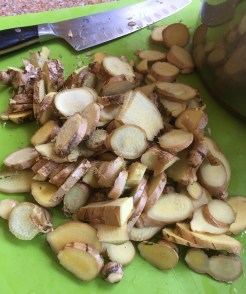
1) I cooked seedy crackers, vegan tapioca pudding, and pans and pans of roasted vegetables, including my own asparagus. I boiled a few quarts of ginger tea and tried out another vegan lemon cake recipe that I probably won’t make again. I’m done with cakes for a while. It makes sense to make cakes when one can use eggs and butter.

2) I baked communion bread at church. For a year we haven’t been using the little prosphora loaves that get sent into the altar along with our prayer requests, but we are starting that tradition again; four of us made 200 prosphora. What we call lambs, the larger loaves that we didn’t bake this week, are cut up and consecrated along with wine for Holy Communion. This photo is from the past.

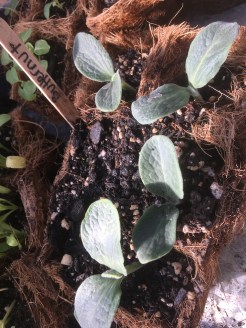
3) I worked in the garden and the greenhouse. Most days now, when the sun shines, I open the door and vent of the greenhouse so that the seedlings don’t swelter. Then I close them up at night to shut out the cold marine breeze. Soon I’ll need to put a shade cloth on one side of the roof as well. The first butternut squash seed took an entire month to sprout; the next several were even later. Nothing like the pumpkins which were the first of all to emerge. I’ve moved most of the plants to larger pots so they can spread their roots in the next few weeks.

4) I shopped at a farmers market with Bella. We ate breakfast there and bought a few vegetables. How long had it been since I’d been to one of those? The sun shone and everyone was cheery. Then we went across town to her community garden plot, because she had a few potatoes that really needed to get into the dirt. I wandered around dreamily while she dug. Besides us, only a very quiet father and little daughter were working their plot, in which they had strawberries in process.

Bella sent me home with some horsetail which she told me to make tea out of, but it is still waiting in the refrigerator.

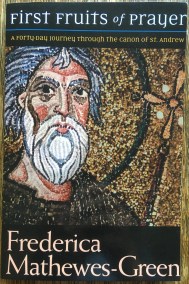
5) I went to church several times, and did a little housework, and got my taxes paid. I prepared for my church school class by reading more of The Screwtape Letters, and for the women’s book group by reading some of First Fruits of Prayer, which we discussed on ZOOM this afternoon. I ended up not enjoying that book very much. The Canon was not “itself,” plucked out of its normal context of Compline, extracted as a text to read, with explanatory notes but without the usual accompanying music, prostrations, and other tactile and sensory aspects, not to mention the fellow worshipers in the services in which we pray it, divided into four parts for the first week of Lent. This week we will do the whole Canon again, all in one morning.

6) I attended a doubly belated birthday party with my friends with whom I have celebrated for 36 years now, ever since we learned that we were born in the same week of the same year. At that time we lived on the same block of our “village.” Last spring we couldn’t manage it, so this was our 35th luncheon. We ate on the patio at S.’s house and the sun was just warm enough to make it easy to sit and chat for several hours.

7) I found these eggs that my daughter-in-law Joy knitted for me a few years ago, but which were stashed away in a box during the remodel. I posed them among the flowers but then brought them in to brighten up the living room.

This will be another full week. It’s such a blessing to have many different things to do, but — can you tell how worn out I am? It’s a great gift that God gives us rest, too. It’s the 5th Week of Lent – Pascha is coming!

Eating food that is not dead.

“Prepare yourself, my soul! Be courageous like Abraham, Isaac and Jacob, that acquiring diligence and wisdom you too may meet your God. Through contemplation may you reach the awesome depths in which He dwells and in so doing become a good steward of the Lord.”

-Canon of St. Andrew

For the Orthodox, it is the first week of Great Lent, which is called Clean Week. We began the fast on Monday, after the Vespers of Forgiveness on Sunday. This year in my parish we were thankful for good weather that day, as our long line of people bowing to each other in their masks, and mostly not hugging, stretched in a long loop that went out the side door of the church and wrapped loosely around the front. We were saying, “Forgive me,” to each one, and replying “God forgives.” Many of us had not seen each other in person for months or even the whole year.
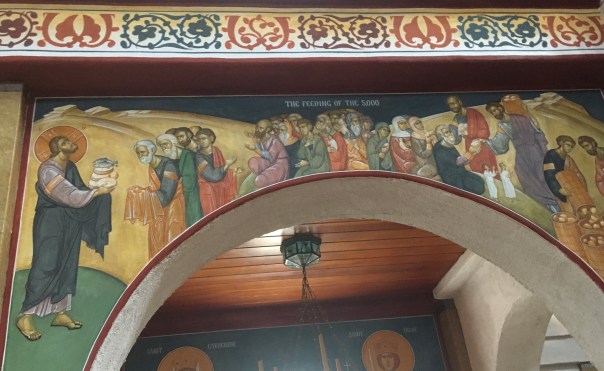
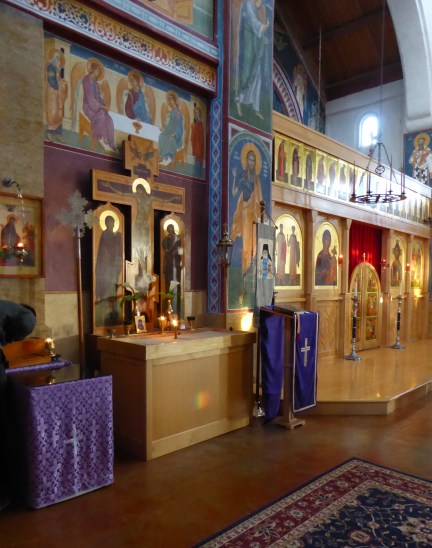
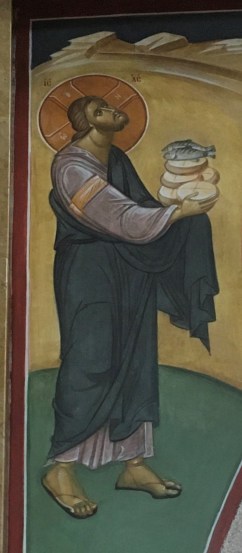
Two new frescoes had been completed just in time to take down the scaffolding and make room for Lenten services. As I took pictures of them on Sunday I realized how each of them draws me into an aspect of the season.

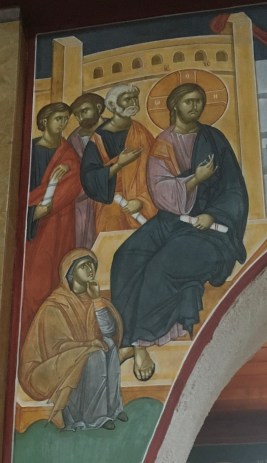
Christ in the House of Mary and Martha in Bethany (on the other side of the arch, not pictured, is Martha scowling) makes me want to imitate Mary and sit at Jesus’s feet. And The Feeding of the Five Thousand reminds me of various levels of meaning in the lines of the Lord’s Prayer, “Give us this day our daily bread.” As we are going without physical food in various ways during this season, that part of our prayer is extra meaningful. The most striking words I ever read on the relation of earthly and heavenly food were in For the Life of the World by Fr. Alexander Schmemann:
“The natural dependence of man upon the world was intended to be transformed constantly into communion with God in whom is all life. …He still loves, he is still hungry. He knows he is dependent on that which is beyond him. But his love and his dependence refer only to the world in itself. He does not know that breathing can be communion with God. He does not realize that to eat can be to receive life from God in more than its physical sense. He forgets that the world, its air or its food cannot by themselves bring life, but only as they are received and accepted for God’s sake, in God and as bearers of the divine gift of life. By themselves they can produce only the appearance of life.
“…Things treated merely as things in themselves destroy themselves because only in God have they any life. The world of nature, cut off from the source of life, is a dying world. For one who thinks food in itself is the source of life, eating is communion with the dying world, it is communion with death. Food itself is dead, it is a life that has died and it must be kept in refrigerators like a corpse.”

The most prominent reading during the first week of Lent is The Great Canon of St. Andrew of Crete, which is typically divided into four parts sung during services of that week. This year our women’s book group also chose a book on the Canon to read during this season.

I’ve noticed that during the Compline service when the Canon is being read, year by year, there are so many Scripture passages and characters referred to, that I can’t absorb half of it in my mind. Being at the service and participating with my whole body, soul and spirit is the way to do it — we humans are so much more than our thoughts! This week the Compline hymns have been the sweetest part for me, and as usual, a phrase or two from the Canon about a particular sin or person in the Bible will also grab my mind and stick. I seem to have the opportunity for more contemplation generally these days, which is why the lines at top made their impression.

Psalm 69/70 is part of Compline, also, and a few lines from it will help me end this ramble.

“Let all those that seek thee
rejoice and be glad in thee:
and let such as love thy salvation say continually,
Let God be magnified.

“But I am poor and needy:
make haste unto me, O God:
thou art my help and my deliverer;
O Lord, make no tarrying.”