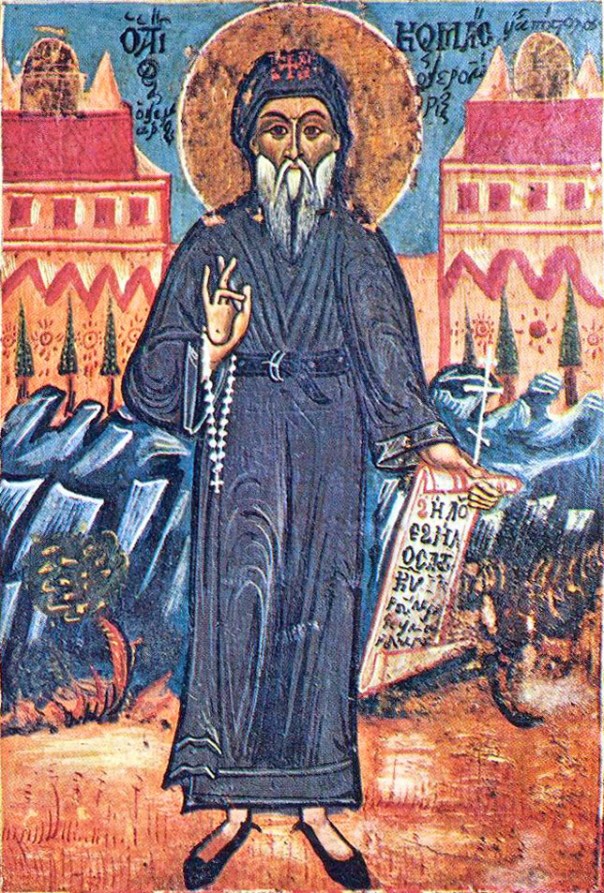
“Since the churches could not accommodate everyone wanting to hear the wise preacher, Saint Cosmas with forty or fifty priests served the Vigil in the fields, and in city squares, where thousands of people prayed for the living and for the dead, and were edified by his preaching. Everywhere that Saint Cosmas halted and preached, the grateful listeners set up a large wooden cross, which remained thereafter in memory of this.
“The apostolic service of Saint Cosmas was brought to a close by his martyric death in the year 1779. At 65 years of age, he was seized by the Turks and strangled. His body was thrown into a river, and after three days, was found by the priest Mark and buried near the village of Kolikontasi at the monastery of the Entrance into the Temple of the Most Holy Theotokos. Afterwards, parts of his relics were transferred to various places as a blessing.”
For the last week or so, I’ve been spending a lot of time in the kitchen, and an equal amount in church. It was quite the experience to attend Divine Liturgy three days in a row: First for Sunday, the usual Resurrectional Liturgy — though the cathedral had been so brightly decorated on Saturday, it was far from the usual visually. Plus, at the end of the service the choir sang several carols with great zest. We returned for a short Festal Matins in the evening, and sang the glorious “God is With Us!”
Then Monday, which was Christmas, the Nativity of Christ, and the church was full again, with lots of families with babies. My baby goddaughter has had stranger anxiety for several months but that morning she was okay with me carrying her up for Communion, after which I toted her around for a while and showed her off to everyone.
Today is the Synaxarion of the Mother of God, she who was so essential to the event we celebrated yesterday. Of course, the church was not as full of people as on Christmas Eve and Day, but it was surprising how many of us came back for more of the rich spiritual feast — and there was certainly more than we could take in, more than enough to fill our cups to the brim, with a holy elixir.
Cranberry Jellies
My cookie tins have been filled to their brims, too, with more worldly contents, and then partially emptied as I give them for gifts, and then filled again. I made several kinds of cookies before the First Day of Christmas, and I am continuing now on the Second Day, and have plans for a few more, days and flavors.
Salty Licorice Brownie Cookies
I have friends who will be celebrating according to the old calendar, which means they won’t have Christmas until January 7th, which means more opportunities for gifting cookies that I bake “late.”
So far I have made:
Cranberry Jellies Apricot Macaroons Ginger Spice Cookies Salty Licorice Brownie Cookies Chocolate Almond Macaroons Fruity Meltaways Rolled Gingerbread Cookies Lemon Poppyseed Sandwich Cookies
The end of Christmas Dinner
And I’ve started on:
Flourless Mandarin Almond Cookie (my invention)
…and still plan to make:
Salted Anise Butter Cookies and Mexican Hot Chocolate Cookies
I’d like to replenish the supply of Ginger Spice Cookies, because the first batch I made with einkorn flour, and I didn’t know one needs to use more of that type than of regular wheat flour; the cookies came out flat flat flat. Still yummy, but they don’t present so nicely…
None of my own family were able to come spend Christmas with me this year, except for my grandson Pat and his wife who spent Saturday with me. But I have other guests for a month, a family with three children, and the children do not speak more than a few words of English. It’s surprising how little one needs to talk, to bake cookies together. I added the rolled gingerbread cut-out cookies to my list for their sake, and well, for my sake, too, because it’s a lot of fun to help them have fun.
Fruity Meltaways
So… today I boxed up some more cookies on Boxing Day, and put them out in the garage to stay cool. Tomorrow is St. Stephen’s Day, and if I weren’t ironing altar cloths (we are going back to gold now, after the Christmas red) I would consider driving to our sister parish where they will commemorate the first Christian martyr with another Divine Liturgy.
But, I will stick closer to home, and hopefully bake a few more cookies, and/or help the children to decorate the gingerbread with Royal Icing. And I will visit some dear church friends to share some Christmas cheer, which may or may not include — cookies!
When my Kate was in high school, she and I studied as a part of our history course the children of Queen Victoria, and their marriages and children. You take in a lot of general European and even world history through their stories. Since my conversion to the Orthodox Church, I’ve come gradually to know a little more about some members of the extended family, and one of the most interesting to me is the Grand Duchess Elizabeth.
She was a granddaughter of Queen Victoria through Princess Alice, her father being Ludwig IV, Grand Duke of Hesse and by Rhine; her younger sister married Czar Nicholas II. (That couple are more famous generally, and many books have been written about their family. The only one I have read so far is a photo album sort of book, Tsar: The Lost World of Nicholas and Alexandra, which I loved.)
With her family in 1875; Elizabeth at left.By Friedrich August von Kaulbach
Elizabeth’s mother, who had modeled for her a devotion to helping the poor and living a modest lifestyle, died of diphtheria when Elizabeth was fourteen, along with her youngest sister.
Elizabeth had many suitors and admirers, and was considered by women as well to be exquisitely beautiful in body and soul. She rejected several suitors before she fell in love with Grand Duke Sergei Alexandrovich, son of Tsar Alexander II, who used to visit her family with his mother. It is interesting to me that her grandmother was very unhappy about this, and tried to discourage Elizabeth from accepting Sergei’s proposal. I think she was still trying to arrange marriages, and she had someone else in mind for her granddaughter. But the couple were married in 1884, when she was nineteen. Sergei was appointed Governor-General of Moscow.
Elizabeth and Sergei never had children of their own, but they became foster parents to Sergei’s niece and nephew, and Elizabeth would give parties for children at their summer estate. She converted from the Lutheran faith to Orthodoxy in 1891, against the wishes of her family. The following is from OrthodoxWiki:
“Once the decision was reached, it proved a difficult task to make it known to her relatives. She writes to them at this time that she is ‘intensely happy,’ but that it pains her to cause grief to her beloved family. And yet her determination was firm, ‘I am sure God’s blessing will accompany my act which I do with such fervent belief, with the feeling that I may become a better Christian and be one step nearer to God.’ Explaining the reasons for her decision, she writes in a letter: ‘Above all one’s conscience must be pure and true… many will — I know — scream about (it), yet I feel it brings me nearer to God… You tell me that the outer brilliance of the church charmed me… in that you are mistaken — nothing in the outer signs attracted me — no — the service, the service, the outer signs are only to remind us of the inner things.’
“The Kaiser is thought to have been behind the claim that her husband had forced her to convert, but Elizabeth explained that it would be ‘lying before God’ to ‘remain outwardly a Protestant.’ Of all her family, Queen Victoria showed the most understanding, and provided her with moral support for her decision.”
Wikipedia tells us:
“Elisabeth was instrumental in the marriage of her nephew-by-marriage, Tsar Nicholas II, to her youngest sister Alix. Much to the dismay of Queen Victoria, Elisabeth had been encouraging Nicholas, then tsarevich, in his pursuit of Alix. When Nicholas did propose to Alix in 1894, and Alix rejected him on the basis of her refusal to convert to Orthodoxy, it was Elisabeth who spoke with Alix and encouraged her to convert. When Nicholas proposed to her again, a few days later, Alix then accepted.”
In February of 1905, Sergei was assassinated in the Kremlin by the Socialist Revolutionary Ivan Kalyayev. Elizabeth was, of course, shocked and stricken, but she regained her calm, and according to Edvard Radzinsky,
“Elizabeth spent all the days before the burial in ceaseless prayer. On her husband’s tombstone she wrote: ‘Father, release them, they know not what they do.’ She understood the words of the Gospels heart and soul, and on the eve of the funeral she demanded to be taken to the prison where Kalyayev was being held. Brought into his cell, she asked, ‘Why did you kill my husband?’‘I killed Sergei Alexandrovich because he was a weapon of tyranny. I was taking revenge for the people.’ ‘Do not listen to your pride. Repent… and I will beg the Sovereign to give you your life. I will ask him for you. I myself have already forgiven you.’ On the eve of revolution, she had already found a way out; forgiveness! Forgive through the impossible pain and blood — and thereby stop it then, at the beginning, this bloody wheel.”
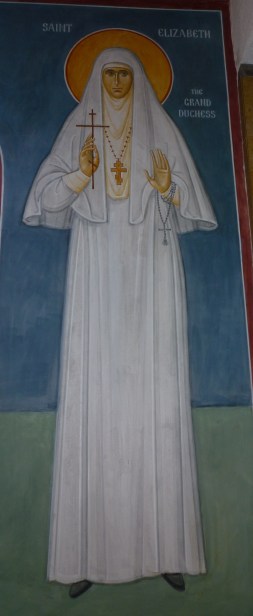
The widow Elizabeth went into seclusion, and eventually sold her jewels and possessions, using the proceeds to establish a convent of which she became the abbess. She and her monastic sisters opened a hospital and accomplished many and various deeds of mercy.
“This creature, so unlike the others, so towering above all, of such captivating beauty and loveliness, of such irresistible kindness; she had the gift of effortlessly attracting people who felt that she stood above them and gently helped them to rise to her…. She was made of the same material as the early Christian martyrs who died in the arenas of Rome” -Countess A. A. Olsufieva
In 1918 the Communist government exiled Elizabeth to Yekaterinburg and then to Alapaevsk, where with several others she was killed by the local Bolsheviks on July 18.
“They were herded into the forest, pushed into an abandoned mineshaft, into which grenades were then hurled. An observer heard them singing Church hymns as they were pushed into the mineshaft. After the Bolsheviks left, he could still hear singing for some time…. Later the White Army briefly recaptured this area, and her relics were recovered and the account of the person who witnessed it recorded. Her relics were first taken by the White Army to Beijing and placed in the Church of St. Seraphim of Sarov, and then they were taken to Jerusalem and placed in the Church of St. Mary Magdalene, which she and her husband had helped to build.”
I have had to leave out many details about this saint’s life, but want to share a couple of memorials before I end this particular remembrance. Elizabeth was commemorated by Westminster Abbey as one of ten Modern Martyrs whose statues above the Great West Door were unveiled in 1998.
And the sand artist Kseniya Simonova has told the story of Elizabeth’s life in a surprisingly moving way here: “White Angel.”
” … if we believe in the sublime sacrifice of God the Father in sending His Son to die and rise again for us, we shall feel the Holy Spirit lighting our way, and our joy will become eternal, even if our poor human hearts and earthly minds pass through moments which seem terrible.”
– Grand Duchess Elizabeth Feodorovna of Russia
May her life and prayers encourage and inspire us to receive with her,
even in our terrible moments, that eternal joy.
 St. Kosmas is commemorated on August 24th.
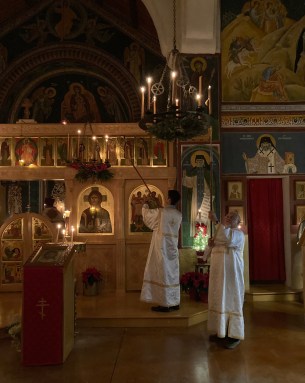 For the last week or so, I’ve been spending a lot of time in the kitchen, and an equal amount in church. It was quite the experience to attend Divine Liturgy three days in a row: First for Sunday, the usual Resurrectional Liturgy — though the cathedral had been so brightly decorated on Saturday, it was far from the usual visually. Plus, at the end of the service the choir sang several carols with great zest. We returned for a short Festal Matins in the evening, and sang the glorious “God is With Us!”



 …and still plan to make:


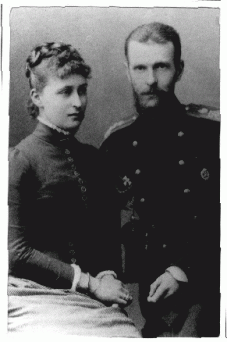 When my Kate was in high school, she and I studied as a part of our history course the children of Queen Victoria, and their marriages and children. You take in a lot of general European and even world history through their stories. Since my conversion to the Orthodox Church, I’ve come gradually to know a little more about some members of the extended family, and one of the most interesting to me is the Grand Duchess Elizabeth.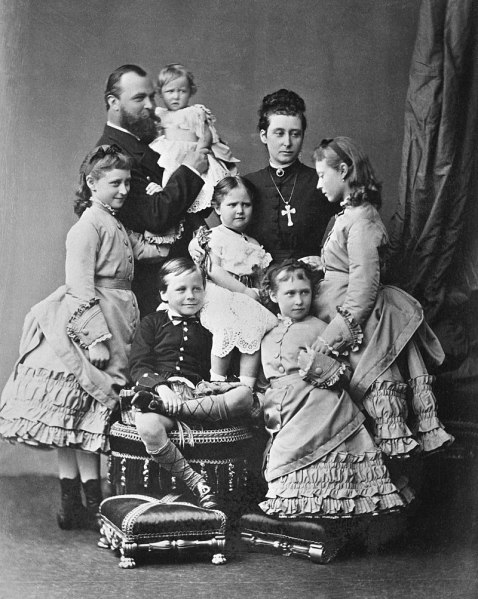

 In February of 1905, Sergei was assassinated in the Kremlin by the Socialist Revolutionary Ivan Kalyayev. Elizabeth was, of course, shocked and stricken, but she regained her calm, and according to Edvard Radzinsky,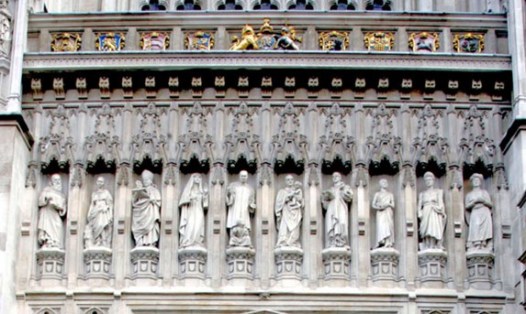
 And the sand artist Kseniya Simonova has told the story of Elizabeth’s life in a surprisingly moving way here:
  Gladsome Lights