Rain… rain… rain… It’s been raining All. Day. It’s night now and still raining. I’ve been exulting in it, because I didn’t have any responsibilities that required my going out. I could tend the fire, chat with my daughters online about their weather, roast onions, read, and even accomplish one housecleaning task that has been hanging over my head for months: cleaning the ceiling exhaust fan in a bathroom. Yippee!
The nodding violet that I brought indoors last week before freezing weather arrived looked so lovely with the rainy light behind it, I had to take its picture.
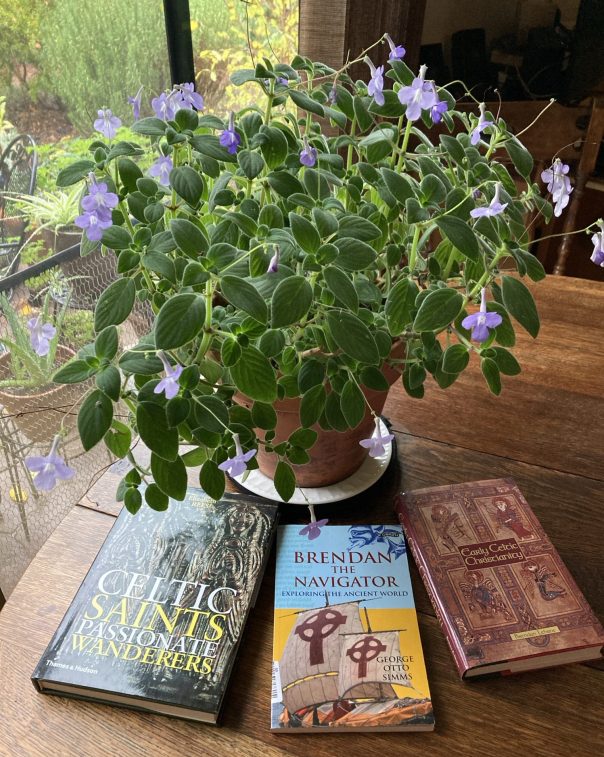

On the table by the violet are a few of the books I bought to go with an online course I am taking this fall: “Christian Wonder Tales.” It is taught by Martin Shaw, the mythologist and storyteller whom I met at the Symbolic World Summit last winter. Tolkien’s Sir Gawain and the Green Knight didn’t get in the picture, but is another title he recommended, and I have it upstairs.
Who knows if I will read any of these books to the end — I haven’t even finished The King of Ireland’s Son, by Padraic Colum, which is quite delightful. Also perfect for listening to, because the narrator Gerard Doyle’s Irish brogue, telling the stories-within-stories as is the custom with Irish stories, has me journeying entranced from the Irish cottage to the castle and back again, meeting mysterious characters and challenging assignments around every bend in the road.
Now to the topic of food: Back when my friend Susan was also my housemate, sometimes I would walk in the front door to another sort of captivating story, the aroma of which was the essential part. What are you cooking?? I would ask, drawn immediately into the kitchen, and it took a few repetitions of this encounter before my nose remembered what she had told me: “It’s only roasted onions!” I eventually had to start making them myself.
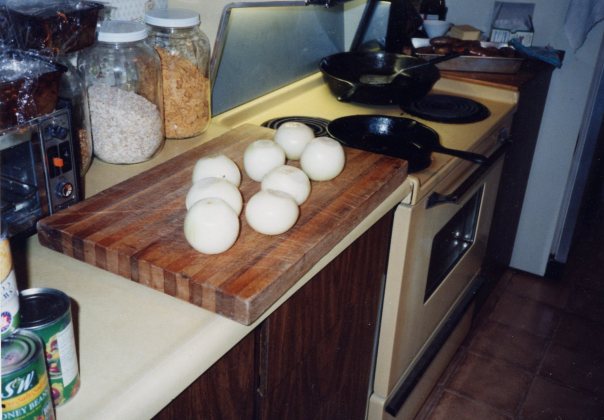
(Above, onions in my kitchen as it was 28 years ago. Notice bread rising in pans at left. The only thing that is the same now is cast iron pans always on the stove top.)
To keep up with my appetite for them, I’d need to roast a batch of onions once a week, but it ends up being more like twice a year. As soon as they are out of the oven I always serve myself a little bowl of them, which seems to be about one onion’s worth… or two — so I usually double the recipe below. Do you roast onions? You can find many recipes online; here is my version:
ROASTED ONIONS
3 large onions, yellow or red
2 tablespoons olive or other oil
1 tablespoon balsamic or other vinegar
1/2 teaspoon kosher salt
fresh ground black pepper to taste
(1 tablespoon chopped fresh thyme) – I never add this
Cut the onions vertically into quarters or sixths, and then slice those wedges crosswise as thick as you want; I make mine 1/8 to 1/3 inch thick. Toss them in a bowl with the other ingredients and roast in a sheet pan at 375 to 400 degrees for 45 minutes to an hour, stirring occasionally, until they are as brown as looks good to you. I think sometimes, in an effort to get them crispier, I have overcooked them and made them a little tough.
This evening I didn’t use balsamic vinegar, because recently I was given an extra special bottle of “plain” red wine vinegar with a noble heritage. Just as bakers like to pass their sourdough starter around to friends, so chefs and winemakers often share a vinegar mother (also called a vinegar scoby). My vinegar was fermented with a mother whose mother belonged to Alice Waters, and whose grandmother grew in Julia Child’s kitchen. Does that make my onions taste better? You know, I think they might just be the best I’ve ever made!


 Gladsome Lights