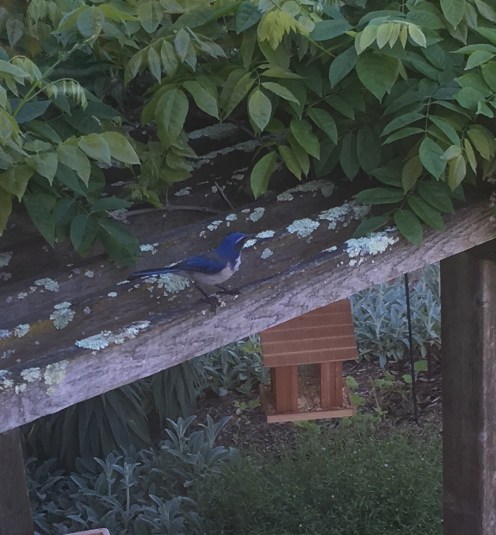
If only those parakeets would settle A little nearer to where I’m sitting, instead of at the tops of far-off trees, this morning Would be so much more remarkable. One could watch the blackbirds, I suppose, peck their ways like Oxford dons across The flagstone paths and lawns, or the swallows, or the sparrows, Or the crows. But those birds are so plain—, so…painfully available. No, only those parakeets will do and they will not do What I want them to. In this, they are like everything else in the world. Every beautiful thing.
-Jay Hopler
I’ve begun listening to replays of Garrison Kiellor’s The Writer’s Almanac on Substack. That is where I heard the poem above. In reading further about the poet, I discovered that he died only last year, at the age of 51. Once when he was asked which five books he would never part with, he included this one:
“The Complete English Poems by John Donne. When I write, John Donne is the mentor who leans over my shoulder and questions my line breaks, my syntax, whether or not my music is rising and falling as it should.”
Rest in peace, Jay Hopler.
I hope you and John Donne are
now hearing the music together,
in kairos time.
Wilt Thou forgive that sin where I begun,
Which was my sin, though it were done before?
Wilt Thou forgive that sin, through which I run,
And do run still, though still I do deplore?
When Thou hast done, Thou hast not done,
For I have more.
Wilt Thou forgive that sin which I have won
Others to sin, and made my sin their door?
Wilt Thou forgive that sin which I did shun
A year or two, but wallowed in a score?
When Thou hast done, Thou hast not done,
For I have more.
I have a sin of fear, that when I have spun
My last thread, I shall perish on the shore;
But swear by Thyself, that at my death Thy Son
Shall shine as he shines now, and heretofore;
And having done that, Thou hast done;
I fear no more.
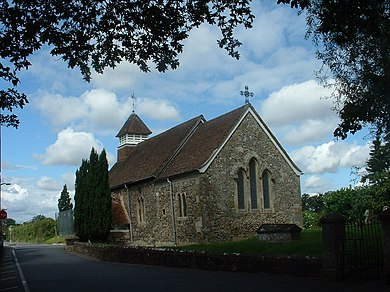
This is the church where George Herbert served as rector for a only a few years before his death at the age of 39. He was born in Wales in 1593, into a wealthy and powerful family. The poet John Donne was his godfather, which was surely an important role, as his father Richard died when George was three years old. After his university education he held posts at Cambridge, was briefly a member of parliament, and held the clerical post of prebend.
But it wasn’t until 1629 that he decided to enter the priesthood and was appointed to the parish where “he lived, preached and wrote poetry; he also helped to rebuild the Bemerton church and rectory out of his own funds.”
He knew he was dying (of consumption); it was in that last year of life that he sent all of his poems to his friend Nicholas Ferrar, asking him to publish them if he thought they were good for anything. He said that they held “a picture of the many spiritual conflicts that have passed between God and my soul, before I could subject mine to the will of Jesus, my Master.” Commenting on George Herbert’s religious poetry later in the 17th century, Richard Baxter said that the poet “speaks to God like one that really believeth in God, and whose business in the world is most with God. Heart-work and heaven-work make up his books.”
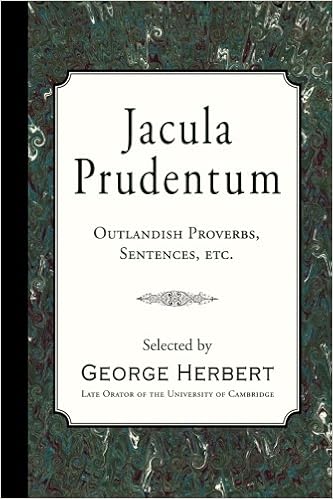
His prose works include a volume of nearly 1200 “outlandish proverbs” that he collected, and which is currently available on Amazon. That’s one that looks interesting to me, too.
Charles Cotton described George Herbert as a “soul composed of harmonies,” and it seems that he was also a skilled lutenist and composed hymns. More than ninety of Herbert’s poems have been set for singing over the centuries by composers like Benjamin Britten, Henry Purcell, and Ralph Vaughan Williams. When I read that the Wesley brothers adapted a few dozen for the Methodist hymnal, I checked out our family’s inheritance of hymnals from Methodist and Presbyterian churches but only found one attribution to Herbert.
But I do have a collection of his poems. I’ve shared other works of this poet; now here is one that I only recently noticed, whose echo-dialogue and themes I like very much. I found online a thorough exploration of the poem by Inge Leimberg, who tells us that “In Herbert the three themes of death, being restored from death, and spiritual vision are closely bound up with music and poetry (which to Herbert are one and the same).” I haven’t finished reading her essay, but I did catch one example of the layers of meaning he was famous for; “holy leaves” likely refer not just to leaves, but also to pages of the Bible.
One friend was of the opinion that Herbert would be singing his melodies with the angels in heaven, and I wouldn’t be surprised if the angels do join in with this harmonious and persevering soul.
HEAVEN
O who will show me those delights on high? Echo. I.
Thou Echo, thou art mortall, all men know. Echo. No.
Wert thou not born among the trees and leaves? Echo. Leaves.
And are there any leaves, that still abide? Echo. Bide.
What leaves are they? impart the matter wholly. Echo. Holy.
Are holy leaves the Echo then of blisse? Echo. Yes.
Then tell me, what is that supreme delight? Echo. Light.
Light to the minde : what shall the will enjoy? Echo. Joy.
But are there cares and businesse with the pleasure? Echo. Leisure.
Light, joy, and leisure ; but shall they persever? Echo. Ever.
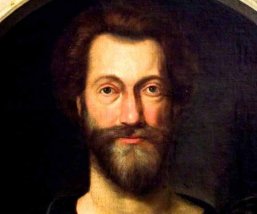
This poem by John Donne I believe did not start out as a poem. Someone posted it as follows, in poetic lines, but I found the same lines as prose on Bartleby.com, in the middle of a passage in “Sermons Preached on Christmas Day.” Donne evidently did not give the title “In Heaven it is Always Autumn” to anything, but more than one person has more recently used his line to title a poem, as I found in my searching.
Donne uses several vivid words to describe the winter we can experience in our soul at any time of year, showing that he is familiar with that inner dark and coldness. We know that he did suffer terrible grief when his wife died, and it was doubtless not the only occasion when he felt desperate need of God’s presence and mercy.
The first time I posted these words it was autumn, but now I am trying for closer to Christmas, in the spirit of their preacher.
In heaven it is always autumn,
His mercies are ever in their maturity.
We ask our daily bread
And God never says
You should have come yesterday,
He never says
You must again tomorrow,
But today if you will hear His voice,
Today He will hear you.
He brought light out of darkness,
Not out of a lesser light;
He can bring thy summer out of winter
Tho’ thou have no spring,
Though in the ways of fortune or understanding or conscience
Thou have been benighted til now,
Wintered and frozen, clouded and eclipsed,
Damped and benumbed, smothered and stupefied til now,
Now God comes to thee,
Not as in the dawning of the day,
Not as in the bud of the spring
But as the sun at noon,
As the sheaves in harvest.
 -Jay Hopler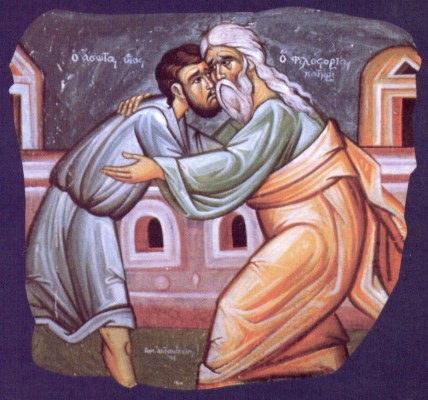
 Gladsome Lights