Tag Archives: koliva

Cooking and commemorating.

Because of the convenient timing of their visit, I was able to conscript my daughter-in-law (definitely Daughter-in-Love) Joy and my grandchildren into my cooking crew, to prepare an agape meal at church in memory of my late husband, “passed from death into life” ten years ago. Memory eternal †

One day two of the boys shopped with me for 45 pounds of potatoes, 20 pounds of carrots, eight cabbages, a big box of cocoa, and many other good ingredients. That day I also put 22 pounds of Great Northern beans to soak, and we squeezed the lemons (from my tree!) for the juice to put in the Greek Beans.
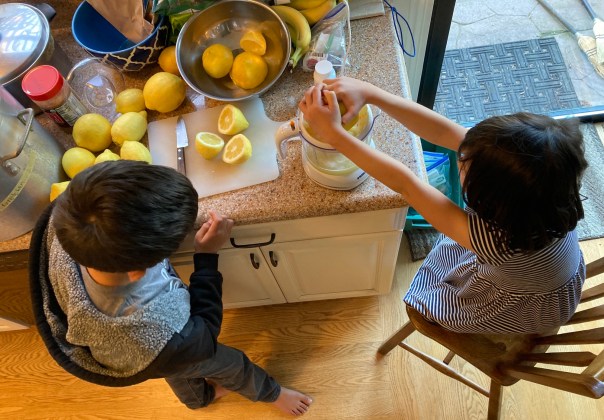
I boiled the wheat and started to assemble the koliva, which Laddie decorated on Sunday morning. On Saturday Clara helped me to dry the soaked beans, and we carried them to church along with all the other ingredients.

The children were incredibly cheerful and hardworking slaves. We all worked for more than six hours on Saturday, with ample breaks as needed for younger conscripts.
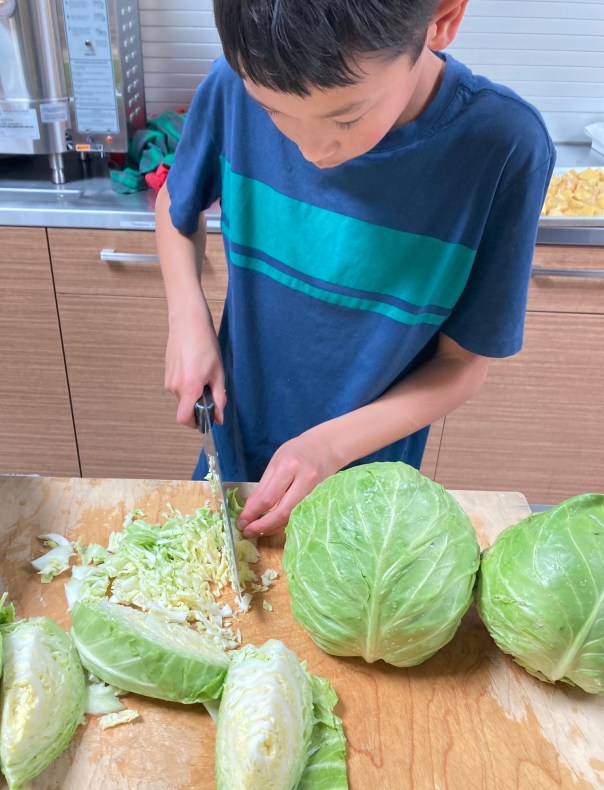
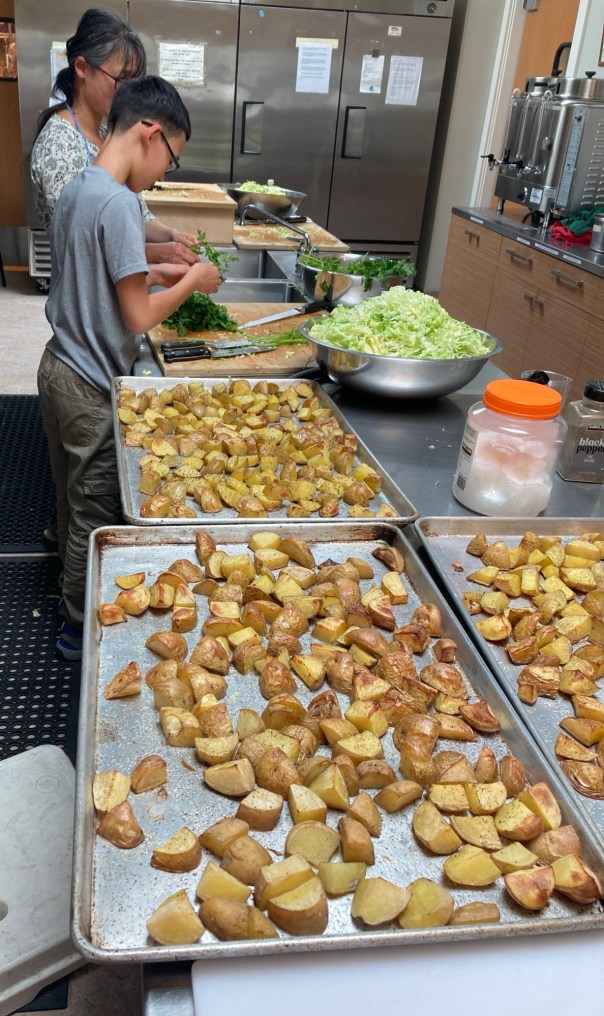
They did laugh at me afterward when I apologized for enslaving them, and said they didn’t feel like slaves at all, and that in spite of their sore feet it had been fun. That’s how we all felt.

Liam singlehandedly assembled the chocolate carrot cake brownies (picture at top). This whole menu is the same one I made twice before as a memorial meal. Every time the brownies have turned out a little different, and this time they were quite compact, but still tasty and popular. It’s always hard for people to believe that they contain no eggs or butter; they are completely vegan.
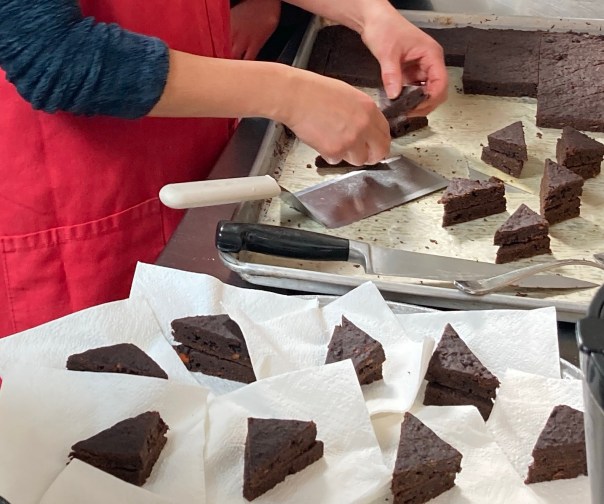
All of the beans, roasted potatoes and brownies were eaten at Sunday’s lunch or taken home by parishioners, and the leftover cabbage salad will be enjoyed after this week’s Presanctified Liturgy.
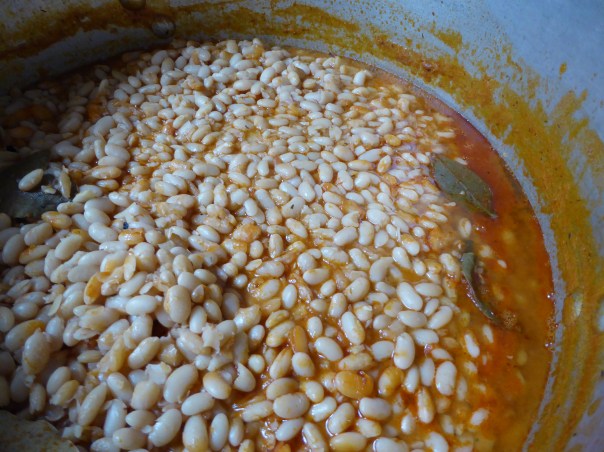
It really was a great meal, but at this point I can’t imagine making it again — I’m still thoroughly wiped out from being chef for a weekend. And happy, so very happy, to have been able to do it, with family helping this time. These children are too young to remember their grandfather, but they were able to contribute to a big project done in his honor, and that was very special.

Sunday afternoon I took three of the children to the beach! I know, it seems crazy that I would have the energy to do that, but the fatigue hadn’t yet hit me. It was supposed to be sunny out there, but just as we drove over the last hill the fog descended on us, and stayed with us the whole time. We flew kites and chased the waves and Brodie built a sand castle. One kite flew so high up into the fog that it disappeared from sight, and took 20 minutes to reel in. We came home with wet leggings and shorts and shoes, but glad hearts. After all that kitchen work, it was great to be out in the wide open weather.

Laddie’s birthday was this week, and we celebrated with his other grandparents and cousins in a nearby town. Spring has fully sprung, bringing 80 degrees worth of sunshine yesterday and today, then a 20-degree temperature drop and rainy week up ahead. I’m sure I’ll have more springy pictures to share soon. And April is coming on fast!

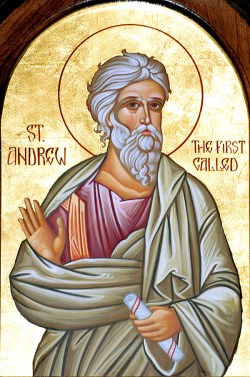
St. Andrew — and then December.

Attending Divine Liturgy on the feast of St. Andrew — what a life-giving way for me to start the day. It was a long and busy day that had me driving back and forth and all over, which is why I am only now getting to the computer to tell about it, now that we are, liturgically, in the following day.

It was a chilly morning, in the middle of the week; the little church was cold in its bones and for the first half hour I stood so close I was almost touching the wall furnace. Who would come on such a morning for a relatively unimportant commemoration? The rector came, of course, with joy. The choir director led a choir of four singers, including a nun from the monastery in the next county.

Two men named Andrew and Andrei were there, because it is their saint’s day, and who would want to miss that? One mother of an Andrew came to remember her son’s saint.

St Andrew's Day is a day of celebration in Scotland (Getty Images)Saint Andrew, the first of the men whom Christ called to be His disciples, eventually became the patron saint of Scotland, and Mrs. Anderson came in her tartan plaid skirt to remember that aspect. She also pointed out to me that her married name means Andrew’s Son.

I myself like to participate for the sake of the Scottish ancestors that both my late husband and I have; not only that, but two of my grandsons were born on this day, and that makes it special to me. Six or eight more people were present who weren’t obviously tied to this specific feast, but I’m sure all of us were happy to receive the Eucharist and be united to Christ in that way.

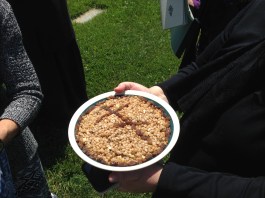
Mrs. Anderson had yet another reason to be there: She was very close to a very dear parishioner named Constantine, who died on this day more than ten years ago, and every time we celebrate the feast of the Resurrection with Divine Liturgy on November 30, we also sing memorial prayers for him. She made a small portion of the memorial dish of boiled wheat, called koliva, for us to eat together in his memory at the end of the service. You can’t see the wheat in this picture because she topped it with lots of dried fruit and fresh pomegranate seeds. It did make a good breakfast.

By then, the church was warmed up, but we could not linger as long as we might have liked. Out we went into the sunny day, and to all of our responsibilities. One of mine was going to the dentist, and I’m glad to get that out of the way. Afterward, I had the fun of shopping for special ingredients — and more butter– for baking Christmas cookies. The boys at the checkout stand got to talking about how they used to put out cookies for Santa. And here it isn’t even December yet! Although it likely will be before you read this.

So I wish you a December that is peaceful and bright.
(And don’t eat too many cookies before Christmas!)

When suffering and death come.

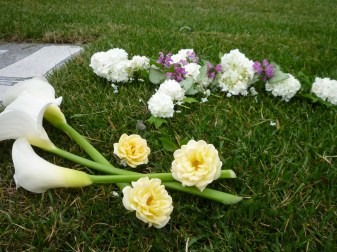
I almost broke out of my “cage” last week to visit my husband’s grave. My priest would meet me there, and we would pray on the memorial of my beloved’s repose, five years ago. But we changed our plan and had a virtual gathering with him praying in the church and more of us praying along via Zoom than would ever have been able to come to the cemetery. Before we had conceived the graveside plan and given it up, we had planned for me to bring a koliva to church to serve after a service there. I know people everywhere have been accomplishing many and various quick-change feats lately.

The Zoom meeting/service was a little odd; I’m certain it was the first prayer service ever held that way in my parish, but under the circumstances it was the best, and I was really glad we did it. More than 21 people were able to be with me that way, and some of you were among them. I could see that 21 devices were tuned in, and some of them represented couples or families.

Most of us had our microphones turned off, but even having two or three people singing or praying together on Zoom confuses the audio stream. I was thankful to all of those who were willing to listen above the superficial distortion to the beauty of the memorial, for the sake of praying with me and for my husband. It was sweet to see their names and/or faces, and after the hymn “Memory Eternal” more people turned on their mics to say it individually.

That was a blessing of the current version of normal, and a good alternative to standing in the rain six feet away from my priest. But when I do eventually feel free to visit the cemetery, that real and physical resting place (I will choose a sunny day), I can see me with my face in the grass, smelling the earth, feeling the breeze blowing over me and over all those waiting for the Resurrection of the Dead. Until then I am sharing a few pictures of events featuring more concrete, material remembrances, the sorts of gatherings which we will be less likely to take for granted in the future — I hope!

Today as I write, it is Saturday, which is the Sabbath, as we were reminded in our (streamed) morning prayers from church. The day of rest. But most of us don’t rest ourselves on this day. Rather, the church remembers those who are resting in death, waiting for the Resurrection, Resurrection Day, which we both celebrate and look forward to on Sundays, as Sunday is the Eighth Day.

When I “came home,” which meant coming downstairs, I read the passage from I Corinthians appointed for the day, and it is on the same theme, a topic on the minds of many in these days of a world pandemic, a time when death statistics are in nearly every news article one comes across. I keep thinking about Ivan in Tolstoy’s story, and how it was only in suffering that he began to get understanding. I will quote from my own blog post, written only a month ago, so soon pertinent to our moment:

“It is the disruption of Ivan Ilyich’s pleasant life, the pain of his illness, and the growing realization that he is dying, that make him pay attention, and even pray. His prayer is along the lines of, ‘What did I do to deserve this?’ but nevertheless: ‘Then he was still, ceased weeping, held his breath, and was all attention; he listened, as it were, not to a voice uttering sounds, but to the voice of his soul, to the current of thoughts that rose up within him.'”
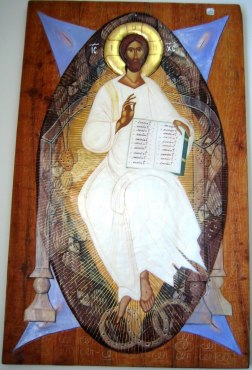
It is always a good thing to realize that one is dying. Those of us who will survive this recent threat and go on to live many more happy decades are no less under the sentence of death than those who will die from Covid-19. The realization can lead to repentance, and that in turn, to life.  Here is the epistle reading for today:

Now this I say, brethren, that flesh and blood cannot inherit the kingdom of God; nor does corruption inherit incorruption. Behold, I tell you a mystery: We shall not all sleep, but we shall all be changed— in a moment, in the twinkling of an eye, at the last trumpet. For the trumpet will sound, and the dead will be raised incorruptible, and we shall be changed. For this corruptible must put on incorruption, and this mortal must put on immortality. So when this corruptible has put on incorruption, and this mortal has put on immortality, then shall be brought to pass the saying that is written: “Death is swallowed up in victory.”

“O Death, where is your sting?
O Hades, where is your victory?”

The sting of death is sin, and the strength of sin is the law. But thanks be to God, who gives us the victory through our Lord Jesus Christ. -I Corinthians 15:50-57

Let’s not only pray that we and the people we love be delivered from physical suffering and death, but also that when suffering and death come, as they will, we all will be able to hear the voice of God in our hearts. As it was for Ivan, for some it will be the beginning of true life.

For Thou art the Resurrection, the Life, and the Repose of Thy servants who have fallen asleep, O Christ our God, and unto Thee we ascribe glory, together with Thy Father, who is from everlasting, and Thine all-holy, good, and life-creating Spirit, now and ever unto ages of ages. Amen.

-From Prayer for the Departed

In us the dead still belong.

Today, about a week before our Orthodox beginning of Lent, is Saturday of Souls, or Memorial Saturday. In Divine Liturgy we commemorate all those who have “fallen asleep in the hope of the resurrection and life eternal.” Father Alexander Schmemann writes in Great Lent:

“To understand the meaning of this connection between Lent and the prayer for the dead, one must remember that Christianity is the religion of love. Christ left with his disciples not a doctrine of individual salvation but a new commandment ‘that they love one another,’ and he added: ‘By this shall all men know that you are my disciples, if you love one another.’ Love is thus the foundation, the very life of the Church which is, in the words of St. Ignatius of Antioch, the ‘unity of faith and love.'”

I was able to attend Liturgy this morning, and many things contributed to my great joy in participating. Saturday morning is not an “easy” day to make it to church, and I probably could count on one hand the number of these memorial Saturdays that I have attended over the years. They are celebrated often during Lent, and other dates on the church calendar.

Today many of us had offered our contributions to the list of names of the departed that were read aloud as we all prayed. My dear godmother was present with me this morning, which made me feel more complete 🙂 and it happened to be the exact date that my uncle was killed in a plane crash long before I was born — the uncle I wrote about once here.

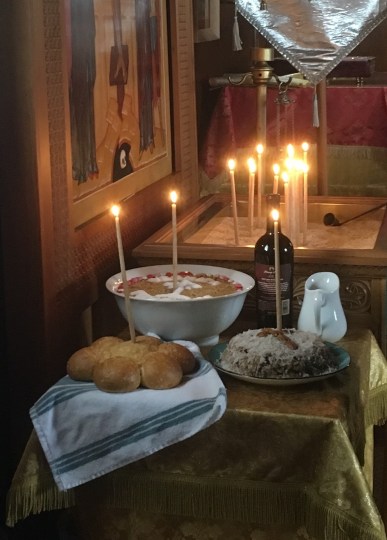
Today we were also praying especially for two men who more recently fell asleep in Christ, one just 40 days previous. George and Nikolai, memory eternal! Romanian women brought koliva, one made of barley instead of wheat, and other commemorative foods.

Just to stand in church, to stand in Christ, to stand with my departed loved ones — it was awfully sweet. Because of this reality that Metropolitan Anthony speaks of in Courage to Pray:

“The life of each one of us does not end at death on this earth and birth into heaven. We place a seal on everyone we meet. This responsibility continues after death, and the living are related to the dead for whom they pray. In the dead we no longer belong completely to the world; in us the dead still belong to history. Prayer for the dead is vital; it expresses the totality of our common life.”