I’m getting ready to leave Mumbai – I might even be at the airport or on the plane home before I manage to publish this post. It seemed right that I make my last Indian post about this city which has been the source and location of nearly all of my experience of India.
 Seven weeks is way too short a time to get to know any place beyond the level of slight acquaintance, but Mumbai must be one of the most challenging in this regard. If she were a human, I’d have to say that I caught a glimpse of her brilliant form once for about five seconds, during which moment I heard her singing a few words I couldn’t understand.
In physical size alone, Mumbai takes up most of Salsette Island, and you would have to drive in three hours of crazy traffic to get from the north end to the south. There is a whole national park within its boundaries. I spent 90% of my time in one neighborhood, in a city of 22 million people, twice the population of Belgium.
Mumbai is the financial and fashion capital of India, and the city where 7-10 people die every day in train related accidents. The most expensive house in the world is in Mumbai, and the most educated slum. A million people live in this slum, Dharavi, which dates from the 1840’s, and 80% of them are employed. They live in 84 settlements taking up less than a square mile, which makes the population density of Dharavi 20 times that of Mumbai as a whole. (Nearly half the population of Mumbai lives in slums, if you count Dharavi as a slum, which according to some definitions it isn’t any longer.)
Dharavi recycles 80% of the plastic trash of Mumbai, and produces 3.5 tonnes (Tonnes are bigger than tons) of food every day. One of its many other businesses and “hutment industries” is the large pottery business at Kumbharwada:
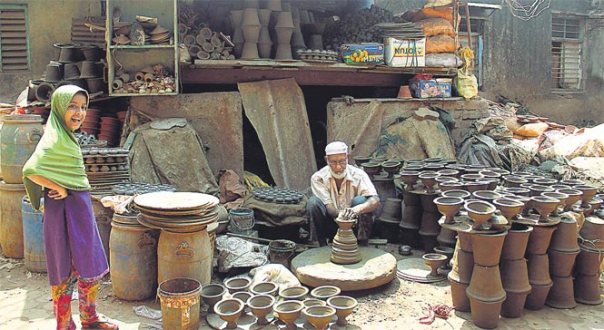

I took a tour of Dharavi this week but didn’t take pictures, so that one above I found online. Our group walked around through the industrial and residential areas for two hours, which gave me exposure to thousands of visual images and other sensations to process, accompanied by the excellent narrative by our guide who was from the slum. I took notes on both; but I am a really slow writer, which is why here at the end of my India stay, when I’m counting down the hours, I don’t have time to convey my direct experience.
The subject and reality of Dharavi is huge and complex, and you can read much about it elsewhere if you are interested, and watch YouTube tours. It’s another one of the many Things Mumbai that I will leave here knowing just superficially, but it was a wonderful tour and did expand my understanding quite a bit.

Tiffin wallahs
The lunchbox delivery service by tiffin wallahs or dabbawalas originated in Mumbai. Maybe some of my readers have seen the movie “The Lunchbox” that tells a story centered  around this local phenomenon. I saw this charming movie years ago but didn’t pay attention to its setting in Mumbai.
Tiffin wallahs have been providing their services in Bombay since 1890, and are known for their high degree of accuracy in delivering lunches from home or restaurant, and the boxes back to the source the same day. This blog does a good job of describing how it works and why it is such a regular part of so many Mumbaikars’ lives: Dabba Dabba Do! And from another article:
“Some 5,000 men dole out over 200,000 meals a day, picking up the tiffins in the morning from women, typically, who have packed steaming, spicy dishes into each compartment: a curry, vegetables, dal (lentils), and flatbread (with some variations).
“For many Mumbai residents, this is the only way to lunch — on a feast, made with the love of a mother or wife.
“‘It’s expensive to eat outside every day, besides it’s not healthy,’ said 36-year-old Naina Bhonsle in Mumbai’s Versova neighborhood. ‘I know what my husband likes eating, and so I prefer to send him a tiffin every day.’”
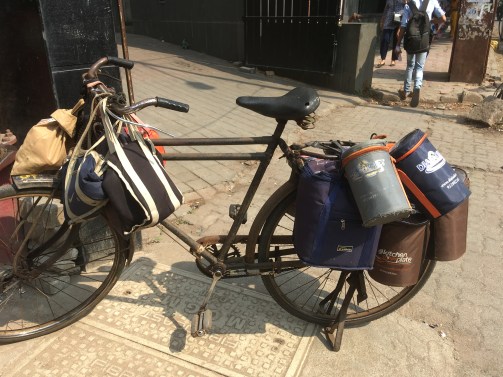
The boxes are transported and distributed by train and on bicycles; on my first day here Tom pointed out this bicycle belonging to a tiffin wallah and since then I’ve seen many of the wallahs, the typically semi-literate men who do the carrying, as they pedal around. It’s another case like Dhobi Ghat of a very organized low-tech, high efficiency system serving basic human needs, and that sort of thing makes me admire all the parties who keep the thing running.
“The Lunchbox” is not a film made according to the Bollywood formula in the style of “Lagaan,” which I mentioned before. But Bollywood style movies are worth mentioning here as a phenomenon because Mumbai is the center of Bollywood. In Reimagining India, Jerry Pinto wrote: “Bollywood is not just a film industry. It is all-pervasive: a home-grown, film-a-day dream machine that maintains a pleasant stranglehold on our imaginations. It determines — or at least shapes — how we see ourselves, how we think, how we talk, dream, speak, love, fight.”
In the same article he describes the Bollywood formula as requiring: “…a fight for the young men, a romantic story for the women, a devotional song for the elderly. Films made for the entire Hindi-speaking market would have to be patriarchal, right wing, jingoistic, and patronizing in their attitudes to anything non-Indian and nonmajoritarian.”

I didn’t know much about Bollywood until the last year or two. I saw a laughably sentimental Bollywood movie first, and then last month, “Lagaan,” a much more enjoyable example. The music of Bollywood films is often the kind that is happy and makes you want to dance, even if — or especially if? — it is separated from the dance routines of the movie. I am not much of a movie watcher in the first place, so I won’t be exploring the genre more, but as a cultural phenomenon, I wouldn’t want to miss it completely. And I have added Bollywood music to my iTunes playlist to listen to on road trips.
Art Deco City
I heard that Mumbai is “the most Art Deco city in the world after Miami,” and though I hadn’t given the style or history of Art Deco one concentrated thought ever before in my life, having Tom on my first day show me some design features in their neighborhood made me focus my eyes in a new way.
From what I have read, it seems that Art Deco and India were made for each other. The Indian Institute of Architects was founded in 1929, the middle class was growing in the 30’s, and many of the buildings in the city from this period featured Art Deco elements in their design. I’ve seen structures from this century include some retro aspects from the style that Mumbai now feels is part of its tradition and heritage.

There is a whole Wikipedia article on Art Deco in Mumbai, which helped me to grasp enough of the concepts to be able to occasionally recognize the Art Deco influence on our outings. If I were going to be here longer, I’d like to go on a tour given by this organization: Art Deco Mumbai . I’ve already seen quite a few examples that would be on the tour, mostly driving past too fast to get a good picture — and some in our neighborhood.

I always love to take pictures of buildings that catch my attention for some reason. Mumbai has been fun that way, because there is such a range of ages and styles — and colors. Sometimes it is just the names of apartment buildings that strike the American ear as funny. I didn’t take a picture of Flushel Apartments, but Tom joked about what was behind that name… Were they advertising that all the toilets worked, or that the walls were straight and plumb? Haha. It was right down the street from the Executive Enclave.
Mostly for my own convenience I am posting below some images of this city that I want to have in this handy Glad collection. Maybe you will like some of them, too!

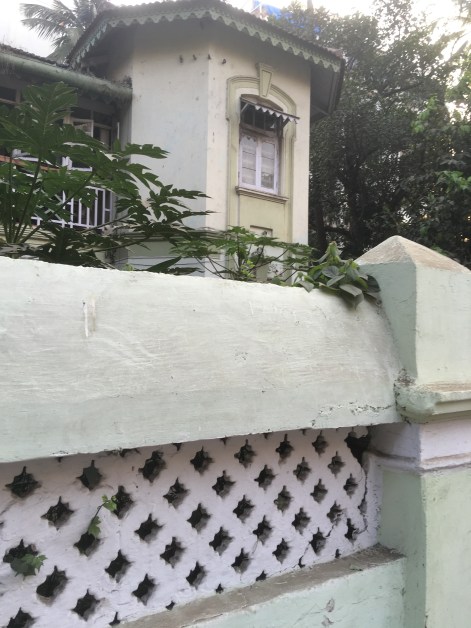

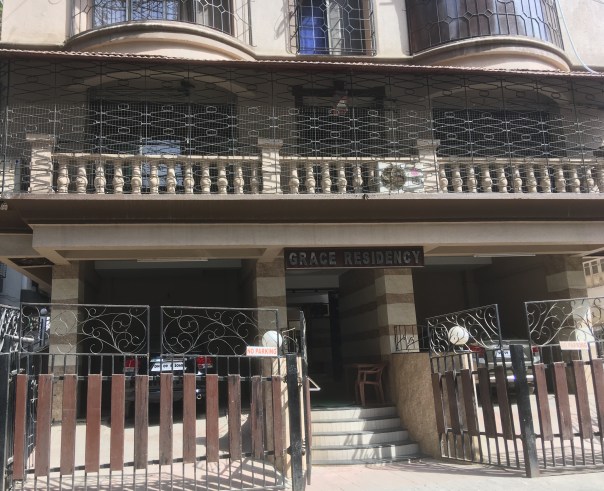

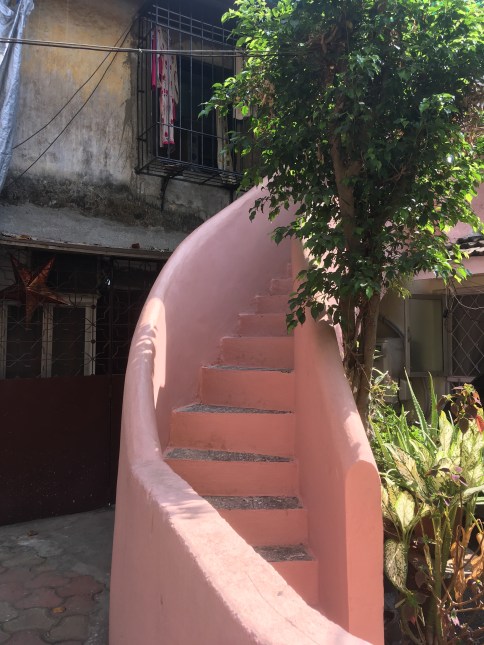


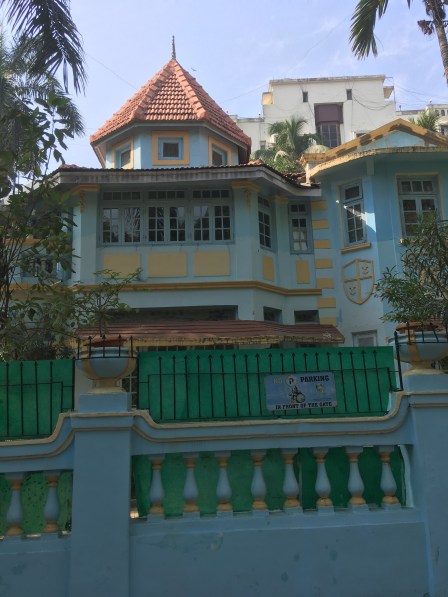


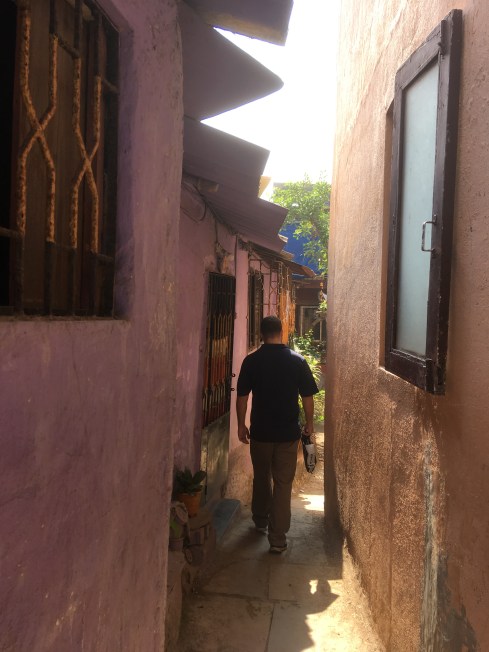
During my last days here, the air cleared a lot, and I was quite pleased to see that one of my photos revealed blue skies with cottony white clouds!

Every walk through the neighborhood, I’m realizing, might be my last down this street or that…
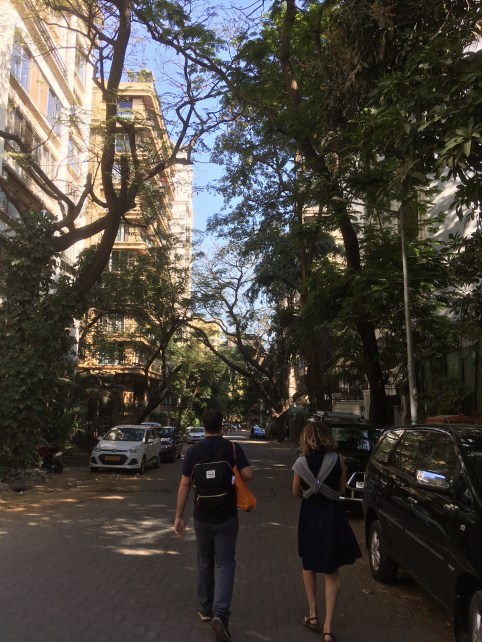
And when I ate one of Kareena’s chapatis fresh from the griddle, it was the most special ever because it was likely the last one that fresh.

I could never take enough pictures of women in colorful clothes to satisfy me, or enough videos of Kareena cooking. I can’t buy all of the lovely dresses in the shops, or learn the names of every surprising Indian dessert. My time of glorious Too-Muchness has come to an end, and I’m going home to Great Lent, which is the perfect way to transition from the superabundance of everything here to… what?
Lent is a journey to Pascha. It’s not the kind of journey where you are bombarded from outside by exciting and even dangerous forces and sensations ranging from air travel to chapatis and people on the street, but a quiet path on which all the struggles come from trying to tune one’s own heart. Considering my starting point, it will surely take all of my effort to accomplish anything in only 40 days.
The hardest part of leaving is, of course, that Raj and his parents are staying here! It has been the sweetest day-after-day to live in the same house as Kate and Tom and their new baby, and to love and be loved in person on a daily basis. The comforting thing is, that except for not being in the same house, we will go on loving and being loved, and be together at the throne of God, as long as He gives us grace. I’m not saying any kind of final good-bye to them.
But I do have to say, “Good-bye, Mumbai!”


 The family here is happy to have me a couple more days, and I’m quite content to be pampered by the family generally, to have extended cuddling, reading and game time, and two outings I’d otherwise have missed. Plus, we watched the TinTin movie together tonight. Laddie and I sat together scrunched into a recliner, with the kitten Clyde occasionally jumping on the back and trying to get us to play.








 Gladsome Lights