Tag Archives: stories

A song for a journey.

Anke Eismann, Bilbo Baggins

Today is Hobbit Day, that is, the birthday of both Bilbo and Frodo Baggins. Maybe next year I will manage to have a party in their honor. I only thought of it a week in advance this year, and that’s not enough time. Besides, Monday is not the best day for a party.

Has any of you, my readers, ever hosted or attended an event on Tolkien’s birthday or that of his hobbit characters? We had one at our house on January 3rd (Tolkien’s birthday) a long time ago, and it was a lot of fun. But this year, I’ll just post this song (with a musical link below it) from the tale of hobbits and their adventure:

MISTY MOUNTAINS

Far over the misty mountains cold
To dungeons deep and caverns old
We must away ere break of day
To seek the pale enchanted gold.

The dwarves of yore made mighty spells,
While hammers fell like ringing bells
In places deep, where dark things sleep,
In hollow halls beneath the fells.

For ancient king and elvish lord
There many a gleaming golden hoard
They shaped and wrought, and light they caught
To hide in gems on hilt of sword.

On silver necklaces they strung
The flowering stars, on crowns they hung
The dragon-fire, in twisted wire
They meshed the light of moon and sun.

Far over the misty mountains cold
To dungeons deep and caverns old
We must away, ere break of day,
To claim our long-forgotten gold.

Goblets they carved there for themselves
And harps of gold; where no man delves
There lay they long, and many a song
Was sung unheard by men or elves.

The pines were roaring on the height,
The winds were moaning in the night.
The fire was red, it flaming spread;
The trees like torches blazed with light.

The bells were ringing in the dale
And men looked up with faces pale;
Then dragon’s ire more fierce than fire
Laid low their towers and houses frail.

The mountain smoked beneath the moon;
The dwarves, they heard the tramp of doom.
They fled their hall, to dying fall
Beneath his feet, beneath the moon.

Far over the misty mountains grim
To dungeons deep and caverns dim
We must away, ere break of day,
To win our harps and gold from him!

I like the YouTube video of Clamavi De Profundis singing “Misty Mountains”, an expanded-version cover of the original soundtrack of “The Hobbit: An Unexpected Journey.” The song comes from the chapter “An Unexpected Party” of The Hobbit, and this group adds verses from later in the book. It’s not a poem I am likely to memorize, but the tune I can’t get out of my head. That’s okay. Its mood seems to be in harmony with my own daily paths:

The King is come unto his hall
Under the Mountain dark and tall.
The Worm of Dread is slain and dead,
And ever so our foes shall fall!

Ivan Aivazovsky, Darial Gorge


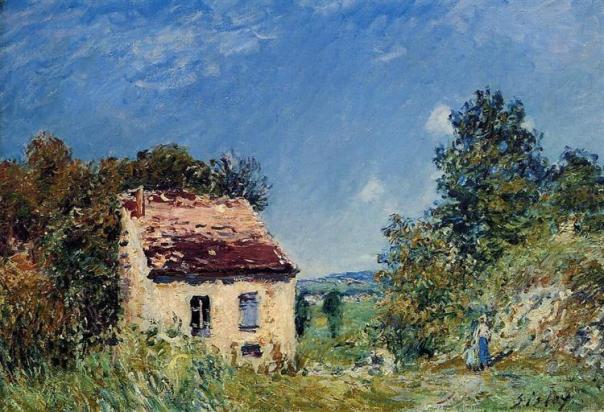
The house stands vacant.

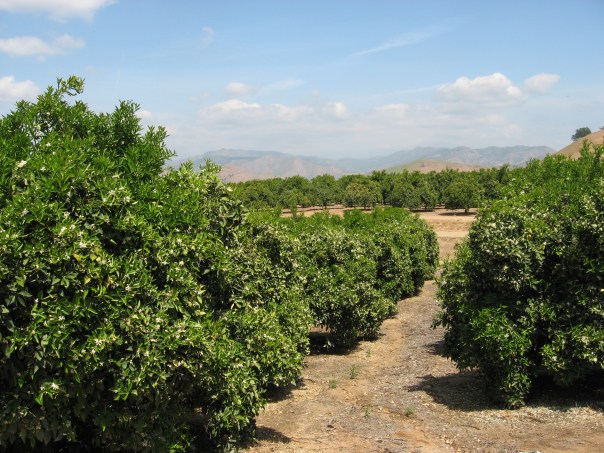
Back in the day when I lived with my family in farm country, in the midst of miles and miles of citrus orchards, my siblings and I would ramble through the groves, ours and our neighbors’, and along the private dirt roads dividing the properties from each another. All the kids did this, and no one ever suggested we were trespassing.

Once we came upon a small and shabby house with its doors and windows open, and obviously abandoned. We dared to go in, and walked through the rooms, which still contained furniture such as a kitchen table with dried up food on plates, other unwashed dishes in the sink, and personal belongings lying about. We didn’t stay long, it was too creepy, but my imagination was stirred from then until now, wondering what story lay behind the disorder. What would prompt the residents to leave without finishing dinner, and never come back? Why had no one bothered to come and clean up the mess, and make the place livable again?

That house didn’t show signs of having been beautiful at any time, but under different circumstances, it might have been. It remains for me a disturbing memory, for all the sad stories it might have been hinting at, but also because of the physical ugliness that stood as a witness to chaos. In all likelihood it has been leveled to the ground long since, and orange trees planted in its spot. I wonder if anyone else remembers it.

The poem below tells of a much richer and more nuanced experience and story. The poet Frederick Goddard Tuckerman was stricken when his wife died after the birth of their third child, and felt that as the father of the child he was somewhat guilty. Most of his poems after her death express these feelings of loss, loss of home and of the woman as the center of family life. One commentator suggests that the description of the mother, twice using the word “sat,” indicates her being frozen in time as a memory.

SONNET XVI (“Under the mountain”)

Under the mountain, as when first I knew
Its low black roof, and chimney creeper-twined,
The red house stands; and yet my footsteps find
Vague in the walks, waste balm and feverfew.
But they are gone; no soft-eyed sisters trip
Across the porch or lintels; where, behind,
The mother sat, — sat knitting with pursed lip.
The house stands vacant in its green recess,
Absent of beauty as a broken heart;
The wild rain enters; and the sunset wind
Sighs in the chambers of their loveliness,
Or shakes the pane; and in the silent noons,
The glass falls from the window, part by part,
And ringeth in the grassy stones.

-Frederick Goddard Tuckerman

Alfred Sisley, Abandoned House


Thanks to Sally Thomas for sharing this poem on her Substack page last month.

Stories about St. John of San Francisco.

St. John (Maximovitch) of Shanghai and San Francisco reposed in 1966. Twenty-five years later Hieromonk Peter Loukianoff, who had been close to St. John in the last few years of his life, and whose family had known the saint since the time they lived in Shanghai, wrote down his recollections: “Remembering Vladika [Bishop] John.”

Partly this was to correct falsehoods that had begun to circulate in the years since Archbishop John had reposed. In addition to conversations Acolyte Peter had with his bishop about various matters that might be of interest mainly in the altar, he relates many stories from everyday life that illustrate what kind of man St. John was, and the profound effect of his life on those who knew him.

St. John of Shanghai and San Francisco giving a sermon. Pavel Lukianov, the author, is the acolyte.
With Acolyte Peter

He conveys how fatherly St. John was with the youth, including alar servers such as Peter — kind and gentle even when he was strict. Peter Loukianoff himself was consecrated a bishop in 2003, and was eventually elevated to the rank of Archbishop of the Diocese of Chicago and Mid-America. He reposed in 2024.

One of the stories is about St. John’s feet:

From the day of his-monastic tonsure, Vladika slept in a sitting position. As a result he had swollen legs and it was painful for him to wear proper shoes, so he wore sandals. At home, in his cell, or when he served at St. Tikhon’s he often went barefoot–not for the sake of foolishness-for-Christ, but because it was easier on his feet.

Abbess Theodora, the late superior of Lesna Convent in France, told how once when Vladika was visiting the convent one of his legs gave him great pain, and she called a doctor, who prescribed rest in bed. Vladika thanked her for her solicitude but refused to lie in bed; nothing could persuade him. “Then,” related Matushka, “I myself don’t know how I was so bold, but I said to him bluntly, ‘Vladika, as the abbess of this convent, by the power given me by God, I order you to lie down.'” Vladika looked with surprise at the abbess, and went and lay down. The next morning, however, he was in church for Matins, and that was the end of the “course of treatment.”

And another story is about his letter-writing:

 Vladika’s daily schedule was as follows: In the morning he served Matins, followed by the Hours and Divine Liturgy. After services, if he served in the cathedral, he would stop on the way home in some hospital where he would visit all the Orthodox patients. Arriving home, he would tend to business. In addition to his official duties, he received scores of personal letters to which he would reply himself. (In his three and a half years in San Francisco he received more than ten thousand letters.)

At the top of each letter Vladika always neatly placed a large cross. In folding the letter to place it in an envelope I had to make sure that the cross was not creased or put in sideways or upside down. Vladika did not allow us to lick envelopes shut, and insisted they be opened with a knife. He used to remark with a smile that only Stalin ripped envelopes.

St. John was canonized in San Francisco on July 2 1994.

Holy Virgin Cathedral in San Francisco

I like rain and roasted onions.

Rain… rain… rain… It’s been raining All. Day. It’s night now and still raining. I’ve been exulting in it, because I didn’t have any responsibilities that required my going out. I could tend the fire, chat with my daughters online about their weather, roast onions, read, and even accomplish one housecleaning task that has been hanging over my head for months: cleaning the ceiling exhaust fan in a bathroom. Yippee!

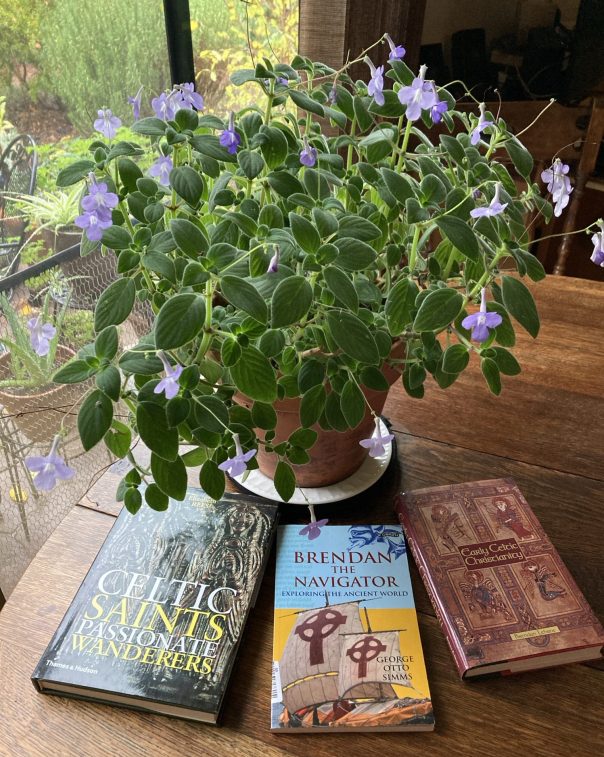
The nodding violet that I brought indoors last week before freezing weather arrived looked so lovely with the rainy light behind it, I had to take its picture.

Sir Gawain by Howard Pyle

On the table by the violet are a few of the books I bought to go with an online course I am taking this fall: “Christian Wonder Tales.” It is taught by Martin Shaw, the mythologist and storyteller whom I met at the Symbolic World Summit last winter. Tolkien’s Sir Gawain and the Green Knight didn’t get in the picture, but is another title he recommended, and I have it upstairs.

Who knows if I will read any of these books to the end — I haven’t even finished The King of Ireland’s Son, by Padraic Colum, which is quite delightful. Also perfect for listening to, because the narrator Gerard Doyle’s Irish brogue, telling the stories-within-stories as is the custom with Irish stories, has me journeying entranced from the Irish cottage to the castle and back again, meeting mysterious characters and challenging assignments around every bend in the road.

Now to the topic of food: Back when my friend Susan was also my housemate, sometimes I would walk in the front door to another sort of captivating story, the aroma of which was the essential part. What are you cooking?? I would ask, drawn immediately into the kitchen, and it took a few repetitions of this encounter before my nose remembered what she had told me: “It’s only roasted onions!” I eventually had to start making them myself.

(Above, onions in my kitchen as it was 28 years ago. Notice bread rising in pans at left. The only thing that is the same now is cast iron pans always on the stove top.)

To keep up with my appetite for them, I’d need to roast a batch of onions once a week, but it ends up being more like twice a year. As soon as they are out of the oven I always serve myself a little bowl of them, which seems to be about one onion’s worth… or two — so I usually double the recipe below. Do you roast onions? You can find many recipes online; here is my version:

ROASTED ONIONS

3 large onions, yellow or red
2 tablespoons olive or other oil
1 tablespoon balsamic or other vinegar
1/2 teaspoon kosher salt
fresh ground black pepper to taste
(1 tablespoon chopped fresh thyme) – I never add this

Cut the onions vertically into quarters or sixths, and then slice those wedges crosswise as thick as you want; I make mine 1/8 to 1/3 inch thick. Toss them in a bowl with the other ingredients and roast in a sheet pan at 375 to 400 degrees for 45 minutes to an hour, stirring occasionally, until they are as brown as looks good to you. I think sometimes, in an effort to get them crispier, I have overcooked them and made them a little tough.

This evening I didn’t use balsamic vinegar, because recently I was given an extra special bottle of “plain” red wine vinegar with a noble heritage. Just as bakers like to pass their sourdough starter around to friends, so chefs and winemakers often share a vinegar mother (also called a vinegar scoby). My vinegar was fermented with a mother whose mother belonged to Alice Waters, and whose grandmother grew in Julia Child’s kitchen. Does that make my onions taste better? You know, I think they might just be the best I’ve ever made!